Why Smart People Struggle With Simple Tasks
How ADHD affects executive function and motivation, why bright people stall on routine tasks, and practical strategies to make everyday work manageable.

If you’re brilliant at solving complex problems but find routine tasks like answering emails or scheduling meetings overwhelming, you’re not alone. This isn’t about laziness - it’s how ADHD impacts your brain’s executive function. ADHD affects systems that manage memory, timing, prioritization, and self-awareness, making simple tasks feel disproportionately difficult.
Here’s why this happens:
- Executive Function Challenges: ADHD disrupts brain circuits that handle working memory, timing, and motivation.
- Dopamine Imbalances: Low dopamine levels make mundane tasks feel unappealing.
- Psychological Patterns: Perfectionism, overthinking, and fear of failure can create mental roadblocks.
- Workplace Struggles: Open offices, digital distractions, and time blindness amplify these challenges.
The good news? There are practical strategies to help:
- Start with small, manageable tasks to build momentum.
- Use tools like Todoist or Trello to offload mental tracking.
- Match tasks to your energy levels and break them into tiny steps.
- Reframe tasks by linking them to immediate, meaningful outcomes.
You’re not flawed - your brain simply works differently. By understanding these patterns and using tailored strategies, you can turn intention into action and make everyday tasks more manageable.
Managing Executive Function & Working Memory Challenges in Adults with ADHD (with Peg Dawson, Ed.D.)
The Neurological Factors Behind Task Struggles
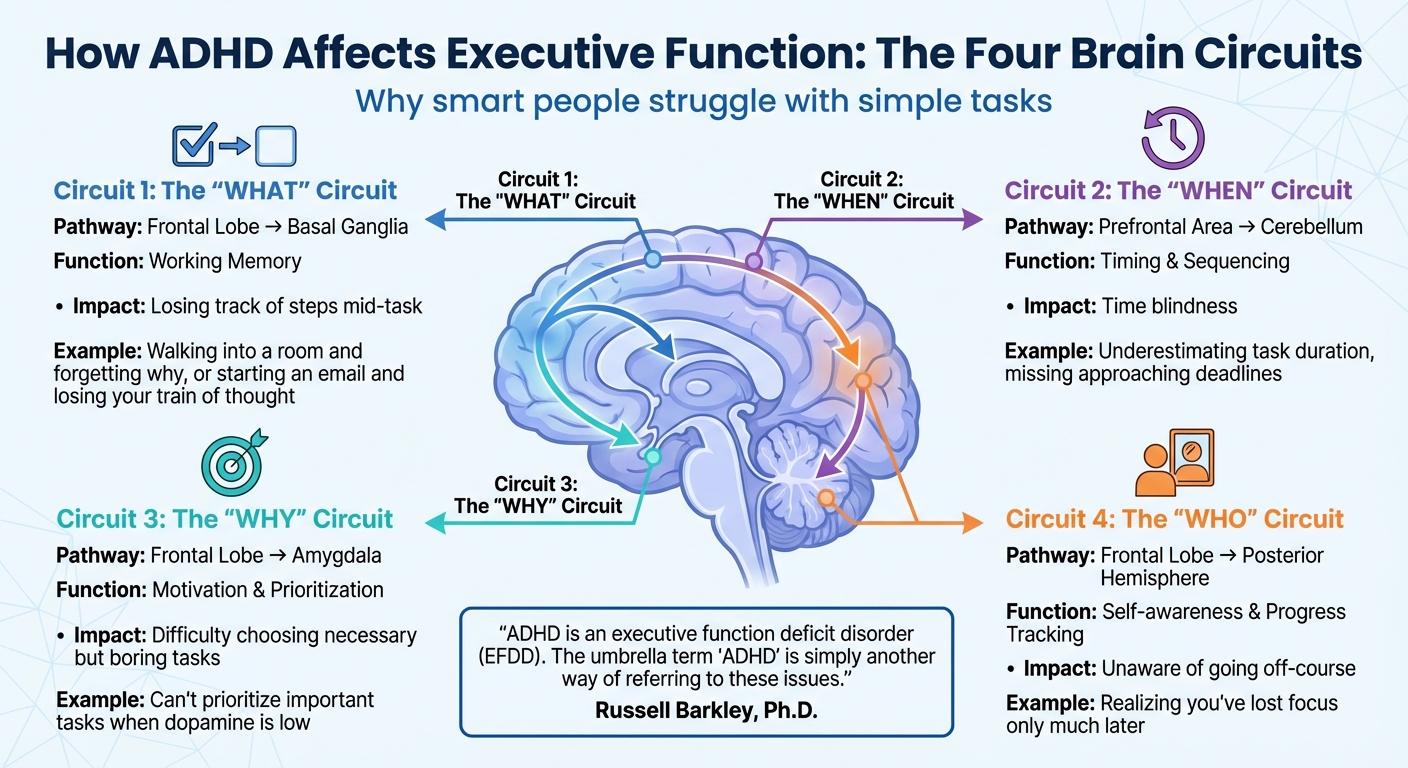
How ADHD Affects Executive Function: The Four Brain Circuits
Your brain isn't malfunctioning - it's just wired differently. Forgetting to return a call or putting off folding laundry isn't about laziness; it's a reflection of how ADHD impacts certain brain circuits.
How ADHD Affects Executive Function
Think of executive functions as your brain's conductor, orchestrating various tasks. With ADHD, this conductor struggles to keep everything in harmony. Here are four brain circuits that play a role in these challenges:
- The "What" Circuit (frontal lobe to basal ganglia): This circuit handles working memory - basically, the ability to hold and use information while working. When it falters, you might start a task but lose track of the steps halfway through. Ever walk into a room and forget why you’re there? Or begin an email only to lose your train of thought? That’s this circuit at work.
- The "When" Circuit (prefrontal area to cerebellum): This one manages timing and sequencing. It’s where time blindness comes into play - like underestimating how long something will take or not noticing deadlines creeping up.
- The "Why" Circuit (frontal lobe to amygdala): This circuit decides what tasks to prioritize, based on motivation. When dopamine levels are low, it’s hard to choose boring but necessary tasks, even if you know they’re important.
- The "Who" Circuit (frontal lobe to posterior hemisphere): This governs self-awareness and progress tracking. With ADHD, this system often fails, leaving you unaware that you’ve gone off course until much later.
Russell Barkley, Ph.D., sums it up: "ADHD is an executive function deficit disorder (EFDD). The umbrella term 'ADHD' is simply another way of referring to these issues".
These neurological challenges explain why even highly capable individuals can struggle with everyday tasks.
Dopamine Imbalances and Motivation
Dopamine plays a huge role in regulating motivation and rewards. In ADHD, reduced dopamine activity in the prefrontal cortex and striatum makes it tough to stay engaged with tasks that don’t offer immediate satisfaction.
Genetic variations in dopamine receptors, like DRD2 and DRD4, and dopamine transporter genes disrupt how dopamine is released and processed. The result? Mundane tasks feel completely unappealing, like they’re missing the pull needed to get started.
Thomas E. Brown, Ph.D., explains it best: "If the task you are faced with is something that turns you on, something really interesting to you, you're 'up for it' and you can perform. But if the task is not something intrinsically interesting to you... you can't get up for it and you can't perform. It doesn't matter how much you tell yourself 'I need to! I ought to!' because it's just not a willpower kind of thing".
This is why you might dive into a complex project for hours but struggle to finish something as simple as an expense report. Tasks that naturally spark your interest trigger dopamine release, pulling in your focus. But you can’t force your brain to find dull tasks exciting - it’s not something you can will into action.
Stimulant medications, which boost dopamine and norepinephrine levels, help about 8 in 10 people with ADHD improve their executive functioning. Recognizing these neurological factors is a key step toward finding strategies that work for your daily life.
Psychological Barriers in High Achievers
Your mind can sometimes be its own worst enemy. For high achievers, especially those navigating ADHD, psychological patterns can turn even straightforward tasks into daunting challenges.
Perfectionism and Overthinking
Perfectionism often feels like a protective shield, but as Sharon Saline, Psy.D., explains:
"an unhealthy obsession with flawlessness that causes people to set unattainable personal standards, compare themselves to others, and never quite feel 'good enough'".
For high achievers with ADHD, this mindset often stems from a desire to overcompensate for past mistakes or feelings of inadequacy. The result? An all-or-nothing approach where anything less than perfect is seen as a failure.
Take the example of a Bangor-based solicitor, who, despite handling multi-million-dollar commercial litigation, put off simpler tasks like business development and website updates for 18 months. By reinterpreting his procrastination as a protective mechanism rather than laziness, he was able to tackle his to-do list and implement a networking plan within just six weeks.
This kind of "perfectionism procrastination" happens when tasks are postponed because the conditions aren’t "just right" - whether it’s the mood, energy level, or resources needed to ensure perfection . The fear of falling short of high standards makes starting a task feel risky. Avoidance becomes a way to protect one's self-image as "the smart one" . As one analysis puts it:
"If you never finish, you never have to face the verdict. Your potential remains safely potential rather than becoming actual and therefore measurable".
For adults with ADHD, this perfectionism often intertwines with anxiety. Nearly 50% of adults with ADHD also experience anxiety disorders, which further fuels these perfectionistic tendencies.
Boredom and Under-Stimulation
The ADHD brain isn’t lazy - it’s under-stimulated. Unlike neurotypical individuals, who can rely on importance to motivate themselves, the ADHD brain needs intrinsic interest, novelty, challenge, or urgency to engage .
This can create a paradox for high-IQ individuals with ADHD. They often excel in divergent thinking - generating creative, non-linear ideas - but struggle with convergent thinking, which requires precision, logic, and repetitive effort for mundane tasks.
Low-stimulation tasks feel like an uphill battle. Micro-decisions and distractions pile up, and if the energy cost of completing the task seems too high for the limited reward, the brain opts for avoidance to conserve energy. As Dr. Karen Wilson explains:
"Individuals with ADHD may have a hard time managing their responses to everyday demands, becoming overwhelmed by even basic tasks".
This dynamic can have serious consequences. About 42% of high-IQ adults with ADHD have dropped out of college at least once, often because academic tasks lacked immediate stimulation. Adding to the challenge, ADHD brains can lag 3 to 5 years behind in social and emotional development while operating years ahead intellectually, creating a frustrating disconnect.
Procrastination and Fear of Failure
Procrastination isn’t just about poor time management - it’s deeply tied to emotional regulation. For high achievers, delaying tasks often becomes a way to avoid feelings of inadequacy, judgment, or failure.
By postponing tasks, individuals shield themselves from the risk of producing results that might not meet their high expectations. A 2018 study published in Intelligence found that people with stronger verbal and abstract reasoning skills are more prone to "task inertia" - the struggle to start tasks due to perceived complexity and fear of imperfect outcomes. Similarly, a 2022 meta-analysis in Personality and Individual Differences revealed that high-IQ individuals tend to ruminate more, which reduces their ability to adapt and initiate tasks. As one researcher explains:
"Intelligent individuals are actually more prone to procrastinate on important tasks because they can more vividly imagine all the ways things could go wrong. It's rather like having a high-definition preview of potential failure playing in your mind before you've even started".
This tendency to overanalyze can turn even simple tasks into intricate mental puzzles, leading to decision paralysis. Many gifted professionals also struggle with a "meaning requirement", resisting tasks they see as trivial or unworthy of their intellect. This mindset not only disrupts productivity but also compounds the day-to-day challenges of managing ADHD.
Workplace Challenges for Gifted ADHD Professionals
The modern workplace often feels like it’s built for a different kind of brain. For professionals with ADHD, even those with exceptional intelligence, the structure and demands of traditional work environments can pose unique challenges. These hurdles aren’t about ability - they arise from the clash between workplace expectations and differences in executive function. The result? Difficulties that range from mismatched skillsets to constant distractions and struggles with time management.
When Skills and Job Demands Don’t Align
Gifted individuals with ADHD often excel at tasks involving problem-solving or recognizing patterns. But they may stumble when it comes to the self-management needed to plan, organize, and complete tasks. As Paul B. Yellin, MD, explains:
"If you know what you need to do and you know how to do it, but you still can't get it done, that's often a problem with executive function".
This disconnect can feel like a paradox. David Neeleman, the founder of JetBlue Airways, summed it up well:
"I have an easier time planning a twenty-aircraft fleet than I do paying the light bill".
For many gifted professionals, the challenge lies in balancing their strengths with workplace demands. They might thrive in high-pressure situations or when tackling complex problems but struggle with routine tasks like filing or administrative work. When jobs require repetitive or highly structured tasks, these individuals often compensate with sheer effort. However, this approach can quickly lead to exhaustion and burnout, especially in roles that lack clear organization.
The Battle Against Distractions
Open offices can be a nightmare for ADHD professionals. The constant hum of conversations, random noises, and frequent interruptions can overwhelm the brain’s ability to filter sensory input. This sensory overload eats away at focus and productivity. For instance, after being interrupted - whether by a colleague or a notification - it can take an ADHD brain 15 to 20 minutes to refocus on the original task. Multiply this by several interruptions a day, and the lost time adds up fast.
Digital distractions make things even harder. Notifications from emails, social media, and endless browser tabs create what some call “inbox overload.” For an ADHD brain, which already struggles to filter out irrelevant stimuli, the constant mental switching between tasks can be exhausting. This cognitive juggling act leaves little room for prioritizing or completing meaningful work.
Time Management: A Constant Struggle
One of the most persistent challenges for ADHD professionals is managing time effectively. The ADHD brain often struggles to rank tasks by importance, making everything feel equally urgent - or equally unimportant. Many describe experiencing time in only two categories: “now” and “not now.” This distorted sense of time makes it difficult to estimate how long tasks will take or to plan for deadlines.
Russell Barkley, Ph.D., explains this phenomenon:
"Time blindness is the most devastating deficit in adult life that ADHD produces… a disruption in the fabric of time".
This time blindness can lead to prioritizing tasks based on emotional appeal rather than urgency. For example, someone might clean their desk or respond to minor emails instead of tackling a high-priority report. This behavior, often referred to as “procrastivity,” allows individuals to stay busy while avoiding more demanding or less enjoyable tasks. The result? Inconsistent performance. A professional might shine during a high-stakes project but miss a simple deadline for submitting an expense report.
Practical Strategies to Complete Routine Tasks
Addressing the challenges tied to ADHD often means finding ways to bridge the gap between knowing what to do and actually doing it. This isn’t about flaws - it’s about working with how your brain functions. By tweaking how you approach, organize, and track daily tasks, you can make noticeable progress.
Task Prioritization Methods
Standard productivity advice doesn’t always align with the ADHD brain. Take the "Eat the Frog" method, for example - starting with the hardest task can sometimes lead to overwhelm. Instead, beginning with a quick, manageable win can spark the dopamine boost needed to tackle bigger challenges.
The Eisenhower Matrix is another helpful tool. It categorizes tasks into four groups: Do, Decide, Delegate, or Delete. As Dwight D. Eisenhower famously said:
"What is important is seldom urgent, and what is urgent is seldom important."
This framework helps you separate immediate priorities from tasks that contribute to long-term goals.
For those who feel buried under endless to-do lists, the One-Thing Priority System can simplify things. By focusing on just one critical task each day, you build trust in yourself and create forward momentum. Research even shows that specifying a date, time, and place for a task boosts follow-through rates to 90%, compared to only 35% when plans are vague.
Breaking tasks into bite-sized steps is another powerful tool. Instead of writing "organize files", try breaking it down to "open Documents folder." This small-step method helps overcome task initiation paralysis - a common struggle for nearly 90% of children with ADHD, which often persists into adulthood.
Task batching, or grouping similar activities together, is another way to lighten the mental load. For instance, dedicating an "admin hour" for emails and invoices reduces the cognitive strain of switching between tasks. ADHD brains often need 15–20 minutes to adjust after each transition, so minimizing these shifts can save time and energy.
Once you’ve prioritized your tasks, the right tools can make execution even smoother.
Task Management Tools
Digital tools can act as an "external brain", helping you manage tasks without overloading your working memory. Apps like Todoist are great for capturing tasks on the fly, such as "Submit expense report Friday at 2pm", ensuring nothing slips through the cracks.
For visual thinkers, Trello offers a board-based system that makes task management more intuitive. Moving a task from "To Do" to "Done" provides instant visual feedback, which can trigger a satisfying dopamine release. To make tasks even clearer, try using a "Verb + Object + Location" format - like "Wipe counter in kitchen" instead of just "kitchen".
Staged reminders are another lifesaver. If you have a monthly report due on the 15th, set alerts for one week before, two days before, and the morning of the deadline. This approach combats time blindness and keeps tasks front and center.
But tools alone aren’t enough - how you think about tasks plays a big role, too.
Reframing How You View Simple Tasks
The way you perceive routine tasks can make or break your ability to complete them. ADHD often disrupts performance, not knowledge. As Russell Barkley explains:
"ADHD is a disorder of performance, not knowledge. The person knows what to do, but struggles to initiate or sustain effort toward that action if the payoff is distant."
One way to tackle this is by linking mundane tasks to immediate, meaningful outcomes. For instance, instead of thinking, "I should organize my inbox", reframe it as, "Clearing five emails now will help me find today’s contract."
Time tracking can also shift your mindset. Treat it like a game to see how long tasks actually take versus how long you think they’ll take. This removes the emotional weight and turns it into a data-gathering exercise.
Setting clear boundaries before starting a task can prevent perfectionism from turning a quick job into an all-day ordeal. For example, decide to limit email replies to three sentences or clean the kitchen for just 15 minutes.
Reframing tasks as "chosen efforts" rather than obligations can also help. Take control of the how, when, and where. Maybe you file expense reports while listening to your favorite podcast or handle emails during a low-energy part of your day, saving your peak focus for more demanding work.
Finally, build flexibility into your schedule by including a 20–40% buffer for unexpected interruptions or fluctuating energy levels. As Ari Tuckman, Psy.D., puts it:
"Success comes from creating systems and backstops to support existing executive functions and take the strain off them."
Using On/Off Genius Resources

Getting the most out of your day isn’t just about managing time - it’s about syncing your tasks with your brain’s natural energy rhythms. On/Off Genius offers tools specifically designed for gifted professionals with ADHD to help them work smarter, not harder.
Managing Energy and Focus
Let’s face it: your mental energy at 9:00 AM probably isn’t the same as it is at 3:00 PM. Tony Schwartz, CEO of The Energy Project, sums it up perfectly:
"While you can't add more hours to your day, you can expand and better direct your energy".
On/Off Genius shifts the focus from rigid schedules to energy management, recognizing that ADHD brains thrive when tasks align with natural peaks and dips in energy.
Here’s how to get started: Spend two weeks tracking your energy levels every two hours. This will help you uncover your personal high-energy windows, whether it’s mid-afternoon, late at night, or right after lunch. For example, some users have found that moving creative tasks to these high-energy periods improves the quality of their ideas and reduces burnout.
Once you’ve identified your energy patterns, match tasks to your current mental state. Creative or problem-solving work fits best during peak focus times, while routine tasks like filing or answering emails can be done during low-energy periods. This approach directly tackles the executive function challenges common in ADHD, making it easier to turn plans into action.
After mapping your energy, the next step is to build systems that keep you on track day after day.
Building Consistent Performance
Consistency with ADHD doesn’t mean doing the same thing at the same time every day - it’s about creating flexible systems that work with your brain. Harold Meyer from The ADD Resource Center explains it well:
"The paradox is that moving slower through tiny, achievable actions gets you further than ambitious leaps that leave you paralyzed".
Breaking tasks into tiny, manageable steps can help overcome task initiation paralysis, a challenge faced by nearly 90% of adults with ADHD. For example, instead of “do laundry,” start with “touch the laundry basket.” Similarly, instead of “write the report,” begin with “open the document.” These small actions can help you build momentum.
When switching between tasks, try the 3-Step Transition Stack. First, jot down any loose ends from the previous task. Next, identify the smallest possible step for the new task. Finally, set a 3-minute timer to get started.
On/Off Genius also recommends building in buffer time - add 20–40% more time than you think you’ll need to account for time blindness and energy dips. Pairing small wins with immediate rewards, like a quick break, can help maintain dopamine levels and keep you motivated throughout the day.
Conclusion
The challenges of routine tasks for individuals with ADHD stem from the unique way their brains are wired. You're not lazy or undisciplined; your brain simply functions differently. For instance, ADHD brains often have 5-10% less dopamine transporter density in key areas, which directly impacts planning and task initiation. As Dr. Russell Barkley aptly puts it:
"ADHD is a disorder of 'doing what you know,' not one of knowledge".
This distinction is crucial. Your brain naturally prioritizes tasks based on novelty, urgency, or interest rather than traditional notions of importance. That’s why complex projects can sometimes feel easier than seemingly simple administrative tasks. What looks straightforward on the surface may actually involve a series of micro-decisions, which can feel overwhelming and make starting much harder.
The encouraging news? You can work with your brain rather than against it. By understanding how your mind operates, you can adopt strategies that make action more achievable. Simple changes - like breaking tasks into the smallest possible steps, using visual timers, or syncing tasks with your energy levels - can make a big difference. In fact, research shows that energy-based scheduling improves productivity by 58% for individuals with ADHD when tasks align with their executive capacity.
Tools like On/Off Genius are designed to provide the systems your brain thrives on, helping translate your intelligence into reliable results. The goal isn’t to "fix" yourself but to create an environment that supports the way you naturally function.
You already have the potential. Now, you have the strategies to unlock it.
FAQs
How do I know if this is ADHD or just stress?
ADHD challenges are often rooted in executive dysfunction, which can make initiating, planning, or completing tasks feel like an uphill battle. These difficulties arise from neurobiological differences and tend to be consistent across different areas of life.
Stress, however, is usually tied to specific situations and leads to a temporary sense of overwhelm. Unlike ADHD, stress-related struggles often improve with relaxation techniques or better time management.
If these challenges don’t ease despite efforts to manage stress, it might be worth consulting a mental health professional for a deeper evaluation.
What’s the fastest way to start a task when I feel stuck?
Breaking down a task into small, bite-sized steps is one of the easiest ways to get started, especially if you're feeling stuck or dealing with ADHD. When the big picture feels overwhelming, focusing on just one small action can make all the difference.
Using external cues like timers, visual reminders, or task management apps can also help push past that initial resistance. These tools act as gentle nudges, simplifying the process and making it easier to focus on the very first step. Even if the task feels daunting, these strategies can help you take that all-important first move.
Which routine tasks should I automate or delegate first?
Start by tackling tasks that tend to feel monotonous, mentally draining, or unstimulating - these are often the ones that trigger executive dysfunction for individuals with ADHD. Think of things like folding laundry, answering emails, or organizing groceries. To make these tasks less overwhelming, consider using tools like reminder apps or automation software to streamline the process. If possible, delegate some of these responsibilities to others. This can help ease the mental burden and leave you with more energy to focus on activities that are more engaging or rewarding.