Why Perfectionism Feels Worse with ADHD
How ADHD traits—emotional sensitivity, hyperfocus and rejection fear—fuel perfectionism and tactics to break the cycle.

Living with ADHD often means battling perfectionism, a cycle where fear of failure and criticism pushes you to set impossible standards. This dynamic creates stress, procrastination, and burnout. Here's why ADHD amplifies perfectionism and how to manage it:
- Emotional Sensitivity: Mistakes feel overwhelming due to poor emotional regulation, leading to all-or-nothing thinking.
- Hyperfocus: Spending too much time on details delays progress and fuels burnout.
- Fear of Rejection: Past criticism drives perfectionism as a shield against judgment.
- Procrastination Loop: The pressure for perfection often makes starting tasks feel impossible.
Breaking this cycle involves setting realistic goals, practicing self-compassion, and using tools like body doubling or the Pomodoro technique. Shifting focus from perfection to progress can help reduce stress and improve mental health.
Perfectionism and ADHD: Making ‘Good Enough’ Work for You (with Sharon Saline, Psy.D.)
sbb-itb-f879324
How ADHD Symptoms Drive Perfectionism
Certain ADHD traits amplify the drive for perfection, creating a cycle that can intensify the challenges associated with ADHD.
Poor Impulse Control and Emotional Regulation
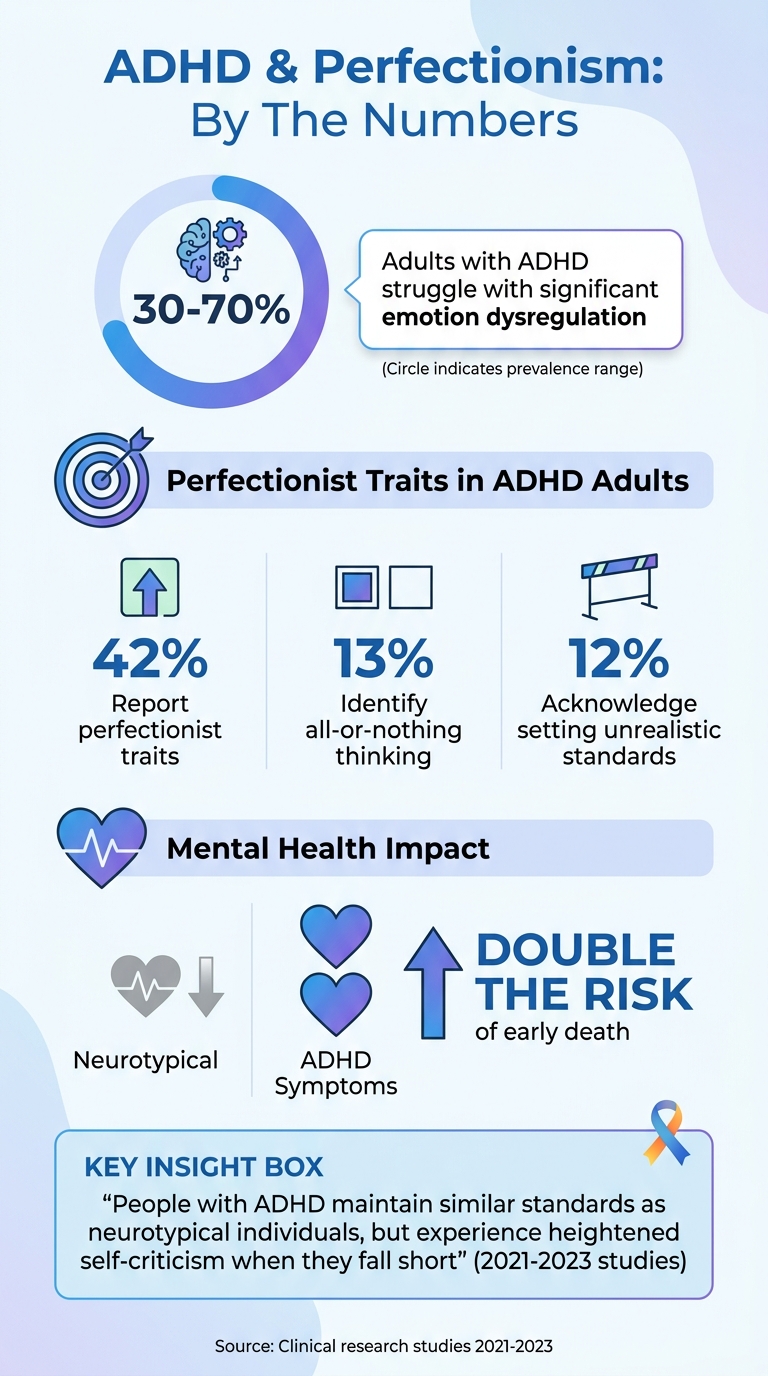
Adults with ADHD often experience intense emotional reactions. Studies indicate that 30% to 70% of adults with ADHD struggle with significant emotion dysregulation. This means even small mistakes can spark an overwhelming emotional response that’s hard to manage.
"Emotional impulsiveness (EI) is an aspect of poor inhibition associated with ADHD that is illustrated by low frustration tolerance, impatience, being quick to anger, aggression, [and] greater emotional excitability." - Russell Barkley, Ph.D.
This heightened emotional sensitivity often leads to all-or-nothing thinking. Surveys reveal that 13% of individuals with ADHD identify this trait, while 12% acknowledge setting unrealistic standards for themselves. When something doesn’t meet those high standards, it can feel like total failure. To avoid this emotional turmoil, many set excessively high expectations, creating a cycle where perfectionism becomes a shield against emotional distress.
Hyperfocus and Overcommitment
Hyperfocus also plays a role in reinforcing perfectionism. This state occurs when someone becomes so engrossed in a task that they lose track of time and perspective.
"In this state [hyperfocus], it can be natural to spend excessive time on the details of a task at hand, which others may perceive as perfectionism because you're absorbed in what you're doing." - Dr. Marcy Caldwell, Licensed Psychologist and Director at The Center for ADHD
While hyperfocus can lead to impressive attention to detail, it often makes it difficult to determine when a task is "good enough." This can result in overcommitment, where too much energy is spent on minor details, delaying progress. Over time, this pattern can lead to burnout and emotional fatigue.
Fear of Failure and Rejection Sensitivity
For many with ADHD, perfectionism is also tied to a deep fear of failure and rejection. It can act as a defense mechanism, shielding against the sting of criticism and rejection. Past experiences of judgment and disapproval often leave lasting scars, making even small missteps feel unbearable.
"For people with RSD, these universal life experiences are much more severe than for neurotypical individuals. They are unbearable, restricting, and highly impairing." - William Dodson, M.D., LF-APA
This fear of failure can be paralyzing. The pressure to produce flawless work often leads to avoidance, as perfectionism becomes a way to prove worth and counteract the weight of past criticisms.
The ADHD-Perfectionism Downward Spiral
When ADHD and perfectionism intersect, they create a cycle that can sap energy and stall progress. This combination often leads to a frustrating standstill - where the desire to start a task is overpowered by the need for everything to feel just right.
How Procrastination and Perfectionism Work Together
ADHD often creates what experts call a "gas and brake" effect. Dr. Andrew Le, MD, describes it well: "When you have ADHD and worry about doing things perfectly, starting a task can feel impossible because one part of you wants to go and another part holds you back." This internal battle shows up in two ways. On one end, front-end perfectionism sets rigid conditions for starting - like waiting for the perfect setup or mood. On the other end, back-end perfectionism kicks in once the task begins, pushing endless revisions that make it tough to ever finish.
Many adults with ADHD report struggling with perfectionist tendencies, such as feeling "not good enough", falling into all-or-nothing thinking, or setting unrealistically high standards. When paired with ADHD's tendency for effort discounting (where tasks feel bigger and harder than they are), perfectionism can make even starting seem overwhelming. This often leads to task paralysis, where fear of imperfection freezes progress entirely. Over time, this lack of momentum drains energy and contributes to emotional exhaustion.
Burnout and Emotional Exhaustion
Trying to meet impossible standards while managing ADHD symptoms quickly leads to burnout. The constant fear of failure keeps the brain in a fight-or-flight state, making it harder to focus, stay organized, or even begin tasks. This pressure is compounded by a harsh internal double standard - where compassion is extended to others but denied to oneself.
As burnout deepens, ADHD symptoms worsen, fueling even more perfectionistic anxiety. This creates a vicious cycle that becomes increasingly difficult to escape without help. For high-achieving individuals, the stakes feel even higher, as the weight of demanding roles and lofty expectations magnifies the strain.
Why Gifted Professionals with ADHD Face Greater Challenges
The Weight of High Expectations
For gifted professionals with ADHD, the stakes are often higher due to a combination of internal and external pressures. Years spent countering stereotypes can lead to a reliance on perfectionism as a shield against criticism. Dr. Stefan Ivantu, a private consultant psychiatrist, highlights this dynamic:
"ADHD-related perfectionism may be an overcompensation for making careless mistakes or compensating for the sensation of 'not being good enough'".
This creates a tricky situation. High achievers often hold themselves to rigid standards, expecting tasks to be completed effortlessly and without errors. But when their ADHD-related executive function challenges surface, the gap between their expectations and reality can result in harsh self-criticism. Negative feedback tied to ADHD-related oversights only reinforces the idea that perfection is the only way to avoid judgment. These internal struggles are further intensified by the pressures of demanding work environments.
Consistency Demands in High-Stakes Roles
In high-stakes roles, consistency is non-negotiable. Employers expect steady, reliable performance - a standard that clashes with the natural ups and downs in focus, energy, and executive function that come with ADHD. To meet these expectations, many professionals adopt exhausting coping mechanisms.
For instance, gifted professionals with ADHD may spend extra time on tasks, meticulously reviewing their work to eliminate every possible error. While this approach demonstrates attention to detail, it also serves as a way to compensate for executive dysfunction. According to surveys, 42% of adults with ADHD report grappling with perfectionist traits like setting unrealistic standards or falling into an all-or-nothing mindset. Over time, the relentless pursuit of perfection takes a toll, draining mental energy and fueling a cycle of burnout.
Research Findings on ADHD and Perfectionism
ADHD and Perfectionism Statistics: Key Research Findings
Studies Connecting ADHD Traits to Perfectionism
Recent research highlights a strong connection between ADHD and perfectionism, often showing how these two traits can fuel each other. For individuals with ADHD, perfectionism is frequently driven by intense self-criticism rather than simply holding high standards. Studies from 2021 and 2023 reveal that while people with ADHD maintain similar standards as neurotypical individuals, they experience a heightened sense of self-criticism when they fall short.
Perfectionism is one of the most common cognitive distortions seen in adults with ADHD. It often appears as all-or-nothing thinking or catastrophizing . For example, college students with ADHD symptoms have been shown to engage in higher levels of experiential avoidance - procrastinating or completely avoiding tasks to sidestep the stress of potential failure.
How Perfectionism Affects Mental Health in ADHD
The impact of perfectionism on mental health for individuals with ADHD is profound. Perfectionistic tendencies and the emotional challenges they bring can create a self-reinforcing cycle, leading to significant mental health struggles. Chronic perfectionism often keeps the body in a prolonged fight-or-flight state, which can result in mental exhaustion and worsen core ADHD symptoms like difficulty focusing and managing emotions.
This pattern is strongly associated with anxiety disorders and is frequently linked to comorbid conditions such as depression and obsessive-compulsive disorder (OCD) . In some cases, specific types of perfectionism are tied to higher rates of suicidal ideation. Alarmingly, a large-scale study found that ADHD symptoms can double the risk of early death - a risk that may be worsened by the mental health toll of perfectionism. Dr. Marcy Caldwell, a psychologist and director at The Center for ADHD, sheds light on this:
"Perfectionism can be a way to shield themselves from potential rejection by striving for flawless performance."
Interestingly, a 2021 study found that in adolescents with ADHD, low levels of perfectionism might actually serve as a risk factor for suicide. This highlights the complex and nuanced relationship between ADHD and perfectionism . These findings illustrate why professionals with ADHD, who are often held to high expectations, may face even greater challenges with their mental health.
Conclusion: Breaking the Cycle
Practical Steps for Gifted Professionals
Breaking free from the ADHD-perfectionism loop requires strategies that address both thought patterns and emotional regulation. Developing self-compassion is a skill that grows over time and practice.
One effective tactic is challenging catastrophic thoughts using the "friend test." When you encounter a setback, ask yourself how you would respond if a colleague or friend were in the same situation. This approach fosters a more balanced perspective and helps counter the intense self-criticism that often fuels perfectionism. Instead of overwhelming yourself with endless to-do lists, focus on setting 2-3 immediate, manageable goals. This method reduces the all-or-nothing mindset that can lead to burnout.
External tools like body doubling (working alongside someone else) or the Pomodoro technique can help maintain focus and momentum. Additionally, define what "good enough" looks like for each task. Not everything requires 100% accuracy - sometimes, 80% is more than enough to meet the situation’s needs. Prioritizing consistent sleep, exercise, and nutrition can also help regulate the perfectionist tendencies tied to ADHD.
For those in demanding roles, platforms like On/Off Genius provide tailored resources to address ADHD-specific challenges, helping professionals balance focus, performance, and consistency. Building a support network that acknowledges the unique tension between high intelligence and ADHD-driven perfectionism can make the journey feel less isolating.
These strategies aim to create a healthier mindset, turning high standards into a sustainable foundation for success.
Key Takeaways
Research highlights how ADHD and perfectionism intertwine, offering insights into breaking this cycle and fostering a more compassionate approach.
Perfectionism in ADHD isn't just about setting high standards - it’s rooted in harsh self-criticism and distorted thinking patterns like all-or-nothing reasoning. With 42% of adults with ADHD displaying perfectionist traits, understanding this connection is essential. Studies reveal that perfectionism often acts as a shield against rejection, but instead, it can lead to procrastination, burnout, and worsening mental health.
The way forward involves shifting to a growth mindset, where mistakes are viewed as opportunities for learning rather than as personal failures. Practicing radical acceptance of your unique strengths and challenges is key. As Sharon Saline explains:
"Perfectionists are often driven by the fear of disappointing themselves or others. They are all-or-nothing thinkers; if it's not completely right, then it must be a failure".
Recognizing these patterns is the first step toward rewriting them - one compassionate choice at a time.
FAQs
How can I tell ADHD perfectionism from healthy high standards?
ADHD perfectionism often means placing excessively high or rigid expectations on yourself, often fueled by a fear of failure, criticism, or feeling inadequate. This mindset can leave you feeling drained and ashamed when those standards aren’t met. On the other hand, striving for healthy high standards comes from a place of wanting to grow. It’s more forgiving, adaptable, and sees mistakes as part of the learning process. Understanding whether your drive comes from fear or a desire for self-improvement can help you tell the difference.
What’s a quick way to stop task paralysis when I can’t start?
Breaking through task paralysis starts with dividing the task into smaller, bite-sized steps. Instead of tackling everything at once, focus on completing just one small part. This approach helps reduce the feeling of being overwhelmed and makes it easier to push past perfectionism or ADHD-related difficulties with starting. By simplifying the process into a single, manageable action, you can avoid the all-or-nothing mindset and take that crucial first step forward.
How do I decide what “good enough” looks like at work?
Setting realistic goals is key to defining what "good enough" means, especially for those with ADHD. Instead of striving for perfection - which can feel overwhelming and out of reach - focus on achievable progress. Break tasks into manageable steps, outline clear success criteria, and remind yourself that growth often involves making mistakes along the way. By shifting your focus to priorities and sustainability rather than flawless execution, you can reduce stress and boost productivity.