How Perfectionism Fuels Impostor Syndrome in ADHD
How perfectionism, forgetfulness, and all-or-nothing thinking in ADHD drive impostor syndrome—and simple strategies to rebuild confidence and reduce burnout.

Living with ADHD often means battling perfectionism and impostor syndrome, which can create a draining cycle of self-doubt and anxiety. Perfectionism, driven by fear of failure or rejection, pushes individuals to set unrealistically high standards. When those standards aren’t met, impostor syndrome creeps in, making successes feel like luck rather than earned achievements. This cycle is intensified by ADHD traits like forgetfulness, all-or-nothing thinking, and rejection sensitivity.
Key insights include:
- 42% of adults with ADHD report struggling with perfectionist traits.
- 50% of adults with ADHD also experience anxiety, which amplifies these tendencies.
- ADHD often causes "success amnesia", where past accomplishments are forgotten, making each new task feel like starting from scratch.
Breaking free requires recognizing harmful thought patterns, practicing mindfulness, tracking achievements, and setting realistic goals. Self-compassion is also a powerful tool to counter self-criticism and reduce feelings of inadequacy. By addressing these patterns, individuals can reduce stress, improve productivity, and rebuild confidence.
Perfectionism Explained: Dr. Sharon Saline on ADHD & Imposter Syndrome
What Impostor Syndrome Looks Like in ADHD Professionals
For professionals with ADHD, impostor syndrome often feels like a constant fear that your successes are just accidents waiting to be uncovered. Licensed clinical social worker Carmelle Ellison sheds light on the root cause:
"The imposter syndrome in people with ADHD often stems from a history of perceived failures or inconsistent performance due to their disorder".
The unpredictable nature of ADHD plays a big role here. One week, you might hyperfocus and deliver outstanding work, only to struggle with even basic tasks the next. This inconsistency chips away at your confidence. Even when you achieve something, it feels like luck rather than skill, leaving you doubting your own abilities.
ADHD advocate Mallory Band describes this experience perfectly:
"My brain wasn't much help, as it seemingly blocked out memories of my past successes and the tremendous amount of effort and passion they took to achieve".
This "success amnesia" creates a sense that each new challenge starts from scratch, as if your past accomplishments don't count.
ADHD Traits That Trigger Impostor Syndrome
Certain ADHD traits make impostor syndrome even harder to shake. Forgetfulness and missed deadlines often leave you feeling like you're constantly playing catch-up. When you do manage to deliver great work, it’s often during a last-minute burst of hyperfocus. Instead of feeling accomplished, you might feel as though you "cheated" your way to success rather than earning it through steady, consistent effort.
Another hurdle is all-or-nothing thinking. In a survey of ADHD professionals, 13% identified this as their most challenging perfectionist trait. A single mistake can feel like proof that you're not qualified, no matter how strong your overall performance might be.
Rejection Sensitive Dysphoria (RSD) adds another layer of difficulty. Feedback, even when constructive, can feel like confirmation that you're a fraud. For 8% of adults with ADHD, this heightened sensitivity to criticism is the main driver of their perfectionism.
These traits create a perfect storm, setting the stage for emotional struggles that go beyond just feeling like an impostor.
The Mental Health Impact of Impostor Syndrome in ADHD
The effects of impostor syndrome aren’t just professional - they take a serious toll on mental health. Living with the constant fear of being "found out" fuels chronic anxiety and self-doubt. It’s like waiting for the moment when a single misstep will expose your perceived inadequacy.
This anxiety often piles onto existing challenges. For example, nearly 50% of adults with ADHD also have an anxiety disorder. The two conditions feed off each other: anxiety erases memories of past successes, which deepens self-doubt, which then triggers even more anxiety.
The cycle can be draining. You might overwork, obsessing over every detail to prove your competence. Or you might procrastinate, frozen by the fear that starting will reveal your shortcomings. Either way, you’re caught in a loop where impostor syndrome, perfectionism, and burnout reinforce each other. This relentless cycle not only impacts your work but also makes it harder to break free from the perfectionist mindset that so many ADHD professionals wrestle with.
Why Perfectionism Becomes a Coping Strategy in ADHD
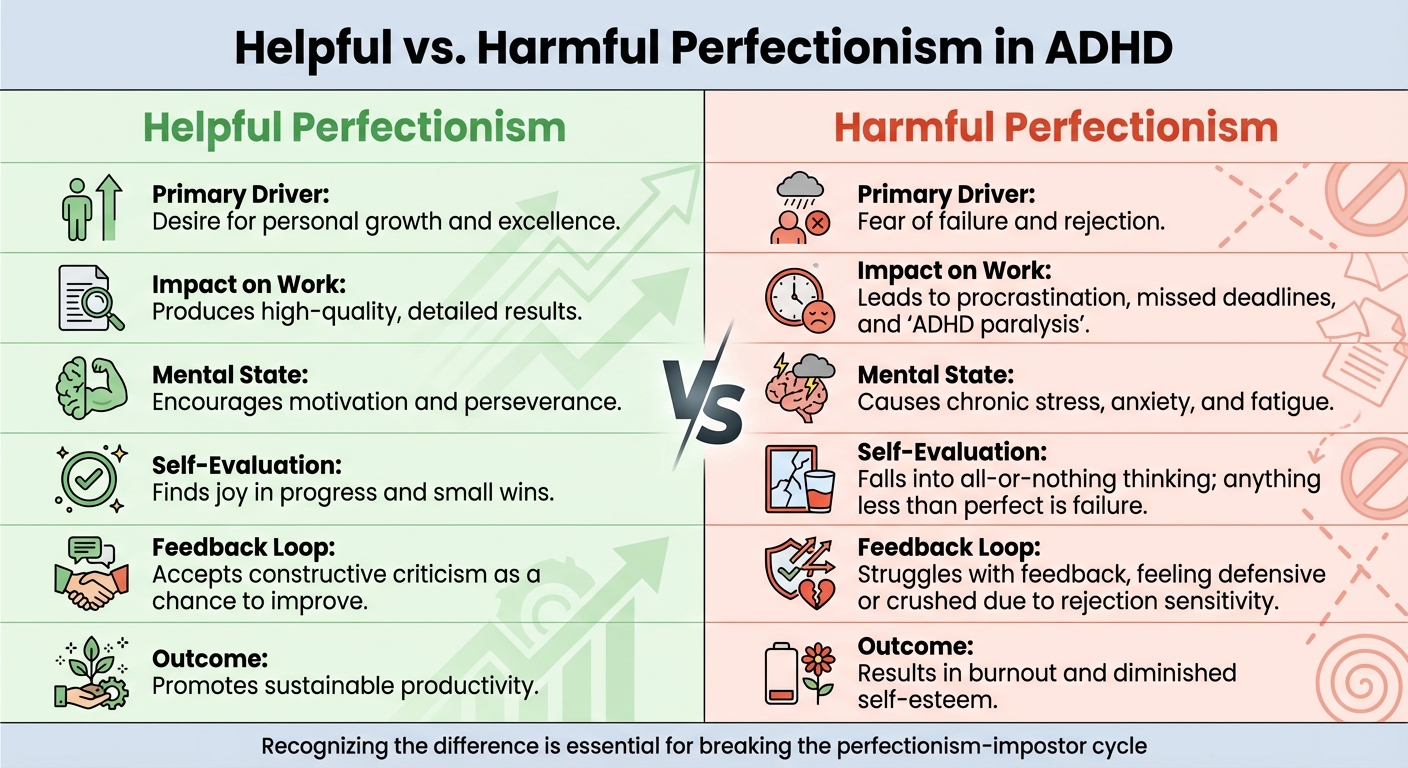
Helpful vs Harmful Perfectionism in ADHD: Key Differences
Years of missed deadlines, forgotten details, and avoidable mistakes often drive professionals with ADHD to lean on perfectionism as a way to shield themselves from criticism and feelings of inadequacy.
Dr. Marcy Caldwell, a licensed psychologist and Director of The Center for ADHD, explains:
"Perfectionism can be a way to shield themselves from potential rejection by striving for flawless performance."
The reasoning behind this is simple: if everything appears perfect on the outside, the internal struggles of ADHD might go unnoticed. Perfectionism, in this context, becomes a way to manage anxiety - something that nearly half of adults with ADHD experience. It also ties into dopamine dysregulation, where the pursuit of external approval temporarily fills the gap left by ADHD's reward system challenges. However, while this strategy might seem like a solution, it often comes with a price.
Perfectionism can motivate, but it can also paralyze. What starts as a coping mechanism can quickly spiral into procrastination, burnout, and heightened self-doubt. Recognizing these patterns is key to differentiating between perfectionism that drives success and perfectionism that hinders it.
Helpful vs. Harmful Perfectionism in ADHD
Perfectionism isn't inherently harmful. There's a clear difference between striving for excellence and being consumed by the fear of failure. Helpful perfectionism stems from a genuine desire to produce quality work and grow. It pushes you to give your best effort and take pride in your achievements. Harmful perfectionism, by contrast, is rooted in fear - fear of letting others down, fear of being exposed, and the belief that anything short of perfect equals failure.
Psychologist Sharon Saline breaks it down well:
"Perfectionists are often driven by the fear of disappointing themselves or others. They are all-or-nothing thinkers; if it's not completely right, then it must be a failure."
Here’s a closer look at how these two types of perfectionism play out for individuals with ADHD:
| Feature | Helpful Perfectionism | Harmful Perfectionism |
|---|---|---|
| Primary Driver | Desire for personal growth and excellence | Fear of failure and rejection |
| Impact on Work | Produces high-quality, detailed results | Leads to procrastination, missed deadlines, and "ADHD paralysis" |
| Mental State | Encourages motivation and perseverance | Causes chronic stress, anxiety, and fatigue |
| Self-Evaluation | Finds joy in progress and small wins | Falls into all-or-nothing thinking; anything less than perfect is failure |
| Feedback Loop | Accepts constructive criticism as a chance to improve | Struggles with feedback, feeling defensive or crushed due to rejection sensitivity |
| Outcome | Promotes sustainable productivity | Results in burnout and diminished self-esteem |
Recognizing the difference between these two forms of perfectionism is essential. When perfectionism shifts from being a tool for improvement to a shield against shame, it stops helping and starts feeding the very insecurities it’s meant to protect against. This shift often worsens impostor syndrome, leaving individuals feeling stuck in a cycle of self-doubt.
How Perfectionism and Impostor Syndrome Feed Each Other
Perfectionism and impostor syndrome often fuel one another, creating a vicious cycle. Many ADHD professionals set impossibly high standards for themselves, often as a response to past criticism. When they inevitably fall short of these unrealistic goals, feelings of being a fraud take over. This sense of failure not only deepens self-doubt but also pushes them to set even stricter and more unattainable goals, perpetuating the cycle.
This pattern is deeply tied to how ADHD affects memory and self-perception. The ADHD brain tends to downplay past successes while magnifying struggles, making it harder to recognize achievements. To compensate, individuals may work excessively hard, often to the point of exhaustion. Ironically, this overexertion worsens ADHD symptoms like forgetfulness and difficulty focusing, further feeding into the cycle of self-doubt.
Studies show that 12% of ADHD professionals identify setting unreasonable standards as their biggest challenge. In fact, perfectionism has been highlighted as the top cognitive distortion among adults with ADHD. This creates a rigid mindset where failures feel catastrophic, reinforcing both perfectionism and impostor syndrome.
How All-or-Nothing Thinking Makes It Worse
All-or-nothing thinking - viewing situations in extremes - only adds fuel to the fire. For many ADHD professionals, work is either flawless or a total disaster. A minor mistake, like a typo in an email or a misstep during a presentation, can lead to intense self-criticism. This often results in endless revisions or delays as they strive for unattainable perfection.
Dr. Sharon Saline captures this mindset perfectly:
"Perfectionists are often driven by the fear of disappointing themselves or others. They are all-or-nothing thinkers; if it's not completely right, then it must be a failure."
The ADHD brain's struggle with cognitive flexibility makes it difficult to embrace the idea that "good enough" is often sufficient. Survey data reveals that 13% of respondents cite all-or-nothing thinking as their most challenging perfectionist trait, while another 13% feel that not being good enough is their biggest struggle. This rigid way of thinking creates a self-reinforcing loop: impossible standards lead to perceived failures, which intensify impostor feelings. ADHD coach Paula Engebretson explains:
"We focus on the black and white rather than the gray in-between and our perfectionism prevents us from accepting things as 'good enough.'"
This mindset can also lead to ADHD paralysis - the fear of starting tasks because they might not be completed perfectly. This hesitation often results in missed deadlines and even more stress.
Effects on Work Performance and Mental Health
The combination of perfectionism and impostor syndrome takes a toll on both work output and mental health. At work, the constant pressure to achieve perfection can lead individuals to over-check emails, endlessly revise documents, or spend excessive time researching. This drains energy that could be spent on more important tasks.
Dr. J. Russell Ramsey from Penn Behavioral Health highlights the impact of these tendencies:
"Perfectionism emerged as the #1 distortion in the thinking of adults with ADHD. It can play a role in the ADHD person's sense of shame."
This relentless drive for perfection chips away at self-esteem and contributes to chronic stress. Licensed clinical social worker Carmelle Ellison explains:
"The pressure to perform perfectly all the time can lead to chronic stress and anxiety. It also increases the risk of burnout, as individuals with ADHD may push themselves too hard in an attempt to meet their high standards."
This combination of perfectionism, impostor syndrome, and burnout forms what some call a "toxic triad." It leads to both physical and emotional exhaustion, further worsening ADHD symptoms. On top of that, professionals who feel like impostors often interpret even constructive feedback as validation of their inadequacy. This sensitivity to feedback is a significant challenge for 8% of ADHD professionals.
How to Break the Perfectionism-Impostor Cycle
Stepping out of the perfectionism-impostor cycle takes deliberate effort and a readiness to confront ingrained thought patterns. Building on earlier challenges, these strategies are designed to directly address the mental habits that fuel both perfectionism and impostor syndrome. Start small - choose one or two strategies that resonate most with your situation.
Use Mindfulness to Challenge All-or-Nothing Thinking
Mindfulness can help disrupt the rigid, black-and-white thinking that often feeds perfectionism and impostor syndrome. It’s not about having a perfectly calm mind but about recognizing when your thoughts veer into extremes and bringing yourself back to balance. Dr. Mark Bertin, a mindfulness teacher, explains it well:
"Mindfulness isn't perfectionism - it's the antidote for perfectionism instead."
When you catch yourself thinking in absolutes - like "I completely blew that presentation" - pause and reframe it with more balanced language. For instance, "I made a mistake in that presentation, and I also delivered several strong points." This "both/and" approach acknowledges the full picture without spiraling into negativity.
Another helpful tactic is labeling your inner critic. When self-critical thoughts arise, name them as "judgment" and use a neutral phrase to redirect yourself, like, "Thanks, but I’m not engaging with this today." This helps you stay present and avoid getting caught in a mental loop. Similarly, try emotional "sitting" by acknowledging your feelings - "I feel anxious right now, and that’s okay" - to build tolerance for uncertainty, a key driver of perfectionism.
Here’s a quick comparison of all-or-nothing thinking versus mindful thinking:
| All-or-Nothing Thinking | Mindful/Balanced Thinking |
|---|---|
| Uses words like "always", "never", "failure" | Replaces with "sometimes", "and", "learning" |
| Focuses solely on outcomes | Focuses on effort and process |
| Catastrophizes: "I ruined everything" | Reframes: "I made a mistake, what can I learn?" |
| Seeks external validation | Leans on self-compassion and realistic expectations |
This mindfulness-based approach is a practical way to counteract the cognitive distortions that perpetuate the perfectionism-impostor cycle.
Counter Self-Criticism with a Record of Your Achievements
Keeping a tangible record of your successes can help combat the distorted self-view that fuels impostor syndrome.
Start a simple "success record" by jotting down three things that went well each day. These don’t have to be monumental - small wins like completing a task, speaking up in a meeting, or helping someone count too. Writing them down creates a resource you can revisit when self-doubt sneaks in.
Another idea: save positive feedback and reminders of your achievements. Keep a folder with emails, compliments, or notes about projects you’re proud of. This isn’t about boasting - it’s about building a bank of evidence to challenge impostor thoughts. When self-doubt arises, you’ll have proof that you’re capable and deserving of your successes.
Set Realistic Standards with a Growth Mindset
Perfectionism often comes from setting impossible standards based on what you think you "should" do instead of what’s realistically achievable. Adopting a growth mindset means focusing on learning and effort rather than just the final outcome.
To start, limit yourself to two or three "must-do" tasks each day. This keeps your to-do list manageable and gives you a sense of accomplishment rather than overwhelm. Use the SMART framework (Specific, Measurable, Attainable, Relevant, Time-based) to set clear, achievable goals and avoid moving the goalposts.
To counter catastrophic thinking, play the "Positive What-If" Game. Instead of asking, "What if I fail?" ask, "What if it goes well?" or "What if I’m good enough?". You can also create affirming phrases like, "Progress matters more than perfection" or "I don’t need to know everything all the time" to keep self-doubt in check.
When receiving feedback, pause and ask yourself, "Is there something here I can learn?" This shifts your mindset from defensiveness to curiosity, making feedback feel less like a personal attack and more like an opportunity for growth.
Practice Self-Compassion to Reduce Feelings of Inadequacy
Self-compassion isn’t about lowering your standards; it’s about treating yourself with the same kindness you’d show a friend. For those with ADHD, this practice directly challenges the harsh self-criticism that feeds perfectionism and impostor syndrome.
Try the "Best Friend" Test: When you make a mistake, ask yourself, "What would I say to my best friend in this situation?" Then, say those same words to yourself. ADHD advocate Mallory Band captures this shift perfectly:
"I am ready to start living instead of letting perfectionism dictate my self-worth. I don't need to wait for others to validate my life; I can do this for myself. I am good enough - and so are you."
Adopt the "Good Enough" approach by setting clear, limited criteria for tasks. For example, decide, "This email needs one proofread, not five", to avoid overanalyzing. Keep grounding phrases handy, like "This is hard, and that’s okay" or "I’m learning, and that takes time".
Research by Dr. Kristin Neff shows that practicing self-compassion can lower stress hormones and improve emotional regulation within weeks. Think of it like building a muscle - the more you practice, the stronger it becomes. You can even set reminders on your phone with kind messages to reinforce this habit throughout your day. Each step chips away at the cycle, creating space for a healthier mindset.
Resources for ADHD Professionals on On/Off Genius

On/Off Genius offers a wealth of practical tools and insights tailored to ADHD professionals looking to tackle challenges like perfectionism and impostor syndrome. The platform's resources focus on improving focus, organization, and consistency while addressing the unique struggles faced by individuals with ADHD.
Articles on Managing Perfectionism and Impostor Syndrome
For those grappling with perfectionism and impostor syndrome, On/Off Genius dives into how these issues often stem from self-protection rather than genuine ambition. ADHD coach Kevin Bailey, CTACC, captures this idea perfectly:
"You don't fall into perfectionism because you're striving. You fall into it because you're protecting."
The blog explores how perfectionism can manifest as either overworking or avoiding tasks altogether. Through concepts like "strategic imperfection", readers are encouraged to let go of unrealistic standards. There’s even a Burnout Style Quiz designed to pinpoint the root causes of perfectionism and provide actionable recovery steps.
Tools for Managing Energy and Motivation
Beyond articles, On/Off Genius offers tools aimed at improving consistency and focus. For example, the 10-Minute "Messy Draft" Timer helps users start tasks without overthinking, a common hurdle for those dealing with ADHD perfectionism. Other techniques include body doubling and the Pomodoro Technique, both of which are effective for maintaining energy and focus throughout the day.
The platform also highlights ways to make daily routines more engaging. Apps like Habitica and Forest are recommended to gamify tasks, providing a dopamine boost to counteract executive function challenges like time blindness and task initiation struggles. These tools, combined with the strategies discussed, help ADHD professionals find a sustainable path to productivity while breaking free from the perfectionism-impostor cycle.
Conclusion
Throughout this article, we've delved into the importance of breaking the perfectionism-impostor cycle to reach your full potential. Letting go of this cycle can free up the mental energy needed to truly thrive. With 42% of adults with ADHD reporting struggles with perfectionist traits like all-or-nothing thinking and unrealistic standards, it’s clear this isn’t about personal failure - it’s a common challenge that requires deliberate effort to overcome. Addressing it can turn obstacles into opportunities for growth.
The strategies shared here - mindfulness, tracking achievements, setting realistic goals, and practicing self-compassion - are tools designed to help separate your self-worth from your productivity. They also encourage learning from mistakes rather than being consumed by shame. As clinical psychologist Dr. Monica Johnson highlights, "It's actually your criticism that slows you down". Similarly, ADHD advocate Mallory Band encapsulates the power of this shift:
"I am ready to start living instead of letting perfectionism dictate my self-worth. I don't need to wait for others to validate my life; I can do this for myself".
While ADHD may predispose you to focus on the negative, adopting these approaches can help recalibrate that perspective. With consistent effort, it's possible to reshape these patterns. The time and energy once lost to procrastination, over-editing, and decision paralysis can instead fuel your strengths and allow you to engage in work that matters - opening doors to both professional success and personal fulfillment.
FAQs
How can I tell if my perfectionism is helping or harming me?
To figure out whether your perfectionism is working for or against you, think about its impact. Does it push you toward productive motivation? If so, it might be serving you well. On the other hand, if it triggers self-criticism, anxiety, or a sense of not being good enough, it’s probably doing more harm than good. When perfectionism feeds impostor syndrome or causes significant stress, it tends to be harmful. Take a moment to reflect - does it help you achieve your goals, or does it pile on unnecessary pressure?
What can I do when “success amnesia” makes me doubt my abilities?
When "success amnesia" creeps in and makes you doubt yourself, it’s important to shift your focus to your past achievements. Keep in mind that memory lapses are a common experience for those with ADHD. To regain your confidence, consider these approaches:
- Practice self-compassion: Be kind to yourself and acknowledge that everyone struggles at times.
- Keep a record of your successes: Write down your accomplishments, no matter how small, so you have a tangible reminder of your abilities.
- Challenge negative thoughts: Question self-doubt and replace it with evidence of your strengths and past wins.
These steps can help you push back against self-doubt and reinforce the confidence you deserve.
How do I handle feedback at work without spiraling into impostor thoughts?
Receiving feedback can feel challenging, especially for professionals navigating ADHD or perfectionist tendencies. Instead of viewing feedback as a critique of your value, try to see it as a chance to grow and refine your skills. Focus on the actionable takeaways - what you can do differently or improve upon - and approach yourself with kindness. Remember, making mistakes is part of learning, not a reflection of your worth. By separating your self-esteem from criticism and taking time to recognize your strengths, you can ease impostor feelings and handle feedback in a healthier, more productive way.