How to Stop Starting Projects You Never Finish
Finishing projects is about systems, not willpower — prioritize, break work into tiny steps, time-block, use tools and body doubling to finish.
Do you start projects with enthusiasm but struggle to finish them? For many, especially those with ADHD, this is a common challenge tied to how the brain processes motivation and time. The thrill of starting something new often fades as tasks become routine, leading to unfinished work piling up. But it’s not about laziness - it’s about brain chemistry and how dopamine impacts focus and follow-through.
Here’s how to break the cycle:
- Understand ADHD tendencies: Reduced dopamine levels make long-term tasks harder to sustain.
- Prioritize effectively: Tools like the Eisenhower Matrix help focus on what’s urgent and important.
- Break tasks into smaller steps: Tackling bite-sized actions makes big projects feel less overwhelming.
- Use time management methods: Techniques like time blocking and the Pomodoro Technique improve focus.
- Leverage tools and support: Task management apps and body doubling can keep you on track.
- Build habits that stick: Daily check-ins and managing an idea backlog help maintain progress.
The key isn’t perfection - it’s steady progress. Start small, focus on what matters, and finish projects that align with your goals.
How To Finish The Projects You Start: ADHD Edition
Why ADHD Makes It Hard to Finish Projects
Starting a project often feels thrilling, thanks to the initial dopamine rush that comes with new ideas and possibilities. But as that excitement fades, keeping up the momentum becomes a struggle. Routine and consistency, which are less stimulating, take over - and that’s where many ADHD brains hit a roadblock.
"The longer a project continues, the more it shifts from running on passion to requiring consistency and follow-through. What started as an exciting adventure gradually transforms into something that demands routine maintenance, and that's exactly where many ADHD brains hit the wall." - Maaya Hitomi, ADHD Coach
Another challenge lies in the way ADHD affects time perception. Known as time blindness, this unique way of experiencing time can disrupt motivation. The brain often operates on a "now/not-now" timeline. If a deadline feels far off, it might not register as urgent or real. Instead of tackling the project, you may find yourself chasing tasks that offer immediate dopamine hits - like spending hours researching tools or ideas without actually starting the work.
Cognitive factors also play a role. For example, working memory, which acts as the brain’s short-term notepad, can falter. When this happens, projects that aren’t actively on your mind can slip away entirely. Add in emotional dysregulation - a challenge for 30% to 70% of adults with ADHD - and the frustration or boredom of the "messy middle" stage of a project can become overwhelming. This often leads to avoidance as a coping mechanism.
Recognizing these neurological and cognitive obstacles is the first step toward finding solutions. The next section will explore strategies designed to work with your brain’s unique wiring to help you finish what you start.
Using the Eisenhower Matrix to Prioritize Tasks
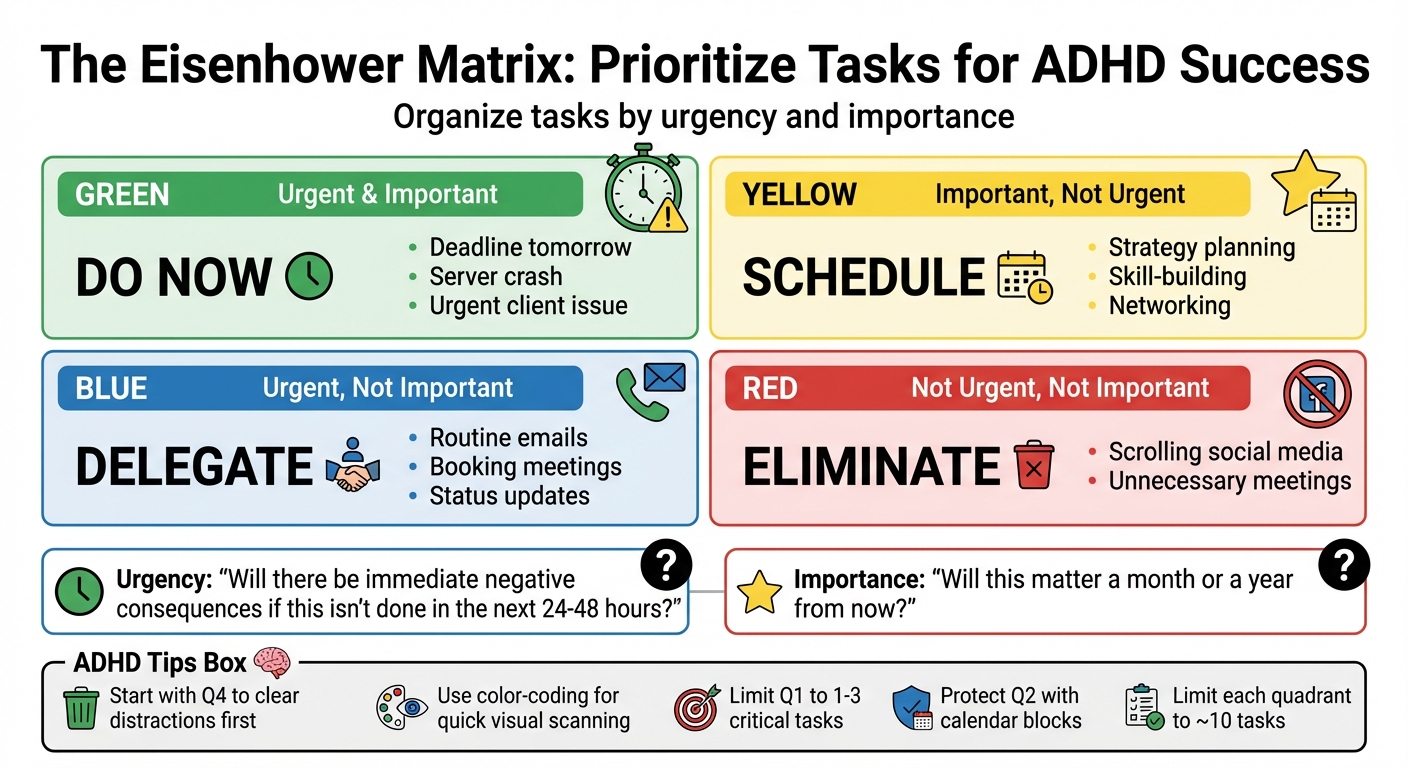
Eisenhower Matrix for ADHD Task Prioritization
A never-ending to-do list can feel paralyzing, especially for those with ADHD. The Eisenhower Matrix offers a practical way to cut through the chaos by organizing tasks into a simple 2x2 grid. It all boils down to two questions: Is this urgent? and Is this important?
This method takes its name from President Dwight D. Eisenhower, who famously said, "I have two kinds of problems, the urgent and the important. The urgent are not important, and the important are never urgent." By separating immediate demands from long-term goals, the matrix provides clarity. For ADHD professionals, this visual framework transforms an overwhelming mix of tasks into clear categories, making the next steps easier to tackle.
Studies show that prioritizing tasks deliberately can boost both performance and well-being. This is especially helpful if you often spend your days handling minor emergencies while critical projects sit untouched.
The strength of the Eisenhower Matrix lies in addressing a common ADHD challenge: urgent tasks feel more pressing and rewarding than important ones. By laying out both types side by side, it becomes easier to focus on what truly matters.
How to Set Up the Eisenhower Matrix
Start by writing down every single task, without worrying about order or importance. This creates a complete picture and clears mental clutter.
Next, divide your tasks into four quadrants by asking two key questions. For urgency, ask: "Will there be immediate negative consequences if this isn’t done in the next 24–48 hours?" For importance, ask: "Will this matter a month or a year from now?"
Here’s how the matrix typically looks:
| Quadrant | Action | Workplace Examples |
|---|---|---|
| Q1: Urgent & Important | Do Now | Deadline tomorrow, server crash, urgent client issue |
| Q2: Important, Not Urgent | Schedule | Strategy planning, skill-building, networking |
| Q3: Urgent, Not Important | Delegate | Routine emails, booking meetings, status updates |
| Q4: Not Urgent, Not Important | Eliminate | Scrolling social media, unnecessary meetings |
- Quadrant 1 is for tasks that are both urgent and important. These are your immediate priorities - things like deadlines or crises that require action right now.
- Quadrant 2 holds tasks that drive long-term success. These include planning and professional growth, which should be scheduled as regular commitments to avoid neglect.
- Quadrant 3 is for tasks that feel urgent but don’t necessarily need your direct attention. If possible, delegate these or find ways to automate them.
- Quadrant 4 is the zone for distractions and time-wasters. These tasks should be minimized or removed entirely.
To keep things manageable, aim to limit each quadrant to about 10 tasks. If a task feels too big, break it into smaller, actionable steps before assigning it to a quadrant.
Adapting the Matrix for ADHD Work Patterns
The traditional advice suggests starting with Quadrant 1, but for ADHD minds, it might be better to begin with Quadrant 4. Clearing distractions first can free up mental energy, making it easier to focus on what’s left.
Adding color-coding can also make the matrix more ADHD-friendly. For instance, you could use green for Q1, yellow for Q2, blue for Q3, and red for Q4. This visual layer helps you quickly identify priorities at a glance.
Consider creating separate matrices for work and personal life. Mixing professional deadlines with errands can lead to confusion since they often require different timelines and resources. Keeping them distinct adds clarity.
Protect Quadrant 2 tasks by blocking time on your calendar. These tasks often lack immediate consequences, making them easy to postpone. But ignoring them for too long can lead to future crises. Treat these calendar blocks as non-negotiable.
Finally, limit Quadrant 1 to just one to three critical tasks at a time. When everything feels like a top priority, it’s easy to lose focus. Ask yourself, "What would really happen if this waited until tomorrow?" This simple question can help you avoid turning every task into an emergency.
Breaking Large Projects into Smaller Steps
Big projects can feel paralyzing, especially for ADHD brains. The sheer scale of tasks like "Launch new website" or "Reorganize department workflow" can make it hard to know where to start. Without clear, actionable steps, initiating work can feel impossible.
The trick isn't to push harder - it’s to break the project into smaller, manageable tasks. This approach works because ADHD brains often see time in two extremes: "Now" and "Not Now." A deadline weeks away feels distant and abstract, but a task you can finish in 20 minutes feels immediate and doable.
Each small win also delivers a dopamine boost, building momentum and helping to overcome that initial resistance to starting.
"Task snacking involves breaking big tasks into tiny, manageable steps that you can tackle in short bursts." - Ny'L Thompson, MS, LCSW-C, therapist at ADHDAdvisor
Start with the STM Framework: list all the Steps, arrange them in Sequence, estimate the Time each will take, and Map them onto your calendar. For instance, a daunting task like "Write quarterly report" could break down into bite-sized pieces: "Open template" (2 minutes), "Pull sales data" (15 minutes), "Draft introduction" (20 minutes), and so on. Each task should feel like a "finishable unit" that takes no more than 10–20 minutes. If a step still feels too big, apply the Two-Minute Rule: start with the smallest action, like opening a document.
Another helpful mindset? Aim for 70% completion instead of perfection. Moving forward with "good enough" progress is far better than getting stuck chasing flawlessness.
Once your tasks are broken down, organize them using time blocking to match your energy levels throughout the day.
Time Blocking to Organize Your Day
Time blocking transforms your to-do list into a structured schedule by assigning specific time slots to each task. This method helps counteract time blindness - the tendency to underestimate or lose track of time.
The secret lies in syncing tasks with your energy patterns. Schedule high-focus work during your peak hours (often mornings) and save simpler tasks for energy dips. For clarity, color-code your calendar: red for deep work, green for routine tasks, and yellow for creative projects.
Don’t forget to add buffer time - about 25% more than your estimate - for transitions, breaks, or interruptions. Simple rituals, like spending five minutes between tasks to save your work, clear your desk, or review what’s next, can make switching gears smoother.
Limit focus blocks to 90 minutes or less. Even if you’re fully immersed, taking regular breaks prevents burnout and keeps productivity steady. Once your schedule is set, the Pomodoro Technique can help maintain focus and momentum.
Working in 25-Minute Sessions with the Pomodoro Technique
The Pomodoro Technique divides work into 25-minute sprints followed by five-minute breaks. For ADHD professionals, this method creates urgency, turning tasks into a race against the clock and triggering a helpful dopamine release.
Here’s how it works: pick one small task from your list, estimate how long it’ll take, and set a 25-minute timer. When the timer goes off, take a five-minute break. After completing four sprints, reward yourself with a longer 15–30-minute break. This cycle keeps mental fatigue at bay while maintaining productivity.
Breaks are just as important as work sessions. Use them wisely - get up, stretch, or take a short walk. Physical activity during breaks recharges focus more effectively than scrolling through your phone.
Lastly, track how your time estimates stack up against reality. If a task you thought would take one Pomodoro actually takes three, note it down. Over time, this practice will sharpen your ability to estimate tasks, making future projects feel less overwhelming.
Using Task Management Tools to Track Your Work
Your brain isn’t designed to hold every deadline, idea, and to-do list item. Trying to do so can drain your mental bandwidth, leaving you prone to forgotten tasks and snap decisions. For professionals with ADHD, this constant juggling can feel like an endless race where you’re always behind.
Task management tools like Trello and Todoist can act as your external brain - a reliable place to store and organize every task, idea, and deadline. With features like visual boards, color-coded labels, and countdown timers, these tools help turn vague deadlines into clear, actionable timeframes. This can be particularly helpful for addressing time blindness - a common challenge for ADHD brains.
Here’s an eye-opener: tasks are three to four times more likely to get done when you assign them a specific day and time. Plus, ADHD brains often need 15–20 minutes to refocus each time you switch between tasks. A well-organized system can cut down on that mental reset time, making your day flow more smoothly.
Creating Your Task Management System
Start with a Master List - a central place where all your tasks, ideas, and obligations land before they’re sorted. Think of this as your inbox for everything swirling in your head. From there, you can filter and prioritize tasks for your daily plan.
Make your system easier to navigate by adding color codes and icons. These visual cues help you quickly identify categories and reduce the mental effort of scanning your list.
For bigger tasks, break them into smaller, actionable steps. For instance, instead of writing down “Complete quarterly report,” begin with something bite-sized like “Open report template.” Even a 2-minute action can help you gain momentum. If a task still feels overwhelming, ask yourself: What’s the very next thing I need to do?
Another tip: include a 20–40% buffer in your schedule to account for transitions. Working backward from deadlines can help turn abstract due dates into clear starting points.
Wrap up your day with a "Tie the Bow" ritual - dedicate the last 15 minutes to tying up loose ends. This could mean filing documents, sending final emails, or preparing materials for the next day. As Dr. Kathleen Nadeau puts it, “You aren’t done with a task until you’ve completed it, down to the last step”.
Reviewing Your Progress Daily and Weekly
Setting up a system is just the first step. Regular reviews ensure everything stays on track and help you build confidence in your process, easing both anxiety and mental strain.
A daily review only takes 2–5 minutes. Use this time to close open loops, tidy up your digital workspace, and identify your top three priorities for the next day. Adding these priorities to your calendar ensures they get your attention first.
A weekly review, which might take 30–45 minutes, allows for deeper reflection. Look back on what went well, what didn’t, and where you felt stuck. Identify three key goals for the upcoming week and block time for them on your calendar. Be kind to yourself - rather than focusing on what didn’t get done, look for patterns of friction or overwhelm and tweak your system accordingly.
"Consistency beats intensity for ADHD brains." - Akiflow
These quick reviews reduce the mental drag of transitions and keep your system running smoothly. Over time, this habit transforms your task manager from a source of stress into a trusted ally, helping you stay focused and accountable.
Staying Focused with Body Doubling and Regular Check-Ins
Body doubling and structured check-ins are strategies that align with ADHD tendencies, making it easier to start and stick with tasks. While a task management system is helpful, it often needs an extra push to break through the barrier of getting started. That’s where these techniques come into play, offering a fresh way to approach your projects.
What Body Doubling Is and Why It Works
Body doubling means working alongside someone else - either in person or virtually - while focusing on your own tasks. It’s not about collaboration; simply having another person present provides structure and accountability, making it easier to tackle tasks.
"Body doubling is a form of external executive functioning. It's when you work or do tasks alongside another person... to help stay focused and motivated." - Dr. Michael Manos, Cleveland Clinic
Watching someone else work can naturally boost your focus. Plus, their presence can trigger a dopamine release, which helps address the motivation challenges often associated with ADHD.
The effectiveness of this method is backed by data. Focusmate, a virtual body doubling platform, reports that 96% of sessions lead to progress on tasks, with users seeing a 50% productivity boost overall. Similarly, 94% of Flow Club users feel more productive when using the service. A 2024 study also highlighted that body doubling helps people with ADHD both start and complete tasks.
There are various ways to try body doubling. Platforms like Focusmate (offering free sessions or unlimited access for $5–$10/month) connect you with a partner for one-on-one video sessions. Flow Club ($40/month) hosts group sessions led by ADHD-aware facilitators. If you prefer something less formal, "Study With Me" videos on YouTube or TikTok provide a similar vibe without direct interaction.
To maximize the benefits of body doubling, focus on one challenging task rather than a long to-do list. Start each session by stating your goal to create a sense of commitment, and set simple rules - like "no talking" - to minimize distractions. Choose a partner who is dependable and nonjudgmental, ensuring a productive and interruption-free environment.
Pairing body doubling with regular check-ins can further enhance your focus and accountability.
Scheduling Check-Ins to Monitor Progress
Scheduled check-ins build on the structure of body doubling, helping you stay on track with your goals. These quick check-ins allow you to assess your progress without breaking your flow.
Start each session with a 30-second check-in to define your task and set a clear goal. This small step turns vague intentions into actionable plans and adds a layer of accountability.
For longer work periods, set a mid-session reminder - around the 30-minute mark - to refocus if your attention starts to drift. At the end of your session, take another 30 seconds to review what you’ve accomplished, identify any sticking points, and outline your next step. These brief moments of reflection help consolidate your progress and make it easier to pick up where you left off.
Tools like timers can make check-ins feel more natural. For example, the Pomodoro Technique (25 minutes of work followed by a 5-minute break) creates built-in checkpoints. Scheduling recurring sessions for tasks you tend to avoid, like tackling administrative work, adds predictability to your routine. And if live check-ins aren’t an option, you can text a friend at the start and end of a task to create accountability.
Building Habits to Stop Starting Too Many Projects
In addition to using prioritization tools and managing your time effectively, developing consistent habits can help you stay focused and see projects through to completion. These habits are especially crucial for pushing past the "messy middle" - that point when the initial excitement fades, and the hard work begins.
"The goal isn't to finish everything you ever start. The goal is to finish what matters." - Mateo Vargas, Science Communicator
One major reason people abandon projects is decision fatigue. As your energy dips later in the day, it's tempting to ditch challenging tasks in favor of easier ones. Even large organizations struggle with this - only 35% of complex digital transformation projects succeed worldwide.
Daily Check-Ins on Energy and Priorities
Start your day by identifying a single must-do task instead of overwhelming yourself with a long to-do list. This approach builds self-trust and helps you stay focused. Before diving into a new project, check if it aligns with your current energy levels and workload.
Match your tasks to your energy throughout the day:
- High-energy periods: Tackle strategic or creative work, like planning or solving complex problems.
- Medium-energy periods: Handle routine tasks, such as responding to emails or scheduling.
- Low-energy periods: Focus on passive or restorative activities, like reading or planning tomorrow's priorities.
| Energy Level | Task Type | Examples |
|---|---|---|
| High | Strategic & Creative | Project planning, writing, problem-solving |
| Medium | Routine & Admin | Email processing, scheduling, basic housework |
| Low | Passive & Restorative | Reading, learning, planning the next day |
To avoid over-planning, try a "Now and Not Now" list. This simple method separates what you need to do today from tasks that can wait. Limit your planning time to 10 minutes to avoid turning it into procrastination.
"Organizing under pressure can't be done. You need to disconnect from feelings of, 'If I screw this up...' and take some quiet time to do the organizational thinking." - Beth Main, ADHD Coach
Before starting anything new, pause and assess how you're feeling. Are you tired, hungry, or in need of a break? Addressing these needs first can help you avoid impulsive decisions driven by comfort-seeking.
Once you've nailed down your priorities for the day, any new ideas can go into a managed backlog.
Creating an Idea Backlog for Future Projects
When inspiration strikes, jot your idea down in a backlog and return to your current task. This practice helps clear mental clutter and keeps you focused. Unfinished tasks tend to linger in your mind, creating anxiety until they're recorded somewhere.
"Think of your master list as a buffet table. You're not going to eat everything today, but each day you are filling up your plate, making your daily to-do list." - Beth Main, ADHD Coach
Your backlog isn't a traditional to-do list - it's a holding space for ideas. Pick only one or two items from it to focus on daily. This method also helps you manage the natural drop in motivation as the novelty of a project wears off.
Stick to the "One Project" rule: finish or intentionally pause your current project before starting another. Review your backlog regularly when you have the mental clarity to evaluate ideas objectively. If an idea keeps getting shuffled around without progress, consider removing, delegating, or breaking it into smaller steps.
Before promoting an idea from your backlog to active status, do a quick "Why" audit. Ask yourself if it aligns with your long-term goals or if it's just a fleeting distraction. Research shows that people who set specific dates, times, and locations for their tasks are 90% more likely to follow through, compared to only 35% for vague plans.
Conclusion
Tackling ADHD-related challenges and finishing meaningful projects isn’t about sheer willpower or chasing perfection. It’s about understanding your own tendencies and using practical strategies to make progress more manageable. By prioritizing tasks with the Eisenhower Matrix, breaking work into smaller, actionable steps, using task management tools to track progress, and building habits that stick, you can create a system that helps you focus on what truly matters.
Start small: pick one strategy from this article and try it for just 15 minutes today. Maybe that’s simplifying your next task until it feels effortless or jotting down distractions in a "distraction overflow list" to keep your focus intact. Open your project, set a timer, and take that first step. Even the smallest accomplishment can spark a dopamine boost, helping you build momentum.
Remember, it’s not about finishing everything - it’s about finishing what matters. The 70% Rule can be a game-changer: aim to complete tasks well enough to move forward, rather than striving for perfection. As Kathleen Nadeau, Ph.D. puts it:
"You aren't done with a task until you've completed it, down to the last step."
That final touch - tying up loose ends - is what truly marks a project as complete.
Focus on making small, consistent changes that add up over time. Adjust your environment to reduce friction, align tasks with your energy levels, and use If-Then planning to prepare for potential setbacks. Each small step builds your confidence and strengthens your ability to finish the projects that matter most.
FAQs
How do I pick one project to finish first?
To decide which project to tackle first, pick one that matches your priorities and feels doable. Break it down into smaller, actionable tasks to make progress less intimidating. Tools like the Eisenhower Matrix can help you sort tasks by urgency and importance, ensuring you focus on what truly matters. Starting with a project that's both meaningful and manageable can boost your momentum and make the process feel less overwhelming.
What should I do when I lose motivation mid-project?
Losing steam halfway through a project happens to many people, especially those with ADHD. One effective way to tackle this is by breaking the project into smaller, bite-sized steps. This approach makes the task feel less daunting and gives you a clear starting point to get back on track. Focus on just the first actionable step - it’s often enough to rebuild momentum.
Take a moment to think about why you started the project in the first place. What was your initial motivation? Reconnecting with that can reignite your drive. And don’t forget to celebrate small wins along the way - whether it’s finishing a task or just making progress, rewards can keep you motivated.
Tools like visual trackers, checklists, or setting deadlines can also help you stay engaged. But most importantly, remind yourself that struggling with motivation is a common part of living with ADHD. It’s not a reflection of your abilities or worth.
How can I stop new ideas from derailing my current work?
To keep your focus sharp and your productivity on point, break tasks into manageable, finishable units. Identify the very first physical action required to get started, and nurture habits that encourage tackling one task at a time. These steps lighten the mental load and minimize distractions, making it easier to stay committed and see each task through to completion.