7 Ways to Stay Focused When Your Brain Won't Cooperate
ADHD-friendly focus tactics: flexible micro-Pomodoros, decluttered workspace, task chunking, movement breaks, body doubling, and quick mindfulness resets.

Ever feel like your brain just won’t focus, no matter how hard you try? You’re not alone. Struggles like losing track of time, forgetting tasks, or feeling stuck often stem from how your brain processes attention and energy. But here’s the good news: there are practical ways to work with your brain, not against it.
Here’s a quick rundown of strategies to help you regain focus:
- Flexible Pomodoro Technique: Use short work intervals (5–15 minutes) and visual timers to make time feel manageable.
- Declutter Your Workspace: Keep only essentials nearby and minimize distractions like phones or clutter.
- Break Tasks into Steps: Start small, like opening a document, and use prioritization tools like the Traffic Light System.
- Movement Breaks: Short bursts of physical activity, like jumping jacks or walks, can boost focus.
- Body Doubling: Work alongside someone (in-person or virtually) for accountability.
- Quick Mindfulness Resets: Try 1–5 minute exercises like the 5-4-3-2-1 senses method or deep breathing.
- Explore More Resources: Use blogs or tools designed specifically for ADHD brains to find additional tips.
These methods align with how your brain naturally works, helping you tackle distractions, time blindness, and task paralysis. Start with one strategy, stick with it, and adjust as needed to see real progress.
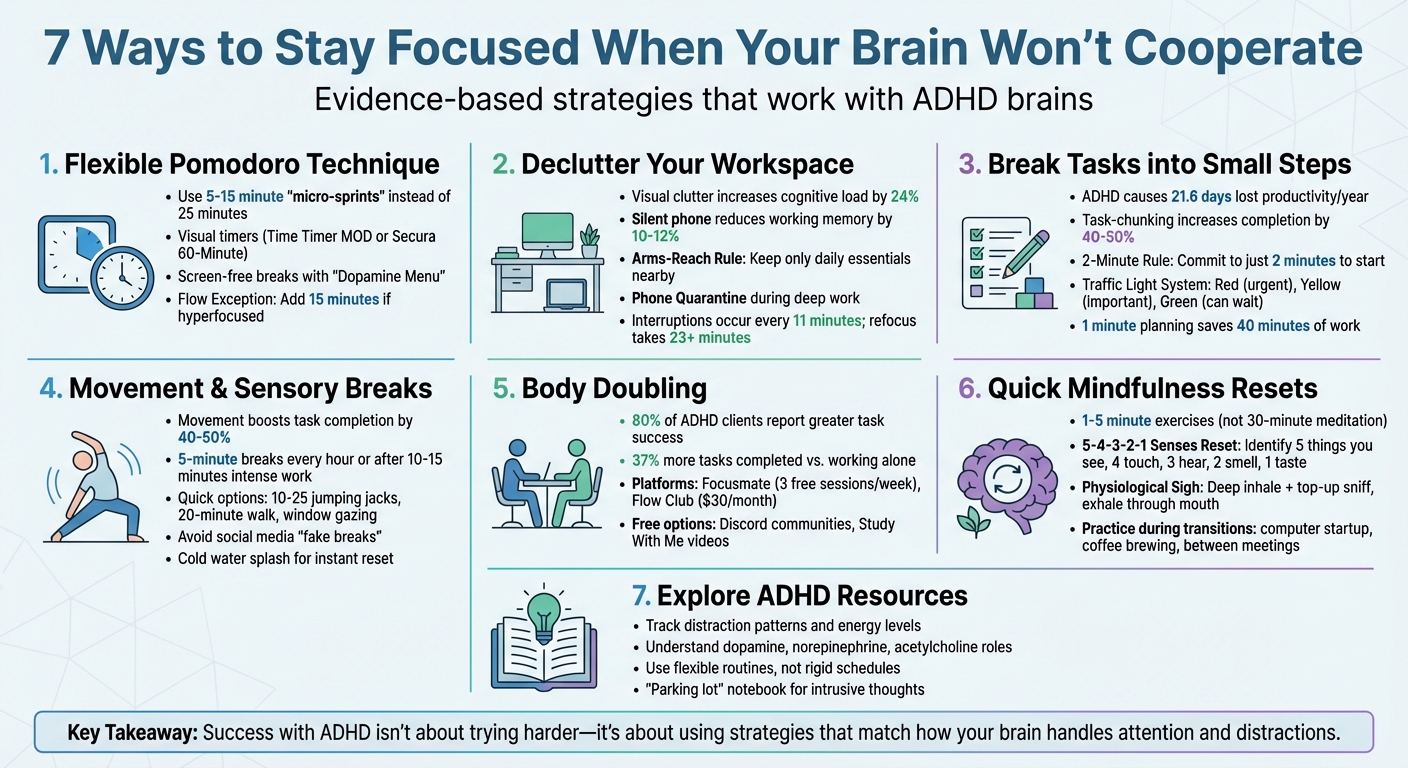
7 Focus Strategies for ADHD Brains: Quick Reference Guide
Effective ADHD Hacks for Focus & Motivation | Crush ADHD Procrastination
1. Try the Pomodoro Technique with ADHD Adjustments
The traditional Pomodoro Technique - working in fixed 25-minute intervals - doesn’t always click for ADHD brains. Those standard time blocks can feel too long when you’re struggling to get started and too short when you’re in the middle of a productive groove. That’s why a more flexible approach can make all the difference.
Start with "Micro-Sprints" - short bursts of just 5, 10, or 15 minutes instead of the usual 25. This makes it easier to overcome the initial hurdle of starting. One helpful trick is using a "Liar’s Timer." Tell yourself you’ll stop after just 5 minutes, but often, once you’re rolling, you’ll naturally keep going. Why does this work? Research shows the brain needs less dopamine to keep going than it does to get started in the first place.
Skip the phone timer - it’s easy to get distracted by notifications or lose focus. Instead, opt for a physical visual timer, like the Time Timer MOD (about $35) or the more affordable Secura 60-Minute Visual Timer (around $15). These timers use a disappearing red disk to make time feel tangible and visible, which can help combat time blindness.
Breaks are as important as your work sessions, but it’s key to choose them wisely. Social media might seem like a quick escape, but the dopamine rush can make returning to work feel almost impossible. Instead, create a "Dopamine Menu" of screen-free activities: try some jumping jacks, splash cold water on your face, stretch, or take a quick walk. Use a separate timer for your break to avoid turning a short rest into an hour-long detour.
If you’re in a hyperfocused state when the timer goes off, don’t force yourself to stop immediately. Use a "Flow Exception" - give yourself an extra 15 minutes or take a brief two-minute pause to jot down your next steps. This way, you can maintain momentum without losing your train of thought.
2. Set Up Your Workspace to Reduce Distractions
Once you’ve fine-tuned your work intervals, the next step is to create a workspace that minimizes distractions. Your surroundings aren’t just passive - they actively compete for your attention. For example, visual clutter can increase cognitive load by 24%, while even a silent smartphone nearby can reduce working memory by 10–12%. For individuals with ADHD, every item in view can sap mental energy.
One helpful strategy is the "Arms-Reach Rule": keep only the tools or items you use multiple times a day within reach. Everything else? Store it away. Transparent storage bins with clear labels can make this easier, keeping your essentials close but your workspace tidy.
Your phone deserves special attention. Try a "Phone Quarantine" - leave it in another room or place it in a timed lockbox during deep work sessions. This small change can free up significant mental resources. If you need background noise, consider pink noise or video game soundtracks, which provide subtle auditory stimulation without being distracting. Adjusting your workspace layout can also help. For example, position your desk to face a blank wall rather than a window or a high-traffic area to reduce interruptions.
Interruptions are more frequent than you might think - on average, they occur every 11 minutes. Worse, it takes about 23 minutes and 15 seconds to fully refocus afterward.
Don’t overlook temperature and lighting. Cooler environments (below 68°F or 20°C) can increase errors by 44% and reduce productivity by half. Meanwhile, natural light can enhance cognitive performance by 15%. If natural light isn’t an option, use bright, cool lighting (5000–6500K) in the morning to stay alert, and switch to warm, dim lighting (2700–3000K) in the evening to wind down effectively.
3. Break Tasks into Small Steps and Prioritize What Matters
Building on effective time management and workspace strategies, breaking tasks into smaller pieces and prioritizing them can make a huge difference in maintaining focus. Big projects often feel overwhelming, especially for those with ADHD, and this can lead to what's known as ADHD paralysis - where starting feels impossible. The solution? Break the job into small, actionable tasks. Instead of writing "Finish report" on your to-do list, try starting with "Open a blank document" or "Write the title." These tiny steps make the task feel manageable and provide small dopamine hits that help you keep going [13, 23].
On average, adults with ADHD lose about 21.6 days of productivity each year due to presenteeism (being at work but not fully functional) and another 13.6 days to absenteeism. While medication can improve symptoms for 70–80% of people, adding task-chunking methods into your routine can increase task completion rates by 40–50%. One simple strategy to try is the 2-Minute Rule: commit to working on a task for just two minutes. This small commitment can often overcome the mental block that keeps you from starting.
Once you've broken tasks into smaller steps, the next challenge is prioritizing them. A daily focus list can help: jot down three main priorities and three secondary ones to zero in on what matters most [38, 39]. The Traffic Light System is another helpful tool - mark urgent, high-impact tasks as red, important-but-not-urgent ones as yellow, and tasks that can wait as green. You can also apply the One-Thing Rule: complete one high-priority task before moving on to anything else.
"Much of the stress that people feel doesn't come from having too much to do. It comes from not finishing what they've started." – David Allen, Productivity Expert
To counter time blindness, set anchor deadlines - personal mini-deadlines that come before the actual due date. These create a sense of urgency and help you stay on track [13, 39]. Start by doing a brain dump to clear your mental clutter and free up working memory. And remember, taking just one minute to plan can save you up to 40 minutes of work time.
4. Add Movement and Sensory Breaks to Your Day
Once you've set your priorities, it's time to give your brain a physical reset. Movement plays a big role here - it increases blood flow and releases dopamine and norepinephrine, chemicals that help sharpen focus. In fact, research suggests that incorporating movement breaks into your day can boost task completion rates by 40–50%.
To make the most of these breaks, try timing them strategically. A quick 5-minute movement break every hour or after 10–15 minutes of intense work can work wonders for resetting your mind and recharging your energy. Even just two minutes of movement can significantly enhance alertness. This method pairs perfectly with earlier strategies by ensuring your brain gets a chance to recover between periods of deep focus.
"Physical movement activates neural pathways, breaking your mental link to the previous task." – Brain.fm
So, what can you do during these breaks? Simple activities like 10–25 jumping jacks or 5 deep shoulder rolls can give you an instant dopamine boost. A brisk 20-minute walk is another fantastic option, as it naturally elevates neurotransmitter levels. Need something less active? Just gazing out a window at something in the distance can reset your visual focus and quiet your thoughts.
If you're in a meeting or need something more subtle, try using fidget rings, stress balls, or even chewing gum to stay engaged without drawing attention. But steer clear of "fake breaks" like scrolling through social media. These activities might feel like a break, but they can actually drain your mental energy further.
"An understimulating environment can make it just as hard to focus as an overstimulating one." – Jeffrey James, CNP, Cleveland Clinic
Another quick reset? Splash cold water on your face or wrists. It’s a simple but effective way to wake up your senses. Keep in mind that building new habits takes time - anywhere from 2–5 months - so stick with these resets to make them a natural part of your routine.
5. Use Body Doubling for Accountability
Body doubling is a technique where you work alongside another person - either in person or virtually - while focusing on your own tasks. It’s not about teamwork or chatting; instead, it’s about creating a sense of accountability that helps keep your mind focused. This straightforward method has been shown to be effective for individuals with ADHD.
Research backs this up. A 2018 study from the ADHD Coaching Association revealed that 80% of ADHD clients reported greater success in completing tasks when using body doubling. Additionally, adults with ADHD accomplished 37% more tasks in a parallel work environment compared to working alone. Having someone nearby - even if they’re just quietly working on their own - can act as a reminder to stay on track.
"Body doubling is a form of external executive functioning. It's when you work or do tasks alongside another person, either in person or online, to help stay focused and motivated." – Dr. Michael Manos, PhD, Behavioral Health Specialist, Cleveland Clinic
If you want to try body doubling, there are plenty of ways to get started. Platforms like Focusmate offer one-on-one virtual sessions, giving you three free 50-minute sprints per week (or unlimited sessions for $5/month). For a group experience, Flow Club hosts small sessions for around $30/month. Free options include Discord communities like "ADHD Nerds" or "Study Together", or even watching "Study With Me" videos online.
Before you begin, set a specific goal for your session, such as "Write three client emails." Clear your workspace by closing non-essential tabs and setting your phone aside. Pair this with a Pomodoro timer (work for 25 or 50 minutes, followed by a short break) for added structure. Combining body doubling with timed work intervals can provide the extra push needed to tackle even the most challenging tasks.
6. Practice Quick Mindfulness Reset Exercises
Traditional 30-minute meditation sessions often fall flat for ADHD brains. Why? Because your mind thrives on stimulation, not prolonged stillness. That’s where micro-mindfulness exercises - lasting just 1–5 minutes - come into play. Think of them as "neural pit stops" that offer a quick dose of sensory input or movement, rather than demanding extended calmness from your hyperactive mind.
The goal here isn’t to achieve some serene, zen-like state. Instead, it’s about how quickly you can bounce back from distractions, especially during those moments when you’re stuck staring at your screen or struggling to transition between tasks. These brief exercises act as mental reboots, aligning seamlessly with other strategies to help you stay on track.
One effective technique is the 5-4-3-2-1 Senses Reset. When you’re feeling overwhelmed, try identifying:
- 5 things you can see,
- 4 things you can touch,
- 3 things you can hear,
- 2 things you can smell, and
- 1 thing you can taste.
This exercise shifts your focus outward and anchors you firmly in the present moment. Another option is the Physiological Sigh: inhale deeply through your nose, add a quick "top-up" sniff, then exhale fully through your mouth. This simple action helps release excess carbon dioxide and signals your brain to relax.
"Mindfulness for ADHD doesn't require sitting still for 30 minutes. These 5-minute exercises are designed for your unique brain wiring." – Sarah Thompson, Author, Ahead
To make these exercises part of your routine, tie them to everyday activities. For instance, practice a reset right after powering up your computer, while waiting for your coffee to brew, or between meetings. Pick one or two techniques to use during task transitions. Even a quick 30-second exercise can clear the mental fog and help you move forward.
7. Read On/Off Genius Blog Resources for More Help
The techniques mentioned earlier are just the tip of the iceberg. On/Off Genius provides a dedicated resource hub for professionals navigating ADHD in the workplace. Here, you'll discover step-by-step guides designed to help sustain attention, all rooted in the science of how your brain works.
One practical way to start is by using the blog to better understand your ADHD patterns. For instance, track what distracts you throughout a day or monitor your energy levels over the course of a week. This can help you identify the times when you're most focused and productive.
The blog also dives deeper into the roles of dopamine, norepinephrine, and acetylcholine in regulating focus. These insights can help explain why some tasks seem impossible while others come naturally. As Kacy Boone, VP of Marketing at Clockwise, puts it:
"Maintaining focus with ADHD isn't about trying harder; it is about using strategies that match how your brain handles attention and distractions." – Kacy Boone
Conclusion
When your brain resists, it may just need a different way of approaching things. The seven strategies outlined here work because they align with the neurological reality of ADHD: lower dopamine levels, time blindness, and executive function difficulties that often make traditional productivity advice feel impossible to follow.
Each of these techniques is crafted to complement how your brain naturally operates. They provide external structures to support areas where ADHD brains often struggle, such as using flexible routines, creating social accountability, and breaking tasks into manageable steps. For example, body doubling creates the external motivation that might not come internally. As the Expert ADHD Coaching Team explains:
"The goal isn't to work like a neurotypical person. It's to work in a way that uses your ADHD strengths while working around its challenges".
The key is consistency, not perfection. Small, regular actions add up over time, helping you build the "muscles" needed for sustained focus by working with, rather than against, your brain's chemistry. These strategies adapt productivity techniques to fit ADHD brains, turning obstacles into opportunities.
To keep things fresh, try changing small details - like app settings or color themes - to maintain interest. Flexible time blocks can replace rigid schedules, helping you avoid unnecessary pressure. And a "parking lot" notebook is a great way to quickly jot down intrusive thoughts so you can refocus on your current task.
Success begins with trying one strategy at a time. Pick the one that feels most relevant to your challenges, stick with it for a few weeks, and tweak it as needed. By applying these tools and making adjustments along the way, you can turn ADHD-related challenges into strengths.
FAQs
How do I pick the best focus strategy to start with?
When tackling ADHD challenges, it’s important to pick strategies that directly address your needs. Start with methods that introduce structure and help minimize feelings of overwhelm. For example, try time blocking with built-in buffers or using timers to create a sense of urgency.
You might also consider more adaptable techniques, like breaking tasks into smaller, more manageable steps, setting up reminders, or incorporating movement breaks into your day. The key is to experiment with tools and approaches that feel doable and match your natural tendencies. This way, you can discover what fits your routine best.
What should I do if I keep ignoring timers and deadlines?
Struggling with timers and deadlines is a common experience for those with ADHD, often tied to challenges like time blindness and executive dysfunction. Instead of falling into self-blame, consider approaches tailored to ADHD needs. Tools like visual timers can make time more tangible, while breaking tasks into smaller, manageable steps can reduce overwhelm. Another helpful technique is timeboxing, where you set clear start-and-stop points for activities, making it easier to stay on track. If these strategies still feel difficult, working with an ADHD-informed coach or therapist can provide support in creating systems that suit your unique needs.
How can I stay focused in open offices or shared spaces?
Staying focused in open office environments can be a challenge, but creating a personal "mind zone" can help. Start by setting clear psychological boundaries - noise-canceling headphones are a great tool for this. Not only do they block out distractions, but they also signal to coworkers that you're in the zone and prefer not to be interrupted.
If the noise becomes overwhelming, consider relocating to a quieter spot, like a conference room, where you can concentrate more effectively. Additionally, having an open conversation with your team about noise levels and expectations can promote a more focused and considerate workspace for everyone.