What to Do When Motivation Disappears Overnight
Neuroscience-backed strategies to restart focus when ADHD-related motivation suddenly drops: timers, micro-steps, movement, environment tweaks, and accountability.

Feeling like you can't get started? You're not alone. For people with ADHD, sudden motivation loss isn't laziness - it's how the brain works. ADHD brains rely on dopamine, a chemical that drives action, and when levels drop, even simple tasks feel overwhelming. This isn't a personal failure; it's a neurological reality.
Key Points to Reset Motivation
- Understand Triggers: ADHD brains need novelty, urgency, or emotional intensity to activate. Lack of these can cause a "freeze."
- Quick Fixes: Use short breaks, movement, or timers to restart your focus.
- Break Tasks Down: Start small - focus on the first step, like "open the document."
- Use Tools: Visual timers, fidget tools, and noise-canceling headphones can help.
- Find Support: Body doubling (working alongside someone) or ADHD coaching can provide accountability.
When motivation vanishes, the solution isn’t to push harder - it’s to work with your brain, not against it. By adjusting your environment, routines, and approach, you can tackle tasks even on tough days.
Low Tech Solutions to ADHD: 3. Self Motivation
Why Motivation Crashes Happen
Motivation crashes aren’t a personal failing - they’re tied to how the brain works, especially for those with ADHD. These crashes often come from two key areas: how ADHD brains handle motivation and external factors that drain dopamine.
How ADHD Brains Process Motivation
For ADHD brains, motivation doesn’t respond to traditional cues like "this is important" or "you should do this." Instead, it thrives on novelty, challenge, urgency, or emotional intensity. Andrea Hernandez, an ADHD therapist and coach, sums it up perfectly:
"ADHD isn't a motivation problem. It's an activation problem."
This is partly due to how ADHD brains toggle between two modes: the Default Mode Network (DMN), which drives constant environmental scanning, and the Task Positive Network (TPN), which supports focus. The imbalance between these two can lead to "time blindness", where future rewards feel abstract until urgency kicks in. When hyperfocus sets in, dopamine can be depleted quickly, leading to a crash - not laziness. Research backs this up, showing that people with ADHD often rank lowest in intrinsic motivation, meaning they depend on external stimuli to get started.
But it’s not just internal wiring - external factors play a big role, too.
External Triggers for Motivation Loss
Environmental factors can sap motivation just as much as internal ones. For instance, when routines are disrupted, ADHD brains lose the structure they rely on. A 2020 ADDitude Magazine survey of 501 adults with ADHD found that 65.86% reported reduced productivity when routines were interrupted, and 72.55% noted that losing social connections made it harder to stay on track. As ADDitude editors put it:
"The ADHD brain both resents and relies on external structure."
Some environments also create "frictional costs", where multiple steps are required before starting a task - making even simple tasks feel overwhelming. Negative feedback or perceived criticism can trigger Rejection Sensitive Dysphoria (RSD), flooding the body with cortisol and disrupting executive function. Even biological factors, like a blood sugar crash after a carb-heavy breakfast, can derail focus later in the day.
Traditional work environments, with their emphasis on quiet, isolation, and routine, often fail to provide the external stimulation ADHD brains need. Recognizing these triggers is the first step toward finding strategies that work with, rather than against, the way your brain operates.
Quick Strategies to Reset Your Energy
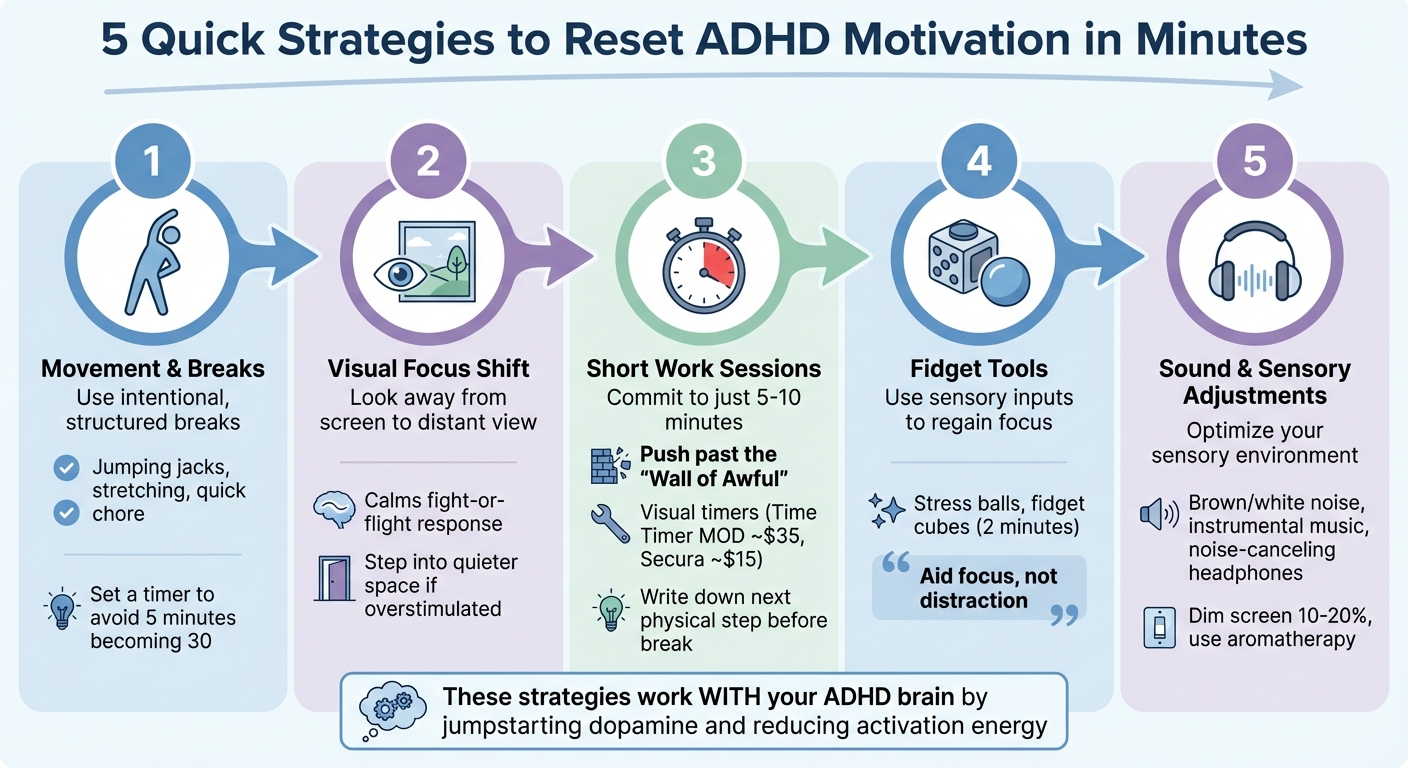
5 Quick Strategies to Reset ADHD Motivation in Minutes
When your motivation hits a wall, quick resets can make all the difference. These strategies are designed to work in just minutes, helping you bounce back before the day spirals out of control. They specifically address ADHD-related dopamine dips by jumpstarting your brain's reward system.
Using Breaks and Movement to Recharge
Physical activity can be a game-changer for resetting an ADHD brain. Simple actions like stretching, doing a few jumping jacks, or even tackling a quick chore can re-energize both your body and mind far more effectively than scrolling through your phone. Emmy Bolghman, Creator of One Woman Rituals, highlights the importance of intentional breaks:
"ADHD work break strategies are intentional, structured pauses that protect focus, restore energy, and stop overwhelm from snowballing during the workday."
Sometimes, just shifting your focus can work wonders. Look away from your screen and focus on a window or a distant view - this change in visual input helps calm your brain's fight-or-flight response. If you’re feeling overstimulated, stepping into a quieter space for a few minutes can help you regain control. To avoid accidentally extending your break, set a timer so a planned five minutes doesn’t turn into 30.
Using Timers and Short Work Sessions
Facing a daunting task? Try committing to just 5 or 10 minutes of work. This small step can help you push past the "Wall of Awful" - that mental block between wanting to start and actually starting. Once you engage even briefly, momentum often kicks in naturally.
Visual timers can be especially helpful for ADHD brains that struggle with time perception. Tools like the Time Timer MOD (approximately $35) or the Secura 60-Minute Visual Timer (around $15) feature a shrinking red disk that provides a clear, visual representation of time passing. Keeping the timer in your peripheral vision can help you stay mindful of time without added stress. Before you take a break, jot down the next physical step you’ll take when you return. This simple trick can make restarting much easier.
If time management feels insufficient, incorporating sensory inputs can provide the extra boost you need.
Using Fidget Tools and Sensory Inputs
When timers aren’t enough, sensory strategies can help reset your focus. Fidget tools, like stress balls or fidget cubes, aren’t distractions - they’re quick, effective ways to regain focus in just a couple of minutes. Helena Territt, an Executive ADHD Coach at HatchedCoaching, emphasizes their value:
"Encouraging movement during meetings or the use of fidget tools to aid focus".
Sound can also play a big role. Brown noise, white noise, or instrumental music can help drown out intrusive thoughts and improve concentration. For noisy environments, noise-canceling headphones are a lifesaver. Other sensory adjustments, like dimming screen or overhead light brightness by 10% to 20%, can reduce mental strain. Even aromatherapy can help your brain transition more smoothly between tasks.
Breaking Down Tasks for Steady Progress
Tackling big projects can feel overwhelming, especially when viewed through an ADHD perspective. The trick isn’t about working harder - it’s about starting smaller. Break tasks into tiny, manageable steps that require minimal effort to begin. This reduces the mental energy needed to take that first step, often referred to as "activation energy". For instance, instead of setting out to "Write quarterly report", start with something as simple as "Open the document." That one small action can kickstart the process.
ADHD motivation thrives on instant rewards. Each micro-step completed triggers a dopamine boost, helping to build momentum. As noted by an expert from Executive Function Toolkit:
"Action creates motivation, not the other way around."
In essence, motivation often follows action, not the other way around. Once you’ve taken those initial steps, the next move is to organize your project into clear, achievable milestones.
Chunking Projects Into Clear Milestones
Start by decluttering your mind with a brain dump. Write down every thought, task, or concern related to your project. This simple exercise helps reduce mental overload. Once you’ve emptied your thoughts onto paper, use the STM Framework: list all the steps, arrange them in order, estimate the time each will take, and then schedule them on your calendar.
To stay on track, focus on micro-deadlines instead of distant final goals. For example, instead of "Finish presentation by March 15th", aim for something like "Complete outline by Tuesday at 2:00 PM." This approach combats time blindness by bringing tasks into your immediate focus. On days when energy is low, switch to a Plan B list - a simplified set of tasks that keeps you moving without overexerting yourself. Think of it as maintaining progress even when you’re in low gear.
Visual Tools for Task Management
When motivation dips, working memory can lag, making it harder to keep track of tasks. Visual tools can act as an external memory aid. Apps like Trello let you organize tasks into columns such as "To-Do", "Doing", and "Done", providing a clear snapshot of your progress.
For more complex projects, mind mapping tools can be useful. Place your main goal at the center and branch out into smaller sub-tasks. If digital tools don’t stick, try physical options like a whiteboard or corkboard with sticky notes. Keeping this visible in your workspace can make a big difference. You can even color-code tasks based on energy levels: green for low-effort, yellow for moderate, and red for high-focus. This way, you can quickly match tasks to your current energy level. By making next steps visible and specific, you’ll reduce the mental friction of deciding what to do next.
Connecting Tasks to Your Values and Interests
Breaking tasks into manageable steps is just the start. To truly stay committed, it helps to connect those tasks to your personal values. When motivation fades, it’s often because what you’re doing doesn’t feel aligned with what you care about most. For people with ADHD, this disconnect can feel even stronger since their brains naturally have lower baseline dopamine levels. That’s why finishing a report by Friday can feel like climbing a mountain, while diving into a hobby for hours feels effortless.
The key isn’t forcing yourself to care about dull tasks - it’s about finding a way to link them to something meaningful. Research shows that when goals align with your values, they can improve well-being and reduce symptoms of depression and anxiety. Tasks rooted in values like creativity, teamwork, or independence stop feeling like chores and start feeling like choices. Let’s look at how reframing tasks and adding playful elements can help you reconnect with what matters most.
Reframing Tasks to Show Their Relevance
Start by identifying what drives you. Think about three to five moments when you felt proud or deeply satisfied. What values were at play? Maybe it was problem-solving, helping others, or expressing creativity. These moments can reveal what motivates you and makes work feel rewarding.
Once you’ve pinpointed your values, use the "Five Whys" technique to connect them to your current tasks. For example:
- Why finish this report? → To meet the deadline.
- Why does the deadline matter? → To keep the project moving forward.
- Why is that important? → So the team can succeed.
- Why does that matter? → Because you value being reliable and contributing to the group.
Now, instead of seeing the report as just paperwork, it becomes an opportunity to demonstrate integrity and collaboration. You can also rephrase your goals to reflect this connection. Instead of saying, "Finish this report by Friday", try, "I will finish this report by Friday to honor my value of reliability to my team".
As Ramon from Goals and Progress puts it:
"Values-aligned living doesn't mean everything becomes easy. It means the hard things feel worth it."
Another approach is associative linking - tying a boring task to something you enjoy. For instance, if you like design but dread data entry, use a creative tool to make the data visually appealing. Even small tweaks like this can make tasks more engaging. And if reframing isn’t enough, gamification can add an extra layer of motivation.
Gamifying Work for Better Engagement
When reframing isn’t quite doing the trick, gamification can be a powerful way to stay engaged. A 2020 study found that game-like strategies can improve focus and motivation for people with ADHD, while also helping develop executive function skills. Adding elements like streaks, levels, or rewards can provide those quick dopamine boosts that make tasks feel more doable.
One simple method is the "Speed Run" technique: set a timer for 10 minutes and challenge yourself to complete as much as possible. The sense of urgency can trigger adrenaline, giving you the push you need. Another option is the Dice Roll method: list six tasks, roll a die, and work on the selected task for 10 minutes.
For larger projects, try setting up a point system. Assign points to tasks based on their difficulty, and then "spend" those points on rewards:
| Task Example | Points Earned | Reward Example | Points Cost |
|---|---|---|---|
| Load/unload dishwasher | 2 | Go out for dessert | 25 |
| Clean and fold laundry | 3 | Theater performance | 75 |
| Clean car (inside/out) | 4 | New clothes shopping | 100 |
| Complete difficult project | 5 | Full spa day | 200 |
You can also make tasks more fun by using fantasy reframing. Imagine yourself as a detective piecing together clues, a chef racing against the clock, or a contestant on a reality show. Adding this layer of creativity can make even routine chores feel more engaging. As Harold Meyer, Founder of the ADD Resource Center, explains:
"Once we stop fighting neurology and start working with it, everything changes."
Finally, try temptation bundling: pair a dull task with something you love, like listening to a favorite podcast or audiobook. Reserve that enjoyable activity exclusively for these tasks. It won’t make the work thrilling, but it will make it far more bearable.
Setting Up Your Environment and Schedule
If you want to tackle sudden dips in motivation, it’s essential to design your workspace and daily routines to work with your ADHD brain, not against it. The way you set up your environment and structure your day can either drain your energy or help you conserve it.
Creating Distraction-Free Workspaces
A cluttered workspace isn’t just messy - it’s mentally draining. For those with ADHD, every visible item can become a distraction, adding unnecessary strain to your focus.
One simple strategy is the "Arms-Reach Rule": keep only the essentials within reach and store everything else out of sight in drawers or cabinets. Even small changes, like removing your phone from your desk, can make a big difference. Studies show that just having your phone nearby - even silent and face down - can reduce your working memory by 10% to 12%.
Interruptions are another major productivity killer. It takes about 23 minutes to fully refocus after being interrupted, and even a split-second distraction can double your error rate on tasks. To minimize disruptions, try creating separate browser profiles for work and personal use, or enable "grayscale mode" on your phone to make checking notifications less tempting. Adding small barriers, like logging out of social media or placing your phone in another room, can create a 5–10 second pause that helps curb impulsive actions.
Sound and lighting matter too. Background noise, like chatter at 70 dB in an open office, can cut cognitive performance in half. Using pink noise or instrumental music (like video game soundtracks) can help mask distractions and improve focus. For lighting, opt for bright, cool tones (5,000–6,500K) in the morning to boost alertness, and switch to warm, dim light (2,700–3,000K) in the evening to support better sleep. Exposure to natural light can also improve cognitive performance by 15% and help you sleep an extra 46 minutes at night.
As Johannes, Creator of Super Productivity, puts it:
"Focus is not merely a matter of willpower – it's an environmental and neurological design problem."
Once your space is optimized, the next step is building routines that keep you on track, even when motivation wanes.
Building Routines for Consistency
Routines are like anchors - they keep you steady, even when motivation feels unpredictable. Think of motivation as a passing weather pattern, while routines act as the sturdy architecture that holds everything together.
One effective approach is habit stacking: tie new habits to existing ones to make them easier to remember and follow. For instance, you might say, “After I make coffee, I’ll write down my top priority for the day,” or “When I sit at my desk, I’ll open my task list before checking email.” These small, automatic rules can turn actions into habits without relying on willpower.
Another helpful strategy is setting "floor" and "ceiling" goals. The ceiling represents what you’d aim for on your best day - like a 45-minute workout - while the floor is the bare minimum you’ll do on low-energy days, such as a 5-minute stretch or walk. This approach keeps you moving forward without falling into an all-or-nothing mindset.
To make mornings smoother, prepare the night before. Lay out your clothes, pack your bag, or set up your workspace so your first steps require little to no decision-making. You can also create a 5-minute startup ritual to signal "work mode" to your brain. This might include reviewing your calendar, picking 1–3 priorities, and clearing your desk.
Visual tools like timers and checklists are great for externalizing structure, especially if you struggle with "time blindness." For example, analog clocks or timers that visually display time as a shrinking colored wedge can make time feel more tangible. When scheduling tasks, avoid back-to-back bookings - add a 25% to 40% buffer to account for energy fluctuations and unexpected delays.
With routines in place, you can take things a step further by aligning your work with your natural energy cycles.
Scheduling Work During Peak Focus Hours
Your energy levels don’t stay constant throughout the day, so timing your tasks to match your natural focus patterns can make a big difference. Start by tracking your energy levels over a week, checking in 3–4 times a day to note when you feel most alert versus when you’re more scattered.
Most people fall into one of three chronotypes:
- Lions: Morning types who are sharpest between 8–11 AM.
- Bears: Midday types who thrive from 10 AM to 1 PM.
- Wolves: Night owls who hit their stride between 4–8 PM.
Once you’ve identified your peak focus hours, protect them for your most challenging tasks, like problem-solving or creative work. Reserve medium-energy periods for things like emails or meetings, and save low-energy times for lighter activities like organizing or taking a break.
Sam McCarthy, Author, explains it perfectly:
"Most burnout doesn't come from working too much. It comes from working against your energy."
To make your schedule even clearer, consider color-coding tasks. ADHD brains often process color faster than text. For instance, use red for deep work, green for admin tasks, and purple for self-care. And if you find yourself in a hyperfocus zone, set a 90-minute timer to remind yourself to hydrate, stretch, or take a short break. This can help you avoid burnout and the recovery slump that often follows.
Getting Support When Self-Help Isn't Enough
Sometimes, despite your best efforts, self-help strategies just don't cut it. When motivation dips persist, it might be time to seek outside support. Whether through professional guidance or simple accountability tools, external structure can help bridge the gap between knowing what you need to do and actually doing it. Let’s dive into two effective options when self-help methods fall short.
How ADHD Coaches Can Help
ADHD coaches specialize in helping you turn ideas into action. Unlike therapists who focus on mental health or past experiences, coaches work on practical, day-to-day strategies tailored to your specific challenges. They address issues like task initiation, emotional regulation, and creating systems that align with how your brain works. For example, they can help you break tasks into smaller, manageable steps or design routines to ease transitions.
Harold Meyer, Founder of The ADD Resource Center, emphasizes the importance of self-awareness in this process:
"Awareness is the first step toward meaningful change."
Coaches also provide accountability through regular check-ins, helping you stay on track when motivation wanes. They can even assist with advocating for workplace adjustments, like flexible schedules or customized environments. For those who are self-employed, coaching fees - ranging from $300 to over $700 per month - might qualify as a tax-deductible business expense.
If you’re considering a coach, start by identifying your goals and preferences. Resources like ADDA, CHADD, or the Professional Association for ADHD Coaches (PAAC) offer directories to help you find certified professionals. Many coaches provide free 15–30 minute consultations, giving you a chance to see if they’re the right fit before committing.
Using Accountability Tools Like Body Doubling
If professional coaching feels like too much of a leap or you need immediate support, body doubling is another great option. This simple technique involves working alongside someone else - either virtually or in person - whose presence helps you overcome the initial hurdle of getting started.
With body doubling, you share a workspace but focus on your own tasks. A 2024 study found that this method not only helps with task initiation but also improves task completion. Research suggests it activates dopamine reward pathways, which can counterbalance ADHD-related challenges.
Dr. J. Russell Ramsay, an ADHD expert, explains the concept well:
"A lot of people with ADHD will say, 'I have a hard time getting started on this if I'm doing it for myself, but if I know somebody else is relying on me... I'm more likely to go and be there because I don't want to let them down.'"
To make body doubling effective, choose a partner who is committed to a quiet, distraction-free work session. Start by sharing a specific goal like, "I’m going to draft this report" or "I’ll organize these documents." Sessions can range from 20 to 90 minutes, and using techniques like the Pomodoro method (25 minutes of work followed by a 5-minute break) can help maintain focus.
If finding an in-person partner isn’t feasible, virtual options like Focusmate or Flow Club provide structured sessions with others. Alternatively, you can work in public spaces like libraries or coffee shops, or even join "study with me" livestreams to tap into the focused energy of a shared environment.
Conclusion
When motivation seems to vanish, it doesn’t mean there’s something wrong with you. For individuals with ADHD, losing motivation is tied to neurological factors, not personal shortcomings. The way the ADHD brain functions means these dips in motivation are a natural state, not a failure of character. Recognizing this can help shift the focus from self-blame to finding effective solutions.
The strategies discussed here are designed to work with your brain’s unique wiring. Techniques like quick resets, breaking tasks into smaller steps, and aligning tasks with personal values cater to the novelty and stimulation that an interest-driven nervous system thrives on. When self-guided approaches fall short, external tools - such as coaching or body doubling - can provide the extra structure and accountability needed to navigate executive function challenges.
As Caren Magill, a Certified ADHD Coach, explains:
"Productivity with ADHD isn't about perfection - it's about building flexible systems that honor your fluctuations."
The goal is to embrace your natural rhythms rather than fight against them. This might mean creating a backup plan for days when energy is low, matching tasks to your current focus level, or leaving small cues to make transitions easier. These methods lay the groundwork for maintaining productivity in a way that feels sustainable and achievable.
FAQs
How can I tell if this is an ADHD motivation crash or burnout?
An ADHD motivation crash tends to hit without warning, often following periods of intense focus or effort. It feels like a sudden wave of low energy, loss of focus, and a dip in motivation. Burnout, on the other hand, creeps in over time due to ongoing exhaustion and shows up as constant fatigue, irritability, and a sense of detachment. While a crash can often be resolved with rest, recovering from burnout usually demands more substantial adjustments to daily routines and self-care habits. Understanding the distinction between the two is key to finding the right way to recover.
What’s the fastest way to start when I feel stuck?
Sometimes, getting unstuck is as simple as changing your physical state. Try standing up or doing a quick stretch - this can signal your brain that it’s time to shift gears. Need a little extra push? Engage in a small activity that brings you joy to give your motivation a boost. Another option is to tackle one tiny task or set a timer for just a few minutes. This can help you build momentum and ease the feeling of being overwhelmed. These small actions can make a big difference in breaking through inertia and getting things moving.
How can I explain sudden motivation drops to my manager?
Sudden drops in motivation can often be explained as a natural aspect of ADHD, which is known to cause shifts in focus and energy levels. It’s important to note that these dips are temporary, and you’re actively addressing them by using strategies like prioritizing tasks, managing energy effectively, and leveraging productivity tools. By emphasizing your dedication to maintaining strong performance despite these challenges, you can help your manager understand the situation and foster their support.