Daily Productivity Checklist for Inconsistent Focus
Work with your brain: an ADHD-friendly daily checklist to clear mental clutter, pick top tasks, time-block your day, and manage energy for steadier focus.
If you struggle to focus or start tasks, you’re not alone - ADHD affects how your brain plans, prioritizes, and takes action. Instead of pushing harder, you need strategies that work with your brain. Here’s a simple checklist to help you stay productive:
- Morning Brain Dump: Write down everything on your mind to clear mental clutter. Use action verbs and keep a separate "Master Backlog" for non-urgent tasks.
- Prioritize with the Eisenhower Matrix: Focus on tasks that are important but not urgent (Q2). Pick three key tasks to tackle each day.
- Time Blocking: Schedule tasks during your peak energy hours and leave buffer time for transitions.
During the day, match tasks to your energy levels. Use tools like timers and body doubling for focus, and switch to easy tasks during energy dips. End your day with an evening review: cross off completed tasks, set priorities for tomorrow, and reflect on what worked.
This system isn’t about doing more - it’s about doing what matters with less stress. Start small and adjust as needed to find what fits your routine.
The Checklist Hack Productivity Gurus Don’t Tell You About #adhdorganization #checklists
Morning Checklist
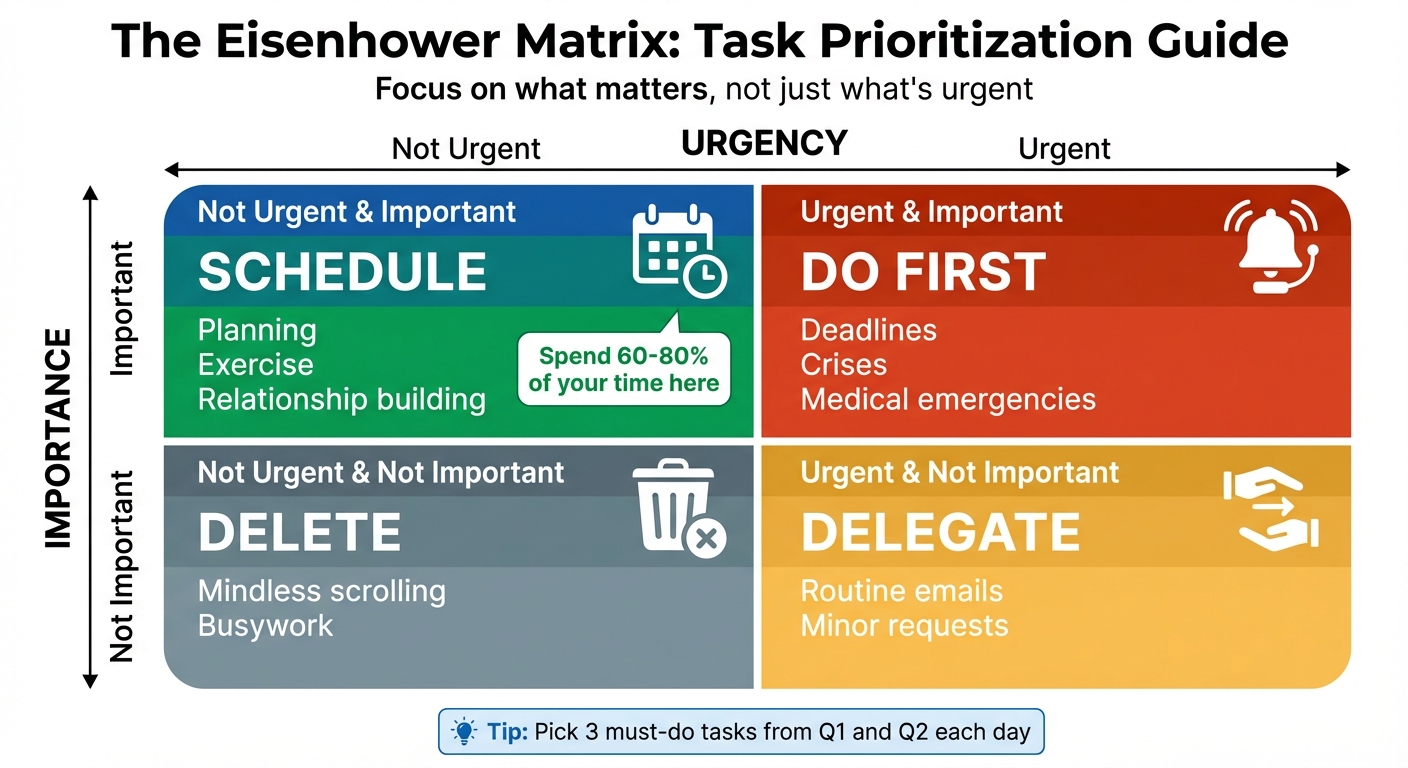
Eisenhower Matrix for Task Prioritization - Urgency vs Importance Guide
Write Down Everything (Brain Dump)
Start your day by clearing your mind. Take five minutes to jot down every task, idea, or concern swirling in your head. This simple act creates what experts call "external scaffolding" - a way to free up your mental bandwidth so you can focus on doing rather than remembering.
Use a notebook or an app to capture everything, and make sure each item begins with a clear action verb like "Call", "Draft", "Research", or "Schedule". For example, instead of writing "Files", be specific: "Create '2026 Receipts' folder."
Here’s the trick: keep your brain dump separate from your daily to-do list. Toss everything into a "Master Backlog" instead of trying to tackle it all at once. Mixing long-term tasks with immediate priorities can feel overwhelming. Also, organize your tasks by categories like Work, Health, or Personal Projects to avoid everything competing for your attention.
"The system is not about doing more. It's about doing less, with focus." - Jessica Walsh, PMHNP, ADHD Specialist
If you spot a task that takes less than two minutes, handle it right away. For more complex projects, consider sketching a quick mind map to break them into manageable pieces. This process primes your mind for the focused work ahead.
Sort Tasks by Urgency and Importance
Once your brain dump is complete, it’s time to prioritize. The Eisenhower Matrix is a great tool for sorting tasks based on urgency and importance. It helps you avoid the trap of chasing things that feel urgent but don’t actually matter - like endless emails.
Here’s how the matrix works:
| Quadrant | Type | Action | Examples |
|---|---|---|---|
| Q1 | Urgent & Important | Do First | Deadlines, crises, medical emergencies |
| Q2 | Not Urgent & Important | Schedule | Planning, exercise, relationship building |
| Q3 | Urgent & Not Important | Delegate | Routine emails, minor requests |
| Q4 | Not Urgent & Not Important | Delete | Mindless scrolling, busywork |
The goal? Spend 60-80% of your time in Quadrant 2 - the zone of important but not urgent tasks. This is where you can focus on long-term growth and prevent future crises.
To keep things manageable, pick just three "must-do" tasks from Q1 and Q2. Ask yourself: If I could only complete three things today, which ones would make the biggest difference?. You can also apply the "One Month Test" to gauge importance: Will this task matter in a month or a year? If not, it probably belongs in Q3 or Q4.
Effective prioritization doesn’t just keep you productive - it can also reduce anxiety. Studies show that good time management is linked to lower stress levels.
Block Time for Your Tasks
Now that you’ve identified your priorities, it’s time to schedule them. Assign specific blocks of time on your calendar for your top three tasks, and always add at least 25% more time than you think you’ll need. Include 5–10 minute buffers between tasks to make transitions smoother.
Here’s a surprising stat: A 40-hour time-blocked work week can produce the same results as a 60+ hour unstructured work week. That’s because structure beats long hours when it comes to productivity.
If you estimate a task will take 40 minutes, block off an hour. This extra time accounts for interruptions and helps combat "time blindness." Use color-coding to make your calendar easier to navigate: red for deep focus tasks, green for admin work, and yellow for creative projects. And don’t forget to schedule your hardest tasks during your peak energy hours - not just whenever your calendar looks free.
"A 40 hour time-blocked work week, I estimate, produces the same amount of output as a 60+ hour work week pursued without structure." - Cal Newport, Author of Deep Work
Finally, leave a 30–60 minute flex block open each day for unexpected tasks or emergencies. Your schedule should support you, not overwhelm you. This method is especially helpful for managing ADHD-related focus challenges and keeps your day running smoothly.
Task Execution Checklist
Set Up Focus Tools
Before starting your work, take a moment to fine-tune your digital workspace for better focus. Tools like Todoist can help you organize tasks using natural language input. For instance, typing "Email client report tomorrow at 2pm" automatically schedules it for you. This kind of streamlined system is especially helpful for those who find task management overwhelming, as overly complicated setups often lead to abandonment.
Instead of sorting tasks solely by priority, try categorizing them based on your current energy levels. Create filters like "@high_energy" for tasks that require deep focus or "@braindead" for simpler tasks, like organizing files, when you’re feeling mentally drained. This method ensures you’re working in sync with your energy, not against it.
Combat time blindness by using visual timers - a floating timer on your screen can make the passage of time feel more concrete. This reduces the mental strain of constantly deciding when to start or stop, helping you maintain momentum.
For managing emails, set up server-side filters to automatically sort non-urgent messages into a separate folder. This way, you’re not distracted by unnecessary notifications. Another strategy is body doubling, which involves working alongside someone - either in person or virtually through platforms like Focusmate. The presence of another person, even virtually, can help anchor your focus.
Once your tools are in place, it’s time to structure your work sessions effectively.
Work in Timed Sessions
With your workspace ready, break your tasks into focused time blocks. The Pomodoro Technique is a great option: work for 25 minutes, then take a 5-minute break. During these intervals, avoid distractions like emails or casual chats. If a thought interrupts you, jot it down to revisit later. This method helps shield your focus from constant interruptions.
"Concentration and consciousness lead to speed, one Pomodoro at a time." - Francesco Cirillo, Creator of the Pomodoro Technique
Not all tasks fit neatly into 25-minute blocks, so adjust session lengths based on what you’re working on. For tasks that feel daunting, start with shorter bursts of 10–15 minutes. For creative or engaging work, go longer - 50 minutes or more. Experiment with different intervals to find what works best for your energy and the task at hand.
If you finish a task before your timer runs out, use the extra time for "overlearning" - polishing your work or diving deeper into related skills - rather than jumping straight to the next task. For larger projects requiring multiple sessions, break them into smaller, manageable steps. Similarly, batch small tasks like "pay rent" or "set appointment" into a single focused session.
When it’s time for a break, make it an active one. Skip the temptation to scroll through social media and instead opt for physical activities like stretching, quick chores, or even a short walk to recharge mentally. And if you’re struggling to get started, commit to just 5 minutes of work. Often, this small step is enough to build momentum and keep you going.
Check Your Priority List Between Tasks
After completing a task, take 30 seconds to glance at your Top 3 priorities before moving on. This quick check can prevent decision fatigue and procrastination. It also helps you avoid the mental clutter of trying to recall tasks at the wrong time.
Use a 3-Step Transition Stack to shift seamlessly between tasks: note where you left off, identify the smallest next step for the new task, and set a 3-minute timer to get started. This simple process keeps your workflow smooth and prevents loss of momentum.
Automate this habit with an "If/Then" trigger. For example: "If I finish a task, then I will review my Top 3 list for 30 seconds". If you’re feeling low on energy, switch to a filtered view tailored to your capacity - like a "Zombie Mode" list that shows only easy tasks - instead of your full task list.
Keep a "parking lot" notepad nearby to jot down distracting thoughts as they come up. This lets you quickly return to your main focus without losing track of those ideas. After every task, take a brief 2-minute reset - move around, grab a drink, or stretch. These small actions can boost your focus and motivation for the next task. Plus, marking tasks as complete gives you a satisfying dopamine boost, making it easier to tackle the next item on your list.
Midday Energy Management Checklist
After a productive morning, it's natural for your energy to dip in the afternoon. Use these strategies to recalibrate and keep moving forward.
Switch to Easier Tasks When Needed
Your brain isn’t wired to maintain high-intensity focus all day. Between 1:00 PM and 4:00 PM, your body hits a natural low point - known as the circadian trough - when body temperature and cortisol drop, and melatonin levels increase. Instead of pushing through demanding tasks, shift to activities that match your energy.
During this period, focus on simpler tasks that don’t require heavy mental effort. For example, tackle emails, schedule appointments, or handle basic admin work. Avoid tasks like organizing or decluttering, as they involve too many small decisions that can drain your mental reserves.
To make this transition smoother, set up an "if-then" plan. For instance, "If it’s 2:00 PM and I feel sluggish, then I will reply to five quick emails". If you’re working from home, this could also be a good time to take care of easy physical chores like unloading the dishwasher or folding laundry - tasks that give you a quick sense of accomplishment without overtaxing your brain.
Once you’ve shifted gears, focus on recharging your body and mind.
Move and Hydrate
Did you know your brain uses about 20% of your body’s total energy? Even mild dehydration - just 1–2% below optimal levels - can impact your memory and focus. Combat this by drinking water, and consider adding a pinch of sea salt or a low-sugar electrolyte mix to improve absorption.
Incorporate movement into your midday routine. A short 5–15 minute walk or some light stretching can boost cognitive performance by up to 20%. If stepping away isn’t an option, try Box Breathing: inhale for 4 counts, hold for 4, exhale for 4, and hold for 4. This simple exercise can lower stress and help you regain focus. And whatever you do, avoid scrolling through social media during breaks - passive distractions can leave you feeling even more drained.
Once you’ve recharged, take a moment to acknowledge your progress before diving back into work.
Mark Your Progress
Recognizing what you’ve accomplished can give you a much-needed dopamine boost, making it easier to tackle what’s next. Whether you’re using a Kanban board or a task app, moving a completed task to the “Done” column can reinforce your momentum.
Before jumping into a complex task, try a quick, under-two-minute activity - like sending a message or tidying your desk. These small wins can help reenergize your focus and prepare you for the next phase of your day. Just remember, the goal isn’t to replicate your morning intensity but to ease back into a productive rhythm.
Evening Review Checklist
Take 10–15 minutes each evening to prepare for tomorrow, clearing mental clutter and cutting down morning decision-making by up to 70%.
Review What You Finished
Start by crossing off completed tasks. This simple act not only wraps up your day but also gives you a boost of accomplishment. For anything left unfinished, decide right away: should it roll over to tomorrow's priority list, or does it belong on your master list instead?
"This ritual should ensure that every incomplete task, goal, or project has been reviewed and that for each you have confirmed that either 1) you have a plan you trust for its completion, or 2) it's captured in a place where it will be revisited at the right time." - Cal Newport, Author of Deep Work
If tasks were left undone, pinpoint why. Maybe the task was bigger than you thought, or an unexpected meeting threw off your schedule. Let go of any guilt and adjust your plans for tomorrow accordingly.
Set Up Tomorrow's Priorities
An evening review helps you wake up with a clear direction. Decide on your Top 3 tasks for tomorrow, ensuring your focus is on what truly matters. This small step saves mental energy and sets the tone for a productive day.
Check your calendar for appointments and block out time for any prep work. For example, if you’ve got a 10:00 AM meeting, schedule a quick 15-minute prep session beforehand. Take a moment to close unnecessary browser tabs or work windows - this digital reset can help your future self dive into tasks without distractions.
Prepare a physical "launch pad" by your door. Gather essentials like your keys, wallet, bag, laptop, or any documents you’ll need. Spend a few minutes tidying up your desk - starting tomorrow with a clean workspace can make a big difference.
Write Down What Worked and What Didn’t
Dedicate 5 minutes to reflecting on the day. What went well? What didn’t? Instead of focusing on personal shortcomings, look at where your system might need tweaking. Were you clear on your first action in the morning? Did certain strategies make your day easier? Where did you feel stuck?
This practice, done consistently, can reduce stress and improve productivity in just a few weeks. Pay attention to patterns, like when your energy peaks or how many tasks you finish. If something didn’t work today, turn it into an "If-Then" plan for tomorrow. For instance: "If I feel overwhelmed at 2:00 PM, then I’ll switch to a simple admin task."
Wrap up your evening review with a shutdown ritual. Whether it’s closing your laptop, locking your office, or saying “shutdown complete,” this signal helps your brain wind down and prepare for rest.
Conclusion
This checklist is a flexible guide designed to work with your energy and focus, not against them. The idea is to create habits that align with how your brain functions best. Start with a morning brain dump to clear mental clutter, use timed sessions to stay on track, and wrap up by setting priorities for the next day. These small but consistent habits help reduce decision fatigue and free up mental space for what truly matters.
Think of this checklist as a work in progress. Some strategies might fit seamlessly into your routine, while others may need a bit of tweaking. Maybe 25-minute sessions feel too long, and shorter bursts work better for you. Or perhaps tracking progress after completing tasks gives you a motivational lift. Pay attention to what feels helpful and what adds unnecessary stress, and adjust accordingly.
The goal is to make your routine supportive, not burdensome. If a particular step starts feeling like more work than it’s worth, don’t hesitate to modify or skip it. Your system should be there for you, even on tough days. To make it even more effective, consider adding some buffer time - about 20% to 40% of your schedule - to handle transitions or unexpected dips in energy. This flexibility keeps the system from falling apart when focus wavers.
Above all, be kind to yourself. Missing a day isn’t a failure; it’s a chance to learn and adapt. Start each day by clearing your mind, and keep moving forward. Remember, the checklist is meant to support you, not the other way around.
FAQs
How do I pick my Top 3 tasks when everything feels urgent?
When everything feels like it needs your immediate attention, take a step back and focus on what truly matters. Look at your to-do list and pinpoint three tasks that will have the most impact on your goals. These should be the ones that genuinely push your projects forward. It's important to recognize that not all urgency is created equal - some tasks might feel pressing but aren't actually critical. By consistently identifying and prioritizing your top three tasks, you can stay on track and productive without letting the chaos overwhelm you.
What should I do when time-blocking falls apart mid-day?
If your time-blocking plan starts to unravel halfway through the day, don’t panic - just hit pause and reset. Take a deep breath, stretch, or step away for a moment to clear your head. Then, revisit your priorities and tweak your schedule as needed. Tools like visual timers or quick re-prioritization techniques can help you refocus and regain momentum. Instead of clinging to a rigid schedule, stay adaptable. This way, you can maintain productivity without feeling overwhelmed.
How can I stay focused if timers and Pomodoro don’t work for me?
If rigid timers or the Pomodoro Technique feel too restrictive, consider using a flexible focus system. This method replaces strict time intervals with timed steps, allowing for easier transitions and less pressure from rigid schedules.
Another option is to tailor your sessions to match your energy levels. Tools like visual timers or color-coded schedules can help make time feel more concrete, aligning with your natural focus rhythms.