The Complete Guide to Managing ADHD at Work
Research-backed tactics to manage ADHD at work — time-blocking, visual timers, body doubling, workspace changes, accommodations, and energy hacks to improve focus.

Managing ADHD at work can feel like an uphill battle, but understanding how your brain works and using the right strategies can make a big difference. ADHD often leads to challenges like difficulty focusing, managing time, and staying organized. However, it also brings strengths like hyperfocus, creativity, and quick decision-making. The key is to build systems that play to these strengths while addressing common obstacles.
Key Takeaways:
- Challenges: Struggles with task paralysis, time blindness, distractions, and prioritization.
- Strengths: Hyperfocus, problem-solving, and thriving under pressure.
- Solutions: Use tools like visual timers, task boards, body doubling, and time-blocking. Break tasks into smaller steps and pair less engaging work with enjoyable activities.
- Accommodations: Request flexible schedules, quiet spaces, or written instructions to improve focus and productivity.
By designing your workday around how your brain functions best, you can overcome obstacles and turn ADHD into an asset in the workplace.
Workplace Strategies for Professionals with ADHD (with Cheryl Chase, Ph.D.)
How ADHD Shows Up at Work
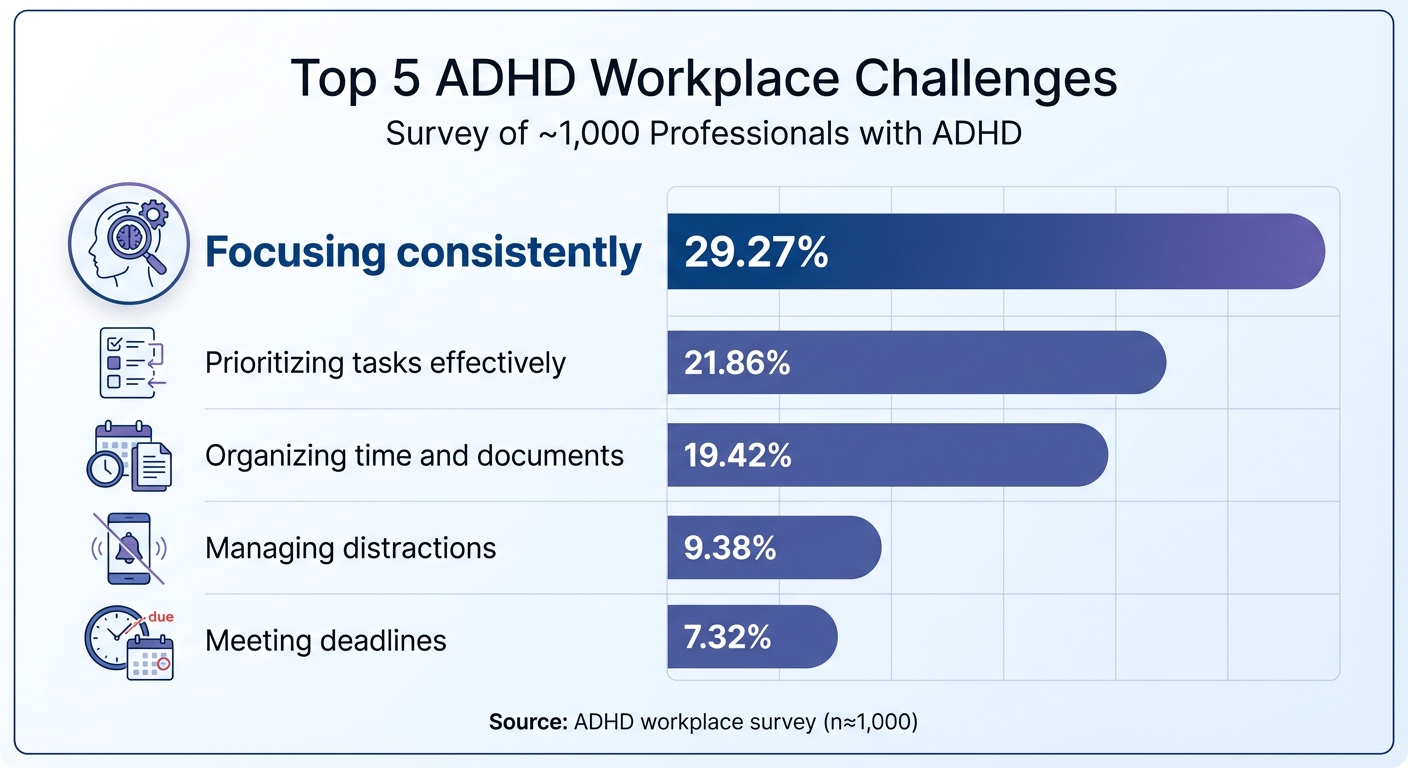
Top 5 ADHD Workplace Challenges: Survey Results from 1,000 Professionals
ADHD shows up in varied ways, especially in professional environments. While the challenges are real, understanding how these symptoms manifest - and learning to use the strengths that come with them - can help you create systems that work better for your brain.
Common Workplace Challenges
One of the biggest hurdles is task paralysis. When a project feels too large or vague, it can be tough to figure out where to even begin. This mental block can make workplace tasks feel overwhelming. Then there’s time blindness, which makes it hard to estimate how long tasks will take or to keep track of time effectively. A study of over 1,200 adults found that inattention symptoms often lead to work struggles, especially when someone feels like they’re falling short of their own expectations.
A poll of nearly 1,000 professionals with ADHD highlighted the top workplace challenges:
- Focusing consistently (29.27%)
- Prioritizing tasks effectively (21.86%)
- Organizing time and documents (19.42%)
- Managing distractions (9.38%)
- Meeting deadlines (7.32%)
Distractions - both external, like office noise, and internal, such as racing thoughts - are common culprits. Then there’s the hyperfocus paradox: while intense concentration can be a strength, it can also lead to spending hours on a non-urgent task while critical deadlines are missed.
"Neurotypical folks might find listening to music or having a podcast playing at the same time that you're doing something to be distracting. I don't. What I do find distracting is the wristrest on my desk."
– Mickey Atkins, Therapist and ADHD Professional
Social interactions can also be tricky. You might interrupt colleagues in meetings, worried you’ll forget your thought, or take constructive feedback too personally. Many people with ADHD experience Rejection Sensitive Dysphoria (RSD) - a strong emotional reaction to perceived criticism or failure. This can lead to procrastination fueled by anxiety. These struggles often result in masking, where you put extra effort into blending in, which can cause mental exhaustion, higher job turnover, and slowed career growth.
Recognizing these challenges is the first step toward tapping into the unique strengths ADHD brings to the workplace.
ADHD Strengths at Work
Despite the challenges, ADHD comes with some incredible strengths that can shine in professional settings. Research shows that ADHD is linked to higher levels of creativity, divergent thinking, and curiosity. Your brain’s ability to make unexpected connections often leads to solutions others might not see.
Hyperfocus, when directed at the right task, can result in extraordinary productivity. If something genuinely interests you, you might accomplish in hours what others take days to finish. ADHD professionals are also often great at adapting quickly and making fast decisions, which can be a major asset in high-pressure or fast-paced environments.
The energy and enthusiasm that often accompany ADHD can inspire teams and push projects forward. What some see as procrastination may actually be your brain waiting for the urgency that makes a task feel engaging. This ability to perform under pressure can be a hidden strength in deadline-heavy roles.
"Once they have adjusted to their condition and developed coping mechanisms, adults who have ADHD often perform exceptionally well in the workplace."
– Elizabeth Lombardo, PhD, Psychologist and Leadership Coach
The key is recognizing that an ADHD brain thrives on interest, not importance. Just knowing a task matters doesn’t make it engaging. By embracing this and creating systems that play to your strengths while addressing challenges, you can turn ADHD into a unique advantage in the workplace.
Practical Strategies for Managing ADHD at Work
Managing ADHD at work isn't about pushing yourself harder - it's about creating systems that align with how your brain works best. Below, you'll find practical strategies to tackle common challenges like time blindness, task paralysis, and distractions, all while improving time management and organization.
Time Management Methods
Time blindness can make estimating how long tasks take a real challenge for those with ADHD. To counter this, try adding 25% more time to your initial estimate for any task. For instance, if you think a report will take two hours, plan for two and a half hours instead.
Adopt modified time blocking by including transition periods and flexible buffers between tasks. Avoid scheduling back-to-back meetings, as they can quickly lead to overwhelm.
Breaking larger projects into smaller, manageable chunks can help with task initiation paralysis. Instead of writing "Complete quarterly report" on your to-do list, break it down into steps like "Draft introduction" or "Compile Q1 sales data".
"It's not about trying harder. It's about designing your workday so your brain can do its best work." – COE Editorial
Visual timers, like analog clocks with a shrinking colored wedge, and transition alarms can help you stay on track. Identify your peak focus hours and schedule your most demanding tasks during that time.
The two-minute rule can help cut through mental clutter: if something takes less than two minutes to complete, do it right away instead of adding it to a list. For emails, consider setting specific times for email sprints (e.g., 9:00 a.m., 1:00 p.m., and 4:00 p.m.) to handle messages in focused bursts.
Body doubling, or working alongside someone else - whether in person or virtually through platforms like Focusmate - can provide the accountability needed to stay engaged with less exciting tasks.
In addition to better time management, having a strong organization system will help maintain productivity.
Organization Tools and Systems
An external memory system can be a game-changer for managing tasks and deadlines. Digital tools like Todoist, Trello, or Asana can act as your "external brain", keeping everything organized and visible. Stick to one tool to avoid confusion from switching between systems.
Interestingly, writing tasks by hand can improve recall. Studies suggest that handwriting increases brain activity and helps with memory. Many ADHD professionals find a hybrid approach works well - using digital tools for long-term planning and handwritten lists for daily tasks.
Point of performance cues can reduce cognitive load by placing reminders or tools exactly where they're needed. For example, if you often forget to submit timesheets, stick a note on your monitor every Thursday afternoon. If you frequently lose your laptop charger, keep a spare in your work bag.
For meetings, transcription tools like Otter.ai or Fathom can handle note-taking, allowing you to focus on the discussion. Pairing less engaging tasks with something enjoyable, like listening to a podcast while doing data entry, is another helpful strategy known as interest bundling.
Creating a sense of urgency by setting external deadlines can also be effective. For instance, tell a colleague you'll send them a draft by a specific time to give yourself that extra push to focus.
Finally, managing distractions is crucial for maintaining focus.
Reducing Distractions
Your workspace plays a huge role in your ability to concentrate. Start by decluttering your desk - visual clutter can be a major source of distraction. Keep only the items you need for your current task in view, creating a focused "space bubble."
Noise-canceling headphones or white noise can help block auditory distractions. Some people work best in silence, while others prefer background music or ambient sounds. Experiment to find what works for you.
During focus periods, use website blockers to avoid the temptation of social media or news sites. Similarly, batching email processing into specific time blocks (as mentioned earlier) can help you avoid constant context switching.
Don't underestimate the power of movement breaks. Short walks, stretching, or even standing while working can help reset your attention. Fidget tools or a standing desk can also provide an outlet for extra energy.
For more accountability, revisit the body doubling technique mentioned in the Time Management Methods section. It’s a simple yet effective way to stay on track, especially for tasks that feel overwhelming.
Workplace Adjustments and Accommodations
The Americans with Disabilities Act (ADA) requires employers with 15 or more employees to provide reasonable accommodations for ADHD. These adjustments aren't about receiving special treatment - they're about creating an environment where you can perform at your best.
Flexible Schedules and Regular Breaks
Adjusting your work schedule can make a big difference. For example, starting your day later might align better with your natural focus patterns, enhancing your productivity. Similarly, short breaks - 5 to 10 minutes every 45 minutes - can help you stay engaged and minimize mistakes.
To request these adjustments, consider submitting a written request to your HR department or supervisor. Be specific about how the change will improve your performance. For instance:
"I request a 9:30 a.m. start to better align my focus with key tasks, which will improve the quality of my deliverables."
"Workplace accommodations for people with ADHD mainly focus on executive functioning abilities because lacking these skills can significantly interfere with an employee's ability to perform work duties." – Scott S. Shapiro, M.D., Assistant Professor of Psychiatry, New York Medical College
You don't always need to disclose your ADHD diagnosis. Instead, frame your request around productivity benefits. For example, explain that a later start time helps you work more efficiently - this keeps the conversation professional and outcome-focused.
Beyond scheduling, your physical workspace can also play a big role in maintaining focus and productivity.
Setting Up Your Workspace
Your environment greatly influences your ability to concentrate. If distractions are an issue, you might request a desk in a quieter area or access to a dedicated quiet room for focused work.
Noise-canceling headphones are another great option. They not only block distractions but also signal to coworkers that you're in deep work mode. Ergonomic tools like standing desks, stability balls, or even pacing during virtual meetings can help channel excess energy in a productive way.
Additionally, requesting written instructions or meeting agendas ahead of time can support working memory and help you stay on track. Most managers are open to providing these resources once they understand how they enhance your performance.
While a well-organized physical setup is essential, digital tools can also strengthen your ability to stay structured and focused.
Technology and Apps for ADHD
Digital tools can act as a virtual assistant, helping you manage ADHD-related challenges. Whether it's breaking down large projects or staying on top of deadlines, the right apps can lighten your cognitive load. For example, task management platforms can divide projects into smaller, actionable steps, and transcription tools can handle note-taking during meetings.
| Tool Category | Examples | Benefit for ADHD | Setup Tip |
|---|---|---|---|
| Task Management | Trello, Asana | Externalizes memory; breaks projects into steps | Stick with one tool to avoid switching between systems |
| Time Tracking | Visual timers, analog clocks | Makes time tangible; reduces "time blindness" | Keep the timer visible during work sessions |
| Meeting Support | Otter.ai, Fathom | Captures details without relying on memory | Test the tool's audio quality before important meetings |
| Focus Accountability | Focusmate | Encourages accountability | Schedule sessions during your most challenging tasks |
When choosing digital tools, simplicity is key. Many professionals find a mix of digital tools for long-term planning and handwritten notes for daily to-dos works well, offering both structure and flexibility.
Staying Accountable and Motivated
For individuals with ADHD, external structure plays a crucial role in sparking motivation and overcoming executive function challenges. Accountability systems act as a helpful framework, providing the urgency and social reinforcement needed to start and complete tasks.
The trick is moving away from rigid, punitive accountability tied to strict deadlines and instead embracing a supportive approach that prioritizes progress. This shift reduces the likelihood of falling into shame cycles and aligns better with how ADHD brains operate. External support, when applied thoughtfully, turns potential stumbling blocks into manageable steps.
"Accountability is any kind of external support to help you follow through. It's not about punishment or shame." – Work Brighter Editorial
Working with Accountability Partners
Adding an accountability partner to your time management strategies introduces another layer of structure. Regular check-ins can break overwhelming projects into smaller milestones, allowing you to address challenges early on.
However, not all partnerships are equally effective. Studies indicate that partnerships where both individuals have ADHD fail 64% of the time within 60 days, often due to shared inconsistency. To counter this, eliminate decision fatigue by setting fixed parameters - such as a consistent check-in time (like 8:00 PM), a dedicated platform (e.g., WhatsApp), and a simple format (like using "✓" for completed tasks or "X" for unfinished ones).
Communication that avoids triggering Rejection Sensitivity Dysphoria (RSD) is also essential. Since up to 99% of adults with ADHD experience RSD, it’s important to use neutral, non-critical language. For instance, if a check-in is missed, phrases like "See you tomorrow" can maintain the partnership's momentum without causing unnecessary stress or discouragement.
To test compatibility, start with a 7-day trial. This low-pressure period allows you to gauge whether your communication styles and expectations align before committing to a long-term arrangement. These practices, when integrated into your daily routines, can strengthen the strategies explored earlier.
ADHD Coaching and Support Resources
If peer accountability isn't enough, professional ADHD coaching offers tailored strategies that go beyond general productivity advice. Coaches specialize in helping you develop systems for task initiation, time management, and emotional regulation - customized to fit how your brain works. Coaching sessions typically cost between $100 and $200 each.
"Ask them about their thoughts on your performance. Setting expectations is the key here… It's a way to catch any problems before they actually happen." – Tamara Rosier, PhD, President of the ADHD Coaches Organization
Additionally, platforms like On/Off Genius offer tools and insights designed for high-achieving professionals with ADHD. These resources provide targeted strategies to manage focus and energy, helping you avoid the trial-and-error process of generic advice.
When creating an accountability system, keep in mind that forming new habits can take anywhere from 2 to 5 months - and sometimes up to a year. Be patient and flexible. Focus on approaches that genuinely work for you, rather than forcing yourself to adhere to traditional productivity methods that may not fit your needs.
Managing Energy and Focus Throughout the Day
When it comes to managing your day effectively, understanding how your energy ebbs and flows is key - especially if you have ADHD. Unlike a predictable 9-to-5 routine, ADHD brains often experience fluctuating energy levels. Some days, you're ready to tackle the world by mid-morning; other days, you don't hit your stride until well past lunch. To work smarter, align your tasks with these natural energy patterns instead of forcing yourself to fit into a rigid schedule.
Break your tasks into categories based on the energy they require:
- High Energy: Activities like problem-solving, writing reports, or brainstorming creative ideas.
- Medium Energy: Tasks such as emails, scheduling, or casual meetings.
- Low Energy: Routine work like data entry, filing, or tidying up your desk.
Schedule your most demanding tasks during your peak energy periods, and give yourself a 20%-40% buffer for moments when your energy dips. When focus starts to wane, try the 3-Step Transition Stack: jot down where you left off, identify the smallest next step, and set a 3-minute timer to ease back into the task.
"It's not about trying harder. It's about designing your workday so your brain can do its best work." – COE Editorial, COE Mental Health
To make low-energy tasks more engaging, use temptation bundling. Pair them with something enjoyable, like listening to a podcast while entering data or reading an article while processing receipts. This simple trick turns mundane chores into something you’re more inclined to tackle.
Mindfulness and Breathing Techniques
When stress or distractions creep in, breathing exercises can help you reset quickly. One method, the PP478 technique, works wonders: inhale for 4 counts, hold for 7, and exhale slowly for 8 counts. Do this three times to calm your nervous system and shift out of "fight-or-flight" mode. It’s discreet and takes less than two minutes, making it perfect for a quick desk-side reset.
Another option is box breathing: breathe in, pause, exhale, and pause again, each for 4 counts. This rhythmic pattern helps anchor your attention and quiet mental chatter. For moments when you’re starting a demanding task, try the DWYDN Protocol - say aloud, "Do What You're Doing Now." This verbal cue helps block out distractions like emails or texts and keeps your focus intact.
If sitting still isn’t your thing, movement-based mindfulness can be a better fit. Take a mindful walk during a phone call or savor the sensory details of making coffee - notice the warmth of the mug, the aroma, and the sound of the pour. These small practices offer the benefits of mindfulness without requiring you to sit in silence.
"90 percent of the noise in my brain was useless, ego-based chatter - worrying about the past, anxieties about the future, and petty judgments about this and that." – Alan P. Brown, ADHD Coach and Author
Another quick fix? Intentional yawning. A few deep yawns combined with gentle stretching can calm an overstimulated brain in under a minute. It’s a surprisingly effective way to break out of mental gridlock.
Mindfulness techniques are great for regaining focus, but pairing them with movement can amplify their impact.
Movement Breaks and Exercise
Exercise is a game-changer for ADHD. It boosts dopamine and norepinephrine levels, two chemicals that are essential for focus but often in short supply in ADHD brains. Even micro-movements, like a 60-second stretch or a quick walk up the stairs, can reinvigorate your mind and body. Simple activities like fidgeting with a stress ball or standing during a call can also provide enough stimulation to keep your brain engaged.
For more lasting benefits, aim for 30- to 40-minute workouts four to five times a week. Activities that require both physical and mental coordination - like martial arts, dance, or rock climbing - are particularly effective because they challenge your focus, balance, and timing all at once. Exercising outdoors adds an extra layer of benefit, reducing ADHD symptoms more effectively than indoor workouts.
| Exercise Type | Examples | ADHD-Specific Benefit |
|---|---|---|
| Aerobic | Brisk walking, cycling, swimming | Boosts focus by increasing key brain chemicals |
| Complex | Martial arts, dance, rock climbing | Improves coordination, memory, and focus |
| Strength | Lunges, squats, weightlifting | Builds executive function and adds variety |
| Micro-breaks | Staircase walks, stretches | Provides quick mental resets and oxygenation |
Sometimes, a simple change of scenery can work wonders. Move to a different room, a coffee shop, or even just a new chair. These small shifts can refresh your perspective and spark new ideas, especially during the dreaded mid-afternoon slump.
"We need to understand that 'on' is impossible without 'off,' and the distance between the two needs to be made closer." – Tom Gibson, Digital Strategist
To recharge during low-energy moments, schedule movement breaks. Even a quick 10-minute walk can reset your mindset and prepare you for the next task. These strategies help bridge the gap between planning and execution, keeping your momentum steady throughout the day.
Conclusion
Managing ADHD at work isn’t about trying to fit into a mold - it’s about understanding how your brain works and creating systems that align with its natural tendencies. The goal is to work with your brain, not against it.
Throughout this guide, you’ve explored practical ways to tackle challenges while tapping into the strengths that come with ADHD. Self-advocacy plays a big role here - shaping a work environment that meets your needs can make all the difference.
At the heart of effective ADHD management is self-awareness. This means knowing when your energy levels are at their highest, recognizing when you need to move around, and figuring out which tasks drain you versus those that energize you. Combine this awareness with clear communication - for instance, letting others know what conditions help you perform at your best.
Resources like On/Off Genius provide tools and insights to help navigate these hurdles. With the right support and systems in place, you can tap into the unique strengths of your ADHD brain and thrive in the workplace.
FAQs
How do I start a task when I feel stuck?
If you're feeling stuck, try tackling the task in smaller, bite-sized steps to make it less intimidating. Start with one simple action to help you push through that initial hurdle. Tools like timers or task management apps can also provide helpful external cues to keep you on track. To spark motivation, focus on a part of the task that feels enjoyable or grabs your interest. Play around with these approaches to discover what suits you best.
What should I say when asking for accommodations?
When seeking workplace accommodations for ADHD, it’s important to approach the conversation with clarity and professionalism. Start by explaining how ADHD affects your work responsibilities and then propose specific accommodations that could improve your performance. For instance, you could say something like, “I have ADHD, which can impact my focus and time management. Having flexible work hours or access to a quieter workspace would allow me to stay more productive and focused.” Emphasize how these adjustments directly contribute to enhancing your efficiency and effectiveness on the job.
Which tools should I use without overcomplicating things?
Managing ADHD at work doesn't have to be overwhelming. Start with straightforward tools and strategies that fit into your routine. For example:
- Use task management apps to break projects into smaller, bite-sized steps. This makes big tasks feel more manageable.
- Minimize distractions by silencing notifications or working in a quiet space when possible.
- Experiment with time-blocking or visual organization systems like color-coded calendars to structure your day.
You can also explore digital tools designed for sensory regulation, but make sure they’re simple to use and suited to your preferences. The key is finding solutions that help you stay focused without adding unnecessary complexity.