How to Build a Morning Routine That Actually Sticks
ADHD-friendly morning routine tips to reduce decision fatigue: consistent wake time, night prep, brief movement, visual timers, and starting small for lasting habits.

Mornings can be tough, especially if you have ADHD. Struggling with decision-making, time perception, and starting tasks often drains your energy before the day even begins. The solution? Create a morning routine that reduces mental strain and relies on simple, automatic habits. Here’s how:
- Wake up at the same time daily: Consistency beats waking up early. Use alarms and natural light to ease into your day.
- Prep the night before: Lay out clothes, set up essentials, and prepare breakfast to avoid morning decisions.
- Incorporate movement and breakfast: Even 5 minutes of activity and a protein-rich meal can boost focus and energy.
- Use visual reminders and timers: Tools like sticky notes, checklists, and alarms help you stay on track.
- Start small: Focus on 1–2 habits first, then gradually expand your routine.
The key isn’t perfection - it’s consistency. Missing a day is okay; restart with small steps and self-compassion. Over time, these strategies can help you start mornings with less stress and more control.
Best ADHD Morning Routine (that you'll actually stick to)
Common Morning Challenges for People with ADHD
Mornings can be especially tough for people with ADHD because their brains operate a little differently. The prefrontal cortex - the part of the brain responsible for planning and starting tasks - tends to be sluggish right after waking up. On top of that, ADHD affects time perception, making it hard to tell the difference between five minutes and thirty minutes. This often leads to a false sense of having "plenty of time", only to realize later that distractions have eaten up more time than expected .
Starting tasks is another hurdle, thanks to low dopamine activity in the prefrontal cortex. Without enough dopamine, the brain craves immediate rewards, which is why activities like doomscrolling can feel so tempting while essential tasks get pushed aside. Even small decisions - like choosing an outfit or figuring out what to eat - can feel overwhelming and drain your mental energy before the day has even begun .
These neurological challenges explain why typical morning advice often falls flat. Let’s take a closer look at why traditional routines don’t always work for ADHD brains.
Why Standard Routines Don't Work for ADHD Brains
Most traditional routines are built on the assumption that people can smoothly transition between tasks and follow multi-step plans. But for ADHD brains, rigid and overly detailed schedules can feel suffocating because they lack the novelty and flexibility the brain craves . In fact, a monotonous routine can feel so draining that it becomes unsustainable.
"For a brain that runs on dopamine and craves novelty, a rigid, repetitive schedule can feel like a punishment."
– Mateo Vargas, Science Communicator, Inflow
Advice like "just wake up earlier" or "tackle the hardest task first" often fails to account for ADHD-specific challenges like working memory issues, time blindness, and executive function difficulties. For example, trying to "eat the frog first" (doing the hardest task right away) can backfire, leading to avoidance or even complete paralysis. Instead, ADHD brains tend to thrive with external tools like visual timers, alarms, and checklists that reduce reliance on willpower and make transitions easier.
Recognizing these unique needs is important, but so is being kind to yourself when things don’t go as planned.
Why Self-Compassion Matters When Building Habits
Perfectionism can be a major roadblock when creating a routine. Missing one step can trigger a spiral of self-criticism, which adds unnecessary emotional strain and disrupts your entire morning.
"A routine followed at 70% is infinitely better than an abandoned 'perfect' system."
– The ADD Resource Center
Shifting your mindset from strict discipline to self-compassion can make all the difference. Instead of seeing slip-ups as failures, treat them as learning opportunities . The goal isn’t to create a perfect routine - it’s to build one that makes mornings less chaotic and more manageable.
5 Steps to Build a Morning Routine That Lasts
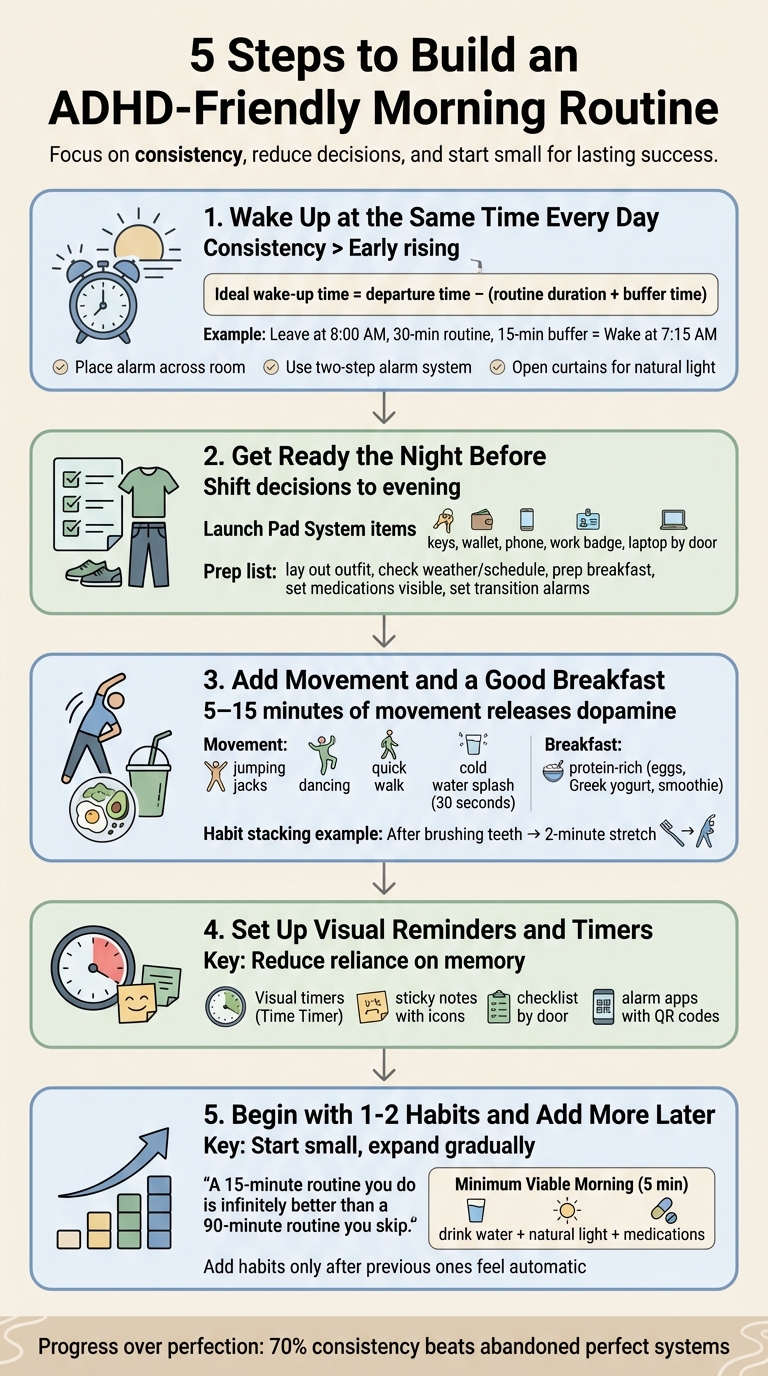
5 Steps to Build an ADHD-Friendly Morning Routine
Now that we've explored why standard routines often fall short for ADHD brains, it's time to craft a routine that works. These steps are designed to address the unique challenges of ADHD, turning potential hurdles into a manageable and effective morning structure.
Step 1: Wake Up at the Same Time Every Day
Forget the idea that you need to wake up at 5:00 a.m. For ADHD, consistency is far more important than waking up early. Since ADHD brains tend toward later sleep cycles, forcing yourself to rise too early can backfire. Instead, pick a wake-up time you can stick to daily - even on weekends. This consistency helps regulate your natural sleep-wake rhythm.
To figure out your ideal wake-up time, work backward:
Ideal wake-up time = departure time – (routine duration + buffer time).
For example, if you need to leave by 8:00 a.m., and your routine takes 30 minutes, adding a 15-minute buffer means setting your alarm for 7:15 a.m..
"The first 30–60 minutes after waking are high-stakes for the ADHD brain. Executive function is at its lowest, and every decision feels harder than it should."
– Harold Robert Meyer, Founder, The ADD Resource Center
Since your brain is sluggish in the morning, external cues are key. Place your alarm across the room, use a two-step alarm system (one to sit up, one to stand), and pick a high-energy sound like a favorite song or podcast for an immediate dopamine boost. Open your curtains right away - natural light suppresses melatonin and signals your brain to wake up. For added accountability, text a friend or partner with a quick "I'm up" within five minutes of your alarm.
Step 2: Get Ready the Night Before
Shifting decisions to the evening can significantly reduce mental strain in the morning. As Harold Robert Meyer explains:
"Evening preparation isn't just helpful for people with ADHD - it's transformative."
Try the Launch Pad System: set up all your essentials - keys, wallet, phone, work badge, and laptop - by the door. Lay out your outfit, including socks and accessories, and check the weather and your schedule for the day ahead. Prep easy breakfasts like overnight oats or pre-portioned yogurt, and place any medications in a visible spot (or use a pill organizer). Set alarms for key morning transitions, like finishing breakfast or leaving the house.
On nights when energy is low, focus on a "Minimum Viable Prep" - for instance, just setting out your keys and wallet. Use a recurring alarm to remind you to start winding down. Finally, charge your phone outside the bedroom to minimize morning distractions and ensure you have to get up to turn off your alarm.
Step 3: Add Movement and a Good Breakfast
A little physical activity in the morning can do wonders for activating your brain. Movement releases dopamine and norepinephrine, which are essential for focus and attention. You don’t need a full workout - just 5–15 minutes of activity can make a difference. Try simple options like jumping jacks, dancing to an upbeat playlist, or a quick walk around your home.
Use habit stacking to make this easier: pair movement with an existing routine. For example, “After I brush my teeth, I’ll do a 2-minute stretch”. Reduce barriers by sleeping in workout clothes or placing your shoes beside your bed. Even splashing cold water on your face for 30 seconds can help kickstart your day.
Pair this with a protein-rich breakfast - like scrambled eggs, Greek yogurt, or a smoothie - to stabilize your energy and avoid a mid-morning crash. Together, movement and a solid breakfast fuel your focus and energy while keeping decision-making stress low.
Step 4: Set Up Visual Reminders and Timers
ADHD can make it hard to rely on memory alone, so visual reminders can be a game-changer. They reduce mental clutter and help you stay on track. Use visual timers, like a Time Timer, to make the passage of time more tangible. Sticky notes or dry-erase boards with simple icons (for hydration, medications, breakfast, etc.) can be placed on mirrors or near your coffee maker. A checklist by the door ensures you don’t leave without essentials like your phone, keys, or bag.
You can also try alarm apps that require you to scan a QR code to stop them, forcing you to move and engage. Tools like On/Off Genius can send reminders and track your progress throughout your routine, keeping you accountable.
Step 5: Begin with 1–2 Habits and Add More Later
The biggest mistake people make is trying to overhaul their entire morning routine at once. Start small - just one or two habits - and expand only after these become second nature.
"A 15-minute routine you do is infinitely better than a 90-minute routine you skip."
– Cohorty
Focus on creating a “Minimum Viable Morning” - a simple 5-minute routine that might include drinking water, getting some natural light, and taking any medications. Once this feels automatic, add another habit, like a 2-minute stretch or a quick breakfast. On low-energy days, scale down to a shorter version of your routine (e.g., a 1-minute stretch) to keep the momentum going. The goal isn’t perfection - it’s about building consistency over time. Once the basics are in place, you can refine and track your progress to keep improving.
How to Stay Consistent and Track Your Progress
Creating a morning routine is one thing - sticking with it is a whole different challenge. For people with ADHD, consistency doesn’t mean doing it perfectly every time; it’s about showing up regularly. The trick is to design systems that work with your brain, not against it.
Reward Yourself for Completing Morning Tasks
ADHD brains thrive on immediate rewards. That’s why it’s so important to sprinkle small rewards throughout your routine rather than waiting until the end. This approach, sometimes called "candy trailing", keeps you motivated step by step.
"ADHD brains thrive on ongoing rewards that guide each step."
– Sam Dylan Finch, ADHD Coach
One great strategy is habit coupling - pairing a less exciting task with something you love. For instance, listen to your favorite podcast while getting dressed or use different toothpaste flavors to make brushing your teeth more engaging. End your routine with a fun anchor, like taking a short walk or playing a quick game of Wordle, to leave on a high note.
You could even create artificial consequences by texting a friend when you wake up on time, turning accountability into a mini reward. Once rewards are in place, the next step is to track your progress to build consistency.
Track Your Routine with Apps and Habit Trackers
Tracking your routine helps you refine habits and identify what’s working over time. Start small - track just one or two habits until they feel natural, then gradually add more.
Apps like On/Off Genius can send reminders, track progress, and show trends, such as how your sleep quality impacts morning energy. Many of these tools also include timers and visual cues, which are particularly helpful during those groggy early mornings.
A great tip is to create a minimum viable morning - a stripped-down version of your routine with just 3–5 essential tasks for days when energy is low. This keeps you consistent without feeling overwhelmed. Remember, sticking to your routine 70% of the time is far more effective than aiming for perfection and abandoning it.
To avoid burnout, add a 20-minute buffer to your schedule for unexpected distractions, and organize tasks by effort level (Easy, Moderate, High) to prevent back-to-back energy-draining activities. Review your progress weekly - Sunday evenings work well - to see what’s clicking and what might need tweaking.
What to Do When You Miss a Day
Even with the best systems, you’ll miss a day here and there. It’s okay - one slip-up doesn’t erase your progress. Research shows it takes between 106 and 154 days for a behavior to become automatic, and habits make up about 45% of daily actions. Missing a day isn’t the end of the world.
Avoid falling into all-or-nothing thinking, which can derail your efforts. Instead, pause and ask yourself, "What got in the way?" Identify the issue and make a small adjustment.
The Five-Minute Rule can help you restart: commit to just five minutes of your routine, and then decide if you want to continue. Often, the hardest part is just beginning.
"A minimum viable morning that actually happens beats an elaborate routine that never gets off the ground. Progress matters more than perfection."
– Harold Robert Meyer, Founder, The ADD Resource Center
Finally, celebrate the reset. Getting back on track is an accomplishment in itself. Practicing self-compassion isn’t just kind - it’s a smart strategy. Treat yourself as you would a friend who’s struggling and keep moving forward.
3 Sample Morning Routines for ADHD Professionals
Here are three sample morning routines tailored to different needs and energy levels, offering practical ways to start the day on the right foot. Each routine considers ADHD subtypes - whether hyperactive or inattentive - and time constraints, making it easier to find one that fits your lifestyle.
Quick Energizer Routine (15–20 Minutes)
This is a no-frills routine designed to tackle the essentials and get you moving, perfect for hectic mornings or when decision-making feels like a chore.
Steps:
- Take any prescribed medication.
- Drink a full glass of water.
- Eat a pre-prepared breakfast (like Greek yogurt or hard-boiled eggs).
- Get dressed in clothes you laid out the night before.
- Grab your bag from its designated spot.
By planning everything in advance, you eliminate decision fatigue and morning fog. For example, instead of waiting to feel ready, set a clear intention: "As soon as I get out of bed, I’ll put on my workout shoes."
Calm Starter Routine (30–40 Minutes)
This routine focuses on easing into the day with gentle transitions and sensory regulation, ideal for reducing anxiety and starting on a calm note.
Steps:
- Open the blinds to let in natural light.
- Feed your pets or water plants as a soothing first task.
- Drink water with a touch of lemon for refreshment.
- Spend five minutes stretching or practicing deep breathing.
- Enjoy a protein-rich breakfast.
- Take five minutes to journal about your top priority for the day.
- Get dressed and check your visual to-do list.
Avoid checking your phone for the first 10–20 minutes to stay focused and avoid getting caught in a dopamine-driven distraction loop. Sensory cues, like the smell of coffee or changing out of pajamas, can signal that it’s time to officially start your day.
Motivated Mover Routine (45–60 Minutes)
This routine is all about movement and energy, making it a great choice for those who thrive on a more active start to their day.
Steps:
- Begin with 15–20 minutes of movement, such as a brisk walk, yoga, or dancing to an upbeat playlist.
- Take a refreshing shower to re-energize.
- Have a hearty, protein-packed breakfast.
- Use a visual timer to review your daily plan.
- Pack your bag and double-check your launch pad.
- Leave about 10 minutes earlier than usual to account for time blindness.
Research suggests that 15 minutes of movement in the morning can improve focus and performance throughout the day. To keep this routine engaging, switch things up - try different playlists, breakfast options, or walking routes. Tools like a visual timer can also help you stay on track and manage longer routines effectively.
| Routine Type | Duration | Best For | Focus |
|---|---|---|---|
| Quick Energizer | 15–20 min | Busy mornings; low-energy days | Essential tasks with minimal decisions |
| Calm Starter | 30–40 min | Gentle transitions; reducing anxiety | Sensory regulation and smooth adjustments |
| Motivated Mover | 45–60 min | High-energy individuals; active starts | Movement and focus activation |
Conclusion
Creating a morning routine that works for you isn’t about chasing perfection - it’s about building a flexible system that reduces decision-making, incorporates preparation the night before, and uses tools like visual timers or habit trackers to support your ADHD brain.
"A routine followed at 70% is infinitely better than an abandoned 'perfect' system." – ADD Resource Center
Think of your routine as a flow rather than a rigid checklist. Some mornings you might complete your full Motivated Mover routine, while on others, just doing the basics - taking your medication, drinking water, and getting dressed - will be enough. Both are wins.
The key is to minimize friction and plan for smoother transitions. Laying out clothes ahead of time, using visual reminders, and allowing buffer time between tasks can make a big difference. These small adjustments align with the earlier idea of using external cues to work around ADHD challenges. When you design an environment that supports your needs instead of relying solely on willpower, consistency becomes much more manageable. Tools like On/Off Genius can provide the structure and accountability needed to turn good intentions into lasting habits.
Start small. Test what works for you and adjust as needed. Your morning routine doesn’t have to look like anyone else’s - it just needs to help you start your day with less stress and more ease.
FAQs
How do I pick a wake-up time I can actually keep?
Choosing a wake-up time that aligns with your natural sleep patterns and daily responsibilities can make mornings smoother. Aim for a time that allows you to get enough rest by heading to bed early. The secret? Consistency. Following the same schedule every day helps your body adjust and cuts down on the mental hassle of deciding when to wake up.
To simplify the process, set clear cues: use alarms, lay out your clothes, or prepare breakfast the night before. A routine that feels doable is much easier to stick with in the long run.
What’s the minimum morning routine I can do on bad days?
When you're having a tough day, keeping things simple can make a big difference. A low-energy routine helps cut down on decision fatigue and keeps you moving forward. Focus on a few key steps:
- Wake up with an anchor: Start your day with something familiar and grounding, like a favorite song or a comforting drink.
- Do a body-first activity: Stretch, take a short walk, or do anything that gently wakes up your body.
- Complete one automatic task: Pick something easy and routine, like making your bed or tidying up your desk.
- Quick get-ready routine: Keep it simple - just the basics to feel refreshed and ready to face the day.
These small, manageable actions can help you stay consistent even when your energy is running low.
How can I stop getting distracted by my phone in the morning?
To cut down on morning phone distractions, consider starting a phone-free routine for the first hour after you wake up. A simple trick is to place your phone across the room, making it less tempting to grab right away. Instead of relying on your phone, use a visual timer or an alarm clock to stay on schedule. Fill this time with healthier habits - like sipping water, stretching, or doing light exercise. Over time, you can fine-tune your environment and routines to create a more focused, distraction-free morning.