Time Blocking vs. Task Batching: What Works Better
Time blocking gives structure; task batching reduces context switching—compare pros, cons, and combined strategies to match ADHD energy and focus.

Struggling to stay productive? If you’re managing ADHD, two productivity methods - time blocking and task batching - can help you organize your day and reduce mental strain. Here’s a quick breakdown:
- Time Blocking: Schedule tasks into specific time slots on your calendar. Great for managing time blindness, hyperfocus, and prioritizing deep work.
- Task Batching: Group similar tasks together (like emails or calls) to minimize mental fatigue from switching between tasks. Ideal for routine tasks and unpredictable schedules.
Which one works better? It depends on your needs. Time blocking offers structure, while task batching is more flexible. Many find combining both methods - batching tasks within time blocks - works best. Below, we’ll dive into the strengths and challenges of each approach and how to make them work for you.
Time Blocking vs. Task Batching: Which Productivity Method Actually Works To Get Work Done Fast?
What Is Time Blocking?
Time blocking is a way to manage your time by dividing your day - or even your entire week - into specific blocks, each dedicated to a particular task or set of tasks. Instead of working through a vague to-do list, you schedule each task directly into your calendar.
The idea is simple: break your day into chunks - 30, 60, or 90 minutes, for example - and assign a task to each block. During that time, you focus entirely on the task at hand before moving to the next. This approach is especially useful for ADHD professionals who often deal with "time blindness", where the passage of time feels unclear or hard to track.
How Time Blocking Works
Start by breaking your day into manageable chunks based on how long tasks typically take. For those with ADHD, consider using the 25% Rule: schedule your blocks at least 25% longer than your initial estimate. This extra time accounts for delays or distractions, which are common when managing time blindness or unexpected interruptions.
Next, assign tasks to each block. For example, your schedule might look like this:
- 9:00 AM–10:30 AM: Deep work on a major project
- 10:30 AM–10:45 AM: Short break
- 10:45 AM–11:30 AM: Administrative tasks
Including 5- to 10-minute transition buffers between blocks allows time to reset before diving into the next task.
To stick to your schedule, use tools like visual timers or alarms to signal when it’s time to move to the next block. These are especially helpful for managing hyperfocus, a common ADHD experience where you become so absorbed in a task that hours pass unnoticed. Sarah, a writer, shared her experience:
"I used to hyperfocus for 8 hours and burn out. Now I use 90-minute blocks with mandatory breaks. I get more done in less time and don't crash afterward."
Color-coding your calendar can make it even easier to follow. For example, use red for deep focus tasks, green for administrative work, and purple for personal time. This visual approach aligns with how ADHD brains often respond well to clear visual cues.
Once you understand the structure, it’s clear how time blocking can address ADHD-specific challenges.
Time Blocking Benefits for ADHD
Time blocking makes time more tangible, helping to reduce time blindness and decision fatigue. By pre-planning your day, you eliminate the need to constantly decide what to do next.
It also helps manage hyperfocus by setting clear start and stop points. Alarms and transition blocks ensure you don’t accidentally spend hours on a single task. Alex, a software developer, explained:
"Time blocking changed my life. I went from constantly feeling behind to actually finishing projects early. The key was making time visual and building in buffer time for my ADHD brain."
What Is Task Batching?
Task batching is the practice of grouping similar tasks into one focused session. Instead of constantly switching between different types of work throughout your day, you handle tasks of the same type together - for example, dedicating a block of time to respond to emails or process invoices. While time blocking organizes your day by allocating specific time slots for activities, task batching takes it a step further by grouping tasks that require similar mental processes, making transitions smoother.
To get started, identify tasks that require the same type of focus or tools, group them into categories, and schedule dedicated time for each category. For instance, you might batch all communication-related tasks - like emails, Slack messages, and calls - into two or three specific time slots, instead of addressing them as they pop up throughout the day.
This method is particularly helpful for professionals with ADHD, as it tackles a major hurdle: context switching. Switching between tasks often drains mental energy and disrupts focus. Eric Kaufmann, a Certified Executive Function Coach at UpSkill Specialists, explains:
"Each transition requires executive function skills: refocusing, reinitiating, and reorganizing. That mental reboot drains energy fast."
By staying in the same mental "mode" for an extended period, task batching minimizes these energy-draining transitions and eliminates the constant need to decide what to tackle next. Below, we’ll explore how to implement task batching effectively.
How Task Batching Works
Start by listing all your weekly tasks - everything from emails and administrative duties to creative projects and errands. Then, group them based on similarity. You can organize tasks by the tools or environment they require (context) or by the type of work involved, such as analytical, creative, or communication-focused tasks. For example, you might create categories like communication, administrative, creative work, and meetings.
Once grouped, decide which task batches deserve your peak energy hours. For example, use tools like the Eisenhower Matrix to prioritize tasks and schedule high-focus work, such as creative projects, during your most productive times. Save lower-effort tasks, like administrative work, for periods when your energy naturally dips.
Convert each task group into a time block on your calendar, typically ranging from 30 to 90 minutes. For professionals with ADHD, shorter batches - around 10 to 20 minutes - can be more effective. Be specific about what you aim to accomplish. Instead of a vague "check email" block, try something more concrete, like "respond to 5 emails." To avoid burnout, include 5–15 minute transition breaks between batches to let your brain reset. Using visual timers can also help manage time blindness and keep you on track.
Task Batching Benefits for ADHD
Task batching helps address ADHD-specific challenges by reducing mental strain and improving focus. One key advantage is that it cuts down on the "switching tax" - the mental energy lost when jumping between tasks. Research shows that frequent task switching can lower productivity by up to 40%, and it may even elevate cortisol levels, which can lead to burnout.
Another benefit is how batching creates a dopamine-driven momentum. Completing a series of similar tasks in a row can trigger dopamine releases, making it easier to maintain focus without constantly restarting. Psychiatrist Alisa Gorshkova, who specializes in ADHD, explains:
"For ADHD brains, the chaos of constant switching isn't just distracting - it's overwhelming. Task batching creates islands of structure in a sea of unpredictability."
Additionally, pre-planning task batches reduces decision fatigue. By setting clear priorities ahead of time, you avoid the stress of deciding what to work on next. This structure can also ease anxiety about forgetting tasks, as everything has a designated time slot.
Finally, task batching supports hyperfocus - a state where deep engagement in a task leads to heightened productivity. Grouping similar tasks keeps your brain in one mode, making it easier to enter and sustain this flow state. Starting your day with a focused batch of quick tasks can even build momentum for tackling larger projects later on.
Time Blocking vs. Task Batching: Key Differences
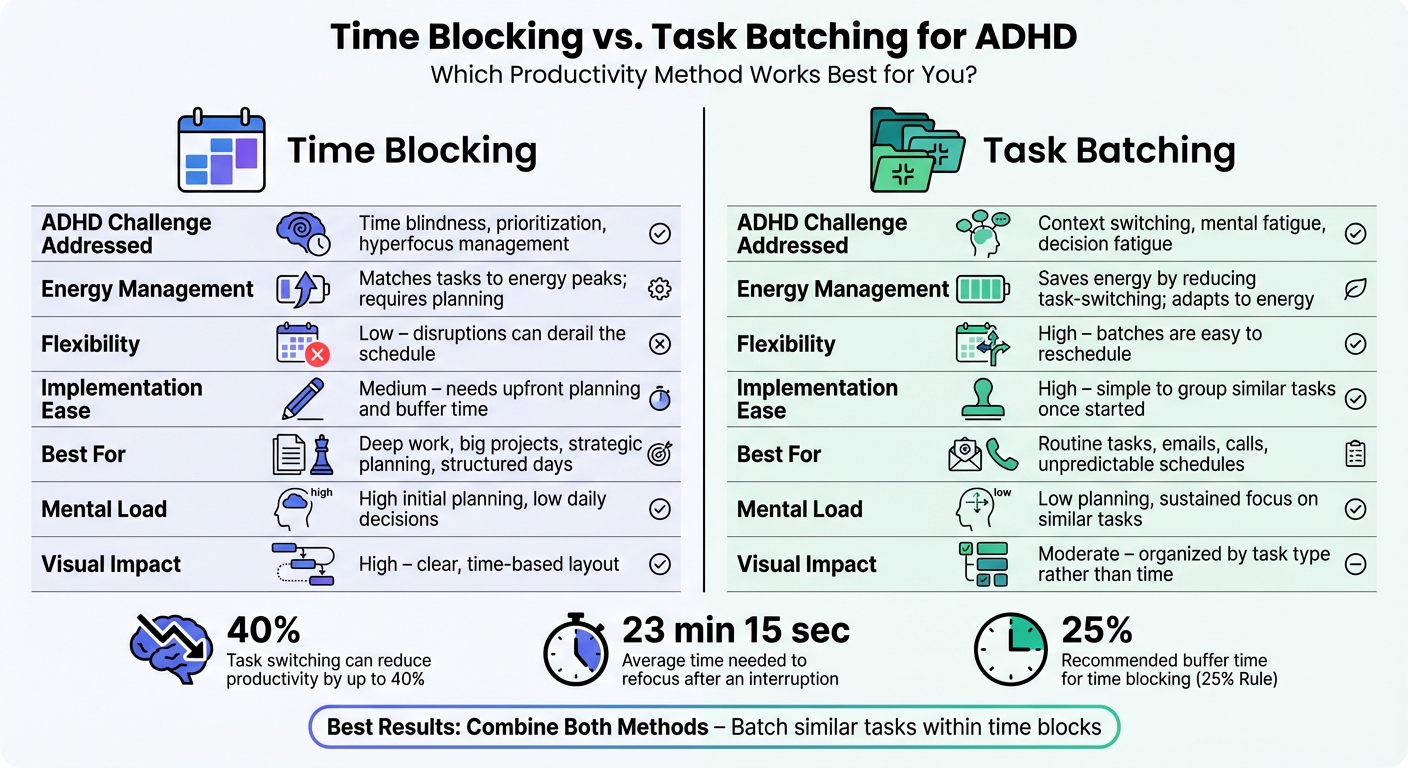
Time Blocking vs Task Batching for ADHD: Complete Comparison Guide
Let’s dive into how these two methods tackle ADHD-related challenges and what sets them apart.
How Each Method Addresses ADHD Challenges
Time blocking is a lifesaver for managing time blindness - the struggle to estimate how long tasks take or to remember when to start them. By visually scheduling tasks, it reduces decision paralysis and helps you stay on track. Plus, it’s great for managing hyperfocus by setting hard stops, ensuring you don’t lose hours on a single task.
On the other hand, task batching shines when it comes to minimizing context switching. Constantly jumping between tasks can be mentally draining, but batching keeps your brain in the same mode - whether that’s answering emails, brainstorming, or tackling admin work. This reduces the cognitive exhaustion that comes from shifting gears and lowers decision fatigue since you’re not constantly deciding what to do next.
Now, think about how these methods handle energy. Time blocking syncs tasks with your natural energy peaks and medication windows, a strategy often called "Energy Matching". Meanwhile, task batching conserves energy by cutting down on the productivity loss caused by task-switching - a habit that can eat up nearly 40% of your productive time. Time blocking also encourages regular breaks, like the 90-minute intervals many experts recommend, while task batching builds momentum by letting you stick with similar tasks back-to-back.
Flexibility is another big difference. Time blocking is pretty rigid - if one thing goes off schedule, it can throw your whole day into chaos. Task batching, however, is more adaptable. You can easily shift batches around to match your energy levels or deal with unexpected changes.
Comparison Table: Time Blocking vs. Task Batching
| Category | Time Blocking | Task Batching |
|---|---|---|
| ADHD Challenge Addressed | Time blindness, prioritization, hyperfocus management | Context switching, mental fatigue, decision fatigue |
| Energy Management | Matches tasks to energy peaks; requires planning | Saves energy by reducing task-switching; adapts to energy |
| Flexibility | Low – disruptions can derail the schedule | High – batches are easy to reschedule |
| Implementation Ease | Medium – needs upfront planning and buffer time | High – simple to group similar tasks once started |
| Best For | Deep work, big projects, strategic planning, structured days | Routine tasks, emails, calls, unpredictable schedules |
| Mental Load | High initial planning, low daily decisions | Low planning, sustained focus on similar tasks |
| Visual Impact | High – clear, time-based layout | Moderate – organized by task type rather than time |
Both approaches have their strengths, so the choice depends on your priorities and how you work best. Whether you need structure or flexibility, there’s a method here to suit your needs.
Time Blocking: Pros and Cons for ADHD
Time blocking can be a game-changer for professionals with ADHD, offering some clear benefits while also presenting unique challenges. Let’s dive into both sides to better understand how it works.
Time Blocking Advantages
One of the biggest perks of time blocking is that it makes time more tangible. For many people with ADHD, time blindness - a common trait where hours seem to vanish or task durations are hard to estimate - can be a daily struggle. A visual calendar transforms the abstract concept of time into something concrete, making it easier for the brain to process and manage.
Another major win? It cuts down on decision fatigue. By pre-planning your day, you eliminate the constant “What should I do next?” dilemma. Plus, time blocking protects your ability to focus by carving out specific periods for deep work. In fact, a well-organized 40-hour time-blocked week can match the productivity of a chaotic 60+ hour one. Dedicated blocks also help you avoid the "task-switching tax", which costs an average of 23 minutes and 15 seconds to refocus after an interruption.
As exoplan.io explains:
"Time blocking is implementation intentions applied to your entire day. Every block is an if-then plan... You're not just organizing your schedule. You're programming follow-through."
Time blocking can also help manage hyperfocus, a common ADHD trait. Setting alarms or hard stops prevents you from accidentally spending four hours on a single task and burning out.
The method also allows you to align tasks with your energy levels. For example, you can schedule mentally demanding work during peak focus times and save routine tasks for when your energy dips. Research shows that performance on cognitively challenging tasks can vary by 15% to 30% depending on whether you're working during your peak or trough hours.
While these benefits are compelling, time blocking isn’t without its hurdles.
Time Blocking Drawbacks
For individuals with ADHD, time blocking can sometimes feel too rigid. Around 90% of children with ADHD experience executive function challenges, and these often carry into adulthood. This can make sticking to a strict schedule difficult. In some cases, a heavily structured calendar may even feel like a “prison,” triggering feelings of rebellion or avoidance.
Interruptions can also wreak havoc on a carefully planned schedule. Because time blocking relies on a sequential structure, any disruption can throw off your entire day. ADHD-related time blindness and the planning fallacy - where tasks consistently take longer than expected - can lead to overpacked schedules and added stress.
There’s also the issue of planning fatigue. Mapping out every hour of your day can be draining and might even add to the mental load. Additionally, strict time blocking leaves little room for spontaneity or those sudden bursts of creativity that many with ADHD thrive on. Another challenge is "waiting mode", where having an appointment later in the day can make it feel impossible to start anything productive beforehand.
As AFFiNE puts it:
"Time blindness is a neurological reality, not a character flaw. Your brain's prefrontal cortex processes temporal information differently, and no amount of willpower can change your neurobiology."
To work around these challenges, consider using the 25% Rule: schedule tasks to take at least 25% longer than you initially think they’ll need. Adding 10–15-minute transition blocks between tasks can also help your brain shift gears and prevent scheduling overruns. Finally, don’t forget to include “flex” or “emergency” blocks in your day to handle unexpected events without throwing off your entire plan.
Task Batching: Pros and Cons for ADHD
Task batching is a productivity method that can work well for professionals with ADHD, but it comes with its own set of benefits and challenges. Here's a breakdown of how it aligns with ADHD-specific needs.
Task Batching Advantages
Task batching, much like time blocking, introduces structure to workflows, which can help address common ADHD-related hurdles. One of its biggest perks is reducing the mental energy spent on switching between tasks. Executive Function Coach Eric Kaufmann explains:
"Every time you switch tasks, your brain has to reset. Each transition requires executive function skills: refocusing, reinitiating, and reorganizing. That mental reboot drains energy fast."
By grouping similar tasks - like responding to emails or making phone calls - you can stay in the same mental zone, avoiding the energy drain caused by constant transitions.
Another advantage is how it taps into ADHD hyperfocus. Task batching allows you to enter a flow state, where dopamine boosts help sustain momentum and engagement. It also minimizes decision fatigue by pre-planning tasks, eliminating the need to constantly decide, "What should I do next?" Psychiatrist and ADHD Specialist Alisa Gorshkova captures this well:
"For ADHD brains, the chaos of constant switching isn't just distracting - it's overwhelming. Task batching creates islands of structure in a sea of unpredictability."
Task batching can also align tasks with your natural energy levels. For example, you could tackle high-focus work like strategic planning during your peak productivity hours and save simpler tasks for when your energy dips. Additionally, scheduling specific times for communication - like two 30-minute slots for emails - can set boundaries, reduce anxiety about forgetting tasks, and limit interruptions from constant notifications.
While these benefits are compelling, task batching isn't without its hurdles.
Task Batching Drawbacks
For ADHD professionals, the upfront planning required for task batching can be a challenge. Organizing and categorizing tasks into batches demands executive function skills, which may already be a struggle.
Another potential downside is repetitive fatigue. Spending too much time on a single type of task can lead to boredom, disengagement, or even burnout - especially for creative work that thrives on variety and fresh energy.
This method can also feel too rigid for roles that demand real-time responses or involve handling unexpected emergencies. In these cases, a more flexible approach might work better.
Perfectionism and procrastination can also interfere with batching efforts. You might delay starting a batch because the plan doesn’t feel “just right,” or use the batching process to put off tackling larger, more meaningful projects. Misjudging how long a batch will take can also lead to unfinished tasks and added stress.
To navigate these challenges, consider using energy mapping. Schedule demanding tasks during your peak focus times and save routine work for when your energy wanes. Techniques like Pomodoro’s 25-minute focus sprints can help maintain engagement by providing regular dopamine boosts. Also, leave room in your schedule for unexpected tasks by building in buffer time or reactive blocks.
Finding the right balance between these advantages and drawbacks is essential to making task batching work for your ADHD workflow.
Which Method Works Better for Your ADHD Workflow
There’s no one-size-fits-all solution here - it all depends on your unique ADHD challenges, your natural energy patterns, and the kind of work you’re tackling. The key is figuring out what keeps you productive and what tends to throw you off course.
What to Consider When Choosing
Before diving into a specific method, take some time to analyze your energy levels throughout the day. Track them for a week to identify when you feel sharp and when your energy dips. This simple exercise can help you decide whether you need the structured approach of time blocking to manage decision fatigue or the flexibility of task batching to avoid mental burnout caused by constant context switching.
The kind of tasks you handle also plays a big role. Time blocking works best for projects that demand deep focus, like creative work or strategic planning. On the other hand, task batching is ideal for repetitive tasks requiring less concentration, such as answering emails or handling administrative duties. If your day involves a lot of unpredictable tasks, task batching offers more flexibility since you can move a batch without throwing off your entire schedule.
Your specific ADHD challenges are another factor to weigh. If time blindness is a major obstacle, time blocking gives you a clearer sense of how time is passing. If constant context switching leaves you drained by midday, task batching can help you stay in the same mental zone longer, cutting down on that cognitive drain. Studies show that switching between tasks can slash productivity by up to 40%.
Whatever method you choose, don’t forget to build in ADHD-friendly safeguards. For example, add a 25% buffer to your time estimates to account for time blindness. Use visual timers to keep time tangible, and schedule hard stops every 90 minutes to avoid falling into unhealthy hyperfocus patterns. These small adjustments can make a big difference in keeping your workflow manageable.
Combining Time Blocking and Task Batching
For many professionals with ADHD, a mix of both methods works best. The "batch first, then block" approach combines the structure of time blocking with the efficiency of task batching.
Here’s how it works: Set up broad time blocks for your day, then group similar tasks within those blocks. For instance, you might schedule a 2-hour "Content Creation" block and batch related tasks - like drafting, editing, and brainstorming - within that time frame. Tackle high-energy tasks in the morning when you’re most alert, and save simpler tasks for when your energy dips later in the day.
Don’t forget to include buffer periods in your schedule. These extra pockets of time help you stay on track when unexpected delays or distractions pop up. You could also create themed batches, like "Project X Admin" or "Family Admin", instead of lumping all admin tasks into one block. This way, you avoid the mental fatigue that comes from jumping between unrelated tasks.
On/Off Genius Tips for Using These Strategies
Tools and Techniques That Help
Finding the right tools can make a huge difference in managing productivity with ADHD. Visual timers are a game-changer, as they make time more tangible. Tools like the Time Timer MOD or cube timers help counteract time blindness by visually showing how much time is left. Considering it takes about 25 minutes to fully refocus after an interruption, having these visual cues can protect your focus blocks and keep you on track.
Another helpful approach is using apps that combine your calendar and task list in one place. Platforms like Fhynix (starting at $3.99/month) simplify your workflow by eliminating the need to juggle multiple tools. You can see your time blocks alongside your tasks, reducing the mental strain of switching contexts. If digital tools feel distracting, analog options like color-coded Post-Its or planners like the Passion Planner offer a tactile, screen-free alternative.
Color-coding can also be incredibly effective. Assign specific colors to different types of tasks - red for deep focus work, green for administrative tasks, and yellow for creative brainstorming. Since ADHD brains process visual information faster than text, this method lets you instantly know what kind of energy each block requires just by looking at your calendar. Apps like TickTick ($35.99/year) and Toggl Track (free plan available) support this visual approach, making it easier to build productive routines.
How to Build Lasting Habits
Once you’ve selected tools that work for you, the next step is creating habits that stick. Start small to avoid feeling overwhelmed. For example, try blocking just your morning hours for the first week - nothing more. This gradual adjustment helps your brain ease into the new routine without triggering resistance.
Incorporating a 5-minute transition ritual between tasks can also help. Break it down into manageable steps: spend one minute saving your work, another clearing your space, one for stretching or taking a deep breath, one for setting up the next task, and a final minute reviewing your goal. These short rituals make shifting between tasks feel smoother and less abrupt.
At the end of each week, take a moment to reflect. Review which blocks worked well and which didn’t, then tweak your schedule for the following week. The goal isn’t perfection - it’s about discovering what fits your ADHD workflow and making steady improvements over time.
Conclusion: Finding What Works for You
Throughout this article, we’ve looked at how time blocking and task batching can benefit professionals with ADHD. Neither approach is inherently better - it all boils down to your specific ADHD traits and daily workflow. For instance, if prioritizing tasks and staying focused on complex projects feels overwhelming, time blocking might provide the structure you need. On the other hand, if your day is filled with repetitive tasks and constant interruptions, task batching could help you regain control. In fact, many people find success by combining the two, such as dedicating mornings to deep work with time blocks and afternoons to batching administrative tasks.
The most important step? Experiment without judgment. Try each method for a week and observe how your energy, focus, and stress levels respond. Remember, your schedule should work for you, not the other way around. As John Rampton, Co-founder of Calendar, wisely said:
"The key to productivity is finding the strategies that free up your time and brainpower to do your best work".
It’s also crucial to practice self-compassion as you build these habits. If a time block doesn’t go as planned, don’t scrap the entire system. Instead, reschedule the task for later. Life, particularly with ADHD, can be unpredictable, and rigid systems can crumble when disruptions occur. Adopting a flexible mindset is essential for staying productive in the long run.
To make your system even more effective, consider adding buffers. Schedule your blocks 25% longer than you think you’ll need to account for time blindness. Include 5-15 minute transition periods between tasks to give your brain time to reset. These small tweaks can make a big difference in how manageable and supportive your system feels.
At the end of the day, productivity isn’t about being perfect - it’s about making progress. What works for you now might need adjustments in the future, and that’s perfectly okay. Keep refining, stay curious about what helps your brain thrive, and allow yourself the freedom to find a rhythm that truly works for you.
FAQs
How do I know if I should time block or task batch?
Choosing between time blocking and task batching really comes down to how you work best and what your day looks like. If you thrive on structure and like having dedicated time slots for specific tasks, time blocking might be your go-to. It helps you stay focused and ensures you prioritize what’s important. On the other hand, if your schedule tends to be all over the place, task batching could be a better fit. Grouping similar tasks together can reduce the mental strain of constantly switching gears.
For many, a mix of both methods works well. You could use time blocking for intense, focused work and task batching for handling repetitive or routine tasks. It’s all about finding the balance that helps you stay productive without feeling overwhelmed.
What should I do when my schedule gets derailed?
When your schedule gets thrown off - especially if you’re managing ADHD - it's important to stay adaptable and kind to yourself. Instead of being hard on yourself, recognize the disruption for what it is and adjust your plan accordingly. Missed tasks don’t have to be abandoned; simply reschedule them to stay on track. You might also group similar tasks together or tweak your time blocks to better fit the new situation. Taking short breaks or practicing mindfulness can help you reset and regain focus. Think of these interruptions as chances to improve your strategy, not as setbacks.
How can I combine batching and blocking without overplanning?
To merge batching and blocking without overcomplicating your schedule, begin by listing out all your tasks - this clears mental clutter and gives you a clear starting point. Next, group similar tasks into time blocks (batching) while focusing on the most important ones first. Keep these blocks flexible and manageable, leaving some wiggle room for unexpected changes. This method helps you stay focused, manage your energy efficiently, and avoid the pitfalls of an overly rigid plan.