Accountability Groups for ADHD Professionals: Guide
Accountability groups (peer or coach-led) help ADHD professionals reduce procrastination, manage time blindness, and improve follow-through.

If you’re a professional with ADHD, staying on track can feel overwhelming due to challenges like procrastination, time blindness, and executive dysfunction. Accountability groups provide a structured way to manage these hurdles by combining peer support, scheduled check-ins, and techniques like "body doubling." These groups help you stay focused, prioritize tasks, and achieve goals by creating external systems that your brain may struggle to establish on its own.
Key Takeaways:
- Why They Work: Regular check-ins, shared goals, and encouragement improve follow-through rates from 10% to 95%.
- Group Structure: Small groups (5–12 members) with fixed schedules and clear meeting formats work best.
- Professional Support: Adding ADHD coaches can enhance group effectiveness through tailored tools and strategies.
- Flexible Accountability: Gentle systems focused on learning, not criticism, are ideal for ADHD professionals.
Whether you join an existing group or create your own, accountability groups can transform how you approach tasks, turning intentions into consistent action.
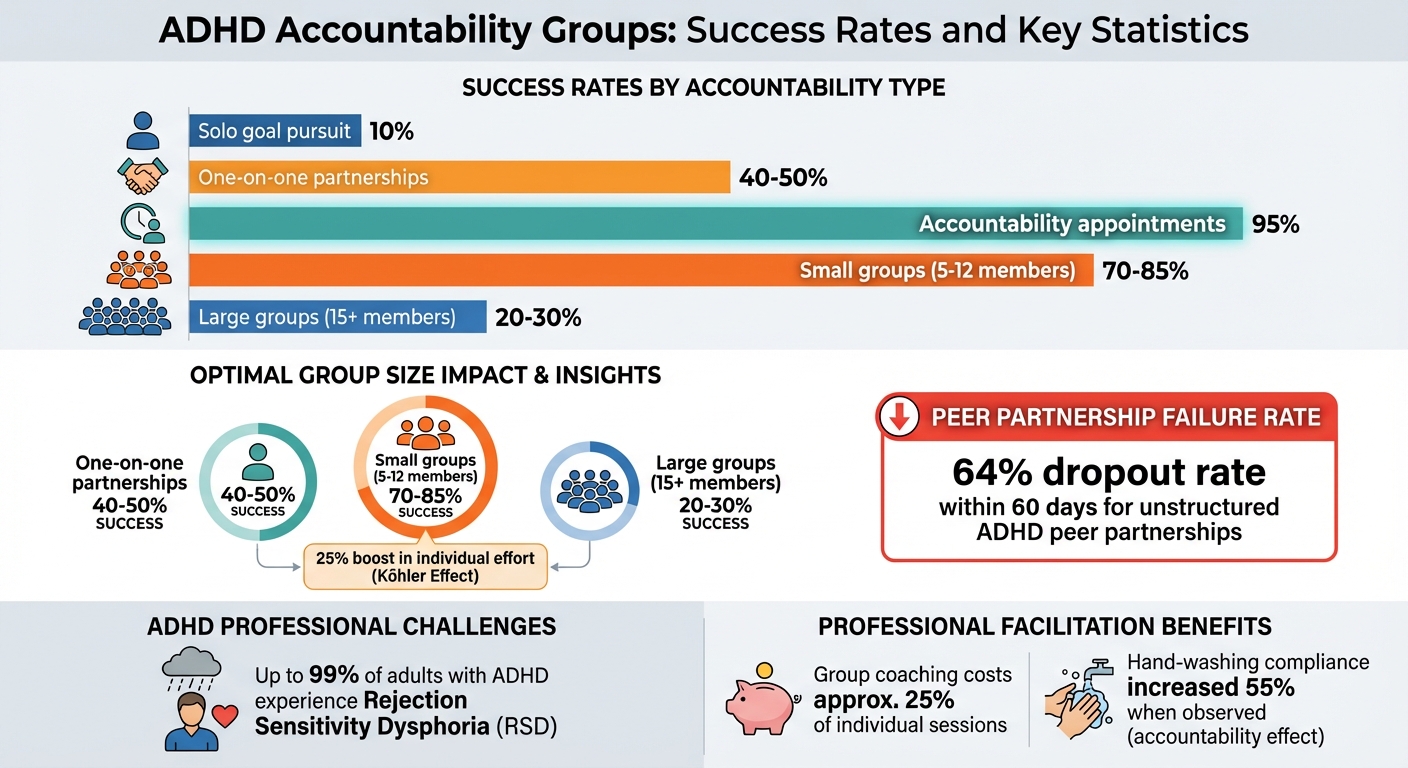
ADHD Accountability Groups: Success Rates and Key Statistics
Why ADHD Professionals Need Accountability Groups
Managing ADHD Productivity Challenges
ADHD professionals encounter hurdles that go far beyond occasional distraction. One of the biggest issues is executive dysfunction, which Mark Katz, PhD, describes as "a mismatch between intentions and actions". Even with clear goals, tasks like starting projects, prioritizing responsibilities, and maintaining focus can feel insurmountable.
Then there’s time blindness - a struggle to accurately perceive the passage of time. This makes planning for the day, week, or even the year incredibly difficult. Add to that decision fatigue, where even minor choices can drain time and energy.
Everyday tasks like expense tracking or handling administrative paperwork often fall by the wayside without a structured system. Eric Tivers, LCSW, refers to these as "im‐bor‐tant" tasks - boring but important - and warns that neglecting them can lead to professional setbacks.
The emotional impact of these challenges compounds the difficulty. Many adults with ADHD (up to 99%) experience Rejection Sensitivity Dysphoria (RSD), which makes harsh accountability systems, like strict deadlines or public criticism, counterproductive. Past failures often leave professionals with lingering shame, creating a vicious cycle where fear of judgment leads to avoidance, which in turn results in more missed deadlines.
While internal strategies are important, having external support can make all the difference in breaking these patterns.
Building a Professional Support Network
Structured peer support can transform these challenges into opportunities for growth. Accountability groups act as a kind of external executive function, helping ADHD professionals manage time blindness and decision fatigue. Jill Johnson, an ADHD Executive Coach, puts it simply: "For those with ADHD, external structure and support aren't just helpful - they're essential".
The benefits of peer support are well-documented. It can help prevent depression and anxiety in adults with ADHD. Plus, the Köhler Effect - where people in small groups tend to work harder than they would alone - shows that collaboration boosts motivation. This isn’t about competition; it’s about the natural energy that comes from working alongside others who understand your struggles. Techniques like body doubling - working in the presence of others, whether virtually or in person - can make tedious tasks more manageable. Even the simple act of being observed has been shown to improve performance; for example, hand-washing compliance among medical professionals increased by 55% when they were aware of being watched.
These networks also replace isolation with validation. Eric Tivers highlights the value of this shared experience:
"Mastermind Sessions are a powerful way for people to receive help and to also let them see they're not alone".
When you connect with others facing similar challenges, the shame associated with inconsistency begins to fade. You realize that these struggles stem from neurological differences, not personal failings.
Accountability groups also foster a mindset of curious accountability, a concept championed by Marla Cummins. Instead of framing missed goals as failures, groups adopt her perspective:
"F.A.I.L. = First Attempt in Learning. Really".
This approach shifts the focus to learning and growth, turning setbacks into opportunities to identify friction points and refine strategies. By prioritizing effort and incremental progress over perfection, these groups help ADHD professionals create the consistency they’ve always aimed for.
ADHD Powerhouse Eric Tivers on Community, Coaching & Finding Your Path
What Makes an ADHD Accountability Group Work
ADHD accountability groups thrive when they focus on three main factors: the right group size, a structured approach to meetings, and guidance from a skilled facilitator.
Small Groups with a Professional Approach
Small groups, typically ranging from 5 to 12 members, create the perfect environment for accountability. They strike a balance between offering diverse viewpoints and ensuring every member gets individual attention. Studies reveal that these groups have a success rate of 70–85% in achieving goals. In comparison, larger groups drop to 20–30%, and one-on-one partnerships hit only 40–50% - and those partnerships often fall apart if one person disengages. Interestingly, the Köhler Effect shows that working in a team can boost individual effort by 25%.
Structured Meetings and Tracking Progress
Consistency is key for ADHD accountability groups. A fixed schedule helps members avoid the pitfalls of time blindness and decision fatigue, two common challenges for people with ADHD. By sticking to a "zero decisions" model - where meeting times, platforms, and formats are set in advance - groups can maintain focus and reduce unnecessary stress.
Accountability appointments are game-changers. They raise success rates to 95%, compared to just 10% when tackling a goal solo. On the flip side, unstructured partnerships between ADHD peers often fail, with a 64% dropout rate within two months. Effective groups keep things simple during check-ins, using quick updates like "Done/Not Done" or emojis for progress reporting. Many adopt a three-part meeting format: 5–15 minutes for setting goals, 45–60 minutes of focused work (often using techniques like body doubling), and 5–15 minutes for reviewing progress. To keep things moving, timers limit individual updates to 1–3 minutes.
The philosophy behind this structure is summed up by Pearson's Law:
"What is measured, improves. That which is measured and reported improves exponentially".
By turning vague goals into measurable steps, these groups help members make real progress. With professional facilitation, this structure becomes even more effective.
The Role of Professional ADHD Coaches
While peer support is helpful, adding a professional facilitator elevates the group’s impact. Certified ADHD coaches bring structure and focus to discussions, ensuring the group stays on track toward its goals. They also introduce ADHD-specific tools, like cognitive-behavioral techniques and organizational strategies, tailored to the unique needs of neurodivergent individuals.
A critical part of their role is promoting what’s called "curious accountability." Instead of focusing solely on whether someone succeeded or failed, they create a supportive environment where setbacks are learning opportunities. ADHD and Productivity Coach Marla Cummins explains:
"When you only focus on whether you succeeded in doing exactly what you said you were going to do, it can be really stressful and diminish the helpfulness of the group".
Facilitators help break overwhelming goals into smaller, achievable steps, identify patterns in behavior, and set ground rules that eliminate shame or judgment. They’re also aware of challenges like Rejection Sensitivity Dysphoria (RSD) and work to ensure the group remains a safe space.
These groups also leverage the power of social interaction. When members connect, their brains release oxytocin, which boosts dopamine - a natural way to improve focus. Research shows that group coaching often outperforms one-on-one sessions by fulfilling the human need for connection and community. Plus, group coaching is more affordable, costing roughly 25% of what individual coaching sessions would.
For example, Neural Revolution launched the "FOCUS Forward" ADHD Group Coaching program in February 2026. Designed for high-achieving adults and entrepreneurs, it includes 60-minute Zoom sessions with a maximum of 15 members. Participants follow a four-week cycle: Foundation & Focus, two weeks of Progress & Optimization, and a final week for Integration & Forward Planning. Tools like a "Personalized ADHD Success Playbook" and pre-session worksheets keep members on track. Similarly, Ryan Mayer Coaching offers bi-weekly group sessions capped at 10 participants. Led by Certified ADHD Coach Ryan Mayer, these sessions focus on celebrating small victories and teaching prioritization techniques.
How to Find and Join an ADHD Accountability Group
Finding an accountability group that fits your needs involves knowing where to search and understanding what to look for. Options range from national organizations to coach-led programs and professional groups, each offering different formats and price points. Let’s break down where to find these groups and what to consider before joining.
Look for Coach-Led or Professional Groups
ADDA (Attention Deficit Disorder Association) offers virtual peer support and workgroups tailored to specific needs for $9.99 per month. Examples include groups like "Entrepreneurs and Self-Employed" (2nd and 4th Tuesdays), "ADHD @ Work > Survive & Thrive" (1st and 3rd Thursdays), and "High Expectations + ADHD" (2nd, 4th, and 5th Thursdays). Members can also join body doubling sessions such as "Momentum Mondays", "Turbo Tuesdays", and "Photo Finish Fridays".
CHADD (Children and Adults with Attention-Deficit/Hyperactivity Disorder) connects individuals through local chapters that offer both virtual and in-person support groups. Their Professional Directory lists ADHD-certified coaches who run private accountability groups. Coaches like Aki Onozuka-Evans and Henry Lam specialize in strategies like "Execution Sprints" to help professionals optimize their performance.
For more intensive support, ADHD reWired Coaching and Accountability Groups (ArC) offers 10-week programs priced at around $1,499. Each group includes 12 participants, one facilitator, and two peer mentors, meeting three times a week for an hour. Smaller accountability teams of four meet twice weekly, and participants gain access to 24/7 virtual body doubling through the "Adult Study Halls" (ASH) platform. Eric Tivers, founder of ADHD reWired, describes ASH as:
"A great place where people can work on things that are 'im-bor-tant.' Those are things that may be boring but are important".
After completing the program, alumni can join a community for $39 per month.
Check if the Group Fits Your Needs
Once you’ve identified potential groups, it’s essential to ensure they align with your goals and working style. One key consideration is the type of accountability system the group uses. "Hustle accountability" relies on rigid deadlines and fear-based motivation, while "gentle accountability" focuses on flexible check-ins and effort-based encouragement. For many with ADHD, gentle systems are more effective at avoiding shame spirals.
Other factors to evaluate include:
- Meeting frequency and communication tools: Some groups rely on platforms like Slack or Teams for ongoing support, while others stick to scheduled meetings.
- Facilitation style: Peer-led groups, like ADDA’s workgroups, emphasize mutual support and shared experiences at a lower cost. Coach-led programs, such as ADHD reWired, provide structured skill-building and targeted feedback but are more expensive.
ADHD Executive Coach Jill Johnson highlights the importance of finding a group that understands ADHD-specific challenges:
"The right ADHD accountability partners are people who understand that ADHD is not a lack of willpower, but a brain wired differently".
Also, check if the group uses formats that suit you, such as body doubling sessions or standard check-ins.
Try a Session Before Joining
Many organizations offer trial sessions or free introductory meetings. For example, ADDA’s $9.99 monthly membership provides immediate access to all their groups. Some private coaches listed in CHADD’s Professional Directory, like Emily Abbott, even offer a free first session with a promo code.
Testing a session can help you determine if the group’s approach supports your needs. Pay attention to its accountability philosophy. Effective groups use "curious accountability", treating missed goals as opportunities to learn rather than failures. As Work Brighter explains:
"Success doesn't mean sticking to the plan, it means making the plan work for you…and not feeling guilty about it".
Additionally, check for clear community standards. For instance, ADDA groups prohibit giving professional advice during peer sessions, focusing instead on sharing experiences and resources.
Research indicates that the amount of "homework" or action items completed between sessions often predicts success in ADHD therapy groups. Ask current members how the group helps them follow through on commitments. Look for groups that promote breaking down goals into manageable steps using frameworks like SMART (Specific, Measurable, Achievable, Relevant, Time-bound). This ensures the group not only keeps you accountable but also respects the unique challenges of ADHD.
How to Start Your Own ADHD Accountability Group
If you can't find a group that suits your needs, creating one yourself gives you the freedom to shape its structure, choose members, and decide on the meeting format. The focus should be on building a system that aligns with how ADHD brains work.
Building Your Group
Start by gathering 5–12 members with similar professional goals. This group size strikes the right balance - smaller groups (2–4 members) risk falling apart if someone leaves, while larger groups (over 15) can feel impersonal. To find potential members, try platforms like LinkedIn groups, local CHADD chapters, or other professional networks.
Before making a long-term commitment, run a 7-day trial to ensure compatibility and effective communication. Research shows that ADHD-only partnerships without structure fail 64% of the time within 60 days, highlighting the need for clear systems.
Once your group is set, create a consistent structure to guide your sessions.
Setting Up Structure and Schedule
ADHD professionals thrive with external systems that reduce the need for on-the-spot decisions. Set a regular meeting time - say, Tuesdays at 7:00 PM EST - use a reliable platform like Zoom or Google Meet, and stick to a fixed format. This eliminates the hassle of planning logistics each week.
Here are two meeting structures that work well:
-
Three-Round Format (15–30 minutes):
- Emotional check-in: Share 3–5 words about how you're feeling.
- Progress update: Spend 2 minutes reviewing last week's goal.
- Goal setting: Commit to a goal for the upcoming week.
-
Silent Work Format (60–90 minutes):
- Goal setting: 5–15 minutes to outline tasks.
- Silent work (body doubling): 45–60 minutes of focused work.
- Progress reporting: 5–15 minutes to share updates.
Between meetings, maintain communication through a low-effort channel like Slack, WhatsApp, or Telegram. Use simple messages like "Done" or "Not today" with ✓ or X emojis to keep things easy. Automate reminders with shared calendars to keep everyone on track.
To create a supportive environment, address Rejection Sensitivity Dysphoria (RSD) from the start. Introduce a forgiveness policy and the "Never Miss Twice" rule - missing one goal is treated as an accident, but a second miss triggers a supportive conversation. Also, establish a clear "release" policy, such as gently letting go of a member after two weeks of no contact, to maintain group momentum. Rotate leadership roles so everyone takes turns as the session captain, sharing responsibility.
Working with ADHD Coaches or Experts
For even better results, consider bringing in a professional ADHD coach or facilitator. While peer-led groups can work, a coach adds structure and strategies that help with prioritization and time management, areas where ADHD professionals often struggle. Coaches also ensure meetings happen, even when members' energy levels fluctuate, reducing the risk of "mutual ghosting".
In October 2019, Eric Tivers, LCSW, introduced the ADHD reWired Coaching and Accountability Groups (ArC) model. This ten-week online program brought together groups of 12 professionals who met three times a week for one-hour sessions. It included "Mastermind Sessions" for targeted feedback and 24/7 "Adult Study Halls" for body doubling.
"Mastermind Sessions are a powerful way for people to receive help and to also let them see they're not alone."
Professional ADHD coaching typically costs $100–$200 per session, but group rates make it more affordable. For example, if 8 members split a $120 session fee, each person pays just $15. Another option is starting with a coach-led program (like 10 weeks or 30 days) to establish habits, then transitioning to a peer-led model.
Coaches also focus on "curious accountability" instead of shame-based approaches. Instead of asking, "Why didn’t you do it?" they ask, "What got in the way?" This encourages members to identify challenges and experiment with new strategies for the next week. As ADHD Coach Marla Cummins puts it:
"The right kind of accountability - the friendly kind - can be a critical part of the scaffolding that can help you follow through on what's important to you."
If long-term coaching isn't an option, consider hiring a coach for the initial sessions. This upfront investment can help you establish habits and systems that set the stage for long-term success.
On/Off Genius: Resources for ADHD Professionals
On/Off Genius provides actionable tools for professionals with ADHD looking to create or improve accountability systems. These resources expand on the earlier discussion about external structures and accountability, addressing common hurdles like staying focused, maintaining consistent performance, staying organized, and following through on tasks.
One key concept here is "curious accountability." Instead of viewing progress as a rigid measure of success or failure, this approach encourages you to treat each week as a learning experiment. By analyzing both your successes and setbacks, you can refine your strategies over time. Tools like Mastermind Sessions are also available, offering a structured way to tap into collective insights and receive feedback on specific challenges.
For those who struggle with starting tasks, On/Off Genius introduces body doubling techniques and virtual co-working setups. These methods provide the extra push to get going when motivation feels out of reach.
The blog also recognizes that accountability needs vary across professions. It offers tailored strategies to address unique challenges faced by different professional roles.
Rather than relying solely on willpower, the focus is on creating practical systems that align with how the ADHD brain works. Whether you’re joining an established group or starting your own, these resources are designed to help you build sustainable accountability frameworks that support your personal and professional growth. They complement and enhance the strategies discussed earlier in this guide.
Conclusion
Accountability groups tackle one of ADHD's biggest hurdles - executive dysfunction - by offering the external structure that your brain might struggle to create on its own. They can boost goal achievement rates from a mere 10% to an impressive 95%. It’s not about simply trying harder; it’s about building a system that works with your brain, not against it.
From here, decide what works best for you: join an existing group that fits your needs, or create one that aligns with your ADHD strengths. Seek out groups led by professionals who understand ADHD and offer supportive, non-judgmental environments. Look for "curious accountability", where missing a check-in isn’t met with shame but rather a chance to refocus. Many groups allow trial sessions - take advantage of this to find a structure and culture that feels right.
If you’re thinking about starting your own group, keep it straightforward. A weekly meeting schedule often works best for professionals. Lay out clear expectations from the start, and consider enlisting an ADHD coach to guide the process. Peer-only groups can falter - 64% fail within 60 days - so having professional facilitation can make all the difference. A consistent framework is what transforms potential into progress.
Kyle Pearce, Founder of ADHD Flow State, captures this perfectly:
"The routine and predictability of weekly meetings can be highly effective at minimising the procrastination and distraction that often accompanies ADHD".
Whether you choose to join an established group or create your own, you’re building an external system to support the internal challenges of ADHD. Start small, stick to a consistent format, and reassess after 30 days. The right accountability group won’t feel like just another task - it will become the foundation for long-term success.
FAQs
How do I know if a group is ADHD-friendly?
Groups that cater to adults with ADHD focus on tackling common challenges such as executive dysfunction, staying motivated, and maintaining consistency. The best ones emphasize gentle, supportive accountability, offer flexible check-ins, and create a judgment-free space. These groups aim to build a sense of connection and understanding, helping members feel engaged and supported. By addressing the specific needs of adults with ADHD, they provide encouragement without overwhelming pressure.
What should I do if I miss a check-in or goal?
If you miss a check-in or fall short of a goal, acknowledge it without being too hard on yourself. Take a moment to reflect on what might have caused the slip and think about how you can tweak your system to better fit your needs. Adjusting your accountability structure or creating routines that work well with the way ADHD brains function can make a big difference. Be open with your group or accountability partner - talk about adjusting goals or schedules to keep things manageable. Remember, missed check-ins aren't failures - they're opportunities to learn and grow.
How can I start a group without it falling apart?
To make your accountability group work well, start by building a solid structure. Set a consistent meeting schedule and decide on clear, realistic goals for each session. Make sure to include time for progress updates and planning so everyone stays on track.
For groups tailored to ADHD, understanding executive dysfunction is key. Regular check-ins, clear expectations, and a focus on maintaining attention can make a big difference. A routine, structured approach combined with supportive communication will help the group thrive over time.