5 Ways ADHD Professionals Handle Fear of Rejection
Practical strategies—reframing, breathing, boundaries, mindfulness, and ADHD-informed coaching—to manage rejection sensitive dysphoria at work.

Many professionals with ADHD face intense emotional responses to perceived rejection, a condition known as rejection sensitive dysphoria (RSD). This goes beyond typical feelings of hurt, often leading to avoidance behaviors that hinder workplace performance. The good news? There are practical strategies to manage RSD effectively:
- Challenge Assumptions: Reframe negative thoughts and seek clarity before reacting emotionally.
- Regulate Emotions in Real Time: Use techniques like 4-7-8 breathing or physical resets (e.g., splashing cold water) to calm your nervous system.
- Set Boundaries: Communicate clearly to reduce ambiguity and stress in workplace interactions.
- Practice Mindfulness: Identify patterns and triggers, creating space between events and emotional reactions.
- Seek Professional Support: Work with ADHD-informed therapists or coaches to develop tailored strategies.
These tools help reduce the impact of RSD, allowing you to navigate workplace challenges with greater confidence and control.
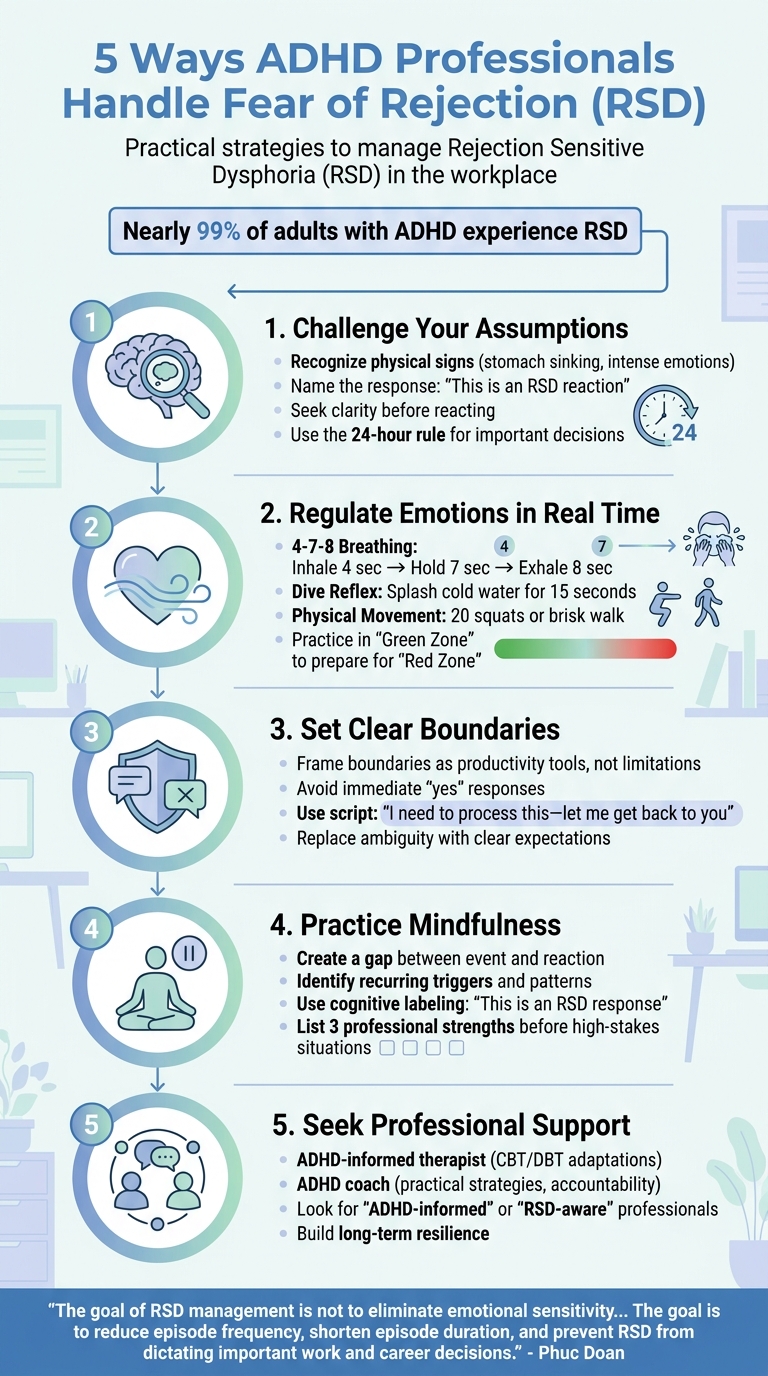
5 Strategies ADHD Professionals Use to Manage Rejection Sensitive Dysphoria at Work
12 RSD Hacks That ACTUALLY Work
sbb-itb-f879324
1. Challenge Your Assumptions with Cognitive Reframing
At times, your ADHD brain might feel like it's narrating a dramatic soap opera, turning everyday workplace moments into worst-case scenarios. For instance, a manager's "Quick chat?" message might instantly translate to "I'm getting fired", or a short email reply could feel like "They hate my work". This happens because, when faced with ambiguous situations, your brain tends to fill in the blanks with rejection stories. The first step to breaking this cycle is recognizing the physical signs that signal your brain is about to spin one of these narratives.
Pay attention to how your body reacts - a sinking feeling in your stomach or a sudden wave of intense emotion - before your thoughts even have a chance to catch up. When you notice these cues, pause and name what’s happening. As Phuc Doan puts it:
"This is an RSD response. My brain is reading rejection into an ambiguous signal. I will wait for more information before responding emotionally." – Phuc Doan, Author
Once you’ve identified the reaction, it’s time to challenge it. Instead of letting assumptions take over, seek clarity. Ask for more information directly. For example, you could say, "I want to make sure I understand your feedback clearly. Can you explain what you meant by that comment?" This simple step can clear up confusion. If you’re still unsure, share the situation with a trusted friend to see if your interpretation matches theirs. This creates a buffer between your initial reaction and your response.
Another helpful tool is the 24-hour rule. Avoid sending defensive emails or making big decisions within 24 hours of feeling rejected. This pause gives your logical mind time to step in and calm the emotional storm.
If emotions are spiraling out of control, a quick physical reset can help. Splashing cold water on your face or doing 20 squats can lower your heart rate and help you break free from distorted thinking patterns.
2. Use Emotional Regulation Techniques in Real Time
When the fear of rejection hits, your body doesn’t wait - it jumps straight into action. A racing heart, tight chest - these are classic signs of the fight-or-flight response kicking in. The upside? You can disrupt this cycle with physical techniques that calm your nervous system almost instantly. These methods work as a quick reset, giving you relief before your mind has a chance to step in with more cognitive strategies.
One simple yet powerful tool is the 4-7-8 breathing technique: inhale for 4 seconds, hold your breath for 7 seconds, and then exhale slowly for 8 seconds. This pattern activates your vagus nerve, which helps slow your heart rate. The best part? It’s subtle enough to do quietly, even during a meeting or at your desk.
For more intense reactions, you can try triggering your dive reflex. Splashing icy water on your face for about 15 seconds can help calm your system fast. Don’t have a sink nearby? Step into a private space for a quick break. Psychologist Marcy Caldwell suggests using this time to say something like:
"I need to process this - let me circle back in a little bit."
This pause gives your brain’s alarm system (the amygdala) a chance to settle down, letting your prefrontal cortex - the part responsible for rational thinking - take the wheel again.
Another option? Physical movement. Doing 20 squats or taking a brisk walk can help burn off the cortisol your body releases during rejection-sensitive moments. To make these techniques second nature, practice them during calmer times, or what’s often called the "Green Zone." That way, when stress spikes into the "Red Zone", your body knows exactly what to do.
With consistent practice, these techniques can help you stay composed and confident, even in high-stakes situations. They’re tools to build resilience and maintain your professional edge under pressure.
3. Set Clear Boundaries and Communicate Directly
Once you've managed your immediate emotional responses, the next step is to set clear boundaries. This is especially important for professionals with ADHD, as vague situations can often trigger excessive worry or fear of rejection. For example, a simple "Can we chat?" message from your manager can send your mind racing to worst-case scenarios. The solution? Direct communication. By addressing ambiguity head-on, you can replace uncertainty with clear expectations, reducing unnecessary stress.
When setting boundaries, it's helpful to frame them in terms of productivity rather than limitations. For instance, instead of saying, "I can't handle the noise in the office", you might rephrase it as, "I'm most productive when I can review my notes in a quiet space before meetings". This approach shifts the focus from a perceived weakness to a proactive strategy for success. According to CHADD research, you can even request accommodations without mentioning ADHD by presenting them as tools to enhance your work. For example: "I work best when I use a tape recorder to ensure I don't miss important details until I become proficient".
Another key strategy is to avoid answering requests immediately. This ties back to the earlier discussion on managing emotional responses. When someone asks for something, your brain's alarm system (the amygdala) may push you to say "yes" out of fear of rejection. Instead, try using a simple script like: "I need to process this - let me get back to you shortly". This gives your rational mind (the prefrontal cortex) time to step in, allowing you to assess your capacity and make a thoughtful decision.
Here are some examples of how to reframe common workplace situations:
| Situation | Instead of saying... | Try saying... |
|---|---|---|
| Needing Focus | "I can't handle the noise in the office." | "I'm most productive when I can review my notes in a quiet place before meetings." |
| Managing Memory | "I have ADHD and I'll forget what you said." | "To ensure I don't miss any details, I'll be taking copious notes/using a recorder." |
| Handling Feedback | "I'm sorry I messed up the report." | "I value your feedback. I will review these points and respond shortly." |
| Workload Limits | "I'm too overwhelmed to do this." | "To maintain the quality of my current projects, I can't take this on until [specific date]." |
4. Practice Mindfulness to Recognize Your Patterns
Mindfulness isn’t about shutting down your emotions - it’s about creating a gap between an event and your reaction to it. For professionals with ADHD, that pause can make a world of difference. Imagine getting a vague message like, “Can we talk?” - your brain’s alarm system, the amygdala, might go into overdrive. Practicing mindfulness allows your prefrontal cortex to step in, giving you a chance to respond thoughtfully rather than react impulsively. This pause lays the foundation for deeper techniques, like cognitive labeling.
While earlier sections discussed quick emotional regulation for intense moments, mindfulness is more about the long game. It helps you identify recurring triggers and patterns, especially those that fuel rejection sensitive dysphoria (RSD). Research indicates that nearly 99% of adults with ADHD experience RSD to some extent. Often, the issue isn’t direct criticism but ambiguity - like a curt “Thanks!” email, a quiet Zoom chat, or a coworker’s neutral expression. Psychologist Marcy Caldwell sheds light on this:
"RSD isn't just fear of rejection - it's anticipating rejection. Past awkward moments play on a loop, convincing you that silence is safer." – Marcy Caldwell, Psychologist
Once you’ve pinpointed your triggers, the next step is turning that awareness into intentional, calming actions.
One effective tool is cognitive labeling. When you feel that familiar stomach drop or your heart starts to race, try naming what’s happening in your mind:
"This is an RSD response. My brain is reading rejection into an ambiguous signal." – Phuc Doan, Author
As Phuc Doan explains:
"The cognitive labeling does not stop the emotion, but it prevents the secondary elaboration that extends the episode." – Phuc Doan, Author
By naming the reaction, you stop small cues from spiraling into a full-blown RSD episode. Pair this with physical relaxation techniques - soften your tongue as if it’s liquid or unclench your jaw. These small adjustments can signal your limbic system to calm down.
Before heading into high-stakes situations, take 30 seconds to list three specific professional strengths. This quick “RSD prep” reinforces your self-worth and helps you feel more grounded if triggers pop up. If you notice stress building - tight chest, clenched fists - use physical resets like the ones mentioned earlier in Section 2 as part of your mindfulness routine. The goal isn’t to erase the fear of rejection but to catch the pattern early enough to choose how you respond. Over time, mindfulness doesn’t just help in the moment - it strengthens your ability to coach yourself through rejection sensitivity in the future.
5. Work with an ADHD Coach or Therapist
While self-management techniques are valuable, sometimes an extra layer of support can make all the difference. An ADHD-informed therapist or coach brings a deep understanding of how ADHD shapes your experiences. They don't view rejection sensitivity as a personal failing but as part of the neurobiological makeup of ADHD. With an overactive amygdala and an underactive prefrontal cortex, managing these challenges often requires more than just willpower or self-reflection.
Therapists can help you unpack moments that might otherwise feel ambiguous or triggering. For example, a short email like "Sounds good" could feel loaded with disappointment. In therapy, you can explore whether these interpretations are accurate or simply neutral. Coaches, on the other hand, provide a space to practice handling tough conversations, helping you build the confidence needed for real-world scenarios.
Both therapists and coaches tailor their approaches specifically for ADHD. Therapists might use adapted versions of CBT or DBT to help you identify and challenge unhelpful thought patterns or regulate overwhelming emotions. Coaches focus on practical strategies, such as offering accountability to tackle procrastination or helping you create scripts for setting boundaries. For instance, you might learn to say, "I work best with written feedback. Could you email me your thoughts?".
Because ADHD shows up differently for everyone, a skilled professional can help you identify your unique triggers - whether it's navigating large meetings, handling performance reviews, or interpreting vague Slack messages. At the same time, they'll help you build on your strengths and validate your experiences. Psychologist Marcy Caldwell emphasizes the value of this kind of support:
"If RSD is tanking your job joy or confidence, therapy isn't a 'last resort' - it's a power move." – Marcy Caldwell, Psychologist
When seeking help, look for professionals who explicitly mention being "ADHD-informed" or "RSD-aware." With their guidance, you're not just addressing rejection sensitivity - you’re building long-term resilience. Combining professional support with self-management strategies creates a robust foundation for thriving in both work and life.
Conclusion
These five strategies help create a much-needed pause between a triggering event and your response. When your amygdala fires up after a curt email or ambiguous feedback, cognitive reframing steps in to challenge the story your brain is spinning. Techniques like splashing cold water or practicing controlled breathing help calm your nervous system, signaling that you're safe. Setting clear boundaries reduces uncertainty, mindfulness helps you spot patterns before they spiral, and professional support provides tailored guidance for ADHD's unique challenges. Together, these tools remind us that managing RSD is an ongoing journey.
The aim isn’t to suppress your sensitivity. As Phuc Doan puts it:
"The goal of RSD management is not to eliminate emotional sensitivity... The goal is to reduce episode frequency, shorten episode duration, and prevent RSD from dictating important work and career decisions."
Your sensitivity is also a strength - it fuels your empathy, sparks creativity, and sharpens your awareness of details others might overlook.
This isn’t about overreacting or a personal failing; it’s a neurological trait that requires ADHD-informed strategies, not just grit or willpower.
With consistent effort, you can start to reshape patterns that may feel deeply ingrained. By the age of 8, many children with ADHD have already faced far more criticism than their neurotypical peers. That buildup of shame takes time to unravel, which is why self-compassion is so important as you navigate this process.
FAQs
How can I tell RSD from real workplace criticism?
Rejection Sensitive Dysphoria (RSD) can trigger overwhelming emotional responses to what feels like rejection - even if the criticism is minimal or entirely imagined. In contrast, actual workplace criticism is typically objective, specific, and meant to be constructive. To tell the difference, ask yourself: Does your reaction feel out of proportion? Is it based on a sense of rejection rather than the actual feedback given? Recognizing this difference can make it easier to handle real criticism in a more balanced way.
What should I say when I need time to process feedback?
You can say, "I need some time to process this feedback," as a way to pause and reflect before responding. This not only demonstrates a composed and professional attitude but also ensures your reply is measured and thoughtful.
Should I disclose ADHD to ask for accommodations?
Deciding whether to share your ADHD diagnosis at work is a personal choice that hinges on your comfort level and the nature of your workplace. Opening up about it can lead to better support, such as accommodations that make your job less stressful and more manageable. On the other hand, it might make you feel exposed, especially if you're worried about how others might react.
If you decide to share, it can help to frame the conversation around how specific adjustments can boost your productivity and overall well-being. Before making the decision, take some time to weigh the potential advantages - like access to resources - against any possible risks, such as misunderstandings or bias.