ADHD and Impostor Syndrome at Work
How ADHD fuels impostor feelings at work and practical steps to reframe thoughts, set boundaries, and use ADHD strengths.

ADHD and impostor syndrome can create a tough cycle at work. ADHD's challenges - like inattention, impulsivity, and inconsistent performance - often fuel self-doubt, making professionals feel like their successes are undeserved. Impostor syndrome, a persistent fear of being exposed as a fraud, adds to this struggle, especially in workplaces designed for neurotypical individuals. Together, these issues can lead to overworking, procrastination, and burnout.
Key takeaways:
- ADHD traits like inconsistent focus, executive function issues, and rejection sensitivity amplify impostor feelings.
- Impostor syndrome causes professionals to dismiss achievements, overprepare, or avoid opportunities.
- Coping strategies include reframing negative thoughts, separating self-worth from performance, and leveraging ADHD strengths like creativity and hyperfocus.
ADHD and Imposter syndrome | MissUnderstood
What Is Impostor Syndrome?
Impostor syndrome is a psychological pattern where you constantly doubt your accomplishments and live with the fear of being exposed as a fraud - even when there's clear evidence of your success. It's not classified as a mental disorder but rather a mindset shaped by internal beliefs, and it can deeply influence your career and professional decisions.
In the workplace, this often looks like attributing your achievements to luck or timing instead of your own skills. You might find it hard to accept your success, set impossibly high standards, and overwork yourself to meet those expectations - sometimes leading to burnout. It can also make you hesitant to ask for a raise, apply for promotions, or speak up in meetings because you're afraid of being judged as incompetent.
This self-doubt can trigger anxiety, depression, low self-esteem, and social discomfort. Psychologist Dr. Sharon Saline describes the inner conflict:
We worry about whether someone's going to discover the real you, the incompetent or foolish or irresponsible one… it's hard to dismiss these thoughts because they can be deeply ingrained.
Main Characteristics of Impostor Syndrome
Impostor syndrome often makes you dismiss your successes as luck while blaming failures entirely on your flaws. Even minor mistakes can overshadow major achievements, as perfectionism keeps you focused on what went wrong instead of the bigger picture.
Psychologist Valerie Young has identified five distinct patterns of impostor syndrome that often show up in professional settings:
- Perfectionists: Feel their credibility is undermined by even the smallest mistake.
- Experts: Experience shame when they don’t know something.
- Natural Geniuses: Believe they’re frauds if tasks take effort or time to master.
- Soloists: Feel inadequate if they need to ask for help.
- Superhumans: Tie their self-worth to managing multiple responsibilities and feel like failures if they fall short.
In practice, this might mean pulling all-nighters to "make up" for perceived inadequacies or staying quiet in meetings even when you have valuable input. You might even brush off positive feedback as people "just being nice" rather than acknowledging your hard work. Psychologist Susan Albers captures this feeling perfectly:
It's the feeling that everyone else knows exactly what they're doing, but you feel lost because you don't believe you deserve your achievements.
Myths About Impostor Syndrome
Understanding impostor syndrome requires clearing up common misconceptions. First, while it can feel overwhelming, it’s not a clinical disorder but a mindset. The good news? This means it’s possible to recognize and shift these thought patterns with intentional effort and reframing.
Another myth is that impostor syndrome only affects people who are struggling. In fact, it’s especially common among high-achievers, perfectionists, and those in competitive fields. A 2020 review of 62 studies involving over 14,000 participants found that up to 82% of people experience impostor syndrome at some point. High-achievers are particularly vulnerable because they often set nearly impossible standards for themselves and work in environments where comparison is constant. For professionals with ADHD, these challenges can feel even more pronounced, making awareness and reframing even more critical.
How ADHD and Impostor Syndrome Connect
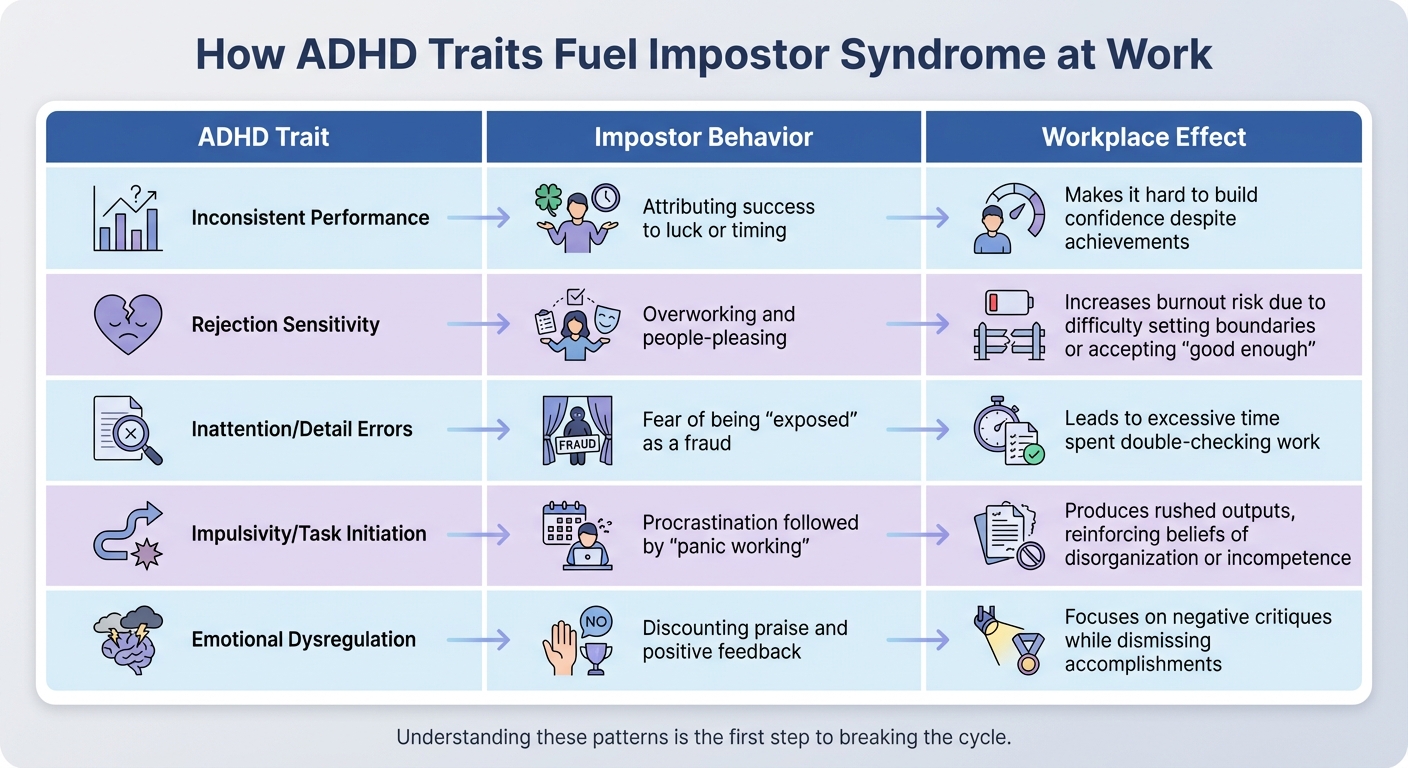
How ADHD Traits Fuel Impostor Syndrome in the Workplace
This section dives into how ADHD traits intersect with workplace expectations, shedding light on the unique challenges professionals with ADHD face.
While ADHD doesn’t directly cause impostor syndrome, the two often feed into each other, creating a tough cycle to break. In workplaces designed for neurotypical individuals, the gap between what you aim to achieve and what you deliver can magnify doubts about belonging. Around 4.4% of adults in the U.S. have ADHD, and studies indicate up to 70% of people experience impostor syndrome at some point . For those with ADHD, these feelings can be more intense and longer-lasting.
The link often starts with years of facing ADHD-related challenges and criticism. If you’ve ever been told, “You’re not living up to your potential” or “You just need to try harder,” these messages can accumulate over time. They shape a narrative that your struggles reflect personal failings rather than neurological differences, making success feel overshadowed by self-doubt.
Masking adds another layer. Many ADHD professionals develop coping strategies to conceal their symptoms - like staying late to triple-check emails, over-preparing for meetings, or creating backup plans for forgotten tasks. While these behaviors help meet expectations, they also deepen impostor feelings. Masking creates a divide between your authentic self and the image you present at work. As Dr. Sharon Saline explains, this disconnect undermines self-confidence, reinforcing fears that success is built on a facade.
Now, let’s break down specific ADHD traits that can fuel these impostor feelings.
ADHD Traits That Trigger Impostor Feelings
One of the biggest challenges is inconsistent performance. ADHD symptoms can vary from day to day. One week, you might be hyperfocused and knocking out tasks effortlessly; the next, even starting a simple project feels impossible. This unpredictability makes it hard to build a stable sense of competence. When your performance fluctuates, success can feel like luck, while struggles seem like proof of inadequacy.
Rejection sensitivity dysphoria (RSD) makes workplace feedback even harder to handle. A small critique from a manager can feel like a crushing blow, reinforcing fears of incompetence. In one survey of adults with ADHD, 8% identified “sensitivity to feedback” as their most prominent perfectionist trait, while 42% reported a mix of perfectionist tendencies, including setting unrealistic standards and comparing themselves negatively to others. This heightened sensitivity often leads to perfectionism, where anything less than flawless feels like failure.
Executive function deficits also play a role. Forgetting details, struggling with time management, or procrastinating on important projects can serve as daily reminders that you’re “different.” The ADHD brain’s lower dopamine levels mean that positive feedback doesn’t stick for long. You might receive glowing praise for a project, but within hours, you’re back to doubting yourself and worrying about the next challenge.
All-or-nothing thinking can be particularly damaging. Dr. Sharon Saline explains:
Perfectionists are often driven by the fear of disappointing themselves or others. They are all-or-nothing thinkers; if it's not perfect, it's a failure.
In the same survey, 13% of ADHD respondents identified this cognitive pattern as their most prominent perfectionist trait. This mindset can make it hard to persevere through learning curves. If you don’t master something immediately, you might abandon it altogether, seeing yourself as a failure instead of a work in progress.
ADHD vs. Impostor Syndrome at Work
These ADHD traits often lead to specific behaviors that feed impostor syndrome, creating workplace patterns that reinforce self-doubt:
| ADHD Trait | Impostor Behavior | Workplace Effect |
|---|---|---|
| Inconsistent Performance | Attributing success to luck or timing | Makes it hard to build confidence despite achievements |
| Rejection Sensitivity | Overworking and people-pleasing | Increases burnout risk due to difficulty setting boundaries or accepting "good enough" |
| Inattention/Detail Errors | Fear of being "exposed" as a fraud | Leads to excessive time spent double-checking work |
| Impulsivity/Task Initiation | Procrastination followed by "panic working" | Produces rushed outputs, reinforcing beliefs of disorganization or incompetence |
| Emotional Dysregulation | Discounting praise and positive feedback | Focuses on negative critiques while dismissing accomplishments |
These patterns create a cycle that’s hard to break. One Ph.D. student, Avery, describes it like this:
I have developed this constant cycle of procrastinating and feeling HUGE guilt, and then doing it all last minute and somehow doing it so well that no one ever believes it was last minute… I'm constantly constantly constantly beating myself up because I only do a fraction of the hours I'm supposed to be doing.
When you consistently deliver high-quality work at the last minute, it’s easy to dismiss your abilities, chalking success up to adrenaline or luck rather than skill. This feeds into the “twice as hard” phenomenon, where ADHD professionals feel they must work twice as hard as their neurotypical peers to achieve the same results. Over time, this reinforces the belief that you’re “faking it” or inherently less capable.
How Impostor Syndrome Affects ADHD Professionals
Impostor syndrome can wreak havoc on both emotional well-being and career trajectories, especially for professionals with ADHD. When the traits of ADHD collide with impostor feelings, it creates a challenging loop that undermines productivity, confidence, and long-term goals. The impact is felt not just at work but also in personal life, as the emotional toll often spills over into every corner of a professional's day.
The Emotional and Career Costs
For individuals with ADHD, impostor syndrome amplifies existing challenges. Anxiety and the constant fear of being "found out" drain mental energy and disrupt focus. This leaves less room for managing thoughts, staying organized, and making the most of already taxed executive functions.
Anne, an intern, shared her experience of how this fear affected her on the job:
This fear of messing up slowly kind of like took over me and affected my ability to perform at this job. I would barely speak up in meetings. I had constant anxiety that I would do something wrong.
This kind of anxiety doesn’t just silence voices in meetings - it stifles growth and creates a barrier to professional development. Dr. Sharon Saline, Psy.D., sheds light on the internal battle many face:
We worry about whether someone's going to discover the real you, the incompetent or foolish or irresponsible one… it's hard to dismiss these thoughts because they can be deeply ingrained.
For ADHD professionals, this anxiety is often heightened by Rejection Sensitive Dysphoria (RSD). This condition makes even routine feedback feel overwhelmingly personal, triggering a fight-or-flight response that neurotypical colleagues might not experience. As a result, constructive criticism can feel like a crushing blow, leading to avoidance of situations where feedback might occur.
Career progression also takes a hit. Impostor syndrome convinces professionals to pass on opportunities, whether it’s declining a promotion, avoiding a job application, or refusing to negotiate for a raise - all due to the belief that they aren’t truly capable or deserving. This hesitance to take risks or embrace new roles stems from a fear of being unable to maintain the "illusion" of competence.
The cycle of overcompensation further compounds these challenges. ADHD professionals often push themselves to work harder than their peers, trying to mask symptoms like distraction or forgetfulness. This excessive effort leads to exhaustion and, eventually, burnout.
Perhaps the most insidious effect is the way impostor syndrome warps self-perception. The ADHD brain has a tendency to focus on failures while dismissing successes. A single mistake can overshadow an otherwise stellar track record. With lower dopamine levels, the satisfaction from achievements fades quickly, leaving self-doubt to take center stage.
Real Workplace Examples
These emotional and career struggles show up in everyday professional scenarios, often in ways that feel frustratingly familiar:
- Over-preparing for simple tasks: Spending hours perfecting a basic email or presentation wastes time and reinforces feelings of inadequacy. This drains energy that could be directed toward more impactful work.
- Avoiding visibility: Opportunities to shine - like presenting at a meeting or leading a project - are passed up because of self-doubt. Even with years of experience, you might feel unqualified or fear being exposed as a fraud.
- Procrastination fueled by perfectionism: Fear of falling short leads to delays. Projects are postponed until deadlines loom, forcing a last-minute scramble. Even if the final product is excellent, the lingering guilt and shame overshadow any sense of accomplishment.
- Deflecting praise: When a team celebrates your success, you might downplay your role, crediting others or chalking it up to luck. Compliments feel undeserved, as if the person giving them doesn’t see the "real" you.
- Invisible overtime: To make up for perceived shortcomings, you might work late nights or weekends without telling anyone. This hidden effort not only accelerates burnout but also reinforces the belief that your achievements require extraordinary effort.
The combination of impostor syndrome, anxiety, and ADHD creates a self-perpetuating cycle. The behaviors driven by impostor feelings - like overworking or avoiding challenges - lead to stress and reduced performance. This, in turn, feeds the belief that you’re not good enough, making it even harder to break free from the pattern.
How to Manage Impostor Syndrome with ADHD
ADHD traits can amplify feelings of being an impostor, but there are strategies tailored to address this. These approaches focus on challenges like time blindness, working memory gaps, and the brain's need for dopamine, helping to break the cycle of doubt.
Reframe Negative Thoughts
For many with ADHD, self-doubt often overshadows success. The brain tends to filter out wins and amplify criticism. To push back, try giving your inner critic a funny name - like "Doubt Goblin" or "Liar Larry." This small step creates emotional distance from those harsh thoughts.
Another tactic is the Success Jar Method. Use a jar or digital folder to save screenshots of compliments, positive emails, or small daily victories. When self-doubt creeps in, revisit these reminders of what you've accomplished.
Shift your focus from achieving perfection to recognizing effort. Dr. Sharon Saline, Psy.D., explains:
We have to shift from 'ugh, I've wasted my time. I'm messing up. I can't focus… I'm not productive' to noticing when things are actually moving in a productive, effective direction.
Challenge the idea of being "lazy." Zach, a professional with ADHD, reframed his procrastination by saying:
The biggest thing that's helped me… is that if I were lazy, I wouldn't care. I WANT things to be done... Lazy people are lazy explicitly because they DON'T care, and so if I do, then I am not them.
When negative thoughts arise, write them down. Seeing them on paper makes it easier to counter with facts. For instance, replace "I don't deserve this role" with evidence like, "The company hired me because they saw my potential."
Finally, work on separating your sense of self-worth from your job performance.
Separate Self-Worth from Performance
It can be hard to untangle your value as a person from your work, especially when ADHD makes external validation feel fleeting. But your worth goes far beyond what you produce professionally.
Set aside time for activities unrelated to work. These "non-negotiables" could be anything - a weekly hobby, dinner with friends, or a morning walk. These moments help you establish boundaries and avoid overworking, which often leads to burnout. As Mark, another ADHD professional, shares:
I think we do need to cut ourselves some slack and just accept the fact that we don't need as much time as other people and to use that extra time for ourselves instead of sitting at our desks beating ourselves up.
Be mindful of "masking", or adopting a persona to meet neurotypical expectations. Recognizing when you're doing this can help you reclaim your authenticity and reduce the fear of being "found out" as a fraud.
When confidence feels out of reach, try "Acting As If." Ask yourself, "What would I do if I believed I belonged here?" Then take that action. Confidence often follows action, making this a practical way to break free from a self-doubt spiral.
This balance between work and personal identity sets the stage for embracing your ADHD-driven strengths.
Use ADHD Strengths to Combat Impostor Syndrome
The traits that make you feel different are often the reasons you stand out. ADHD can bring creativity, out-of-the-box problem-solving, and the ability to hyperfocus on engaging tasks - qualities that add value in the workplace. Shifting your perspective from "different" to "dynamic" can help you see these traits as assets.
Take ADHD coach Jaye Lin, for example. In June 2025, she appeared on the "MissUnderstood" podcast alongside prominent creators. Initially, she felt like an impostor because of her smaller following. But she leaned into her ADHD-fueled "dopamine of opportunity" to take bold risks in her writing, building a portfolio that silenced her self-doubt.
Similarly, a college student named Anne used her ADHD intensity to create a standout video for her dream internship. Her ability to hyperfocus allowed her to produce something unique, setting her apart from typical candidates.
Channel your hyperfocus into projects that highlight your strengths. This shift can replace anxiety with excitement, helping you develop internal validation instead of relying on external praise. Remember, your unique perspective and hard work are what make you deserving of your achievements.
Conclusion
Impostor syndrome goes beyond simple self-doubt - it's a deep-seated fear of being exposed as a fraud. For individuals with ADHD, this feeling can be even more overwhelming. The constant effort to mask symptoms, work harder to meet neurotypical expectations, and navigate challenges with executive function only adds to the struggle.
The strategies discussed - like reframing negative thoughts, detaching self-worth from performance, and embracing your ADHD strengths - aren’t just about coping. They’re about recognizing that your value lies in your unique perspective and effort, not in conforming to a neurotypical standard. The fact that you’re here, reading this, shows your commitment to growth and self-improvement.
These approaches are not just helpful for managing everyday hurdles but are also critical for maintaining a sustainable career. Impostor syndrome thrives in isolation, but you don’t have to face it alone. Support from ADHD coaching, therapy, or peer communities can make a major difference. The stress caused by impostor syndrome is a significant contributor to burnout, which affects 31% of employees in the UK and leads 1 in 10 people to consider quitting their jobs daily. Addressing this head-on is crucial for both your mental health and long-term career success.
For professionals navigating the challenges of ADHD and high performance, On/Off Genius provides tailored tools and insights to help you thrive - not just survive - in your career. You deserve a work life where your strengths shine and your efforts are valued.
FAQs
How can I tell impostor syndrome from ADHD symptoms at work?
Impostor syndrome is marked by ongoing self-doubt, a sense of being a fraud, and crediting success to luck rather than personal ability - even when there’s clear evidence of achievement. ADHD, on the other hand, is characterized by difficulties with focus, staying organized, managing time, and controlling impulsive behaviors. If you often feel unworthy of your accomplishments despite receiving praise or positive feedback, that’s likely impostor syndrome. On the flip side, if you find yourself missing deadlines or struggling to stay focused regardless of how confident you feel, those are more aligned with ADHD-related challenges.
What should I do when feedback triggers rejection sensitivity and self-doubt?
When feedback stirs up feelings of rejection or self-doubt, it’s important to remember that these reactions are common for individuals with ADHD. Try to view feedback as an opportunity to learn and improve, rather than a personal critique. Be kind to yourself - self-compassion goes a long way. Keep in mind that rejection sensitivity dysphoria (RSD) can intensify your emotions, so shift your focus to your strengths and accomplishments. Celebrate even small wins, and don’t hesitate to reach out to trusted colleagues or mentors for support and a balanced perspective.
How can I stop overworking to “prove myself” without hurting my performance?
Overworking can often be linked to self-doubt and impostor syndrome, especially for those with ADHD. To tackle this, it's important to set clear boundaries around your work hours and prioritize quality over sheer quantity. Breaking tasks into smaller, manageable steps can help prevent burnout and make progress feel more achievable.
It's also crucial to remind yourself that your worth isn’t defined by how much you produce. Seeking feedback from trusted colleagues can provide a more objective view of your performance, helping you maintain a balanced perspective while building healthier work habits.