ADHD and Working Memory: Brain Function Explained
How ADHD-related brain differences affect working memory, focus, and impulse control — plus practical strategies and tools to reduce mental overload.

Working memory is your brain's mental workspace, helping you hold and manipulate information in real-time. For people with ADHD, this system often struggles, making tasks like organizing, focusing, and remembering multi-step instructions more difficult. Research shows that 75–81% of children with ADHD face working memory challenges, which often persist into adulthood. These difficulties aren't related to intelligence but stem from differences in brain activity, particularly in areas like the prefrontal cortex, striatum, and cerebellum.
Key points about ADHD and working memory:
- Brain regions involved: Prefrontal cortex, caudate nucleus, and cerebellum show reduced activity, making it harder to process and store information.
- Task complexity: Individuals with ADHD perform well on simple tasks but struggle as complexity increases.
- Types of memory affected: Verbal memory is often stronger than visual memory in ADHD, but both can face challenges depending on the situation.
Managing these difficulties involves strategies like external systems (e.g., writing things down), chunking tasks, and using technology to reduce mental load. Tools like digital planners, voice-to-text apps, and structured routines can help. By understanding these brain differences and using practical methods, individuals with ADHD can better navigate working memory challenges.
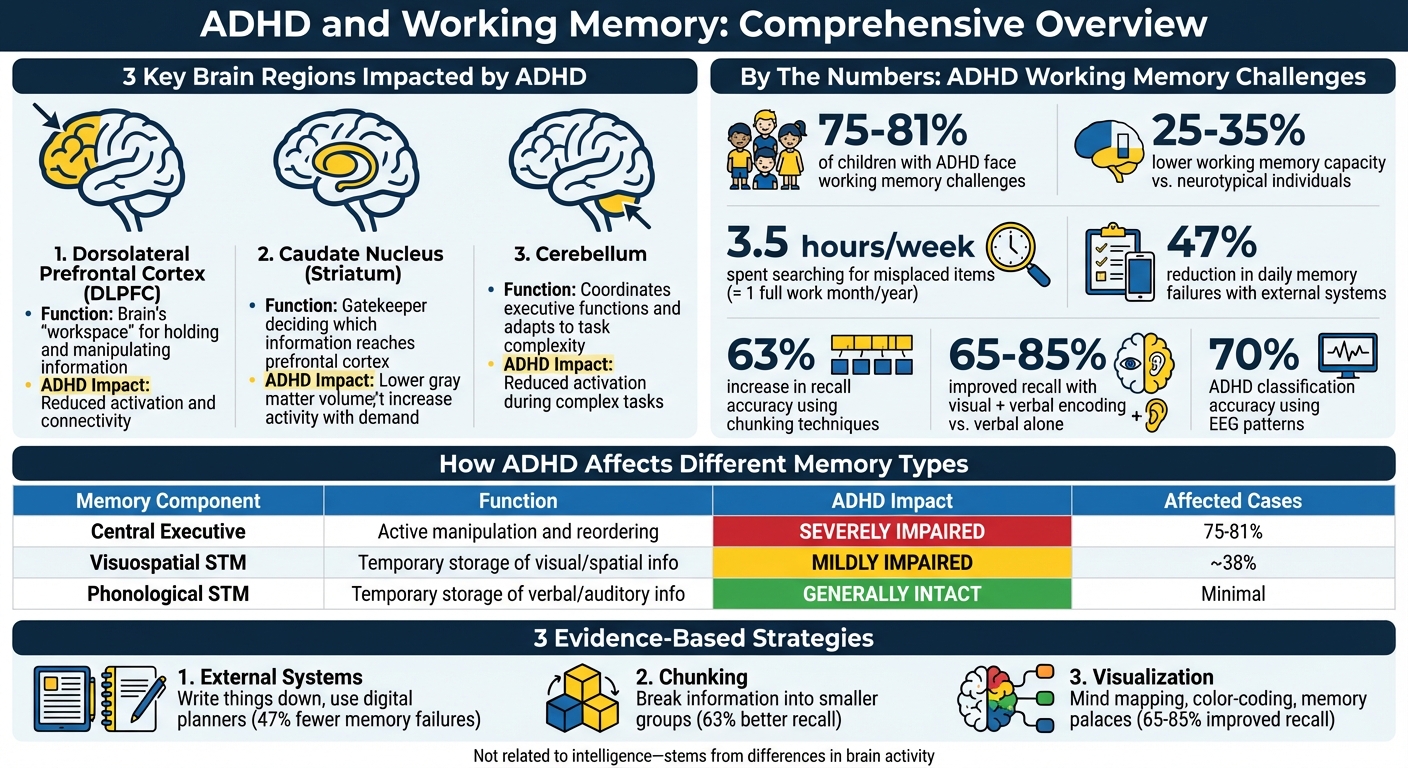
ADHD Working Memory: Brain Regions, Impacts, and Management Strategies
Brain Mechanisms Behind Working Memory in ADHD
Brain Regions That Control Working Memory
Three key brain regions play a role in working memory for individuals with ADHD:
- Dorsolateral Prefrontal Cortex (DLPFC): This area acts as the brain's "workspace", responsible for holding and manipulating information. In ADHD, studies show reduced activation and connectivity in the DLPFC during tasks that require executive functions .
- Caudate Nucleus: Located in the striatum, this region serves as a gatekeeper, deciding which information gets passed to the prefrontal cortex. Research highlights that adolescents diagnosed with ADHD tend to have lower gray matter volume in the caudate. Additionally, this region does not increase activity as working memory demands rise, unlike in neurotypical individuals.
- Cerebellum: Known for coordinating executive functions and adapting to task complexity, the cerebellum is particularly affected in ADHD. For example, tasks requiring sequence reversal instead of repetition reveal reduced activation in the right cerebellum .
"The ADHD group displayed hypo-activation compared to NT group during higher load and greater complexity." – Prerona Mukherjee, Department of Psychiatry and Behavioral Sciences, University of California, Davis
How Brain Networks Connect Differently in ADHD
ADHD doesn't just affect individual brain regions - it also alters how these regions communicate. For example, in neurotypical brains, the default mode network (DMN) - associated with daydreaming - shuts down during tasks requiring focus. In ADHD, however, the DMN often stays active, making it harder to concentrate .
"Working memory in Attention Deficit/Hyperactivity Disorder is characterized by a lack of specialization of brain function." – Catherine Fassbender, MIND Institute
Another key difference lies in the dorsal frontoparietal executive network, which includes the right DLPFC and posterior parietal cortex. In ADHD, connectivity within this network is weaker. Instead of relying on specialized prefrontal areas for working memory tasks, the ADHD brain compensates by recruiting additional regions, such as the insula or medial prefrontal cortex. While this strategy helps, these areas are less efficient for managing such tasks.
What Brain Scans Show About ADHD and Working Memory
Brain imaging studies provide a clearer picture of how ADHD impacts working memory. For instance:
- A 2021 study at the University of California, Davis MIND Institute examined 50 participants with ADHD and 82 neurotypical participants (ages 12–23) using the Picture Order Memory Paradigm. Results showed that as the memory load increased, ADHD participants experienced significant hypo-activation in the right striatum. Additionally, more complex tasks led to reduced activation in the right cerebellum .
- A 2011 study conducted at Massachusetts General Hospital by Dr. George Bush used fMRI scans to analyze 21 adults with ADHD. Participants who received methylphenidate exhibited higher activation in the dorsal anterior midcingulate cortex and broader cingulo-frontal-parietal networks compared to those on a placebo. This suggests that medication may help normalize underactivity in these areas.
- EEG data also supports these findings. Patterns such as reduced P2 amplitude, abnormal alpha desynchronization during encoding, and altered theta synchronization during maintenance can classify ADHD with 70% accuracy. These results point to challenges in the initial encoding phase of working memory, with the brain compensating during later stages.
Types of Working Memory Problems in ADHD
Central Executive Problems
The central executive acts as the control center of working memory, managing and organizing incoming information. In ADHD, this system faces significant disruption. Studies reveal impairments of a very large magnitude (effect sizes ranging from d = 1.63 to 2.03), impacting around 75% to 81% of children with ADHD.
"ADHD status was associated with very large magnitude impairments in central executive working memory that are present in most pediatric cases."
– Michael J. Kofler, Ph.D., Florida State University
These deficits make it difficult to follow multi-step instructions, stick to behavioral rules, or keep long-term goals in focus. Instead, the brain often gravitates toward immediate rewards, neglecting delayed outcomes. This breakdown in the "command center" of working memory provides a foundation for understanding other types of memory challenges in ADHD.
Short-Term Memory vs. Working Memory
Short-term memory and working memory serve different purposes, and understanding these distinctions is key to grasping their role in ADHD. Short-term memory temporarily holds information, like remembering a phone number just long enough to dial it. In contrast, working memory actively processes and manipulates information to complete more complex tasks.
| Memory Component | Function | ADHD Impact |
|---|---|---|
| Central Executive | Active manipulation and reordering of information | Severely Impaired (75–81% of cases) |
| Visuospatial STM | Temporary storage of visual/spatial information | Mildly Impaired (≈38% of cases) |
| Phonological STM | Temporary storage of verbal/auditory information | Generally Intact |
Research shows that while phonological short-term memory remains unaffected in most cases, visuospatial short-term memory experiences mild impairment (effect size: d = 0.60). These differences highlight how specific memory deficits contribute to challenges in managing impulsive behaviors in ADHD.
Effects on Impulse Control
The working memory deficits in ADHD play a direct role in impaired impulse control. When goal-relevant information is hard to maintain, inhibiting impulsive actions becomes a struggle. This often leads individuals with ADHD to opt for smaller, immediate rewards rather than waiting for larger, delayed ones. Additionally, studies show a significant negative correlation between inattention and working memory performance (ρ = -0.346). Reduced activity in the anterior cingulate cortex - an area critical for monitoring performance and adjusting behavior - further exacerbates these issues.
Why I Can't Remember Things -- How ADHD Affects Working Memory
How to Manage Working Memory Deficits
Understanding how working memory deficits impact individuals with ADHD is key to developing strategies that address these challenges effectively.
Cognitive and Behavioral Methods
One practical way to manage working memory challenges is by externalizing information - writing things down or using digital tools to reduce mental strain. As Learn to Thrive with ADHD explains:
"External memory systems aren't a crutch – they're a prosthetic for a neurological difference".
This strategy has been shown to reduce daily memory failures by 47% for people with ADHD.
Another helpful technique is chunking information into smaller, manageable groups. For example, breaking a 10-digit phone number into three parts - area code, prefix, and line number - can increase recall accuracy by up to 63%.
Visualization techniques, like mind mapping, color-coding, or creating memory palaces, also engage the brain's visual strengths. Studies show that encoding information both visually and verbally can improve recall rates by 65–85% compared to relying on verbal encoding alone. Adding physical movement, such as walking while rehearsing information, can further enhance long-term memory retention .
After incorporating these behavioral adjustments, technology can play a key role in reinforcing these strategies.
Technology and Tools That Help
Sometimes, simple tools like paper and pencil are the best choice, as they avoid the distractions that come with digital devices.
When using technology, it’s important to be intentional. For example, voice-to-text tools like Otter.ai can help you capture notes without losing focus. Digital calendars are another useful tool for managing appointments and deadlines. A dual-computer setup - one for focused work and another for tasks like email or browsing - can help reduce distractions. Additionally, apps that block social media or browsing, as well as visual aids like photos of pre-planned outfits or workspace setups, can ease mental overload.
Creating External Support Systems
In addition to personal strategies, creating external systems of support can make a big difference for managing working memory deficits.
Research shows that working memory capacity in individuals with ADHD can be 25–35% lower than in neurotypical individuals. This often leads to challenges like spending an average of 3.5 hours per week searching for misplaced items or forgotten information - equivalent to nearly a full work month each year.
A clutter-free workspace with only task-relevant items can help minimize distractions. Establishing visual anchors, such as a designated spot for essentials, supports better memory recall and workplace organization.
Another useful tip is the "Rule of Three": when receiving instructions, make eye contact, repeat the direction, and state it twice. This process helps transfer the information into long-term memory .
Building external support systems - like working with accountability partners, coaches, or setting up structured check-ins - can significantly reduce the strain on working memory. The aim isn’t to "fix" memory deficits but to create an environment where your brain can focus on what matters most.
These strategies help bridge the gap between the challenges of ADHD and achieving success in the workplace.
Conclusion
ADHD-related working memory challenges are rooted in how the brain processes information. Differences in brain activity, particularly underactivity in the prefrontal cortex and imbalances in dopamine and norepinephrine, play a major role . These differences affect how you encode, store, and retrieve information, which can make it harder to stay focused, regulate emotions, and maintain steady performance at work.
Understanding these brain differences opens the door to practical strategies. Tools like digital planners, paper systems, and visual reminders can help lighten the load on your brain's limited "mental whiteboard." Breaking tasks into smaller, more manageable steps, sticking to consistent routines, and using techniques like the "Rule of Three" for remembering instructions align with how your brain works, rather than fighting against it.
These aren’t shortcuts - they’re tools designed to support the unique way your brain functions. By reducing the strain on your working memory, you free up mental energy for deeper thinking and problem-solving, allowing you to perform at your best.
The strategies shared in this article can significantly reduce memory lapses and improve recall. They create an environment where you can focus on meaningful work without constantly battling forgetfulness or distraction.
Start by trying just one approach - maybe a new external system or a chunking method - for a week. While your working memory capacity may be 25–35% lower than that of neurotypical individuals, the right tools can make that difference manageable and help you achieve more consistent results.
FAQs
How can I tell if my issue is working memory or just distraction?
Working memory problems make it hard to hold onto and work with information for short periods, while distraction involves losing focus because of unrelated stimuli. If you find tasks that require active recall - like remembering instructions or details - particularly challenging, it might signal working memory struggles. Recognizing the difference between these issues can help you create strategies that specifically target your needs.
Do ADHD meds improve working memory, or only focus?
ADHD medications, such as methylphenidate, don’t just help with focus - they also play a role in improving working memory. They achieve this by influencing key brain areas like the dorsolateral prefrontal cortex and posterior parietal cortex, which are crucial for memory-related cognitive functions.
What’s the fastest way to reduce working memory overload at work?
To ease the mental load at work, try breaking tasks into smaller, more manageable steps. This approach makes even complex projects feel less overwhelming. Additionally, use tools like sticky notes, checklists, or digital reminders to store information outside your brain. These simple strategies can help you stay organized and focused, reducing the stress of trying to remember everything at once.