ADHD Identity: Building a Strengths-Based Mindset
ADHD is a different brain with strengths like hyperfocus, creativity, and resilience — reframe identity, craft supportive environments, and use practical tools.

ADHD isn’t a flaw - it’s a different brain profile that thrives on interest, novelty, and urgency. Many adults with ADHD grow up internalizing negative labels like "lazy" or "unreliable", but shifting focus to strengths like hyperfocus, energy, and problem-solving can transform self-perception and improve well-being.
Key Takeaways:
- Strengths-Based Thinking: Focusing on ADHD strengths, such as creativity, resilience, and quick decision-making, reduces stress and boosts quality of life.
- Environment Matters: ADHD traits can be challenges in rigid settings but become assets in flexible, dynamic spaces.
- Self-Compassion: Reframing past struggles and silencing the inner critic helps shift from self-blame to self-acceptance.
- Practical Tools: Use strategies like energy mapping, body doubling, and structured routines to align your tasks with ADHD strengths.
Why It Matters:
Research shows that adults with ADHD who emphasize their strengths report less anxiety, depression, and stress. By understanding your brain’s unique wiring, you can stop battling it and start working with it to thrive personally and professionally.
Understanding ADHD Beyond Deficits
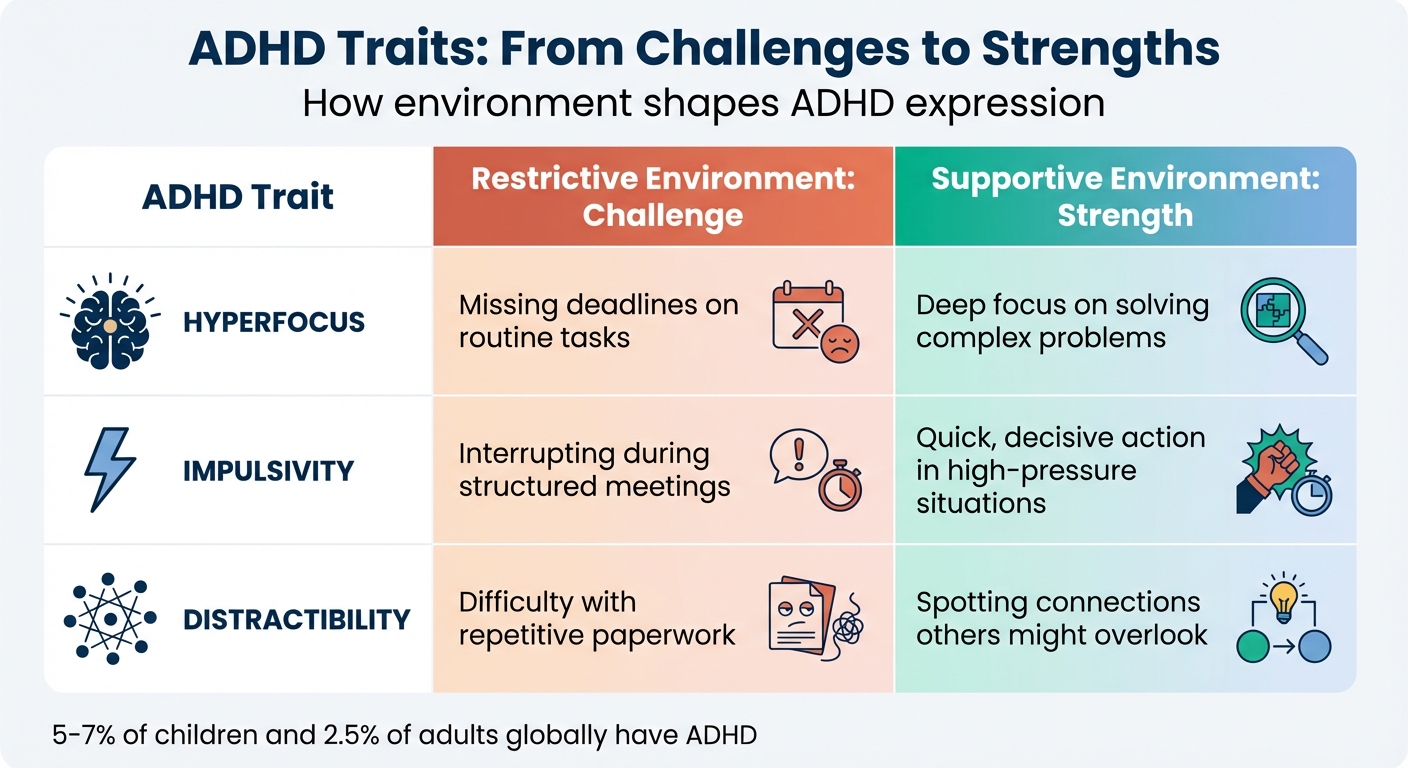
ADHD Traits: Challenges vs Strengths in Different Environments
ADHD as a Different Brain Profile
ADHD isn't about being "broken" or "less than"; it's a completely different way of operating. Unlike neurotypical brains that draw motivation from a task's importance, ADHD brains run on an interest-based system. What grabs attention? Things like novelty, challenge, urgency, or personal passion - not abstract deadlines or external expectations. This isn't a shortcoming; it's simply a different way of processing and prioritizing information.
The term "Attention Deficit" can be misleading. ADHD isn't about a lack of attention - it's about variable attention. You might hyperfocus on a fascinating project for hours but struggle to start a quick, mundane task. This isn't laziness; it's a reflection of how your brain is wired. Additionally, the prefrontal cortex - the area responsible for executive functions like planning and decision-making - develops differently in ADHD brains, often maturing fully between ages 21 and 25.
Instead of thinking, "How can I change to fit the standard mold?" try reframing the question: "What support systems can help me thrive as I am?". Your brain isn't built for repetitive, low-stimulation routines. It excels in fast-paced, high-energy, and creative environments. Embracing this mindset helps shift the focus from "fixing" yourself to recognizing and leveraging your unique strengths. This approach not only redefines challenges but also highlights how much your surroundings influence your experiences.
How Environment Shapes ADHD Expression
Your environment plays a huge role in how ADHD traits show up. The same characteristic that's a challenge in one setting can become a strength in another. For instance, distractibility might seem like a problem when you're buried in repetitive tasks, but it can translate to curiosity when you're exploring new ideas. Similarly, impulsivity may disrupt a formal meeting but enable quick thinking during a crisis or while making bold entrepreneurial moves. Hyperfocus, which might cause you to skip meals, can also lead to groundbreaking results on projects you're passionate about.
| ADHD Trait | Restrictive Environment (Challenge) | Supportive Environment (Strength) |
|---|---|---|
| Hyperfocus | Missing deadlines on routine tasks | Deep focus on solving complex problems |
| Impulsivity | Interrupting during structured meetings | Quick, decisive action in high-pressure situations |
| Distractibility | Difficulty with repetitive paperwork | Spotting connections others might overlook |
Take the example of a rigid office job with endless meetings and strict deadlines - it might feel like your brain is hitting a wall. But in a flexible role with diverse projects and the freedom to follow your interests, those same traits can become your superpowers. Globally, about 5–7% of children and 2.5% of adults with ADHD experience these contrasts, showing how much context matters. Designing an environment that aligns with your natural tendencies can make all the difference.
Core Strengths Associated with ADHD
Understanding your natural strengths is a powerful way to reshape how you view ADHD. These strengths aren’t just abstract concepts - they’re real advantages that can positively impact your personal and professional life.
Energy and Drive
People with ADHD often have an abundance of energy. In one study, every participant highlighted their high energy levels as a positive trait. This energy often translates into enthusiasm and persistence, particularly when you're working on something you’re passionate about. In high-pressure environments, this drive can help you stay focused and meet tight deadlines.
To make the most of this strength, plan your most challenging tasks during your natural energy highs. Adding aerobic exercise - like a brisk walk, HIIT session, or even dancing - can also enhance focus and mental clarity. Research shows that physical activity boosts concentration and cognitive control in individuals with ADHD.
Adaptability and Creative Thinking
The ADHD brain thrives on divergent thinking, which allows you to come up with multiple solutions to a single problem. While others may focus on one path, you can easily see several possibilities. Studies even show that people with ADHD often outperform others in real-time creative tasks. This ability to think outside the box also includes spotting patterns and connections that might elude others.
This creative edge is especially valuable in areas like entrepreneurship, design, software development, and crisis management, where quick thinking is essential. Adopting a "prototype mindset" - treating early attempts as experiments rather than final answers - can help you embrace failure as part of the process and unlock your full creative potential.
Resilience and Problem-Solving
Resilience is another key strength that builds on your energy and creativity. Living with ADHD often means adapting to a world that doesn’t always align with how your brain works. This constant navigation can foster remarkable resilience. For example, challenges like missed deadlines can teach you how to pivot and find alternative solutions quickly.
This resilience doesn’t just help with problem-solving; it can also improve your overall well-being. Many adults with ADHD who focus on their strengths report fewer symptoms of depression and anxiety, along with a better quality of life.
| Strength | Professional Application | Personal Application |
|---|---|---|
| High Energy | Thriving in fast-paced roles like sales or emergency response | Staying active with sports, fitness, or adventurous hobbies |
| Divergent Thinking | Driving innovation, brainstorming, and strategy | Tackling creative projects or solving household challenges |
| Resilience | Adapting to career changes and bouncing back from setbacks | Overcoming daily hurdles and social misunderstandings |
Experts suggest creating "scaffolding with freedom" - a simple routine that provides structure while leaving space for spontaneous and creative moments. This approach balances stability with flexibility, supporting your natural ability to adapt and innovate.
Building Self-Awareness to Reframe ADHD Identity
Adults with ADHD often find themselves labeled negatively in environments designed for neurotypical brains. Over time, these labels - lazy, careless, unmotivated - become internalized. But with self-awareness, these challenges can be seen as characteristics of a unique brain profile rather than personal flaws. Many adults realize, often later in life, that their struggles stem from trying to fit into systems that don’t align with how they process information. This shift in perspective opens the door to practical steps that can turn self-perception into actionable strengths.
Why does this matter? Because it directly impacts well-being. Research shows that people who focus on their strengths daily are 6 times more likely to be engaged in their jobs and more than 3 times as likely to report a high quality of life. An international study from January 2026 found that adults with ADHD who actively identify and use their strengths report greater life satisfaction, improved well-being, and fewer symptoms of anxiety, depression, and stress.
Diagnosis and Self-Compassion
Receiving an ADHD diagnosis can be life-changing. It allows you to reinterpret past struggles - like forgotten deadlines or missed details - not as personal failures but as symptoms of an unsupported brain profile.
Self-compassion plays a critical role here. Many people with ADHD grow up hearing constant negative feedback. By the age of 10, a child with ADHD may have heard 20,000 corrective or negative comments. These messages often create a harsh inner voice that’s difficult to silence. Adding to this, 95% of adults with ADHD experience Rejection Sensitive Dysphoria (RSD), an intense emotional reaction to perceived criticism that makes self-compassion feel risky.
"Compassion may be the fastest route toward functioning better... It's how we learn to cooperate with our ADHD instead of fighting against it."
– Dylan Alter, ADHD Coach
Practicing self-compassion doesn’t mean ignoring challenges. Instead, it’s about treating yourself with the same kindness you’d offer a close friend. When you make a mistake, ask yourself, “What would I say to a friend in this situation?” Then, direct that same understanding toward yourself.
Simple techniques can make a big difference. For example, taking a self-compassion break: place your hand on your heart, breathe deeply, and acknowledge, “This is hard. I deserve kindness”. Another strategy is naming your inner critic. By giving it a name like "Critical Carl", you create distance from the negative thoughts, recognizing them as just that - thoughts, not facts.
| ADHD Trait | Deficit-Focused View | Strengths-Based Reframe |
|---|---|---|
| Impulsivity | Carelessness, lack of filter | Bravery, quick brainstorming, decisive action in a crisis |
| Distractibility | Inability to focus | Noticing details others miss, divergent thinking, creativity |
| Hyperfocus | Neglecting responsibilities | Deep engagement, high productivity, intense learning |
| Emotional Intensity | Vulnerability to overwhelm | Deep empathy, social perceptiveness, strong intuition |
Once self-compassion is in place, the next step is identifying and applying your unique strengths.
Identifying Your Personal Strengths
Self-awareness not only reduces self-criticism but also uncovers talents that can fuel personal and professional growth. Many adults with ADHD overlook their natural abilities, either because these traits were criticized during childhood or because they come so easily that they’re dismissed as unimportant. However, the same strengths you use in hobbies or personal interests can also solve challenges at work.
Start by taking stock of your strengths. Ask yourself: What activities energize me? What do others say I’m good at? What accomplishments make me proud?. Look for recurring themes. For instance, if brainstorming with others consistently excites you, creative collaboration might be one of your core strengths.
Feedback from others can also be eye-opening. Ask five people from different areas of your life - a partner, boss, friend, mentor, and coworker - to name three things they appreciate most about you. Pay attention to patterns. If several people highlight your ability to stay calm under pressure or your knack for creative problem-solving, those are likely key strengths.
Reframing childhood "troubles" can also be revealing. For example, being told you "talk too much" as a child might now translate into strong communication skills in your career. A 2017 study in The Journal of Attention Disorders even found that individuals with ADHD scored higher on divergent thinking tests, a key indicator of creativity.
Energy mapping is another practical tool. Track your energy levels for a week, noting when you feel most focused and productive. This helps identify your "peak windows", times when ADHD traits like hyperfocus are most accessible. Use these windows for your most demanding tasks.
For a structured approach, try a SWOT analysis (Strengths, Weaknesses, Opportunities, Threats) when facing a challenge. Start by listing your strengths first to interrupt negative thinking and reframe the situation. Formal tools like the VIA Character Strengths survey can also provide a baseline for identifying your natural abilities.
"It can be really empowering to recognize that, while ADHD is associated with various difficulties, it does have several positive aspects."
– Luca Hargitai, Lead Researcher, University of Bath
A January 2025 study comparing 200 adults with ADHD to 200 neurotypical adults found that those with ADHD were more likely to identify with strengths such as hyperfocus, humor, creativity, spontaneity, and intuition. Recognizing these patterns shifts the narrative - ADHD isn’t just about challenges; it’s a different way of processing the world, one that comes with its own set of advantages.
Creating Environments That Support ADHD Strengths
Once you’ve identified your personal strengths, the next step is crafting environments that align with the way your ADHD brain operates. Recognizing strengths is only one part of the puzzle; the other is creating spaces - both professional and personal - that let those strengths flourish. For example, what might seem like distractibility in a rigid office could become innovative problem-solving in a more adaptable workspace. Similarly, impulsivity in a slow-moving organization might turn into quick, effective decision-making during high-pressure situations.
The difference between thriving and struggling often boils down to whether your environment works with your natural tendencies. Support from managers can be a game-changer for success in the workplace. Likewise, personal relationships that focus on resolving conflicts quickly - without blame - tend to be more satisfying, especially when both partners openly acknowledge and address challenges.
The goal is to move away from settings that force you to suppress your traits, which can lead to burnout, and toward environments that embrace and leverage your unique wiring. By doing so, you can reinforce a positive sense of self and create spaces where your ADHD traits are assets rather than obstacles. Let’s explore how to structure professional and personal environments to let those strengths shine.
Workplaces That Enable ADHD Strengths
Workplaces that support ADHD often emphasize flexibility and focus on outcomes rather than rigid processes. These environments allow employees to meet goals in ways that play to their strengths, such as creativity and problem-solving.
Practical adjustments can make a big difference. For example, quiet zones can help minimize distractions, while remote work options reduce the mental strain of constant interruptions. Breaking large, vague projects into smaller, manageable steps - complete with interim milestones - can also ease feelings of overwhelm and make it easier to get started. Pairing verbal instructions with written summaries is another effective way to support working memory challenges.
One of the most impactful shifts managers can make is moving from a one-size-fits-all approach to one that prioritizes equity. This means tailoring support to meet individual needs. For instance, providing meeting agendas in advance, scheduling regular breaks during long sessions, or simply asking, “How can I support you?” can go a long way.
"What looks like chaos from one angle may be creativity from another."
– Michael Holker, MSW, Becoming Yourself Counselling
Traits often associated with ADHD - like risk-taking, visionary thinking, and high energy - are increasingly valued in entrepreneurship and crisis management. Many successful entrepreneurs have leaned into these traits to drive innovation and achieve success.
Building Supportive Personal Relationships
Just as tailored workspaces help professionally, supportive personal relationships can amplify your strengths in everyday life. These relationships thrive on clear communication, shared humor, and a collaborative approach to challenges. Rather than viewing ADHD traits as shortcomings, supportive relationships see them as opportunities for deeper understanding.
One effective technique is body doubling - working alongside someone, either in person or virtually, to stay focused on tasks. This shared presence not only enhances concentration but also adds a sense of accountability and connection, making even routine activities feel more manageable.
Quick conflict resolution is another hallmark of supportive relationships. Research shows that couples where one or both partners have ADHD often experience less distress from conflict and report higher satisfaction compared to neurotypical couples. The key is to address impulsive actions or forgotten commitments without attaching shame, then move forward together.
Being part of a neurodivergent community can also help reduce feelings of isolation and stigma. Peer support groups offer a space where shared experiences are understood without explanation. In these communities, no one questions why you need visual reminders or why you’re most productive late at night - everyone just gets it.
For high-achieving professionals navigating these dynamics, resources like On/Off Genius (https://onoffgenius.com) provide tools and insights tailored to the intersection of ADHD and high ability. These resources can help you create environments - both at work and at home - where your strengths are celebrated and can truly thrive.
How Strengths-Based Thinking Improves Well-Being
Focusing on what your ADHD brain excels at rather than what it struggles with isn’t just a feel-good idea - it’s supported by research showing real mental health benefits. In October 2025, a study published in Psychological Medicine by researchers from the University of Bath, King's College London, and Radboud University Medical Center revealed that adults with ADHD who leaned into strengths like hyperfocus and creativity experienced a higher quality of life. This improvement was noted across physical, psychological, social, and environmental areas, even when symptom severity was taken into account. Led by Luca D. Hargitai and Dr. Punit Shah, the study involved 400 adults and highlighted the transformative impact of recognizing and using personal strengths.
Adults with ADHD who develop an understanding of their strengths - like imagination, intuition, and openness to new experiences - report fewer symptoms of anxiety, depression, and stress. Between 55% and 70% of adults with ADHD identify these traits as core personal strengths, showing that embracing your abilities can lead to a more fulfilling life. The idea isn’t about “fixing” ADHD but about leveraging what makes your brain work uniquely well.
"It can be really empowering to recognise that, while ADHD is associated with various difficulties, it does have several positive aspects."
– Luca Hargitai, Lead Researcher, University of Bath
This approach also serves as a protective factor, helping buffer against mental health challenges often experienced in a neurotypical world. Dr. Punit Shah emphasizes this point:
"Our findings highlight that knowing that we have certain skills and positive qualities at our disposal and using these strengths where appropriate can be beneficial for our well‑being".
Shifting your mindset from focusing on deficits ("I can't focus") to recognizing strengths ("I can hyperfocus on what matters") builds a more balanced and empowering self-image.
The key takeaway? Identify your strengths and use them intentionally in your daily life. For example, channel hyperfocus into deep work sessions, rely on intuition for quick decisions, and let your humor strengthen social bonds. Design routines and tasks that showcase these strengths rather than constantly trying to compensate for perceived shortcomings. As Martine Hoogman, Assistant Professor at Radboud University Medical Center, puts it:
"It's important to educate people with ADHD not just about challenges, but also about their potential strengths to improve quality of life and reduce risks in work or education".
Conclusion
ADHD operates on its own unique rhythm, driven by novelty, interest, and urgency. Shifting the perspective from seeing ADHD as a list of deficits to understanding it as a distinct way of thinking can lead to a more balanced and empowering view of yourself. This isn’t about ignoring the challenges - it’s about embracing your unique wiring and integrating it into your life.
Studies show that adults with ADHD who lean into their strengths - like hyperfocus, spontaneity, creativity, and resilience - often experience better mental health and improved quality of life. In the right environment, these traits can fuel innovative ideas and bold decisions. Recognizing this can reshape how you see yourself and help you make practical changes to tap into your potential.
"ADHD is part of your story, but it's not the title. You are defined by your resilience, your creativity, your humor, your heart."
– Harold Robert Meyer, Founder, The A.D.D. Resource Center
Take these words to heart and let them inspire small, actionable steps. Start with something simple: ask three trusted people what they value most about you. Look at past challenges through a new lens - what seemed like "excessive talking" could be a sign of strong communication skills; impulsivity might reflect an ability to act decisively. Use tools like whiteboards, digital reminders, or body doubling to stay on track, and plan tasks during the times when your energy is at its highest.
Throughout this guide, we’ve explored how viewing ADHD through a strengths-focused lens can turn obstacles into opportunities. Building a strengths-based identity takes self-compassion, curiosity, and a willingness to experiment. The goal isn’t perfection - it’s learning to thrive as the best version of yourself.
FAQs
How do I find my ADHD strengths?
To identify your ADHD strengths, start by thinking about traits like creativity, high energy, or intuition that others often mention about you. Try to view challenges - like impulsivity or thinking outside the box - as advantages when applied in the right situations. Notice which activities feel effortless or bring you joy, and take into account feedback from those around you. Shifting your perspective to focus on strengths can boost self-awareness and help you recognize the value of your unique abilities.
What kind of work environment helps ADHD most?
The most effective workplaces for individuals with ADHD focus on leveraging strengths, offering adaptability, and embracing neurodiversity. These environments enable people to tap into qualities like creativity, hyperfocus, and spontaneity, while addressing hurdles such as disorganization or difficulty maintaining focus. Features like flexible schedules, structured routines, and helpful tools can boost both engagement and productivity. By emphasizing strengths and meeting specific needs, these settings help lower stress, build confidence, and empower individuals to thrive.
How can I use hyperfocus without burning out?
To make the most of hyperfocus without overextending yourself, maintaining balance is crucial. Incorporate intentional breaks into your hyperfocus sessions to avoid mental and physical fatigue. Pay attention to how much time you spend in this state and where your energy is going, stepping away when necessary to recharge. By doing so, you can use hyperfocus as a powerful productivity tool while safeguarding your overall well-being.