Why High-Impact Tasks Matter for ADHD Professionals
Practical strategies for ADHD professionals to identify and prioritize high-impact tasks using Eisenhower and Impact‑Effort matrices, time blocking, hyperfocus, and visual tools.

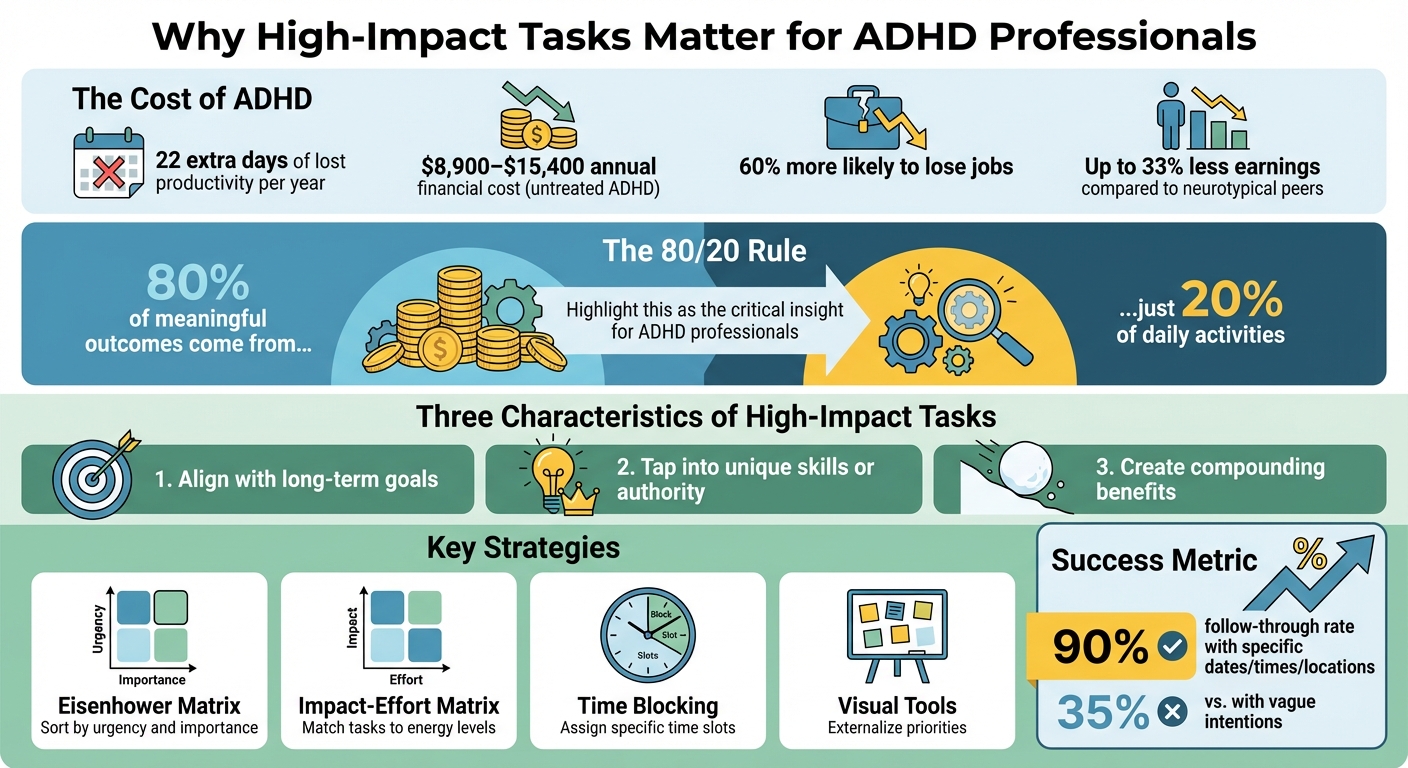
For professionals with ADHD, prioritizing tasks can be tricky. The brain often gravitates toward quick, low-effort activities instead of high-impact tasks that drive long-term success. This tendency, known as "procrastivity", leads to lost productivity - about 22 extra days per year - and financial setbacks, with untreated ADHD costing individuals $8,900–$15,400 annually.
High-impact tasks are essential because they align with long-term goals, utilize unique skills, and deliver lasting benefits. However, ADHD professionals often struggle to identify and focus on these tasks due to challenges like prioritization difficulties, decision fatigue, and "time blindness."
Key strategies include:
- Eisenhower Matrix: Sort tasks by urgency and importance to focus on what matters most.
- Impact-Effort Matrix: Match tasks to your energy levels for better productivity.
- Time Blocking: Assign tasks to specific time slots to reduce overwhelm.
- Visual Tools: Use tools like sticky notes or task boards to externalize priorities.
ADHD Productivity Statistics and High-Impact Task Framework
ADHD Prioritization Challenges + 2 Powerful Matrices To Help | Episode 263
What Are High-Impact Tasks?
Following our earlier discussion about the challenges ADHD professionals face, let’s dive into what defines a high-impact task and why they matter.
What Makes a Task High-Impact
High-impact tasks are those that deliver the greatest results in the least amount of time. Think of them as the activities that give you the most bang for your buck when it comes to energy and focus. Spending just an hour on one of these tasks can often accomplish more than an entire day of busywork.
These tasks share three key characteristics. First, they align with your long-term goals - whether that’s advancing your career, increasing revenue, or creating systems that keep adding value over time. Second, they often tap into your unique skills or authority - the kind of work that only you, in your role, are equipped to handle. Lastly, they create compounding benefits, like building strong client relationships or developing processes that save time every week.
The "glass ball versus rubber ball" analogy helps illustrate this concept. High-impact tasks are like glass balls - delicate and important. If you drop them, they can shatter. On the other hand, low-value tasks are like rubber balls - they bounce back if you let them go. For instance, preparing for a major client presentation? That’s a glass ball. Reorganizing your desktop folders for the third time this month? Definitely a rubber ball. Understanding this distinction can help you focus on the tasks that truly drive progress in your career.
Numbers back this up. Studies show that 80% of meaningful outcomes typically come from just 20% of your daily activities. For professionals with ADHD, identifying that critical 20% is often the difference between spinning your wheels and making tangible progress.
Now, let’s explore why ADHD professionals often struggle to identify these high-impact tasks.
Why ADHD Professionals Struggle to Identify Them
For individuals with ADHD, identifying high-impact tasks can be uniquely challenging. Prioritization relies on executive functions, which are often less developed in people with ADHD. This, combined with ADHD’s neurological tendencies, creates a bias toward tasks that offer immediate rewards.
This leads to what researchers call the "Now versus Not Now" problem. High-impact tasks, which often promise long-term benefits, get labeled as "Not Now." Meanwhile, trivial tasks that pop up in the moment - like responding to an email - feel urgent and get prioritized, even if they add little value.
"Prioritizing tasks and knowing what to do first is difficult for those of us with ADHD, so we rely on anxious feelings to tell us what needs to be done." - Tamara Rosier, PhD
Another issue is ambiguity. High-impact tasks often lack the clear structure of low-value tasks. For example, washing dishes has an obvious start and finish, making it feel manageable. In contrast, a strategic project might feel overwhelming and harder to define, pushing your brain toward simpler, more familiar tasks to avoid the discomfort of uncertainty.
Decision fatigue also plays a role. When faced with multiple tasks, the brain can struggle to prioritize effectively, making every task seem equally important. This can lead to mental paralysis and a tendency to pick tasks based on how they feel in the moment, rather than their actual importance to your goals.
The Benefits of Focusing on High-Impact Tasks
Focusing on high-impact tasks can create real momentum in your career. For professionals with ADHD, this strategy works well with the way your brain naturally operates.
Building Career Growth and Confidence
When you complete high-impact tasks, you build self-trust and break the cycle of leaving projects unfinished.
"The power lies in building trust with yourself. Imagine the confidence you'd develop if most days, that one thing you committed to actually got done." - Learn to Thrive with ADHD
The statistics paint a challenging picture: adults with ADHD are 60% more likely to lose their jobs and can earn up to 33% less than their neurotypical peers. However, focusing on high-impact work allows you to showcase undeniable value with less effort. This approach not only helps you avoid burnout from overcompensating but also sets the stage for steady career growth.
Interestingly, research indicates that setting specific dates, times, and locations for tasks increases follow-through rates to 90%, compared to just 35% for vague intentions. Committing to completing one high-impact task each day builds a track record of success that can reshape both your professional reputation and how you see yourself.
Next, let’s explore how hyperfocus can amplify the benefits of tackling high-impact tasks.
Using ADHD Hyperfocus for Better Results
Hyperfocus can be one of your greatest strengths. By channeling this intense concentration into meaningful tasks, you can make significant career strides. In fact, about 35% of self-employed adults with ADHD credit hyperfocus as a key factor in their success.
When high-impact tasks align with your interests, they trigger the dopamine-driven focus that leads to exceptional work. This often results in innovative solutions and deeper insights that others might overlook. In a way, it becomes your secret weapon.
"ADHD hyperfocus transforms from liability to asset when you understand your brain's unique operating system." - Elevating Minds Psychiatry
The difference between unfocused and purposeful hyperfocus is striking. By directing your energy toward high-impact projects - and keeping these sessions between 4–6 hours to avoid burnout - you can close productivity gaps and even outperform typical benchmarks. This isn’t just about keeping pace; it’s about using your brain’s unique strengths to deliver outstanding results.
How to Overcome Prioritization Challenges
Sorting through tasks and figuring out what to tackle first can feel overwhelming, especially when ADHD tendencies lean toward addressing urgent tasks over important ones. However, practical tools can help bring order to the chaos, turning mental clutter into clear, actionable plans. Below are some methods that can help you prioritize effectively.
Using the Eisenhower Matrix to Sort Tasks
The Eisenhower Matrix is a simple yet powerful tool for organizing tasks into four categories based on urgency and importance.
Start by doing a brain dump - write down every task swirling in your mind to clear mental space. Then, place each task into one of these four quadrants:
- Quadrant 1 (Urgent & Important): These are immediate priorities, like meeting deadlines or paying bills due today. Handle these tasks first.
- Quadrant 2 (Important but Not Urgent): This is where long-term, high-value tasks live, such as strategic planning and skill-building. These tasks often get overlooked because they don’t come with the pressure of a looming deadline.
- Quadrant 3 (Urgent but Not Important): These are interruptions or tasks that feel pressing but don’t contribute much - think routine emails or meetings. Delegate or automate these when possible.
- Quadrant 4 (Not Urgent & Not Important): These are time-wasters, like scrolling social media. Eliminate these tasks to free up mental bandwidth.
"ADHD is, at its heart, a blindness to time. Or, to be more accurate, nearsightedness to the future." - Dr. Russell Barkley, Clinical Psychologist
To make this system work, start by eliminating Quadrant 4 tasks - this will instantly reduce the feeling of being overwhelmed. Keep each quadrant manageable by limiting it to 10 tasks or fewer. For Quadrant 2 tasks, which lack urgency, break them into smaller, actionable steps and schedule specific times to work on them. This ensures they don’t get sidelined by more urgent but less meaningful tasks. You might also find it helpful to create separate matrices for work and personal life to keep priorities distinct.
This approach keeps your focus on tasks that truly contribute to your goals.
Using the Impact-Effort Matrix for Energy Management
The Impact-Effort Matrix is another helpful tool, especially for managing energy levels, which can vary significantly for people with ADHD. This matrix helps you align tasks with your available focus and stamina by evaluating their value and the energy they require.
"The effort side isn't about how hard a task is objectively - it's about how it feels to you in this moment." - Lynne Edris, Productivity & ADHD Coach
Start by conducting an energy audit. Over a few days, set reminders to rate your energy levels (on a scale of 1–10) at different times of the day. This will reveal your natural peaks and dips. Then, match tasks to your energy:
- High Impact/High Effort: Save these for your peak focus times, like mornings or other high-energy windows.
- High Impact/Low Effort: Handle these during lower-energy moments to maintain momentum.
- Low Impact/High Effort: Consider delegating or postponing these tasks.
- Low Impact/Low Effort: Use these as warmups or transitions between more demanding work.
To make this method sustainable, use tools like color-coded calendars or visual task boards. If you’re struggling to start a high-impact task, begin with a low-effort activity to build momentum and generate the dopamine boost needed to move into more challenging work.
This framework ensures your most important work gets done during your peak energy times.
Visual Task Mapping for Better Clarity
If you find it hard to keep priorities straight in your head, visual task mapping can be a game-changer. This method externalizes your tasks, making them easier to manage and prioritize while addressing common ADHD challenges like working memory issues.
One effective tool is the Priority Pyramid. Draw a pyramid and place your most urgent tasks in the top section, with less pressing ones in the wider base. This forces you to rank tasks and avoid feeling like everything is equally urgent. Another option is color-coding, which provides instant visual cues to differentiate between tasks. A "Future You" board is another creative approach: break large projects into smaller steps on sticky notes and arrange them on a wall. Moving completed notes to a “Done” column gives you a visual sense of progress and a dopamine boost.
"Once we have successfully identified our priorities, our brain doesn't have to worry about all the other stuff. It's like putting on horse blinders to block out non-essential tasks and focus on what's important." - Paula Engebretson, ADHD Coach and Podcaster
Physical tools like whiteboards or sticky notes work well because they stay visible and serve as constant reminders of your goals. Adding visual timers with moving parts can also help combat time blindness and keep you on track. When you’re avoiding a big task, set a timer for just five minutes to help you break through the inertia.
Daily Strategies for High-Impact Focus
After diving into prioritization matrices, it’s time to align your daily routines with your most important goals. Small, consistent changes can lead to big results, especially when you work with your ADHD brain instead of fighting against it.
Time Blocking and Daily Priority Reviews
Time blocking transforms the abstract concept of time into something tangible, which is especially helpful for those with ADHD who struggle with "time blindness" - a neurological difficulty in perceiving how time passes. Instead of relying on vague to-do lists, assign tasks to specific time slots on your calendar.
Plan your day around your natural productivity highs. For many, this peak occurs 1–2 hours after ADHD medication takes effect or during a morning energy surge. Use these windows for your most demanding tasks. Pre-scheduling tasks also reduces decision fatigue, preserving your mental energy for the actual work.
"Time blindness is a neurological reality, not a character flaw. Your brain's prefrontal cortex processes temporal information differently." - AFFiNE
A helpful trick is the 25% Buffer Rule. Always add an extra 25% to your estimated task duration. For example, if you think something will take 40 minutes, schedule 50 minutes. This buffer accounts for time misjudgments and unexpected distractions. Color-code your blocks to visually prioritize tasks - use red for deep-focus or high-priority work so it stands out from less critical items.
Start your day by spending five minutes identifying your top three high-priority tasks and slotting them into your schedule. Be specific about the next physical action for each task. For example, instead of writing "Work on Project X", note something actionable like "Open Word and type the title." This tiny adjustment can help you overcome the paralysis that often comes with starting a task.
Don’t forget transition rituals between tasks - like stretching or tidying your workspace. These short breaks help your brain shift gears and refocus, as ADHD brains often need extra time to transition between unrelated activities.
Once your schedule is set, tracking your progress becomes the next step to maintain momentum.
Tracking Progress to Build Momentum
Monitoring your achievements is critical for staying motivated. Completing small portions of work triggers dopamine, creating a positive feedback loop that keeps you going. Breaking tasks into smaller, manageable pieces - called "work packets" - makes it easier to stay on track. For instance, instead of "Write the entire sales page", focus on "Write one section of the sales page." These natural stopping points prevent burnout and give you opportunities to celebrate progress.
"ADHD brains... are really more like airplanes: they can travel far and at high speeds, but they need a long runway to pick up enough speed to take flight." - Renee Fishman
Use task snacking to overcome the hurdle of starting. Break the first step into something so small it feels trivial - like "Open the document" or "Write the title." Once you get started, momentum often takes over.
Another useful habit is leaving "Future You" notes when you pause a task. Jot down the next tiny action required to pick up where you left off. This simple step reduces the mental effort of restarting and can save up to 15 minutes of "mental ramp-up" time.
End your workday with a quick 2–5 minute reset. Close open loops, tidy your workspace, and plan your top priorities for the next day. This small ritual can help you avoid the dreaded "shame cycle" of starting the day already feeling behind. Research even shows that setting specific dates, times, and locations for tasks leads to a 90% follow-through rate, compared to just 35% for vague intentions.
Resources from On/Off Genius
For more tools and tips, check out On/Off Genius. This resource is tailored for professionals with ADHD, offering practical advice on managing focus, staying organized, and building routines that work with your brain. You’ll find strategies for energy management, visual task systems, and other actionable insights to simplify high-priority task management. It’s a great companion for tackling the challenges of ADHD head-on.
Conclusion: Achieving More Through High-Impact Focus
Getting more done with ADHD isn’t about working harder - it’s about creating systems that fit how your brain operates. Did you know ADHD professionals lose an average of 22 extra days of productivity each year? This isn’t because of a lack of effort or ability but because relying solely on willpower doesn’t work as effectively without structured systems.
The strategies covered in this article - like the Impact-Effort Matrix, time blocking, and progress tracking - are designed to cut down on decision fatigue and make important tasks feel automatic. For example, setting clear dates, times, and locations for tasks can boost your follow-through rate to 90%, compared to just 35% when plans are vague. Pairing this level of planning with energy-based scheduling creates an environment where your ADHD brain can truly shine.
"ADHD systems don't fail from lack of effort, they fail from lack of structure." - Roozbeh Khoshniyat, ADHD Coach, Heal and Thrive
The goal isn’t about chasing perfection. It’s about aligning your actions with your intentions, one high-impact task at a time. Start by identifying one non-negotiable task each day, use your peak energy times wisely, and track even the smallest wins to keep momentum going. And if things go off track, a quick reset ritual can help you bounce back.
"The goal isn't to make your brain work like a neurotypical one. It's to create the conditions where your brain can do its best work." - Brain.fm
FAQs
How do I spot my highest-impact task for today?
To figure out which task will make the biggest difference, concentrate on activities that deliver the most value with the least amount of effort. Tools like prioritization matrices can help you weigh factors like urgency, importance, and effort required. A simple question to guide you: Which task will push my goals forward the most today? Begin with that one key task to stay focused and get the best results.
What should I do when everything feels urgent?
When everything seems urgent, take a moment to pause and evaluate whether each task genuinely needs your immediate attention. Ask yourself: Can it wait? Or could someone else handle it? Tools like the Urgent-Important Matrix can help you sort through priorities, allowing you to focus on tasks that have the greatest impact. By deliberately concentrating on what truly matters, you can stay productive and avoid the chaos of reacting to every demand as it arises.
How can I use hyperfocus without burning out?
To make the most of hyperfocus while keeping burnout at bay, it’s essential to set clear limits for your focused sessions. Use tools like timers to help you stay aware of how long you’ve been working. Regular breaks are just as important - they give your mind a chance to recharge. Don’t forget the basics: eat, drink water, and get enough rest. By taking a deliberate approach, you can tap into the power of hyperfocus without sacrificing your health or energy.