Ultimate Guide to Overcoming ADHD Task Paralysis
ADHD task paralysis is a neurological freeze, not laziness—use micro-steps, body doubling, Pomodoro micro-sprints, and a dopamine menu.
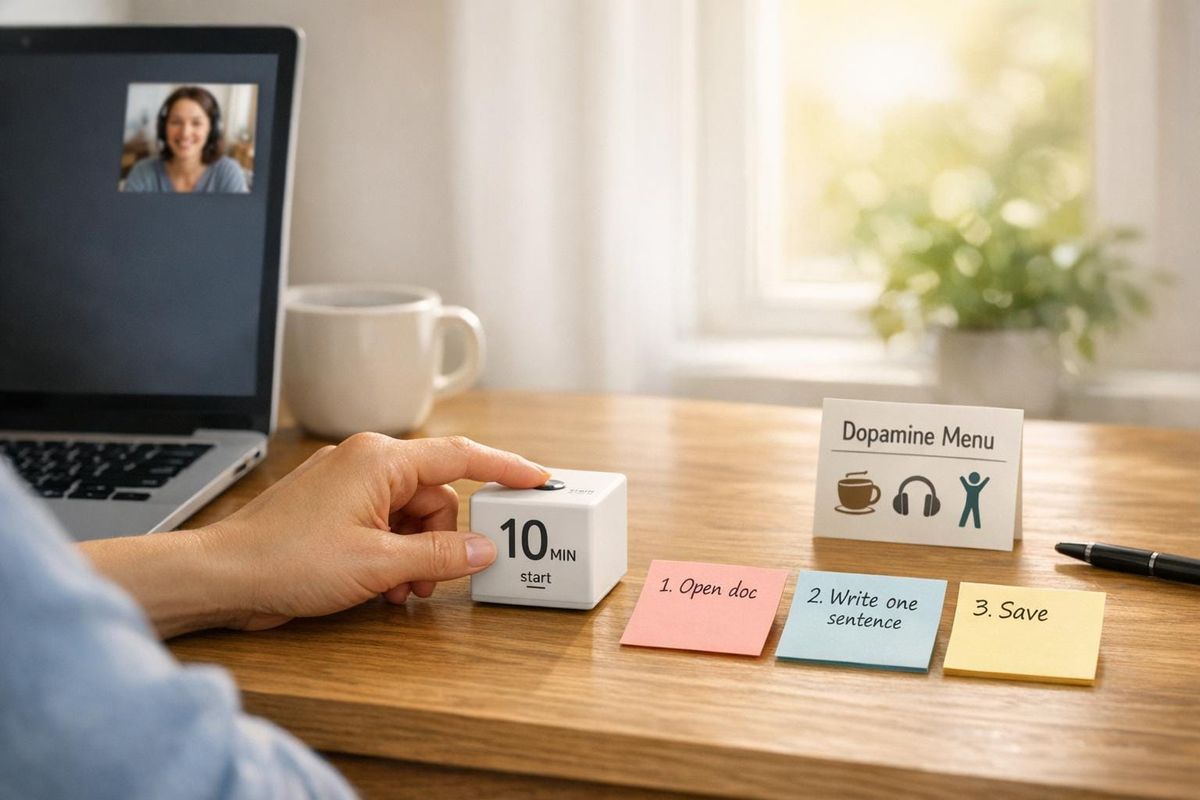
Feeling stuck, even when you want to start a task? That’s ADHD task paralysis - a neurological freeze where your brain struggles to initiate action, not due to laziness, but because of executive function challenges and low dopamine levels. This guide outlines practical ways to overcome it, including:
- Body Doubling: Work alongside someone for accountability.
- Micro-Steps: Break tasks into the smallest possible actions.
- Pomodoro Technique: Use short, timed work sprints (5–10 minutes).
- Dopamine Menu: Plan quick, enjoyable activities to reset focus.
- Evening Planning: Prepare essentials the night before to reduce decision fatigue.
Learn how to recognize the signs, manage mental overload, and build habits that make starting tasks easier. Progress begins with one small step.
Overcoming ADHD task paralysis when you feel stuck
What Is ADHD Task Paralysis?
Let’s break down what ADHD task paralysis actually means.
ADHD task paralysis happens when your brain essentially "freezes", making it nearly impossible to start a task - even when you genuinely want to. It’s not about being lazy or unmotivated. Instead, it’s tied to a disruption in the brain’s executive functions, which are controlled by the prefrontal cortex. Imagine standing in front of an invisible barrier that keeps you from moving forward, no matter how much you want to.
"Task paralysis is when your brain wants to do something but can't seem to get started or follow through, even when you know it's important." - Andrew Le, MD, Buoy Health
Unlike procrastination, which often involves delaying tasks, task paralysis completely halts any progress. You might find yourself frozen - staring at a blank screen or sitting still - unable to take even the smallest step, even with tasks you normally enjoy. For many professionals, this can look like analysis paralysis, where a long to-do list or a complex project feels so overwhelming that you can’t take action. Sometimes, it even happens with something as simple as replying to an email or opening a document.
This experience often leads to frustration and self-criticism, with people labeling themselves as "lazy." But the real issue lies in a dopamine deficiency. Dopamine plays a crucial role in kickstarting action, especially for tasks that don’t offer immediate rewards or urgency. Without enough dopamine, it’s like your brain’s "go" signal is stuck, making every effort feel like you’re fighting against a strong current.
What Causes ADHD Task Paralysis
Understanding the reasons behind task paralysis is key to managing it effectively. The causes are rooted in brain function, not personal shortcomings.
Executive Dysfunction
Think of executive functions as the brain’s "control center", responsible for planning, prioritizing, starting tasks, and managing working memory. For people with ADHD, the prefrontal cortex receives weaker dopamine and norepinephrine signals. This makes it harder to reach the activation threshold needed to begin a task. Even with the best intentions, the brain's signal to take action can feel muddled or blocked.
When working memory becomes overloaded, the brain struggles to juggle goals, steps, and emotions. This can lead to a freeze or shutdown, often referred to as decision overload. Research shows that around 90% of children with ADHD have challenges in at least one area of executive function, and 30% to 70% of adults with ADHD face ongoing difficulties with emotional regulation.
"ADHD paralysis isn't laziness; it's your brain struggling with executive functions like task initiation, emotional regulation, and motivation." - Dr. Russell Barkley, Clinical Psychologist
Dopamine dysregulation plays a major role in making task initiation even more challenging.
Dopamine Dysregulation
Dopamine acts as the brain's motivator, driving reward and action. In ADHD, low baseline dopamine levels make everyday tasks feel unrewarding. While neurotypical brains can visualize future rewards to stay motivated, ADHD brains often focus on what’s happening right now. A 2022 simulation study highlighted that imbalanced dopamine release can explain the inconsistent reaction times and decision-making struggles commonly seen in ADHD.
This imbalance often pushes individuals with ADHD toward high-stimulation activities - like endlessly scrolling social media - for an immediate dopamine boost. Meanwhile, low-stimulation tasks can feel insurmountable.
Dopamine dysregulation also contributes to the sensory and cognitive overload that defines ADHD task paralysis, as explained in the next section.
Information Overload and Understimulation
In addition to executive function and dopamine challenges, ADHD brains struggle to manage sensory input effectively. Filtering out irrelevant information can be difficult. When sensory, emotional, or cognitive input exceeds what the brain can process, the nervous system may enter a protective freeze state. This often happens with large, complex, or vague tasks, leading to avoidance or paralysis as a way to sidestep potential failure.
Here’s where it gets tricky: ADHD brains crave stimulation to counteract low dopamine levels. But they can quickly shift from being under-stimulated by mundane tasks to feeling overwhelmed by environmental factors like noise or pressure. In some cases, even boredom can feel physically draining.
"ADHD paralysis happens when a person with ADHD is overwhelmed by information, emotions, or their environment. As a result, they freeze and can't think or function effectively." - ADDA Editorial Team, Attention Deficit Disorder Association
How to Recognize ADHD Task Paralysis
Spotting task paralysis early is essential for managing it effectively. The signs can be subtle and are often misunderstood as procrastination or laziness.
Did you know that about 75% of people with ADHD experience some level of task paralysis? The trick lies in identifying its telltale signs before the freeze becomes overwhelming. Once you know what to look for, you can begin to address it with strategies we'll dive into later.
Mental Freeze and Overthinking
Ever feel like your brain just shuts down? That’s mental freeze, sometimes called a "brain crash." It happens when you're overwhelmed by thoughts, emotions, or sensory input. You might find yourself staring at a screen or to-do list for hours, unable to take the first step. Your mind races, but your body stays stuck.
A big part of this is overthinking even the simplest decisions - like choosing what to eat for lunch. You get trapped in endless loops of thought, unable to move forward.
This often leads to what’s called the "intention-action gap." Your brain is screaming, "Get started!" but your body doesn’t respond. Unlike those without ADHD, who may find it easier to push through, people with ADHD face rapid decision fatigue because initiating action takes so much more effort.
Poor Prioritization and Avoidance
Struggling to figure out what to tackle first? That’s another sign of task paralysis. Too many options, unclear priorities, or vague instructions can leave you locked in indecision.
Instead of starting that big project, you might find yourself doing less important things like organizing your desk, answering non-urgent emails, or even cleaning. Or maybe you start scrolling through your phone, daydreaming, or snacking - activities that seem like procrastination but are actually your brain’s way of avoiding the overload.
The key difference here is that procrastination is a choice to delay for comfort, while task paralysis is an involuntary freeze. It’s like your brain’s executive functions just won’t cooperate. This can create a cycle of guilt, shame, and anxiety, making it even harder to break free.
Task Switching and Brain Fog
Task paralysis doesn’t just stop you from starting - it can also make switching tasks incredibly hard. If you’ve been hyperfocused on one thing, shifting gears can feel impossible, leaving you stuck between activities.
Then there’s brain fog. It’s that sluggish, unresponsive feeling where your brain’s "start signal" just won’t fire. Stress, fatigue, or overstimulation can make this worse. Even after resting, you might feel mentally drained and unable to think clearly.
Time blindness is another common issue. You lose track of how long you’ve been frozen or misjudge how much time a task will take. Hours can slip by while you remain stuck, unable to begin even the simplest of tasks.
| Type of Paralysis | Primary Characteristic | Common Manifestation |
|---|---|---|
| Mental Paralysis | Cognitive/Sensory Overload | "Brain crash" or difficulty processing |
| Choice Paralysis | Decision Fatigue | Overthinking and stalling on decisions |
| Task Paralysis | Initiation Failure | Hesitation or inability to start tasks |
Strategies to Overcome ADHD Task Paralysis
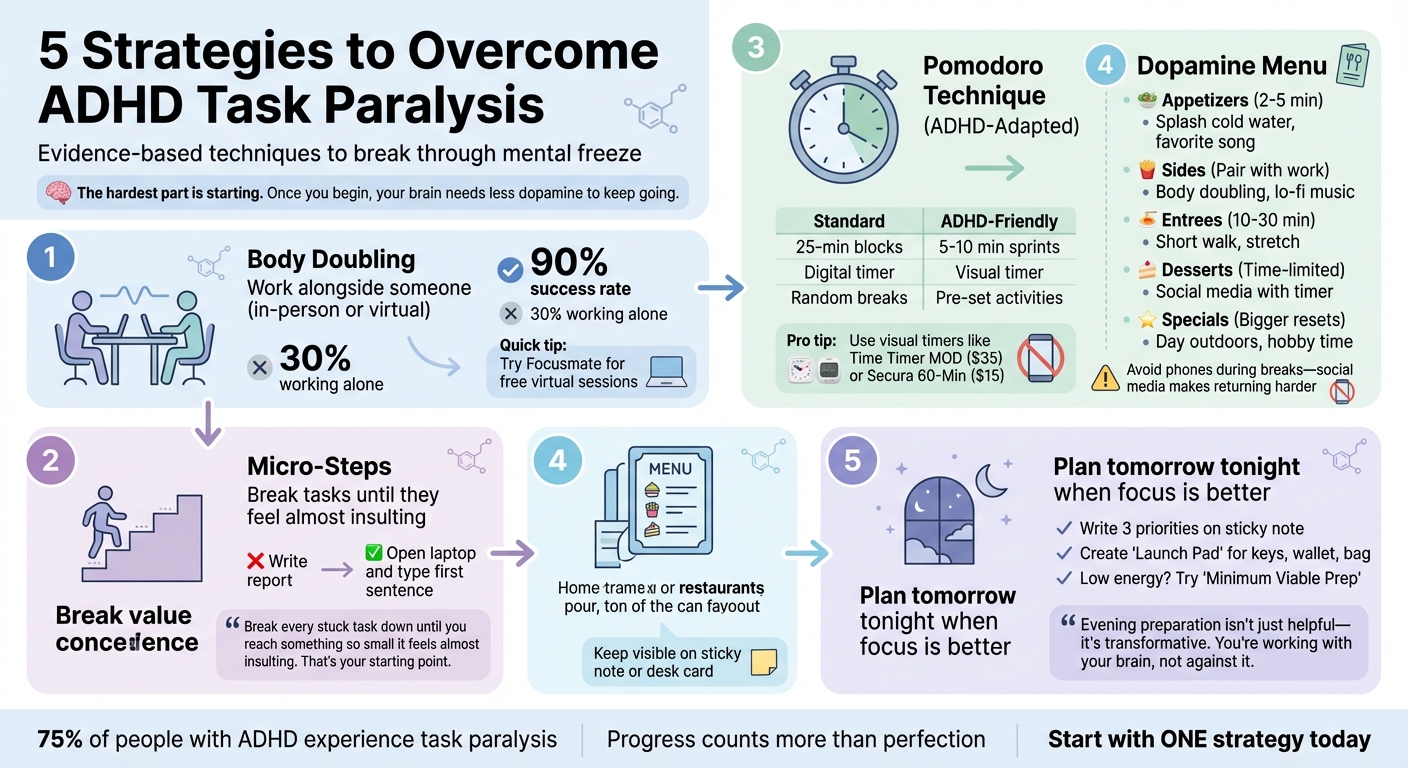
5 Evidence-Based Strategies to Overcome ADHD Task Paralysis
Once you recognize the signs of task paralysis, you can use specific techniques to push past the mental block. These strategies target the challenges with executive function and dopamine regulation that often accompany ADHD. The toughest part? Getting started. Your prefrontal cortex has to override resistance from your limbic system. But once you begin, your brain requires less dopamine to keep going than it did to start. The goal here is to lower that initial barrier.
Body Doubling for Accountability
Body doubling is a simple yet effective approach: work alongside another person, either in person or virtually. This creates external structure and motivation, helping you overcome the inertia of task paralysis. One professional noted a 90% success rate for completing avoided tasks with virtual body doubling, compared to just 30% when working alone. Even knowing someone else is working can provide enough external pressure to help you start.
Platforms like Focusmate offer free virtual sessions where you can share a focused workspace without much interaction. Pairing this social accountability with simplified tasks can make a big difference.
Breaking Tasks into Micro-Steps
Tasks like "Write report" often feel overwhelming because they combine too many decisions and actions. The solution? Break them into tiny, manageable steps.
"Break every stuck task down until you reach something so small it feels almost insulting. That's your starting point." – Johannes, Creator of Super Productivity
For example, instead of "Write report", start with "Open your laptop and type the first sentence." Instead of "Clean the kitchen", begin with "Put one mug in the sink". This approach reduces the mental energy your brain needs to get moving. Even small wins build momentum.
For tasks that frequently trigger paralysis, create an "anti-freeze checklist" when you're calm. This checklist can outline every micro-step for recurring tasks like making dinner or starting your morning routine, giving you a clear guide when you're stuck.
Using the Pomodoro Technique
The Pomodoro Technique is a classic productivity tool, but for ADHD, shorter sprints of 5–10 minutes can be more effective than the traditional 25-minute blocks. The idea of focusing for 25 minutes can feel overwhelming, but setting a timer for just 5 minutes lowers the barrier to entry. A "Liar's Timer" approach - where you commit to just 5 minutes - gives you permission to stop when the timer rings. Often, starting the task loads it into your working memory, making it easier to continue.
Using a visual timer can be more effective than a phone timer. Devices like the Time Timer MOD (about $35) or the Secura 60-Minute Visual Timer (around $15) provide a clear, physical representation of time passing, which can help combat time blindness. Watching the red disk shrink can even give a small dopamine boost as you see progress.
Two key rules for these sessions:
- Avoid checking your phone during breaks - social media offers "cheap" dopamine that makes returning to work harder.
- If the timer rings while you're in hyperfocus, consider resetting it for another 15 minutes instead of stopping. Breaking momentum can sometimes backfire.
| Feature | Standard Pomodoro | ADHD-Friendly Adaptation |
|---|---|---|
| Commitment | 25-minute blocks | 5–10 minute "Micro-Sprints" |
| Timer Type | Digital/Hidden | Large Physical/Visual (Analog) |
| Break Activity | Random/Unstructured | Pre-set "Dopamine Menu" (No screens) |
| Transition | Stop when timer rings | "Flow Exception" for hyperfocus |
If micro-sprints aren't enough, a well-thought-out dopamine menu can help re-engage your focus.
Creating a Dopamine Menu
A dopamine menu - or "dopamenu" - is a pre-planned list of enjoyable, time-limited activities designed to reset your focus when you're stuck. By planning this menu in advance, you avoid decision fatigue when you need a quick boost.
"A dopamine menu is a short list of enjoyable, time-bounded activities you use to reset and then return to your next small step." – Chris Hanson, Founder, Life Skills Advocate
Organize your menu into categories:
- Appetizers: Quick resets (2–5 minutes), like splashing cold water on your face or listening to a favorite song.
- Sides: Supportive activities that pair with work, such as body doubling or playing lo-fi music.
- Entrees: Longer breaks (10–30 minutes) that recharge you, like taking a short walk.
- Desserts: High-stimulation tasks (e.g., social media) with strict time limits.
- Specials: Bigger resets, like spending a day outdoors or engaging in a favorite hobby.
Keep this menu visible - a sticky note on your laptop or a printed card on your desk works better than hiding it in an app. When you're stuck, pick one "appetizer", set a 3-minute timer, and follow it up with a small task.
This method works because ADHD brains often have lower baseline dopamine levels and need stronger or more immediate stimulation to kickstart tasks. A dopamine menu provides that spark without overwhelming you with choices.
Tools and Resources for Managing Task Paralysis
Focus and Productivity Apps
Goblin Tools is a handy AI-powered tool that transforms vague tasks like "organize project files" into clear, step-by-step actions. You can use the web version for free, or download the mobile app for a one-time cost of $1.99.
Apps like Todoist ($4–$5 per month) and TickTick (free or about $3 per month) make capturing ideas effortless. Instead of typing out "Schedule dentist appointment for next Tuesday at 2 PM", you can simply speak it, and the app will process your voice input. This feature is especially useful for those who struggle with working memory, as it prevents ideas from slipping away before you can jot them down.
For improving focus, Brain.fm ($6.99 per month) uses neural phase-locking technology to stimulate beta brainwaves, helping ADHD brains stay on task without the distraction of lyrics or catchy tunes. Tiimo ($5.99–$9.99 per month) offers a visual approach to planning by replacing overwhelming text-based lists with timelines and icons, which can ease decision fatigue. Meanwhile, Forest ($3.99 one-time on iOS; free on Android) gamifies focus by growing virtual trees when you stay off your phone. If you give in to distractions, your tree withers - adding a small emotional consequence that can motivate you to stay on track.
Here's a practical tip: try labeling tasks in your task manager by energy level. For example, tag tasks as @high_energy or @low_energy to match your current mental state rather than just focusing on deadlines. When you're in "Zombie Mode", attempting a high-energy task can worsen feelings of paralysis, so it's better to align tasks with your capacity at the moment.
ADHD-Specific Insights from On/Off Genius

In addition to using these tools, gaining ADHD-specific insights can further enhance your approach to managing task paralysis. The blog On/Off Genius (https://onoffgenius.com) is tailored for professionals with ADHD, offering strategies that address common challenges like maintaining focus, improving organization, and building consistency. Whether you're dealing with fluctuating energy levels or trying to establish sustainable habits, the blog provides actionable advice designed for how ADHD brains function. It's a valuable resource for tackling the unique hurdles that contribute to task paralysis.
Building Habits to Prevent Task Paralysis
The best way to tackle task paralysis is to stop it before it starts. By building routines that align with how your ADHD brain works, you can create what researchers call "environmental scaffolding." This approach reduces the pressure on your executive function and helps you navigate tasks more smoothly.
Evening Planning for the Next Day
Planning your day the night before can save you from morning chaos and decision fatigue. This isn't about achieving perfect organization - it's about working with your brain's natural energy patterns. Many people with ADHD find they have better focus in the evening, making it an ideal time for planning.
Start by jotting down three priorities on a sticky note and placing it somewhere you’ll see first thing in the morning, like your bathroom mirror or next to the coffee maker. Pair this with a "Launch Pad" near your door - a designated spot for essentials like your keys, wallet, bag, and charger. This small habit can prevent the morning scramble that often triggers stress and self-doubt.
"Evening preparation isn't just helpful for people with ADHD - it's transformative. When you prepare the night before, you're working with your brain rather than against it." – Harold Robert Meyer, The ADD Resource Center
On those nights when your energy is low, try "Minimum Viable Prep" - just lay out one or two essentials, like your keys or a coffee mug. The goal is to keep the habit alive, even if it’s not perfect. This simple effort creates a foundation for a smoother start to your day.
Optimizing Your Work Environment
Your workspace plays a big role in reducing the mental hurdles that lead to task paralysis. A clutter-free and well-organized setup can make starting tasks feel less overwhelming. For example, close unnecessary browser tabs or use a separate browser specifically for work to reduce distractions.
Using visual tools can also make a difference. A Kanban board with columns like "Backlog", "Today", "In Progress", and "Done" gives your brain a clear, visual way to process tasks. Keeping frequently used tools visible on your desk, rather than hidden, can also lower the effort needed to dive into work.
Be intentional about managing sensory input. Turn off non-essential phone notifications, and consider using brown noise or focus playlists to help maintain concentration. If you feel stuck, try changing your environment - move to the kitchen table or a library. Sometimes, a fresh setting provides the boost you need to break out of a mental freeze. Adding small, novel changes to your workspace can even trigger a helpful dopamine release.
Practicing Self-Compassion
While your environment sets you up for success, your mindset is just as important. Task paralysis is a neurological response to being overwhelmed, not a personal failure. How you respond to yourself in these moments can either help or hinder your ability to move forward.
"Progress counts more than perfection. Perfection is impossible to achieve, and if that's your goal, it's easy to freeze up out of fear of not achieving it." – Sharon Saline, Psy.D.
If you make a mistake or feel stuck, treat yourself with the same kindness you'd offer a close friend. As EF Bomb Coach explains:
"Shame shuts down the brain's problem-solving part. Kindness and compassion turn it back on"
A simple trick is to name your emotion when you're overwhelmed. Saying something like, "I'm feeling stuck right now", can help calm your brain's alarm system.
For adults with ADHD, emotional regulation can be a significant challenge, with 30% to 70% experiencing difficulties in this area. But self-compassion isn't just a feel-good idea - it’s a practical way to keep your prefrontal cortex engaged, allowing you to problem-solve instead of shutting down. Over time, practicing these habits strengthens your ability to manage task paralysis effectively.
Conclusion
ADHD task paralysis isn’t about personal failure - it's a neurological response tied to executive dysfunction and dopamine regulation. These challenges don’t magically disappear in adulthood; many continue to navigate them daily.
The strategies outlined here work because they align with how the ADHD brain operates. Techniques like breaking tasks into micro-steps, using body doubling for accountability, and creating a dopamine menu help lower the mental barriers to starting. As Dr. Manos puts it:
"If there's anything you can do, take the next action, however small it might be. And that action will open the door to the next action after that".
The key is to work with your brain, not against it. Using visual tools to externalize your working memory, practicing self-compassion, and establishing evening routines to reduce morning decision fatigue can provide the structure your executive function needs. These methods reflect the guide’s central idea: leveraging your brain’s natural tendencies to overcome task paralysis.
Progress, not perfection, is what counts. With adults making an estimated 35,000 decisions each day and 30–70% experiencing emotional regulation challenges, simplifying choices through practical systems can make a big difference.
For more tools and insights tailored to professionals with ADHD, check out On/Off Genius. Their resources are designed to help with focus, organization, and consistency, turning ADHD-related challenges into strengths you can rely on.
FAQs
How can I tell task paralysis from procrastination?
Task paralysis and procrastination might look alike on the surface, but they’re quite different. Task paralysis happens when you feel completely stuck or overwhelmed - like your brain just won’t let you start, even if you genuinely want to. This often stems from things like having too much on your plate or struggling with executive function.
Procrastination, however, is more of a deliberate choice to put something off. It’s often fueled by boredom, fear of not doing well, or just not feeling motivated. Recognizing the difference between the two is key because it allows you to use the right strategies to tackle each one.
What’s the fastest way to start when I’m frozen?
When you're feeling stuck, the fastest way to get moving is to break the task down into small, easy-to-handle steps. Then, focus on completing just one of them. This approach helps cut through the overwhelm that often comes with ADHD-related executive dysfunction.
You can also rely on external cues to get started. Try setting a timer, tackling the simplest step first, or laying out a clear plan. These strategies can make that daunting first step feel more achievable and help you push past the initial paralysis.
How do I build habits that prevent task paralysis?
To sidestep task paralysis, start by breaking tasks into smaller, bite-sized steps. This approach reduces the feeling of being overwhelmed and makes it easier to take that first step. Building consistent routines and using tools like timers can also nudge you into action. Having an accountability partner is another great way to stay on track and maintain momentum.
Consider using task trackers or gamified systems to make the process more engaging. Over time, these small, steady efforts can reshape how your brain reacts to tasks, making it less daunting to begin and helping you avoid getting stuck.