How Microlearning Helps ADHD Skill Building
Short 3–7 minute lessons boost focus, retention, and motivation for adults with ADHD by reducing overload, offering on-demand practice and quick rewards.

Ever feel like long learning sessions just don’t work for you? If you have ADHD, traditional methods can be draining and ineffective. Microlearning offers a better way. By breaking content into 3–7 minute lessons, it aligns with shorter attention spans and provides immediate, actionable insights.
Here’s why it works:
- Higher Completion Rates: Microlearning achieves 80–83% completion, compared to 20–30% for longer courses.
- Improved Retention: Learners retain 50–60% more information.
- Dopamine Boosts: Frequent small wins keep motivation high.
- Fits ADHD Needs: Reduces overwhelm, supports focus, and works with natural attention rhythms.
Microlearning also makes skill-building easier by offering on-demand, focused modules tailored for ADHD challenges like task paralysis and time blindness. It’s not just about learning faster - it’s about learning in a way that works for you.
How Microlearning Works for ADHD Brains
What is Microlearning?
Microlearning is all about delivering bite-sized lessons, typically lasting just 3–10 minutes, each designed to teach one specific skill or concept. Instead of sitting through a lengthy 90-minute session, you can focus on a single task in a quick 5-minute module. This method aligns with your brain's natural attention span, which tends to last around 8–10 minutes. It also helps reduce the risk of mental fatigue that can occur when your brain is bombarded with too much information at once.
These short bursts of learning do more than just hold your attention - they actually trigger dopamine release. This chemical reaction strengthens neural pathways, making it easier to retain what you’ve learned. Plus, each module is designed to fit within your brain’s working memory capacity, which typically handles about 5–9 items at a time. This prevents the mental overload that often comes with trying to process too much information at once.
Another big advantage? Microlearning is often available on demand. This means you can learn a skill right when you need it and immediately put it into practice. No more struggling to recall something you learned weeks ago - this approach keeps the information fresh and actionable.
Next, let’s dive into how ADHD influences learning and why microlearning is particularly well-suited for those with ADHD.
How ADHD Affects Learning
ADHD changes the way your brain processes information and maintains focus. Your brain operates on a limited supply of glucose and neurotransmitters, and long learning sessions can quickly drain these resources, leading to mental fatigue and overload. Dr. Etienne van der Walt, a neurologist and CEO of Neurozone, explains:
"By limiting sessions to just 10–20 minutes, followed by a break, it gives the brain time to rest and reset. This prevents synaptic overload and helps neurons remain responsive".
For individuals with ADHD, this structure can lead to better engagement and memory retention.
Another challenge ADHD presents is time blindness, making it hard to gauge how long tasks or sessions will take. Combined with executive dysfunction - which affects planning and prioritization - traditional learning formats can feel overwhelming. Even switching between tasks can be draining, often requiring 15–20 minutes to refocus, which eats away at your mental energy before you even get started.
Dopamine regulation plays a key role here too. With ADHD, your brain often craves stronger and more immediate rewards to stay motivated. Long-term goals, like completing a certification in three months, might not provide the reinforcement needed to keep you engaged. On the other hand, microlearning offers frequent "small wins" through short, manageable modules, giving your brain the quick rewards it thrives on. This immediate feedback loop aligns perfectly with the ADHD brain’s preference for fast reinforcement over distant goals.
How Microlearning and Connection Transform Adult Learning with Dr. Gina Anderson
Why Microlearning Works Better for ADHD Skill Building
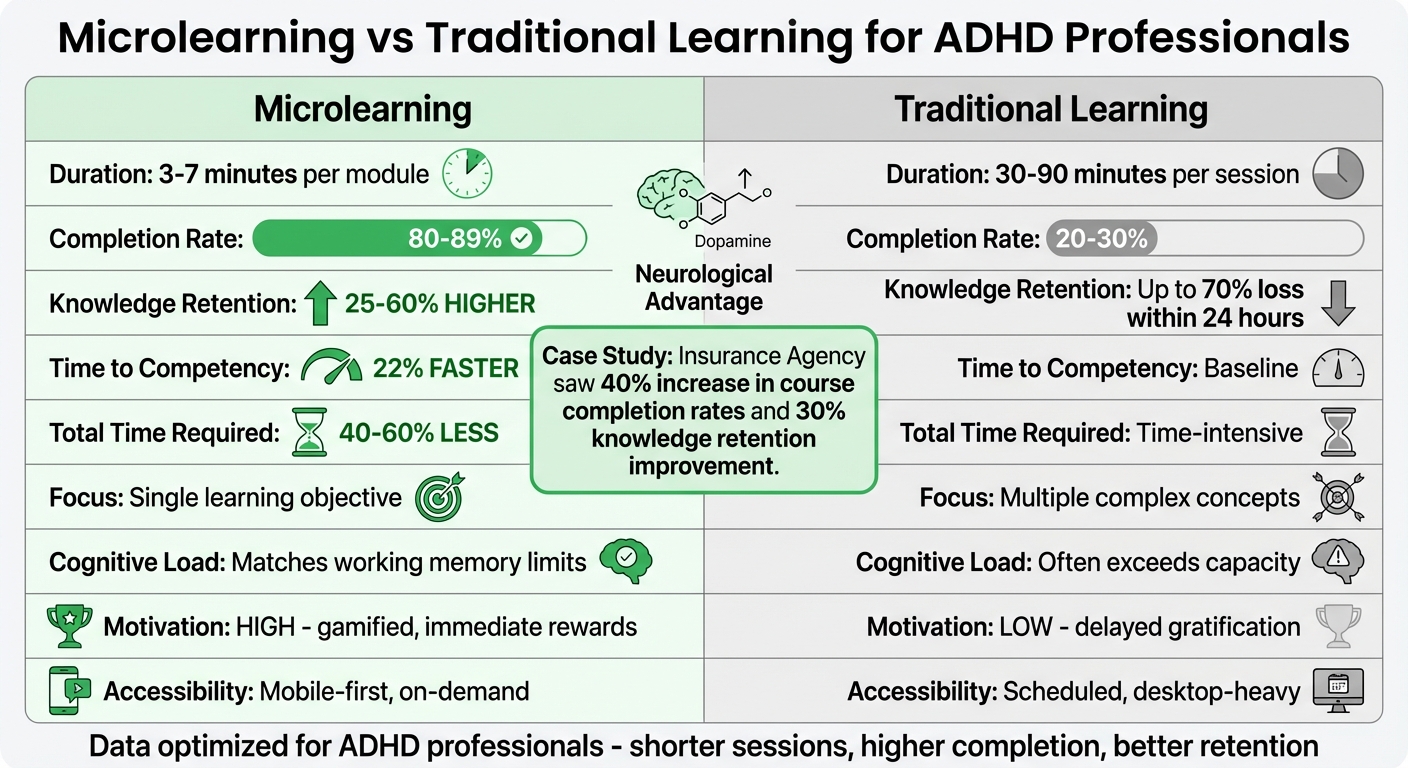
Microlearning vs Traditional Learning for ADHD: Completion Rates and Retention Comparison
Benefits of Microlearning for ADHD
Microlearning is a game-changer for ADHD professionals aiming to build skills effectively. By focusing on one concept at a time, it aligns perfectly with the brain's natural capacity, avoiding the mental overload that can make traditional learning feel daunting.
The results speak for themselves. A North American insurance agency saw a 40% increase in course completion rates within six months after switching to microlearning between 2024 and 2025. Additionally, knowledge retention jumped by 30%. Similarly, a healthcare organization that replaced lengthy monthly sessions with daily 5-minute modules reported a 35% improvement in knowledge application on the job, along with a 28% drop in error rates within just three months.
"Microlearning works because it respects [cognitive] limitations. Instead of overwhelming your mental desk, it delivers one focused stack at a time." - Mahima Chopra, 5Mins.ai
Microlearning also serves as an "external prefrontal cortex". It takes over the planning and organization typically handled by executive functions, which can be inconsistent for those with ADHD. This allows learners to focus their energy on mastering the material rather than figuring out how to approach it.
Another key benefit? Frequent small wins. These short, focused modules provide quick dopamine boosts, creating a positive feedback loop that keeps learners engaged. Instead of the motivation drain that happens during a long session, microlearning delivers rewards more immediately, making the process feel manageable and motivating.
Microlearning vs. Traditional Learning
When comparing microlearning to traditional methods, the advantages for ADHD professionals become even clearer:
| Aspect | Microlearning | Traditional Learning |
|---|---|---|
| Duration | 3–7 minutes per module | 30–90 minutes per session |
| Completion Rate | 80%–89% | 20%–30% |
| Knowledge Retention | 25%–60% higher | Up to 70% loss within 24 hours |
| Time to Competency | 22% faster | Baseline |
| Total Time Required | 40%–60% less | Time-intensive |
| Focus | Single learning objective | Multiple complex concepts |
| Cognitive Load | Matches working memory limits | Often exceeds capacity |
| Motivation | High (gamified, immediate rewards) | Low (delayed gratification) |
| Accessibility | Mobile-first, on-demand | Scheduled, desktop-heavy |
For ADHD professionals, structure is just as important as content. Traditional learning can feel overwhelming, often triggering procrastination or decision paralysis due to unclear pathways. Microlearning eliminates this by making the next step obvious - finish one short module, and the platform guides you to the next one. This streamlined approach reduces overwhelm and makes it easier to stay on track, making microlearning an ideal method for skill-building.
How to Use Microlearning to Build Skills
Break Skills into Small Modules
The key to mastering a skill is to break it down into bite-sized pieces that feel manageable. Instead of tackling a complex skill all at once, focus on the smallest actionable step. For example, if learning Excel feels daunting, start with a short video on basic formulas. By narrowing your focus, you can ease into the learning process without feeling overwhelmed.
Start by analyzing the task at hand. Identify the tools and resources you’ll need, and break the skill into smaller, actionable steps. Using visual outlines can help simplify the process, and applying the SMART framework ensures you set clear, achievable goals.
Got a few spare minutes? Try the "Swiss Cheese" method. This approach encourages you to use small pockets of time - 5 to 15 minutes - to chip away at tasks. Whether it’s watching a quick tutorial, reviewing notes, or completing part of a project, these small efforts accumulate over time.
Once you’ve built momentum, reinforce these steps with techniques like spaced repetition and chunking.
Use Spaced Repetition and Chunking
Your brain can only handle so much at once, so cramming isn’t the way to go - especially for ADHD learners. Instead, spread your learning sessions across the week. This gives your brain multiple chances to process and store the information.
To make this even more effective, mix related topics within a single session, a method called interleaving. This helps you better differentiate between concepts. Pair this with active retrieval: pause your learning, close your notes, and explain what you’ve just learned in your own words. It’s a simple but powerful way to deepen your understanding.
Structure your study sessions into short bursts of 15–40 minutes, followed by breaks of 5–20 minutes. Tools like visual timers or time-management apps can help keep you on track. And for micro-goals that take less than two minutes? Use the Two-Minute Rule and knock them out immediately.
This structured learning pairs perfectly with gamification strategies, which can make the process even more engaging.
Add Gamification and Progress Tracking
For ADHD brains, novelty and immediate rewards are powerful motivators. Gamify your learning experience to keep things engaging and rewarding. Apps like Forest let you "grow" virtual trees while you focus, and Habitica turns your goals into a fun role-playing game.
Tracking your progress visually can also boost your motivation. Tools like Trello or Notion allow you to move tasks from "To Do" to "Done", giving you a satisfying sense of accomplishment. If you need extra accountability, apps like Beeminder or StickK can help. These platforms even penalize missed goals, adding an extra layer of commitment.
Adding a social element, such as body doubling, can further enhance productivity. Whether working alongside someone in person or virtually through platforms like Focusmate, this method can significantly improve task completion. According to an ADHD Coaching Association survey, 80% of clients reported better task completion when using body doubling.
To keep your motivation high, pair focused work sessions with small, near-term rewards. Whether it’s listening to your favorite song, enjoying a quick snack, or taking a short stretch break, these rewards can help maintain your momentum.
This combination of gamification and progress tracking taps into the natural dopamine cycles of the ADHD brain:
"The ADHD brain thrives on novelty and immediate rewards. By structuring tasks to offer quick wins and positive feedback, you tap into natural dopamine cycles that bolster motivation."
– The Cognitive Creek Team
Using Microlearning for Professional Development
Microlearning Examples for Workplace Skills
Microlearning can be a game-changer when it comes to building workplace skills. It’s especially effective for tackling areas where adults with ADHD often face challenges, such as time management, organization, and communication. The idea is to break down these overwhelming tasks into smaller, manageable steps.
For time management, try starting with 5–10 minute "micro-sprints" to help overcome executive dysfunction and get tasks moving forward. Instead of committing to an hour-long project, focus on just five minutes. Tools like the Time Timer MOD (around $35) or the Secura 60-Minute Visual Timer (about $15) can help make time feel more tangible. ADHD brains often need 15–20 minutes to reorient after switching tasks, so adding 30–60 second micro-rituals - like clearing your desk or taking a few deep breaths - between activities can help with transitions. For deadline-driven projects, try backward planning: start with the due date and work your way back, breaking the project into smaller, actionable steps. This approach not only makes time management less daunting but also creates a foundation for better organizational habits.
When it comes to organization, breaking tasks into smaller, bite-sized pieces - sometimes called "task snacking" - can make a big difference. These steps should take just 5–15 minutes to complete. For instance, in 2025, a Fortune 100 technology company introduced microlearning-based training for its engineering teams. By using AI-driven personalized learning paths and short, focused modules, they reduced the time it took employees to master new technologies by 45%, saving $2.3 million in recruitment costs and improving internal mobility by 30%. On a personal level, you can apply this idea by starting a 5-minute morning planning routine to identify your top three priorities for the day. At the end of the day, a quick 5-minute workspace reset can help reduce mental clutter and prepare you for the next morning.
For communication skills, micro-habits like the "five-sentence rule" for emails can help prevent the verbal overload often caused by ADHD impulsivity. Before meetings, take a few minutes to jot down your main ideas in bullet points. During conversations, use the "paraphrase and confirm" technique: summarize what the other person said and ask, "Did I get that right?". This simple habit reduces misunderstandings, which can arise from ADHD-related memory challenges. Linda Walker, PCC, offers this advice:
"Pausing is fine; it's way better than blurting out a response and it shows the other person that you care enough to develop a thorough answer".
The impact of these strategies can be profound. Workers with ADHD lose an average of 22 extra days of productivity each year compared to their neurotypical peers. By breaking professional development into small, actionable chunks - like a concise email strategy or a brief planning ritual - you create systems that work with your ADHD brain instead of against it. These micro steps not only improve specific skills but also build a framework for long-term growth and success. Incorporating these techniques into your daily routine can help you develop sustainable habits that support both your professional and personal goals.
Conclusion
Breaking tasks into smaller, manageable steps is a smart way to work with your natural rhythms. Microlearning doesn’t push your ADHD brain to mimic a neurotypical one - instead, it creates an environment where your brain can thrive. By dividing professional skills into smaller chunks, you’re not just simplifying the process; you’re aligning it with how your brain works best. Completing small modules provides frequent dopamine boosts, visual progress tracking keeps you motivated, and the flexibility to adjust your approach ensures long-term success.
Here’s a striking fact: workers with ADHD lose an average of 22 extra days of productivity each year compared to their peers. This highlights why adopting microlearning techniques - like a 5-minute planning session or breaking tasks into smaller parts with built-in rewards - can make a real difference. These methods address the daily challenges head-on, offering a practical path to reclaim lost productivity.
The key is focusing on progress, not perfection. Research supports this realistic approach. Your microlearning strategy should reflect your unique needs. Experiment with different focus intervals, use tools like visual timers or audio cues, and tweak your techniques to match your workflow. Remember, what works during hyperfocus might not be as effective when you’re feeling stuck.
To get started, try this: pick one skill and break it into its simplest steps. Use external aids like timers, progress bars, or even body doubling to support your efforts. And if things go off track, avoid self-criticism. Instead, ask yourself, “What’s the smallest step I can take right now to move forward?”. Over time, these small steps add up, creating a sustainable system that helps you grow professionally while working with - not against - your strengths and challenges.
FAQs
How do I turn a big skill into micro-lessons?
Breaking a skill into its smallest, most straightforward actions can make learning far less intimidating. Start by pinpointing the main steps involved, then break each one down into micro-steps - tiny, quick tasks like opening a document or jotting down a single word. This method helps reduce feelings of being overwhelmed and creates a sense of progress, which is especially helpful for ADHD brains. By focusing on small, manageable chunks, it becomes easier to stay engaged and absorb information effectively.
How often should I do microlearning with ADHD?
Microlearning is most effective when delivered in short, focused bursts, typically lasting between 5 and 20 minutes. This method is particularly helpful for individuals with ADHD, as it breaks information into smaller, easier-to-digest pieces, which can improve focus and memory retention. To make the most of it, tailor the timing and frequency of these sessions to suit your personal needs, keeping them both practical and effective.
What should I do when I still can’t start?
If starting a task feels daunting, try breaking it down into smaller, bite-sized steps. This can make the process feel less overwhelming and more approachable. Another trick to consider is the 'Just 5 Minutes' rule - simply commit to working on the task for five minutes. Often, that small start is enough to overcome resistance and build momentum. These methods can be especially helpful for those navigating motivation or executive function hurdles, particularly in neurodivergent individuals.