How ADHD Affects Information Processing
Explains how ADHD impairs working memory, slows processing, and weakens attention and inhibition—plus practical strategies to reduce cognitive overload.

ADHD affects how your brain processes and manages information, making tasks like planning, focusing, and decision-making more challenging. It disrupts key brain functions like working memory, processing speed, and inhibitory control, which impacts how quickly you respond to information, resist distractions, and complete tasks.
Key takeaways include:
- Working memory issues: Difficulty holding and using information in real-time.
- Slower processing speed: Delays in absorbing and responding to data, especially in complex situations.
- Inhibitory control challenges: Struggles with managing impulses and tuning out distractions.
- Selective attention problems: Trouble focusing on relevant information in busy environments.
These challenges can make everyday tasks - like finishing work on time or following instructions - feel overwhelming. But understanding these cognitive bottlenecks can help you develop strategies to work with your brain, not against it.
Working Memory and ADHD
What is Working Memory?
Working memory acts as a mental workspace where information is actively used to make decisions and complete tasks. Unlike short-term memory, which simply stores information temporarily, working memory processes and transforms that information, enabling activities like solving problems or following multi-step instructions.
Clinical psychologist Sharon Saline, Psy.D., explains it well:
"Working memory allows us to hold on to chunks of information long enough to process and take action on them... It's how we draw on past experiences to apply ideas and solutions to current or future situations".
This ability to manage and manipulate information is also tied to emotional regulation. A better understanding of how working memory functions helps us explore how ADHD disrupts its efficiency.
Research on Working Memory Deficits in ADHD
Studies show that ADHD doesn't cause a general loss of memory but instead creates challenges in actively using information in real time. As ScienceInsights points out:
"The challenge is not a general loss of memory, but rather a difficulty in actively using information in the moment to guide actions and decisions".
In fact, research highlights that 75% to 81% of children with ADHD experience central executive impairments. This part of working memory is responsible for managing and manipulating stored information. Meta-analyses reveal significant deficits in this area, with effect sizes ranging from d = 0.69 to 0.74 in general tasks and d = 2.01 to 2.15 under more complex conditions, as noted by Michael J. Kofler, Ph.D..
These difficulties become more pronounced as tasks grow more demanding. Neuroimaging studies have shown that adolescents and young adults with ADHD exhibit reduced activity in the right striatum during high-load tasks and in the right cerebellum during complex tasks. While verbal short-term memory (phonological storage) often remains unaffected, visuospatial short-term memory and central executive functions are significantly impaired.
These findings help explain why individuals with ADHD frequently struggle in situations requiring quick decision-making or the execution of detailed tasks. For example, they may face delays in retrieving information during meetings, lose focus on multi-step instructions, or struggle to maintain their train of thought while speaking.
Processing Speed Challenges in ADHD
Research on Slower Processing Speeds
Processing speed involves multiple layers, including perception, cognition, and output functions. Studies consistently reveal that children with ADHD - especially those with the Predominantly Inattentive type - tend to process information at a slower pace compared to their peers.
This slower processing is more closely tied to inattention than to hyperactivity. Michelle Y. Kibby, Ph.D., from Southern Illinois University, explains:
"Inattention may lower stimuli processing efficiency, and the addition of hyperactivity/impulsivity symptoms may hasten overall performance on some simple, perceptual speed tasks".
Interestingly, processing speed performance can predict an ADHD-Inattentive diagnosis with 69% accuracy. While basic reaction times might seem typical in some individuals with ADHD, their processing efficiency drops significantly as tasks become more complex. For example, a 2025 study involving 504 children highlighted that processing speed and working memory act as sequential mediators between inattention severity and academic performance in areas like math, reading, and spelling.
A key framework for understanding this is the Time-Based Resource-Sharing (TBRS) model, which explains how increased cognitive load interferes with the brain's ability to refresh working memory. When processing speed slows, the brain's attentional bottleneck becomes overwhelmed, preventing the effective "refreshing" of information. This leads to memory decay and delays in decision-making. According to this model, slower processing speed can cause individuals to fall behind as new demands arise before they’ve had a chance to fully process prior information. These findings provide a clear picture of how processing speed challenges manifest in daily academic and professional contexts.
Daily Effects of Processing Speed Issues
The real-world impact of slower processing speed is substantial. In both professional and everyday situations, these challenges can create significant obstacles. People with slower processing speeds often find it hard to keep up with fast-paced conversations or multitask effectively. They may take longer to organize their thoughts or respond, which can give the impression of disengagement. This creates a frustrating disconnect - individuals may possess strong intellectual abilities but struggle to showcase them in real-time due to delayed execution.
Meeting deadlines becomes particularly difficult, as breaking down tasks that seem straightforward to others can take much longer. This often leads to mental fatigue and difficulty absorbing new information. In academic settings, childhood processing speed deficits have been shown to predict lower achievement in math, reading, and spelling over time. These challenges also extend to written tasks, note-taking, and the ability to switch between tasks efficiently, all of which require extra time and effort.
How ADHD Impacts Processing Speed - Intellectual Giftedness #56
Selective Attention and Inhibitory Control
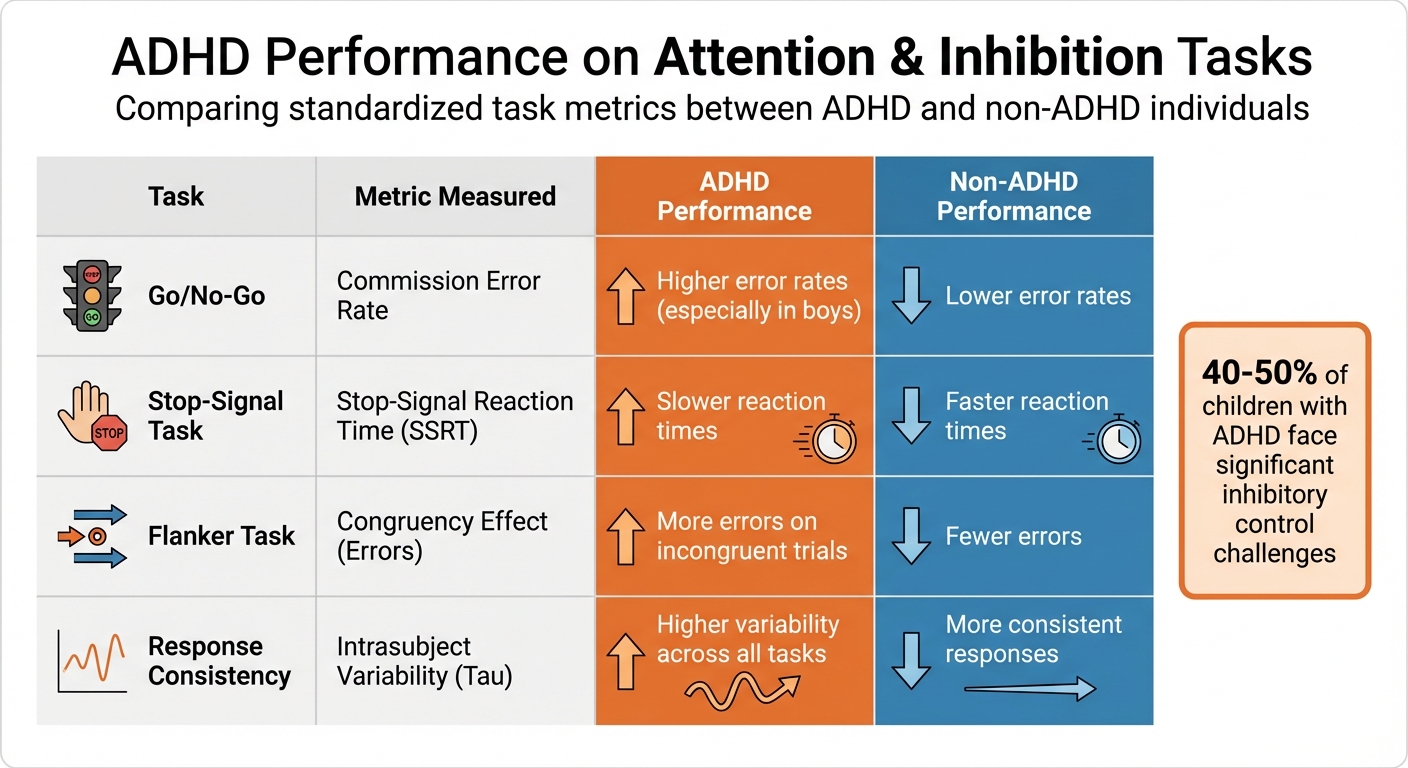
ADHD vs Non-ADHD Performance on Attention and Inhibition Tasks
ADHD brings more than just challenges with working memory and processing speed - it also disrupts selective attention and inhibitory control, adding to the overall cognitive strain.
Deficits in Selective Attention
Selective attention - the ability to focus on relevant stimuli while ignoring distractions - is significantly impaired in ADHD. This stems from neurological difficulties in processing competing stimuli.
The prefrontal cortex relies on balanced levels of dopamine and norepinephrine to filter out distractions. In ADHD, this balance is disrupted, creating an "inverted U" effect: both low and high arousal levels make it harder to focus. This explains why individuals with ADHD often struggle to maintain attention in both dull and overstimulating environments.
Brain imaging studies have shed light on how specific areas of the lateral prefrontal cortex are involved in attention and inhibition. For example, lateral BA 11/47 is responsible for perceptual selection, while lateral BA 10/46 manages memory selection. In ADHD, these areas show unusual activation patterns when trying to filter out distractions or suppress irrelevant memories. Additionally, children with ADHD display reduced amplitudes of the N2pc component (a marker of attentional selection occurring 200–300 milliseconds after a stimulus) and smaller distractor positivity (PD) amplitudes, indicating their brains are less effective at suppressing irrelevant information.
Connectivity issues in the Salience and Fronto-Parietal Networks, particularly between the right dorsolateral prefrontal cortex and the posterior parietal cortex, further undermine attention coordination.
Inhibitory Control and Task Performance
Inhibitory control refers to the ability to manage impulsive actions, which involves two key processes: action restraint (withholding a response) and action cancellation (stopping an ongoing response). Failures in these processes often lead to impulsivity and distractibility.
It’s estimated that 40% to 50% of children with ADHD face significant challenges with inhibitory control. However, these issues are not uniform. Michael J. Kofler, Ph.D., from Florida State University, highlights the role of working memory in these difficulties:
"Working memory broadly affects children's ability to inhibit prepotent tendencies and maintain fast/accurate performance, and may explain the errors that children with ADHD make on inhibition tests".
This suggests that many inhibitory control issues might actually stem from working memory overload rather than being independent deficits.
Standardized tasks highlight these difficulties clearly. Here’s a breakdown of ADHD performance compared to non-ADHD performance across common attention and inhibition tasks:
| Task | Metric | ADHD Performance | Non-ADHD Performance |
|---|---|---|---|
| Go/No-Go | Commission Error Rate | Higher error rates, especially in boys | Lower error rates |
| Stop-Signal Task | Stop-Signal Reaction Time (SSRT) | Slower reaction times | Faster reaction times |
| Flanker Task | Congruency Effect (Errors) | More errors on incongruent trials | Fewer errors |
| Response Consistency | Intrasubject Variability (Tau) | Higher variability across all tasks | More consistent responses |
EEG studies provide further insights. Adults with ADHD consistently show reduced P3 and N2 amplitudes during inhibition tasks, which are linked to error detection and cognitive control. Gender differences also emerge: boys with ADHD tend to make more impulsive errors, while girls often maintain accuracy but respond much more slowly.
These challenges with selective attention and inhibitory control complicate daily tasks, emphasizing the need for strategies to manage the cognitive demands of ADHD effectively.
Managing Cognitive Load with ADHD
Dealing with challenges like working memory issues, attention struggles, and slower processing speed can create a perfect storm for those with ADHD: cognitive overload. Understanding how ADHD increases mental demands - and finding ways to lighten that load - is key to improving daily performance.
Impact of Cognitive Overload on ADHD
ADHD doesn't just make tasks feel harder; it changes how the brain handles mental effort. Cognitive load can be broken into three types: intrinsic load (how hard a task naturally is), extraneous load (avoidable distractions or poor organization), and germane load (productive effort that helps you learn).
For people with ADHD, all three types of load can spike quickly. The brain’s ability to process and act on information gets overwhelmed, especially when juggling two tasks at once - a phenomenon called dual-task interference. Research shows that ADHD brains may only manage 3–4 items in their focus at a time, far fewer than the classic estimate of 7 ± 2 chunks. Even small additional demands can push the system into overload.
On top of this, ADHD brains face a disrupted neurochemical balance, which limits their capacity under high cognitive load. Studies show that under pressure, ADHD brains experience reduced global efficiency, leading to inconsistent performance. This inconsistency isn’t about effort or character - it’s a measurable difference in how brain networks function under stress.
Extraneous load is especially problematic. Digital clutter - like constant notifications or chaotic interfaces - drains cognitive resources that should be directed at the task itself. For someone with ADHD, this kind of mental chaos can quickly lead to overload, irritability, and a shorter fuse.
Interestingly, a 2023 study by Jacob T. Fisher and colleagues at Michigan State University uncovered something surprising: while cognitive load (like following complex rules) reduced brain efficiency in ADHD, perceptual load (making visual tasks harder by reducing opacity) actually improved performance. It even reduced variability in reaction times. This suggests that certain types of environmental complexity might help ADHD brains focus better, narrowing the gap with neurotypical peers.
These challenges highlight the need for strategies that shift mental effort away from internal processing and onto external supports.
Methods for Reducing Cognitive Load
The best strategies don’t rely on willpower - they redesign your environment to make things easier. As clinical psychologist Sharon Saline, Psy.D., explains:
"Sustainable success begins with understanding how ADHD uniquely shows up for you, then building systems that support, rather than fight, your cognitive style".
Externalize your thoughts. Take ideas out of your head and put them somewhere visible. Use tools like visual countdown timers to track time, digital reminders for upcoming tasks, and checklists to avoid relying on memory.
Break tasks into micro-steps. Big projects can overwhelm your mental workspace. Break them into tiny, actionable steps like "open document", "write one sentence", or "send email." Celebrate each small win to trigger dopamine, which helps with focus. This approach addresses the common ADHD challenge of low motivation for less stimulating tasks.
Try "brain dumping." Spend 5–10 minutes writing down every thought, task, or worry before starting focused work. This clears your mental "scratchpad", freeing up working memory for the task at hand.
Cut out distractions. Turn off unnecessary notifications, simplify your workspace, and reduce digital clutter. Your environment can either drain or support your focus, so designing a distraction-free zone is far more effective than relying on self-discipline.
Use sound strategically. Certain types of sound can help ADHD brains focus. A 2024 study in Communications Biology found that engineered audio designed for neural phase locking improved attention more than pink noise. White or brown noise can also provide steady auditory stimulation, helping ADHD brains maintain optimal focus.
Try body doubling. Work alongside someone else - either in person or virtually - to create social accountability and external structure. This technique helps anchor attention and reduces the temptation to get distracted.
Incorporate movement. Schedule 15–20 minutes of moderate exercise before tackling demanding tasks. Physical activity naturally boosts dopamine and norepinephrine, which ADHD brains often struggle to regulate on their own.
All these methods share a common goal: shifting the mental workload away from your brain’s executive functions and onto external systems. The aim isn’t to "fix" ADHD but to create systems that align with how ADHD brains actually work.
Recent Advances in ADHD Assessments
Gamified and AI-Based Assessment Tools
Traditional ADHD testing has often been a lengthy process, taking 1–3 hours and relying on abstract tasks that don’t always reflect real-world scenarios. However, a new wave of digital tools is transforming how ADHD is assessed, using technologies like virtual reality (VR), AI algorithms, and real-time neurofeedback to evaluate how the condition plays out in everyday life.
Take the Virtual Email Sorting Task (VEST) as an example. Developed at University Hospital Bonn, this tool was featured in a March 2026 study led by Laura Asché and Niclas Braun. Participants sorted emails in a simulated office setting filled with realistic distractions. The assessment tracked performance, head movement, and eye activity, revealing that unmedicated ADHD participants showed significantly higher head rotation during distracting moments (P < .001; η²p = 0.23). Niclas Braun, PhD, highlighted the benefits of VR-based assessments:
"VR-based assessments offer several advantages over traditional neuropsychological tasks... [providing] immersive features, such as the presentation of complex 3D environments that participants can interact with in a highly standardized manner".
Another innovative approach comes from Stanford Medicine, which used functional near-infrared spectroscopy (fNIRS) to deliver real-time neurofeedback to 21 children with ADHD. During memory exercises, participants earned "gold coins" on a screen when they successfully engaged their prefrontal cortex. After 12 weeks of this program, half of the participants showed notable improvements in ADHD symptoms.
AI-powered platforms like Creyos ADHD are also making waves, offering cognitive assessments in under 25 minutes. These tools evaluate 14 cognitive markers, such as spatial planning, response inhibition, and sustained attention. By integrating data from EEG, eye tracking, and motion capture, machine learning models have achieved classification accuracy rates above 85%.
These cutting-edge tools not only improve diagnostic accuracy but also provide professionals with actionable insights tailored to real-world conditions.
Applications for Professionals
For professionals, these advancements bring clarity and precision to ADHD assessments, offering data that directly impacts clinical and workplace practices.
High-performing adults with ADHD, for instance, often mask symptoms during clinical interviews, making diagnosis more challenging. Digital tools address this by measuring cognitive performance directly, bypassing the limitations of self-reported symptoms. Tools like VEST, which simulate office tasks such as managing emails amid distractions, help identify specific difficulties - like increased head movement or slower processing speeds when multitasking. Psychologist Jim Chapman explains:
"MOXO... provides very important detail and insight into the presence or absence of ADHD symptoms. It also reveals specific information on sub-characteristics of the ADHD presentation".
These tools also play a critical role in treatment monitoring. Instead of relying on guesswork to determine if a medication or strategy is working, professionals can retest in about 25 minutes and track changes in cognitive markers. The detailed reports generated by these assessments can highlight challenges like working memory deficits or attention inconsistencies, which can support requests for workplace accommodations.
Conclusion
Summary of Key Challenges
ADHD impacts how the brain processes information by limiting working memory, slowing down processing speed, and reducing the ability to select appropriate responses under cognitive load. Slower processing can delay actions, which adds extra strain on cognitive resources and disrupts the brain’s capacity to refresh memory content effectively. The ability to choose and initiate controlled actions - known as response selection - is also diminished, especially during multitasking scenarios. Combined with issues like poor inhibitory control and reduced cognitive flexibility, this makes it harder to block out distractions and switch between tasks. These challenges are particularly noticeable in professional environments, where they significantly affect performance. Understanding these hurdles is the first step toward developing strategies that can improve day-to-day functioning.
Next Steps for Improvement
The key to improving productivity lies in tailoring strategies to fit your cognitive style. A multimodal approach often yields better results. For instance, research shows that combining cognitive behavioral therapy (CBT) with medication leads to a 56% response rate, compared to just 13% for medication alone. Addressing ADHD-specific challenges with targeted cognitive training and environmental adjustments can help close the gap between intention and execution. Simple changes - like using noise-canceling headphones, reducing visual distractions, and applying time management methods such as the Pomodoro Technique (working in focused 25-minute intervals) - can significantly reduce sensory overload. Additionally, tools like checklists, visual flowcharts, and digital reminders can offload mental tasks, freeing up cognitive resources.
Other practical solutions include cognitive training programs like Cogmed to strengthen working memory, visual countdown clocks to combat time blindness, and speech-to-text tools to bypass processing delays. By experimenting with these strategies and finding the right mix for your needs, you can turn ADHD-related challenges into opportunities for growth. These adjustments can help professionals with ADHD thrive in their environments, as highlighted by On/Off Genius.
FAQs
How can I tell if it’s ADHD or slow processing speed?
Slow processing speed refers to the time it takes for someone to absorb, understand, and respond to information. This can lead to delays in completing tasks, even when the person has normal or above-average intelligence. ADHD, however, involves broader challenges like being easily distracted, acting impulsively, and struggling to organize thoughts. If your primary concern is slow response time without issues like impulsivity or attention difficulties, it’s a good idea to consult a healthcare professional. They can help evaluate and differentiate between these conditions.
What’s the fastest way to reduce cognitive overload at work?
To ease cognitive overload at work, individuals with ADHD can benefit from boosting processing speed and working memory. Practical strategies include breaking tasks into simpler steps, giving yourself extra time to process information, and cutting down on distractions. These methods address common ADHD-related challenges, making it easier to handle daily demands.
Do newer ADHD tests like VR or AI tools actually help diagnosis?
Advances in ADHD assessment are making diagnoses more precise, thanks to tools like virtual reality (VR), artificial intelligence (AI), and digital cognitive testing. VR allows specialists to simulate real-world scenarios, helping to identify cognitive difficulties in a controlled, immersive setting. AI steps in by analyzing brain activity patterns, offering objective insights that go beyond traditional methods. Meanwhile, digital cognitive tests simplify the evaluation process, cutting down on errors and the risk of misdiagnosis. Together, these tools are paving the way for data-driven approaches to better understand ADHD and tailor treatment plans.