Ultimate Guide to ADHD Emotional Regulation
Quick grounding techniques, breathing, therapy options, and long-term habits to manage intense emotions and build resilience with ADHD.

Managing emotions with ADHD can be tough. Emotional dysregulation - when feelings hit hard, fast, and linger - affects 70% of adults with ADHD. For many, it’s more disruptive than inattention or hyperactivity. This guide simplifies strategies to help you regain control, whether in the heat of the moment or through long-term habits.
Key Takeaways:
- Quick fixes for intense emotions: Techniques like the 5-4-3-2-1 grounding method, ice cube trick, or breathing exercises (e.g., 7-11 breathing) can help calm your mind fast.
- Long-term tools: Mindfulness, cognitive reframing, and journaling build emotional awareness and resilience over time.
- Therapy options: Dialectical Behavior Therapy (DBT) and Cognitive Behavioral Therapy (CBT) offer structured support for emotional regulation.
- Practical tips: Create a "crisis toolkit" with sensory aids, prepare for common triggers, and channel emotions into productive outlets like art or movement.
By combining these strategies, you can better manage emotional waves and turn challenges into strengths.
The Neuroscience of ADHD and Emotional Dysregulation
sbb-itb-f879324
Quick Techniques for Managing Intense Emotions
When emotions hit hard, having simple, quick strategies ready can make all the difference. Here are some practical methods to help you regain control in the moment.
Sensory-Based Calming Strategies
One effective trick is the ice cube method: hold an ice cube against your wrist to shift your focus from overwhelming emotions to the physical sensation. Similarly, splashing cold water on your face or wrists can create a calming effect almost instantly.
Another option is the 5-4-3-2-1 technique, which helps ground you in the present. Identify:
- 5 things you can see,
- 4 you can touch,
- 3 you can hear,
- 2 you can smell, and
- 1 you can taste.
This exercise takes just a couple of minutes and brings your mind back to the here and now. Psychotherapist Casey Forster also suggests a tactile approach called Havening:
"I gently stroke both his arms from the shoulder to his fingertips repeatedly whilst saying 'I love you. You are wonderful, beautiful and amazing, I love you.' ... It gives him a moment to reset".
For anger specifically, movement-based techniques like Thor's Hammer can help release pent-up energy. Stand with your feet apart, raise your arms overhead while inhaling, and then forcefully swing them down between your legs on a loud exhale. Psychotherapist Bhavna Raithatha highlights its effectiveness:
"This (Thor's hammer) is fantastic for everyone".
These sensory strategies can naturally transition into breathing techniques for further relief.
Breathing Techniques for Fast Relief
Controlled breathing is a powerful way to calm your nervous system. 7-11 breathing involves inhaling for a count of 7, holding for 7, and then exhaling for a count of 11. The longer exhale helps lower your heart rate and ease anxiety.
Another option is box breathing, which creates a steady rhythm: inhale for 4 seconds, hold for 4 seconds, exhale for 4 seconds, and pause for 4 seconds. This technique is especially useful in public or overstimulating situations. Billy Roberts, a Certified ADHD Therapist, explains:
"ADHD takes away the brain's pause button... when they feel, they do so quickly and deeply".
These breathing exercises are simple yet effective tools to include in your emotional management toolkit.
Creating a Crisis Toolkit
It's helpful to prepare a "crisis toolkit" during calm moments so you're ready when emotions escalate. Include sensory aids like ice packs, fidget tools, noise-canceling headphones, or a weighted lap pad. Visual reminders of breathing techniques and cognitive tools, such as affirmation cards or an emotion wheel, can also be valuable.
A "movement menu" with physical activities like brisk walking, dancing, or shaking out your limbs can provide quick outlets for intense feelings. ADHD Coach Leanne Maskell shares:
"For me, the best grounding technique is … questioning our thoughts and spotting the ones causing us to have emotional reactions".
Digital resources, such as playlists, breathing apps, or conversation scripts, can also be lifesavers. Pen King, ADHD Entrepreneur & Investor, emphasizes the importance of preparation:
"Emotional regulation isn't an inborn trait you either have or don't; it's a skill that can be learned, practiced, and strengthened at any age".
Long-Term Strategies for Emotional Regulation
Quick fixes can be lifesavers in the heat of the moment, but building emotional resilience that lasts takes consistent effort. For individuals with ADHD, this means focusing on practices that address the brain's natural tendencies, helping you recognize and manage emotions before they spiral out of control. These long-term strategies work hand-in-hand with the shorter techniques, giving your brain the tools it needs to stay balanced.
Mindfulness and Meditation Practices
Mindfulness for ADHD isn't about sitting still and emptying your mind - it's about noticing what's happening in your body and mind without judgment. As Isabel Skarbinski, a Graduate Student Clinician, explains:
"If you can't tell you're drifting, spiraling, or zoning out, it's extremely hard to steer yourself back".
Research backs this up, showing that mindfulness-based techniques can significantly reduce emotional dysregulation in ADHD, with effect sizes of d = 1.27 or higher. A simple but effective method is cognitive labeling - naming your emotion out loud, like saying, "I feel frustrated." This activates your prefrontal cortex, which helps calm your brain's emotional alarm system (the amygdala). Another helpful framework is R.A.I.N.: Recognize the emotion, Allow it to exist without judgment, Investigate its cause, and practice Non-identification by reminding yourself that emotions are experiences, not your identity. Pair this with the 90-second pause rule, which is based on research showing that emotions often last about 90 seconds - just enough time to pause and avoid acting impulsively.
To make mindfulness more practical, try a one-minute body scan when tension builds. Start at the top of your head and work downward, noticing sensations like a tight chest or fidgety legs without trying to change them. You can also explore ADHD-friendly mindfulness apps like Inflow, Calm, Headspace, Insight Timer, or MindShift CBT. Another tip? Schedule 15-minute "firebreaks" between emotionally taxing tasks to give your brain a moment to reset.
Once you've built this awareness, you can take it further with cognitive reframing techniques.
Cognitive Reframing and Self-Monitoring
For many with ADHD, identifying emotions can feel like solving a mystery. Cognitive reframing helps by teaching you to reinterpret emotional cues and break out of negative thought cycles.
A great way to start is by using strength-based metaphors. For example, instead of labeling impulsivity as a flaw, think of it as having a "race-car brain with bicycle brakes" - a challenge of wiring, not a personal failure. Beth Main, an ADHD Coach and Therapist, puts it this way:
"The current in people with ADHD is just as strong as anyone's... But our switch is not reliable. It turns itself off when we get distracted or overwhelmed".
Another useful tool is evidence journaling. Write down 10 things you’ve accomplished or are proud of to counteract the persistent "failure narrative" that often accompanies ADHD. The F.O.U.L. method (Fact, Opinion, Unhelpful thought, and Logical response) can also help you separate facts from assumptions, leading to healthier reactions - like seeking clarification instead of snapping in frustration. Tracking emotional triggers, their intensity (on a scale of 1–10), and duration can uncover patterns that make it easier to anticipate and manage challenging situations. For women, tracking hormonal cycles can be especially helpful, as estrogen dips during the luteal phase may heighten emotional sensitivity.
When words don’t feel like enough, creative and physical outlets can provide another way to process emotions.
Creative and Physical Outlets
Sometimes, the best way to deal with emotions is to express them without words. Creative and physical activities offer a powerful alternative, helping to release dopamine, serotonin, and endorphins - key neurotransmitters that are often in short supply for people with ADHD.
Artistic activities like painting, drawing mandalas, or sculpting with clay can reduce stress and encourage balance between the brain's hemispheres. Hephzibah Kaplan, Director of the London Art Therapy Centre, explains:
"With people with ADHD, whose minds are often in the fast lane of the motorway, it is important to connect with one's body, and the visceral experience of making art is part of the embodying process".
Bilateral drawing - using both hands at the same time - is another technique that can help process emotions while fostering communication between brain hemispheres. On the physical side, activities like running, yoga, tai chi, or even a quick set of jumping jacks can act as natural mood boosters by releasing endorphins and reducing stress hormones. Sensory-focused activities, such as working with kinetic sand, pottery, or stress balls, can also help regulate emotions. For those seeking more movement, activities like swinging or climbing provide vestibular input, which can promote emotional stability.
To make these outlets more accessible, consider setting up a calming "refuge" space at home. Stock it with items like adult coloring books, crochet materials, aromatherapy tools, or a journal. This space can serve as your go-to retreat when you're feeling overwhelmed, offering options that match your energy - high-intensity exercise for when you're wired, or gentle activities like stretching or art when you need to wind down.
Therapy Options for Emotional Regulation
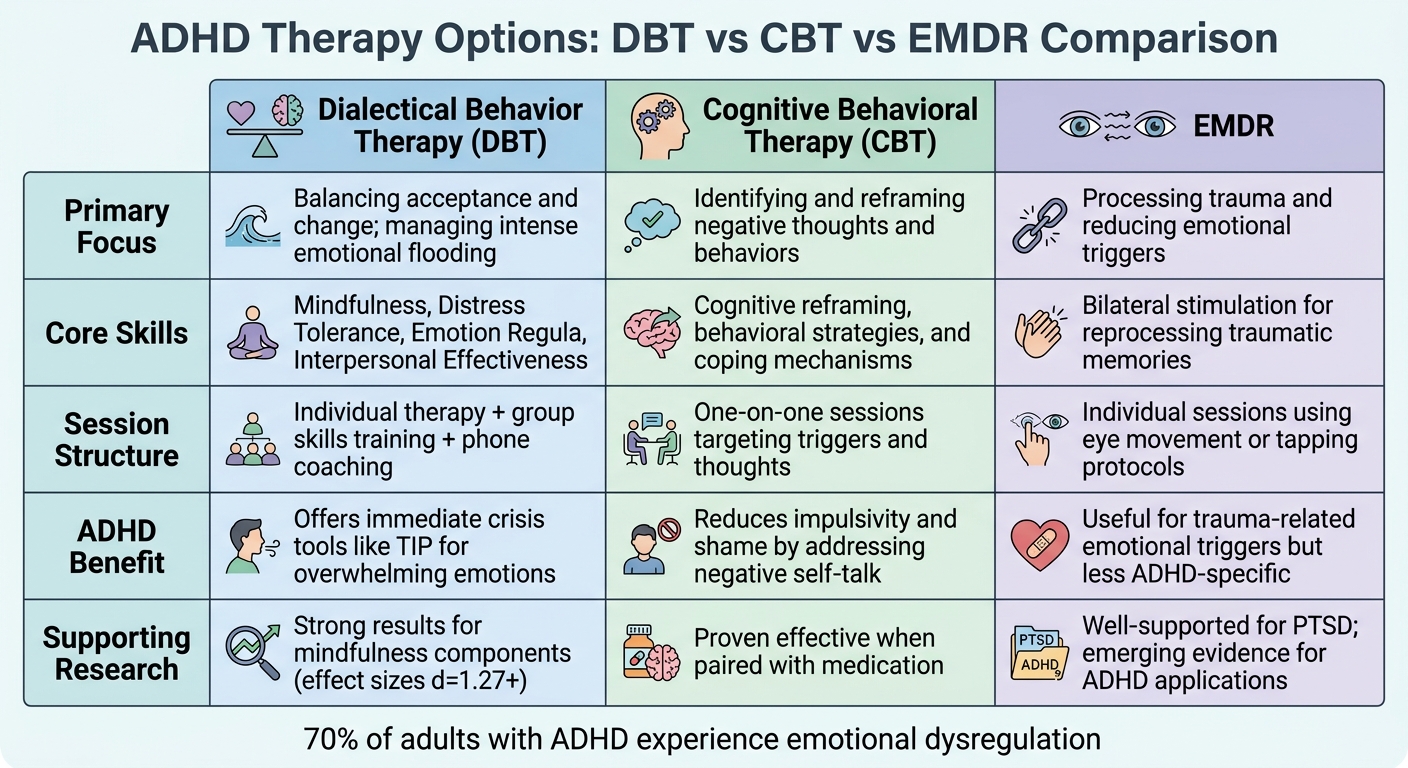
ADHD Therapy Options Comparison: DBT vs CBT vs EMDR
While short-term techniques and self-help strategies can improve emotional control, professional therapy delves deeper, addressing the root causes of emotional dysregulation. Therapy provides structured support to develop long-lasting emotional skills. Two widely recognized approaches are Dialectical Behavior Therapy (DBT) and Cognitive Behavioral Therapy (CBT). Each method offers unique tools, and understanding their differences can help you decide which might work best for you.
Dialectical Behavior Therapy (DBT)
DBT was originally designed for individuals who experience overwhelming emotional responses - moments when feelings completely take over, leaving logic behind. This intense reaction is often linked to an overactive amygdala and a less active prefrontal cortex. DBT focuses on four key skills: mindfulness (staying present), distress tolerance (managing crises without worsening them), emotion regulation (understanding and controlling emotions), and interpersonal effectiveness (asserting needs while maintaining relationships).
The DBT framework includes individual therapy, group skills training, phone coaching for real-life challenges, and therapist consultations to ensure consistent care. Alex VanDusen describes DBT’s ultimate aim as helping individuals create "a life worth living". One practical DBT tool for managing intense emotions, especially for those with ADHD, is the TIP skill. This involves using Temperature (like splashing cold water on your face), Intense exercise (short, vigorous activity), and Paced breathing (longer exhales than inhales) to reset your nervous system. While many therapists incorporate DBT-inspired techniques, research indicates the full DBT model yields the best outcomes.
Cognitive Behavioral Therapy (CBT)
CBT focuses on the interplay between thoughts, emotions, and behaviors. It helps you identify and change negative thought patterns that often drive emotional outbursts. According to Michael Manos, PhD, emotional dysregulation occurs because "we manage emotions using directed attention".
CBT sessions are typically one-on-one and aim to pinpoint triggers, challenge distorted thinking, and develop healthier responses. For individuals with ADHD, CBT often addresses executive function challenges, such as recognizing emotions before they spiral out of control. It’s particularly effective in breaking the "shame spiral" by shifting negative self-talk and is frequently combined with medication for better results. Instead of just handling emotions in the moment, CBT equips you with tools to prevent emotional dysregulation from taking over.
Comparing DBT, CBT, and EMDR
Below is a comparison of DBT, CBT, and Eye Movement Desensitization and Reprocessing (EMDR), highlighting their differences and benefits.
| Feature | Dialectical Behavior Therapy (DBT) | Cognitive Behavioral Therapy (CBT) | EMDR |
|---|---|---|---|
| Primary Focus | Balancing acceptance and change; managing intense emotional flooding | Identifying and reframing negative thoughts and behaviors | Processing trauma and reducing emotional triggers |
| Core Skills | Mindfulness, Distress Tolerance, Emotion Regulation, Interpersonal Effectiveness | Cognitive reframing, behavioral strategies, and coping mechanisms | Bilateral stimulation for reprocessing traumatic memories |
| Session Structure | Individual therapy + group skills training + phone coaching | One-on-one sessions targeting triggers and thoughts | Individual sessions using eye movement or tapping protocols |
| ADHD Benefit | Offers immediate crisis tools like TIP for overwhelming emotions | Reduces impulsivity and shame by addressing negative self-talk | Useful for trauma-related emotional triggers but less ADHD-specific |
| Supporting Research | Strong results for mindfulness components (effect sizes d=1.27+) | Proven effective when paired with medication | Well-supported for PTSD; emerging evidence for ADHD applications |
Though EMDR is mainly used for trauma, it can also help reduce emotional triggers in ADHD, complementing the more targeted approaches of DBT and CBT.
With up to 70% of adults with ADHD experiencing emotional dysregulation - and over 30% identifying it as their most debilitating symptom - the right therapy can be transformative. Whether you need tools for immediate emotional crises (DBT), strategies to reframe negative thinking (CBT), or trauma-focused care (EMDR), professional support offers a depth of guidance that self-help approaches often cannot provide.
In the next section, we’ll explore how cultivating positive emotions can further strengthen your emotional regulation skills.
Building Positive Emotions
Managing emotional dysregulation with ADHD involves more than just handling negative feelings - it’s about creating a strong base of positive emotions. For brains that struggle with dopamine regulation in the prefrontal cortex, practices like gratitude and self-compassion aren’t just nice ideas - they can actually reshape your brain for long-term emotional growth.
Practicing Gratitude and Self-Compassion
Gratitude has a direct impact on brain chemistry, encouraging the release of dopamine and serotonin - two chemicals often lacking in ADHD brains. A 2008 study found that participants who kept a gratitude journal for just two weeks showed real improvements in working memory and attention. After four weeks, they experienced even greater gains in planning and decision-making abilities, thanks to the creation of new neural pathways for positive emotions.
For those with ADHD who often feel trapped in cycles of anxiety, shame, or burnout, gratitude can activate what’s called the "Soothing System". Dr. Kristin Neff explains:
"Self-compassion is being supportive toward oneself when experiencing suffering or pain - be it caused by personal mistakes and inadequacies or external life challenges".
This practice encourages you to treat yourself with the same kindness and understanding you’d offer a close friend.
But let’s be real - sticking to gratitude practices can be tough, especially with an ADHD brain. That’s where ADHD-friendly strategies come in. Try setting up specific plans, like deciding when and where you’ll practice gratitude. Use cues, such as alarms or sticky notes, and build in accountability with a partner. For instance, you could start a Gratitude Text Buddy system, where you and a friend share three things you’re grateful for each day. This social connection can also help reduce feelings of shame tied to ADHD. Another option is a Gratitude Jar, which acts as a physical reminder to jot down moments of thankfulness. Interestingly, research shows that practicing gratitude before bed can improve sleep more effectively than doing it at other times.
When self-criticism creeps in, a Self-Compassion Break can help. Place your hand over your heart to recall comforting memories, and remind yourself that everyone struggles. Pediatrician Mark Bertin highlights the value of this approach:
"Self-compassion is a reality-based antidote for self-criticism and perfectionism. We learn to value self-improvement and take responsibility for mistakes, but without inner heckling".
These practices not only boost emotional resilience but also fuel momentum for productive actions.
Channeling Emotional Energy into Action
Once you’ve built that foundation of gratitude and self-compassion, the next step is to channel your emotional energy into meaningful actions. ADHD emotions can feel overwhelming, almost like they’re dialed up to full volume. But as NeuroDivergent Rebel Lyric Rivera wisely notes:
"Energy, once created, cannot be destroyed. It can only be converted from one form of energy to another".
Rather than letting emotional energy spiral into a meltdown, you can redirect it into productive outlets.
Physical movement is a great way to release pent-up energy. Try dancing, jumping, or doing a quick 60-second burst of exercise. Interestingly, the physiological process of an emotion moving through your body only takes about 90 seconds - after that, it’s your thoughts that keep the feeling alive. If you’re in a setting where movement isn’t an option, like a work meeting, sensory grounding techniques can help. Press your feet firmly against the floor or use a stress ball to manage emotional flooding.
Creative activities also offer a powerful outlet for emotional energy. Painting, writing, or playing music can help you process intense feelings while creating something tangible. If emotions disrupt your focus on complex tasks, consider switching to simpler ones, like organizing files or responding to easy emails, to ease back into productivity. Even vocal expressions, like humming, singing, or what some call "excited rambling", can help release emotional pressure.
The aim isn’t to suppress emotions but to regulate them. As Mikayla Phan from ADHD Solutions Therapy puts it:
"The goal is modulation, not suppression. Emotional depth often correlates with creativity, humor, passion, and relational attunement".
Your emotional intensity is part of what makes you, you. By learning to channel it effectively, you can turn what might feel like a challenge into a strength. These tools - gratitude, self-compassion, and energy redirection - are essential additions to your ADHD emotional regulation toolkit.
Conclusion: Your Emotional Regulation Toolkit
Key Takeaways
Emotional dysregulation is a neurological challenge that affects about 70% of adults with ADHD, often standing out as their biggest hurdle. This stems from an underactive prefrontal cortex paired with an overactive amygdala. Studies reveal that for many, the emotional struggles tied to ADHD can cause greater disruptions in careers and relationships than symptoms like inattention or hyperactivity. Understanding this can help break the cycle of shame that often follows emotional outbursts.
This guide has provided both quick fixes and long-term strategies to help manage emotional responses. The main idea? Create a pause between a trigger and your reaction. Whether you're using the 5-4-3-2-1 grounding technique to stop emotional flooding, reframing thoughts to challenge distortions, or channeling intense feelings into physical activity, the goal is to let your rational brain regain control.
Effective emotional regulation requires a mix of immediate tools and consistent habits. Practices like gratitude, self-compassion, and preparing responses for predictable stressors can build resilience over time. With these insights, it's time to put your emotional regulation toolkit into action.
Next Steps for Managing ADHD and Emotions
To turn strategies into lasting habits, start by choosing 3–5 techniques that feel most practical for you. Practice them during calm moments to build familiarity. Prepare a "crisis toolkit" with items like fidget toys, calming objects, or digital reminders to use in stressful situations.
Spend a few days tracking your emotional patterns to identify common triggers - hunger, noise, rushing, or hormonal changes - and create "if-then" plans. For example, carry snacks if hunger is a trigger or use noise-canceling headphones in loud environments. During calm periods, discuss with loved ones the idea of taking short time-outs during heated moments, explaining that these are regulation strategies, not avoidance.
If emotional outbursts are significantly impacting your daily life, consider seeking help from a therapist who specializes in CBT or DBT. As ADHD entrepreneur Pen King puts it:
"Emotional regulation isn't an inborn trait you either have or don't; it's a skill that can be learned, practiced, and strengthened at any age".
For more tools and strategies tailored to professionals managing ADHD, check out the resources available at On/Off Genius.
FAQs
How do I pick the best 3–5 emotional regulation tools for me?
To find the right emotional regulation tools, start by figuring out what works best for your situation. You could try strategies like scripting your responses ahead of time, using grounding techniques such as the 5-4-3-2-1 method (where you focus on your senses to stay present), or setting clear boundaries to handle potential triggers. The key is to focus on methods that give you a moment to pause and maintain control. Start small - pick one or two techniques - and gradually add more as you get comfortable, tailoring the approach to suit your needs.
What should I include in an ADHD “crisis toolkit” for work or public places?
When you're navigating work or public spaces with ADHD, having a "crisis toolkit" can be a game-changer for managing overwhelming emotions and staying steady. Here are a few essentials to consider:
- Grounding techniques: Try the 5-4-3-2-1 sensory method to anchor yourself in the present moment by focusing on your senses.
- Pre-planned responses: Prepare phrases or strategies for handling social interactions, so you're not caught off guard.
- Sensory tools: Items like stress balls or noise-canceling headphones can help you stay focused and calm.
- Quick calming techniques: Breathing exercises or short mindfulness practices can ease tension in moments of stress.
- Cognitive reframing strategies: Shift your perspective by challenging negative thoughts and focusing on a more balanced view.
Having these tools on hand can make challenging situations feel more manageable.
When is therapy (DBT, CBT, or EMDR) worth considering for emotional dysregulation?
Therapies like DBT (Dialectical Behavior Therapy), CBT (Cognitive Behavioral Therapy), or EMDR (Eye Movement Desensitization and Reprocessing) can offer support when emotional dysregulation interferes with daily life or overall well-being. These methods focus on building skills such as mindfulness, reshaping negative thought patterns, or working through trauma. They’re designed to help regulate intense emotions and improve coping strategies. Therapy can be particularly beneficial if you’re dealing with persistent mood swings, difficulties in social interactions, or low self-esteem - or if medication alone isn’t addressing emotional challenges effectively.