Why ADHD Affects Impulse Control: Brain Insights
How ADHD disrupts impulse control — prefrontal delays, low dopamine/norepinephrine, and practical medication plus behavioral strategies.

ADHD impacts impulse control due to delays in brain signaling, neurotransmitter imbalances, and underactivity in key brain regions like the prefrontal cortex. These neurological differences make it harder to pause, think, and act intentionally. Here's what you need to know:
- Impulse control relies on the brain's ability to pause and assess before acting. In ADHD, this system is slower and less efficient.
- Key brain regions: The prefrontal cortex (responsible for decision-making) and basal ganglia (help suppress impulses) show reduced activity and weaker communication in ADHD brains.
- Neurochemical challenges: Low dopamine and norepinephrine levels disrupt focus and self-regulation, while an overactive dopamine transporter clears dopamine too quickly.
- Everyday struggles: Impulsivity can lead to difficulties at work (interruptions, missed deadlines) and in personal life (unfiltered comments, rash decisions).
Solutions: A combination of medication, cognitive techniques, and mindfulness can help manage these challenges. Medications like stimulants improve brain chemistry, while strategies like breaking tasks into steps, naming emotions, and mindfulness exercises build better control over time.
How the ADHD Brain Works: The Science Behind Impulsivity
The Prefrontal Cortex and Executive Function
Think of the prefrontal cortex (PFC) as the brain's CEO - it’s responsible for decision-making, planning, and self-control. It sends signals to other parts of the brain, steering them toward purposeful actions rather than automatic reactions.
Within the PFC, two areas are especially important:
- The Dorsolateral Prefrontal Cortex (DLPFC) keeps your attention on track and holds information in working memory, helping you weigh options and choose the best response.
- The Orbitofrontal Cortex (OFC) and Ventromedial Prefrontal Cortex (vmPFC) assess risks and rewards, which is key for managing emotions and preventing impulsive decisions.
In ADHD, this system doesn’t function as efficiently. The PFC shows less activity during tasks requiring self-control, and brain scans reveal smaller gray matter volumes in this region compared to neurotypical individuals. Studies estimate that about 89% of children with ADHD face specific challenges with executive functioning.
Disrupted Communication Between Brain Regions
The PFC doesn’t operate in isolation - it depends on smooth coordination with other brain regions, particularly the basal ganglia, which include structures like the caudate and pallidum. These connections play a critical role in helping the brain choose appropriate actions and suppress impulsive ones.
In ADHD, these communication pathways are less efficient. The weakened connection between the PFC and basal ganglia makes it harder for the brain to send the "stop" signals needed for impulse control. This miscommunication often explains why someone with ADHD might act or speak without thinking, as their internal brakes don’t engage quickly enough.
Dopamine and Norepinephrine Deficits
Two key neurotransmitters - dopamine and norepinephrine - are crucial for controlling impulses, and both are often dysregulated in ADHD brains.
-
Dopamine is central to the brain’s reward system. When dopamine levels are low, everyday tasks feel unrewarding, leading the brain to seek out high-stimulation activities instead. As Ellen Littman, Ph.D., describes:
Dopamine-deficient brains experience a surge of motivation after a high-stimulation behavior triggers a release of dopamine. But in the aftermath of that surge and reward, they return to baseline levels with an immediate drop in motivation.
- Norepinephrine helps regulate attention and alertness in the PFC. Low levels make it harder to stay focused and ignore distractions.
Compounding the issue, ADHD brains often have an overabundance of dopamine transporters - proteins that clear dopamine from the synaptic gap too quickly, disrupting communication between neurons. Additionally, decreased glucose metabolism in the PFC leaves the brain with less energy for tasks requiring focus and self-regulation. Researchers have even identified 27 genetic markers tied to dopamine regulation, highlighting just how complex these neurochemical challenges are.
Together, these imbalances make impulse control a constant struggle, creating hurdles that extend far beyond the brain’s biology.
Why ADHD Brains Are So (HEY LOOK BALLOON!) Impulsive
How Impulse Control Issues Affect Daily Life
The neurological challenges tied to ADHD don't just stay in the background - they show up in everyday life, creating hurdles in both professional settings and personal relationships. For gifted professionals, these impulse control issues can create unique challenges that often disrupt even the most capable minds.
Workplace Challenges
Navigating the workplace with ADHD often means grappling with the brain's constant need for stimulation. As Ellen Littman, Ph.D., points out:
"ADHD brains are motivated by their search for optimal stimulation, rather than by what others label as important."
This internal conflict can feel like a tug-of-war between your good intentions and your brain's craving for immediate, high-level engagement. Tasks that lack excitement - like expense reports or routine emails - may remain untouched until the pressure of a looming deadline finally kicks your brain into action. This isn't laziness; it's a neurological block that makes it hard to engage with tasks that don't naturally captivate your attention.
In the workplace, this difficulty with regulation can show up in behaviors like interrupting coworkers, blurting out thoughts without filtering, or impulsively checking your phone during critical meetings. Decision-making can also be impacted - logical reasoning may take a backseat to snap decisions that you might later regret.
Some people with ADHD try to combat low stimulation by fidgeting or creating disruptions, while others may react in the opposite way, becoming hypersensitive. This hypersensitivity can lead to impulsive reactions like withdrawing from situations or becoming irritable when overwhelmed by sensory input. These struggles at work often parallel challenges faced in personal life.
Personal and Relationship Effects
Impulse control issues don't stop at the office door - they also seep into personal relationships. Impulsivity can lead to unfiltered comments or difficulty staying present in conversations, which can cause misunderstandings and even resentment. During emotional conflicts, the inability to regulate feelings can result in rash decisions that are regretted later. Aidan, an individual with ADHD, shared this experience:
"When I get super overwhelmed or feel criticized or stressed or perceive some slight from my wife, I try to end the relationship. In the moment I'm convinced our relationship is terrible/not the right thing. Then once I'm regulated again I don't feel that way at all."
This pattern - acting impulsively during emotional highs and regretting it after calming down - can be particularly damaging to relationships. Rejection sensitivity, a common trait in ADHD, adds another layer of difficulty by making neutral comments feel like criticism. This can trigger defensive reactions or cause withdrawal, further straining relationships.
Outside of relationships, impulsivity can lead to behaviors like compulsive spending, reckless driving, or chaotic daily routines. Late-night bursts of energy, driven by an overactive Reticular Activating System, might lead to impulsive activities like scrolling through social media or gaming, which can disrupt sleep patterns. On top of that, decreased glucose metabolism in the brain may prompt cravings for sugary snacks or carbs as a quick way to boost dopamine and serotonin levels.
The good news? Research suggests that managing these behaviors can lead to life-changing outcomes. A large-scale Swedish study found that men with ADHD were 32% less likely, and women 41% less likely, to have criminal convictions - often tied to impulsive actions - when taking ADHD medication.
How to Manage Impulse Control Challenges
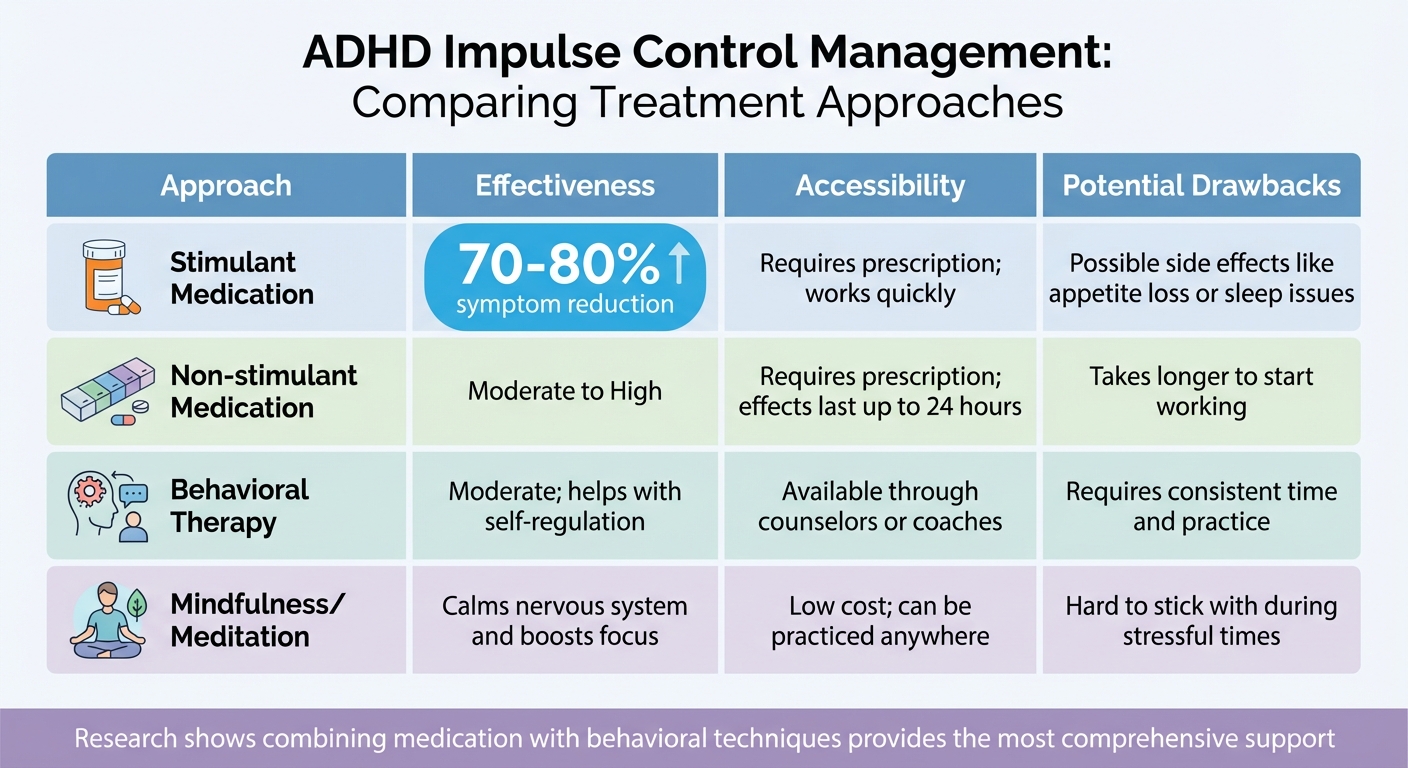
ADHD Impulse Control Management: Medication vs Behavioral Approaches Comparison
Managing impulse control when dealing with ADHD isn't about sheer willpower. It's about understanding your brain's natural tendencies and working with them. Studies highlight that a combination of medication and behavioral techniques tends to deliver better results than medication alone. This approach tackles both the chemical and behavioral aspects of ADHD.
Medication Options
Stimulant medications are often prescribed because they boost dopamine and norepinephrine levels. These neurotransmitters play a big role in managing impulse control. Around 70% to 80% of children with ADHD experience fewer symptoms with stimulants, often seeing improvements soon after starting them.
Non-stimulant medications, on the other hand, work differently. They take longer to build up in your system but offer up to 24 hours of steady effects. These can be a good alternative if stimulants cause side effects like appetite loss or sleep disturbances.
Cognitive Behavioral Methods
Medication isn't the only tool in the box. Cognitive techniques can help you develop better control over impulsive actions. For instance, behavioral sequencing involves analyzing impulsive episodes - identifying what triggered them, how you felt, and the outcomes. This reflective process can help you recognize patterns and find ways to respond differently in the future.
Breaking tasks into smaller, manageable steps can also reduce stress, which often triggers impulsivity. For example, instead of tackling "write a report", break it down into steps like "gather March sales data" or "draft the introduction." Jennifer Skinner, a Licensed Professional Counselor, explains how naming emotions helps quiet impulsive reactions:
"Just being able to name your emotions takes … the reactive part of the brain offline and allows your executive functioning to come into play more."
When you feel the urge to act impulsively, pause and acknowledge your emotions - whether it's frustration, boredom, or anxiety. This brief moment of recognition shifts activity from reactive parts of the brain to the decision-making prefrontal cortex, giving you better control.
Another helpful technique is somatic awareness. Pay attention to physical sensations, like clenched fists or a racing heart, when you're triggered. Sit with these sensations for about a minute without reacting. This practice builds tolerance for discomfort and can help prevent impulsive actions.
Mindfulness and Mental Exercises
Mindfulness is another powerful tool for managing impulsivity. Jennifer Skinner emphasizes its benefits:
"Meditation is one of my favorite tools for addressing impulsivity because it calms the nervous system down, which allows clients to make better choices instead of just reacting."
A quick mindfulness exercise like the 5-4-3-2-1 grounding technique can be a lifesaver. When impulsivity hits, name five things you see, four things you can touch, three you hear, two you smell, and one you taste. This simple exercise pulls you into the present moment, interrupting impulsive behaviors.
Your environment also plays a role. Minimize distractions by turning off unnecessary notifications, keeping your workspace organized, and sticking to routines. Designated spots for essentials like keys or phones can also reduce the mental clutter that contributes to impulsivity.
These mindfulness strategies not only help curb impulsive behavior but also improve focus, which is especially valuable in demanding professional settings.
Medication vs. Behavioral Approaches: A Comparison
To better understand how these approaches work, here's a side-by-side comparison:
| Approach | Effectiveness | Accessibility | Potential Drawbacks |
|---|---|---|---|
| Stimulant Medication | High (70–80% symptom reduction) | Requires a prescription; works quickly | Possible side effects like appetite loss or sleep issues |
| Non-stimulant Medication | Moderate to High | Requires a prescription; effects last up to 24 hours | Takes longer to start working |
| Behavioral Therapy | Moderate; helps with self-regulation | Available through counselors or coaches | Requires consistent time and practice |
| Mindfulness/Meditation | Calms the nervous system and boosts focus | Low cost; can be practiced anywhere | Hard to stick with during stressful times |
Stimulant medications provide quick relief by addressing neurotransmitter imbalances, but their effects wear off as the dose fades. Behavioral techniques, while slower to show results, offer long-term benefits once mastered. These skills can help you maintain self-control even without ongoing medication.
For professionals juggling complex tasks, combining medication with behavioral strategies provides the most well-rounded support. Together, they create a framework for improving both personal and professional performance over time.
Conclusion: Connecting Your Abilities with Consistent Performance
Main Points to Remember
ADHD-related challenges with impulse control are rooted in specific neurological differences. These include delays and imbalances in brain signaling, lower dopamine levels, and reduced glucose metabolism in the prefrontal cortex - all of which limit the brain's energy for regulating impulses. The ADHD brain often experiences a mismatch between two systems: an overactive reward system and a cognitive control system that struggles to keep up. Understanding this biological foundation helps shift the focus from self-blame to actionable strategies.
A combined approach of medication and behavioral techniques tends to be the most effective. For instance, a large Swedish study involving 25,000 participants found that ADHD medication reduced criminal convictions by 32% in men and 41% in women. While medication addresses neural deficits, behavioral strategies - like the "Stop, Think, Act" method, modifying your environment, and practicing mindfulness - help build long-term skills for managing low-stimulation tasks. This combination of approaches is essential for achieving consistent performance.
Moving Forward as a Gifted Professional
Recognizing these neurological differences paves the way for practical management strategies. By working with your brain's natural tendencies, you can turn its unique wiring into a strength. External supports - such as implementing a 24-hour rule for big decisions, using visual reminders, or setting smartphone alerts - can help fill in the gaps caused by internal signaling challenges.
Many professionals with ADHD excel in high-stakes careers, like emergency medicine or firefighting, where the environment provides the stimulation their brains thrive on. Even in less dynamic roles, you can make tasks more engaging by tying them to personal relevance or introducing immediate rewards. The goal isn’t to suppress ADHD traits but to create systems that allow your strengths to shine consistently.
At On/Off Genius, we believe that with self-awareness, structured external tools, and targeted strategies, you can bridge the gap between your potential and your performance. Your brain’s unique wiring isn’t a limitation - it’s an opportunity.
FAQs
Is impulsivity in ADHD a brain issue or a willpower issue?
Impulsivity in ADHD originates from differences in brain function, particularly disruptions in how neural networks communicate. This isn't about lacking willpower - these brain-related challenges influence self-control and decision-making. In essence, impulsivity in ADHD is a neurological issue, not a matter of personal choice.
How do dopamine and norepinephrine affect impulse control in ADHD?
Dopamine and norepinephrine play a key role in managing impulse control in ADHD by influencing activity in the prefrontal cortex. When levels of these neurotransmitters are lower, self-control tends to decrease, leading to increased impulsivity and making it more challenging to regulate impulses effectively.
What are the fastest ways to pause before acting when I feel impulsive?
Taking a moment to pause before acting impulsively can make a huge difference. Simple techniques like taking a deep breath, counting to ten, or even practicing mindfulness can create that much-needed space for reflection. For those looking for more structured approaches, incorporating reinforcement techniques or neurofeedback into daily routines can also help improve impulse control. These strategies are easy to adopt and can be used right away to manage impulsive behaviors more effectively.