Long-Term Efficacy of Non-Medication ADHD Treatments
CBT, mindfulness, exercise and neurofeedback can improve ADHD long-term—skills-based approaches need consistent practice and stronger evidence.

Non-medication treatments for ADHD, like Cognitive Behavioral Therapy (CBT), mindfulness, and neurofeedback, can help manage symptoms over time. While stimulant medications work quickly, their effects are temporary. Non-drug approaches focus on building lasting skills to improve focus, emotional regulation, and organization. Here's what you need to know:
- CBT is highly effective for reducing ADHD symptoms and anxiety in adults, with long-term benefits when combined with consistent practice.
- Mindfulness-based therapies help manage emotional responses and attention but work best for those without anxiety or depression.
- Physical exercise improves focus and motor skills but requires regularity to maintain benefits.
- Neurofeedback and digital therapeutics show promise but lack strong long-term evidence.
Medication often provides faster relief, but combining it with non-medication strategies leads to better outcomes over time. The key to success? Consistently applying learned strategies like organization and planning. However, research gaps and small study sizes mean more high-quality evidence is needed to guide treatment choices effectively.
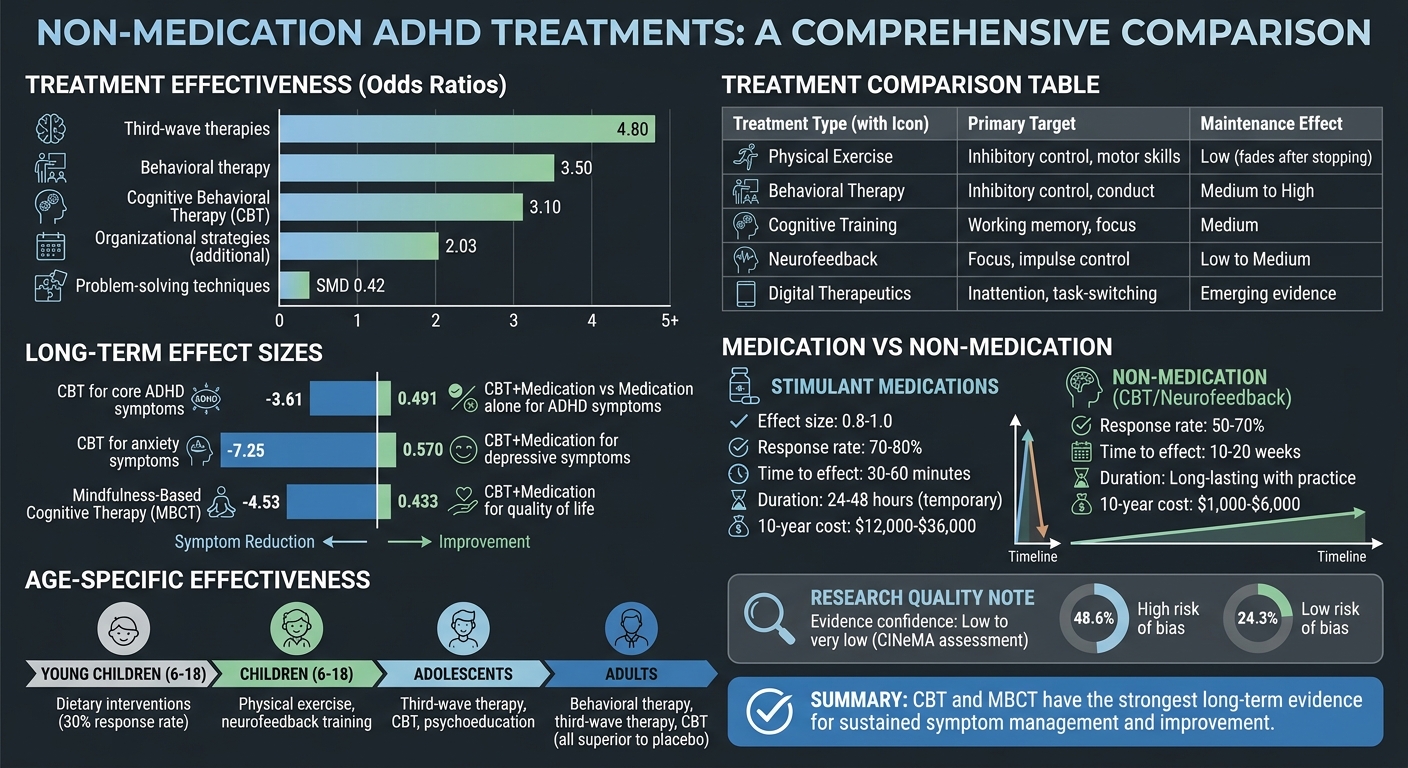
Comparison of Non-Medication ADHD Treatments: Effectiveness and Long-Term Benefits
ADHD treatment without medication: What are my options? | Understood Explains
sbb-itb-f879324
Types of Non-Medication ADHD Treatments
Non-medication treatments for ADHD include a mix of therapies, lifestyle adjustments, and tech-based methods. Each approach tackles different aspects of ADHD, offering alternatives to medication.
Behavioral and Cognitive Therapies
Cognitive Behavioral Therapy (CBT) focuses on identifying and changing thought patterns that worsen ADHD symptoms. By combining mental strategies with actionable steps, CBT has shown notable improvements in clinical assessments compared to self-reports.
Behavioral therapy aims to adjust environments and use reinforcement techniques to improve inhibitory control - the ability to resist distractions and stay focused. This therapy often involves setting up reward systems, reorganizing workspaces, and implementing time management tools. Research highlights that behavioral therapy provides medium-level benefits initially, which tend to persist over time. A study in 2025 found that adding organizational strategies increased treatment effectiveness by an odds ratio of 2.03.
Third-wave therapies, such as mindfulness-based interventions and Dialectical Behavior Therapy (DBT), focus on managing responses to stimuli rather than trying to eliminate them. These methods help improve attention and promote adaptive behaviors through heightened awareness. Compared to behavioral therapy (odds ratio 3.50) and standard CBT (odds ratio 3.10), third-wave therapies show stronger outcomes, with an odds ratio of 4.80.
Cognitive training involves repetitive exercises designed to improve working memory and task-switching. While the impact is modest, it can still play a role in managing symptoms.
These therapies provide a foundation for other interventions, such as lifestyle changes and technological tools.
Lifestyle Interventions
Lifestyle changes can complement therapy and contribute to managing ADHD symptoms.
Physical exercise offers immediate benefits for inhibitory control and motor skills. Programs lasting 45 minutes or more, three times a week, show the most significant results - double the impact of shorter sessions. Exercise has been linked to improvements in handwriting, coordination, and ignoring distractions. However, these benefits fade once the exercise routine stops. Compared to other structured activities, exercise shows improvement, but the difference may not be statistically significant.
Mindfulness and meditation help with emotional regulation and awareness, though their impact on core inhibitory control is less pronounced than exercise. Despite limited evidence, mindfulness shows clear long-term benefits.
Acupuncture is gaining attention as a possible option for reducing hyperactivity and impulsivity in children and improving inattention in adolescents. Although the research is still limited, it’s an area worth exploring.
Dietary interventions, such as omega fatty acid supplements, have shown minimal effects on overall ADHD symptoms. A meta-analysis of 411 participants found no significant improvement in parent-rated symptoms (standardized mean difference -0.32; p = .10). Teacher ratings showed even smaller effects (standardized mean difference -0.08) among 287 participants.
Neurofeedback and Technology-Based Treatments
Neurofeedback uses electroencephalography (EEG) to provide real-time feedback on brain activity, helping individuals train their brains to adopt patterns linked to better focus and impulse control. A 2023 survey rated neurofeedback’s effectiveness at 2.9/5 for 9% of adults and 14% of children, compared to 3.5/5 for medication.
Neurostimulation methods, like transcranial direct current stimulation (tDCS) and external trigeminal nerve stimulation (eTNS), deliver mild electrical signals to stimulate the prefrontal cortex, which is often underactive in ADHD patients. While these techniques target brain activity directly, long-term studies are still lacking.
Digital therapeutics, such as EndeavorRx, use video game mechanics to improve task-switching and sustained attention. By training users to focus on specific goals while filtering out distractions, these tools aim to develop inhibitory control - similar to behavioral therapy. Evidence supporting this approach is still emerging.
| Treatment Type | Primary Symptom Target | Maintenance Effect |
|---|---|---|
| Physical Exercise | Inhibitory control, motor skills | Low (fades after stopping) |
| Behavioral Therapy | Inhibitory control, conduct | Medium to High |
| Cognitive Training | Working memory, focus | Medium |
| Neurofeedback | Focus, impulse control | Low to Medium |
| Video Games | Inattention, task-switching | Emerging evidence |
Despite the variety of options, the quality of evidence for many non-medication treatments remains a challenge. Small study sizes, short follow-up periods, and potential biases limit the conclusions we can draw. As Professor Samuele Cortese from the University of Southampton points out:
We know that people with ADHD and their families are often overwhelmed by conflicting messages about which treatments work.
Gaining clarity about these treatments is essential, especially for professionals seeking effective, sustainable solutions for managing ADHD symptoms.
Short-Term Results of Non-Medication Treatments
Effects on Core ADHD Symptoms
Non-medication treatments can lead to noticeable short-term improvements in ADHD symptoms, though the extent of progress varies by approach. Behavioral and cognitive therapies, for instance, demonstrate strong results: third-wave therapies (OR: 4.80), behavioral therapy (OR: 3.50), and CBT (OR: 3.10). Adding organizational strategies offers an additional OR of 2.03, while problem-solving techniques provide a standardized difference of 0.42.
"Our findings suggest that the optimal treatment package for ADHD may include organisational strategies, third-wave components and problem-solving techniques." - Mental Health BMJ
Physical exercise emerges as particularly effective for improving inhibitory control in the short term. However, these benefits tend to diminish once the exercise routine is discontinued. In contrast, behavior therapy and cognitive training show slightly smaller immediate effects but deliver more sustainable long-term outcomes.
Dietary interventions yield mixed results. One study reported a 51% partial to full response rate in ADHD and emotion regulation symptoms among children adhering to a healthy diet for five weeks, compared to a 35% response rate with a restrictive elimination diet. Supplementing with free fatty acids shows a modest effect (effect size: 0.16), while excluding artificial food colors has a larger effect size of 0.42 in blinded assessments.
Neurofeedback training, when conducted for over 1,260 minutes, leads to measurable improvements in inhibitory control and working memory, with standardized mean differences (SMD) ranging from 0.36 to 0.37.
Despite these encouraging outcomes, non-medication treatments generally fall short compared to stimulant medications, which typically achieve larger effect sizes of 0.8 to 1.0.
"Effective alternatives to medication as the front-line treatment for core symptoms are still lacking." - Edmund Sonuga-Barke, Professor of Developmental Psychology, King's College London
Short-term effects also vary by age group, reflecting developmental differences in how individuals respond to these treatments.
Results Across Different Age Groups
The effectiveness of non-medication treatments depends heavily on the age of the individual, emphasizing the importance of age-specific approaches.
Adults tend to benefit most from behavior therapy, third-wave therapy, and CBT, all of which outperform placebo in reducing core ADHD symptoms during treatment. Among these, third-wave therapies stand out for their effectiveness.
Adolescents respond particularly well to third-wave therapy, CBT, and psychoeducation. These methods align with their developmental needs, such as increasing self-awareness and autonomy.
Children and adolescents (ages 6–18) show strong improvements with physical exercise and neurofeedback training. This age range is critical for executive function development, and neurofeedback is especially effective in addressing deficits - an issue faced by approximately 50% of children with ADHD.
Younger children with more severe symptoms at baseline tend to respond better to dietary interventions. However, across the pediatric population, overall response rates to dietary changes remain around 30%. Interestingly, parents and teachers often rate the effectiveness of dietary changes more favorably than blinded assessors, suggesting some degree of reporting bias.
Long-Term Results and Lasting Benefits
Symptom Control Over Time
Long-term outcomes often tell a very different story compared to short-term improvements. Take Cognitive Behavioral Therapy combined with medication (CBT+M), for example. Research shows that adults receiving CBT+M experienced a 0.491 effect size reduction in core ADHD symptoms, while those relying solely on medication showed no improvement. Additionally, depressive symptoms in the CBT+M group decreased significantly (effect size: 0.570), and their psychological quality of life improved (effect size: 0.433). These lasting results stem from patients consistently using organizational strategies they learned during therapy.
"The superiority of CBT on ADHD core symptoms mainly results in regular and repeated practice of compensatory strategies, such as organization and planning skills in daily life, which could be accumulated and bring long-term benefits." - BMC Psychiatry
In contrast, other treatments often struggle to deliver sustained results. Findings from the Multimodal Treatment Study (MTA), which tracked 579 children over 16 years, revealed that ADHD symptoms frequently persist into adulthood regardless of the initial treatment approach. Notably, the advantages observed during the first 14 months of intensive behavioral therapy had largely faded by the 24-month mark. By the time participants reached young adulthood, symptom severity was similar across all groups, regardless of medication use.
Even physical exercise, while helpful in the short term, provides only temporary relief. On the other hand, behavioral therapy and cognitive training have shown the ability to maintain their effects over time. These findings emphasize that the key to sustained improvement lies in the consistent application of learned strategies.
What Affects Long-Term Success
When it comes to maintaining long-term progress, several factors come into play. The real secret to lasting improvement is building habits that stick. CBT excels in this area because it helps patients develop compensatory strategies - like using planners, breaking tasks into manageable steps, and setting up organizational systems - that naturally integrate into their daily lives. These strategies not only reduce core ADHD symptoms but also improve emotional well-being by addressing depression, reshaping negative thought patterns, and creating a positive feedback loop between these elements.
Daily practices and psychological adjustments are just as important as initial treatment. For example, learning to regulate emotions, reduce depressive symptoms, and reframe negative thinking are all crucial for maintaining long-term benefits. This is particularly relevant considering that nearly 90% of adults with ADHD experience fluctuating symptoms and impairments throughout their lives.
Treatment adherence plays a big role, too. In the CBT study, participants attended an average of 10.76 out of 12 sessions, with only 12% dropping out by follow-up. However, findings from the MTA study suggest that life’s natural progression often overshadows the specific type of treatment received in childhood. While intensive interventions can yield impressive short-term results, long-term success largely depends on whether individuals continue to apply the skills and strategies they’ve learned. This highlights the importance of ongoing, proactive management to keep ADHD symptoms in check over time.
Non-Medication Treatments vs. Medication
Symptom Reduction Compared to Stimulants
Stimulant medications are known for their rapid effects, offering symptom relief within 30 to 60 minutes, with effect sizes ranging from 0.8 to 1.0. However, this relief is temporary - symptoms return within 24 to 48 hours after stopping the medication.
Non-medication treatments, on the other hand, take longer to show results but offer more lasting benefits. Approaches like Cognitive Behavioral Therapy (CBT) and Mindfulness-based Cognitive Therapy work by fostering cognitive and behavioral changes that persist even after the treatment ends. These therapies help individuals develop new ways of thinking and problem-solving that continue to manage symptoms over time. AJ Keller, CEO of Neurosity, explains:
"Medication peaks early and fades. Neurofeedback starts slow and builds. The two approaches have opposite trajectories".
While stimulants provide quick relief with a 70–80% short-term response rate, non-medication options like CBT and neurofeedback show a slower but more enduring improvement, with response rates of 50–70% over a period of 10–20 weeks. Interestingly, findings from a 16-year follow-up of the MTA study revealed no significant long-term differences between children who consistently took medication and those who did not. This suggests that the short-term benefits of medication may not necessarily lead to better outcomes in the long run. These insights are crucial for deciding when to prioritize non-medication treatments.
When to Use Non-Medication Treatments
The differing timelines and benefits of these treatments make it important to know when non-medication approaches are most effective. For example, the UK National Institute for Health and Care Excellence (NICE) recommends combining non-pharmacological therapies with medication for adults managing ADHD. This is particularly relevant since about 30% of people with ADHD either do not respond to or cannot tolerate stimulant medications.
Specific guidelines highlight when non-medication treatments are preferable. For children aged 4 to 6, parent behavior training is advised as the first-line treatment before considering medication. For adults, the choice often depends on co-occurring conditions. Those with anxiety or depression tend to benefit most from CBT, which addresses both emotional regulation and ADHD symptoms. In contrast, Mindfulness-based Cognitive Therapy is often better suited for adults without these comorbidities.
A common approach is to use medication for immediate symptom control while simultaneously starting non-medication therapies to build long-term improvements. This combined strategy not only enhances outcomes over time but also reduces reliance on medication. For example, neurofeedback users often report being able to lower their stimulant doses by 30–50% while maintaining symptom control. From a cost perspective, this can be significant - over a decade, medication expenses typically range from $12,000 to $36,000, whereas neurofeedback costs are estimated at $1,000 to $6,000.
Research Gaps and Study Limitations
While the earlier sections explored treatment effects, it's clear that certain research limitations affect the reliability of these findings. Despite increasing interest in non-medication ADHD treatments, significant gaps remain. A 2025 systematic review of 37 randomized controlled trials involving 2,289 adults revealed that 48.6% of the studies carried a high risk of bias, while only 24.3% were rated as low risk. This means nearly half of the available research might not offer dependable conclusions.
One major issue is the size of the studies. While medication trials often include thousands of participants, studies on neurofeedback and other non-medication treatments usually involve only a few hundred. This smaller scale makes it challenging to determine if the results apply to the broader ADHD population. AJ Keller, CEO of Neurosity, highlights this issue:
The 'neurofeedback' label covers everything from rigorously designed SMR/theta-beta protocols... to questionable consumer apps making wild claims about 'brain optimization.' Study design quality is critical.
Another hurdle is the lack of consistency in how these studies are conducted. Differences in diagnostic criteria, intervention schedules, and outcome measures create a fragmented picture. Many studies compare interventions to passive controls, like waiting lists, rather than active controls, such as regular therapy. This approach can inflate the perceived effectiveness of treatments and introduces concerns about observer bias. These inconsistencies emphasize the need for more standardized, high-quality research to guide long-term treatment strategies.
For interventions like Tai Chi, Working Memory Training, and Vitamin-Mineral Treatment, data on their long-term effects is still lacking. In fact, only five non-medication interventions have enough data to evaluate their impact on adult anxiety. Additionally, publication bias has been flagged in studies assessing long-term outcomes for core ADHD symptoms. As Xinyue Yang and colleagues warn:
Caution is needed in interpreting our results, and high-quality RCTs are urgently required for more reliable insights.
Confidence in the evidence remains "low" or "very low", according to CINeMA assessments. This uncertainty highlights the need for clearer evidence to manage ADHD effectively beyond initial symptom relief. At this stage, the available research doesn’t provide strong enough support to make definitive recommendations about which treatments are most effective over time, for whom, and in what specific circumstances.
Conclusion
Research highlights that non-medication treatments for ADHD can provide lasting benefits, though their effectiveness depends on the specific approach. For instance, Cognitive Behavioral Therapy (CBT) has demonstrated a long-term effect size of –3.61 for core ADHD symptoms and –7.25 for reducing anxiety symptoms. CBT works by equipping individuals with strategies to address both ADHD-related challenges and difficulties with emotional regulation.
Another promising option is Mindfulness-Based Cognitive Therapy (MBCT), which shows a long-term effect size of –4.53. This approach helps regulate the brain's default mode network, reducing attention drifts during demanding tasks. Research suggests that CBT tends to be more effective for adults with ADHD who also experience emotional disorders. On the other hand, MBCT may be better suited for individuals without such co-occurring conditions.
For optimal results, CBT is often recommended at a frequency of at least two sessions per week, particularly when addressing depression alongside ADHD. Unlike medication, which provides temporary relief, these therapies focus on building enduring skills. Additionally, interventions like psychoeducation and noninvasive brain stimulation have shown potential for sustained benefits, though CBT and mindfulness currently have the strongest evidence to back them. These findings emphasize the importance of aligning treatment approaches with an individual’s unique symptom profile.
In contrast, methods such as neurofeedback, working memory training, and vitamin–mineral treatments lack strong long-term evidence. With nearly half of the existing studies carrying a high risk of bias, it’s essential for professionals to rely on treatments supported by solid research.
The key takeaway? Choosing the right treatment depends on personal challenges. For those managing ADHD with anxiety or depression, CBT might be the best fit. If frequent mind-wandering is the main hurdle, mindfulness-based approaches could provide the focus you’re seeking. For further guidance on integrating these strategies into your professional life, On/Off Genius offers tools tailored to help gifted professionals tackle ADHD-related challenges with greater focus, organization, and consistency.
FAQs
How do I choose between CBT and mindfulness for ADHD?
Choosing between Cognitive Behavioral Therapy (CBT) and mindfulness for ADHD largely depends on your goals and the type of support you're looking for. Research shows that CBT is highly effective for managing ADHD symptoms over the long term. It helps improve daily functioning and tackles lingering challenges associated with the condition.
On the other hand, mindfulness, which is often included as part of therapy, focuses on improving attention and emotional regulation. While it can be helpful, the evidence for mindfulness as a standalone approach for sustained ADHD symptom management isn’t as strong.
In most cases, CBT is the go-to option. However, mindfulness can serve as a valuable addition, depending on individual preferences and needs.
How long do non-medication ADHD treatments take to work?
Non-medication treatments for ADHD, like behavioral and cognitive therapies, typically take months before showing noticeable changes. Studies indicate that these methods can lead to better outcomes in the long run, but they demand consistent effort and dedication to see lasting improvements.
What should I look for in neurofeedback or digital ADHD programs?
When considering programs aimed at improving executive functions or inhibitory control, it's essential to focus on those with a track record of delivering long-term benefits. Look for evidence that supports their ability to enhance cognitive performance while keeping potential side effects to a minimum. Programs backed by research showing lasting results over time should take priority, ensuring both effectiveness and safety in achieving meaningful outcomes.