Ultimate Guide to ADHD Wearable Technology
Wearables that track HRV, sleep, EEG and use haptic cues to improve focus, time management, and energy for adults with ADHD.
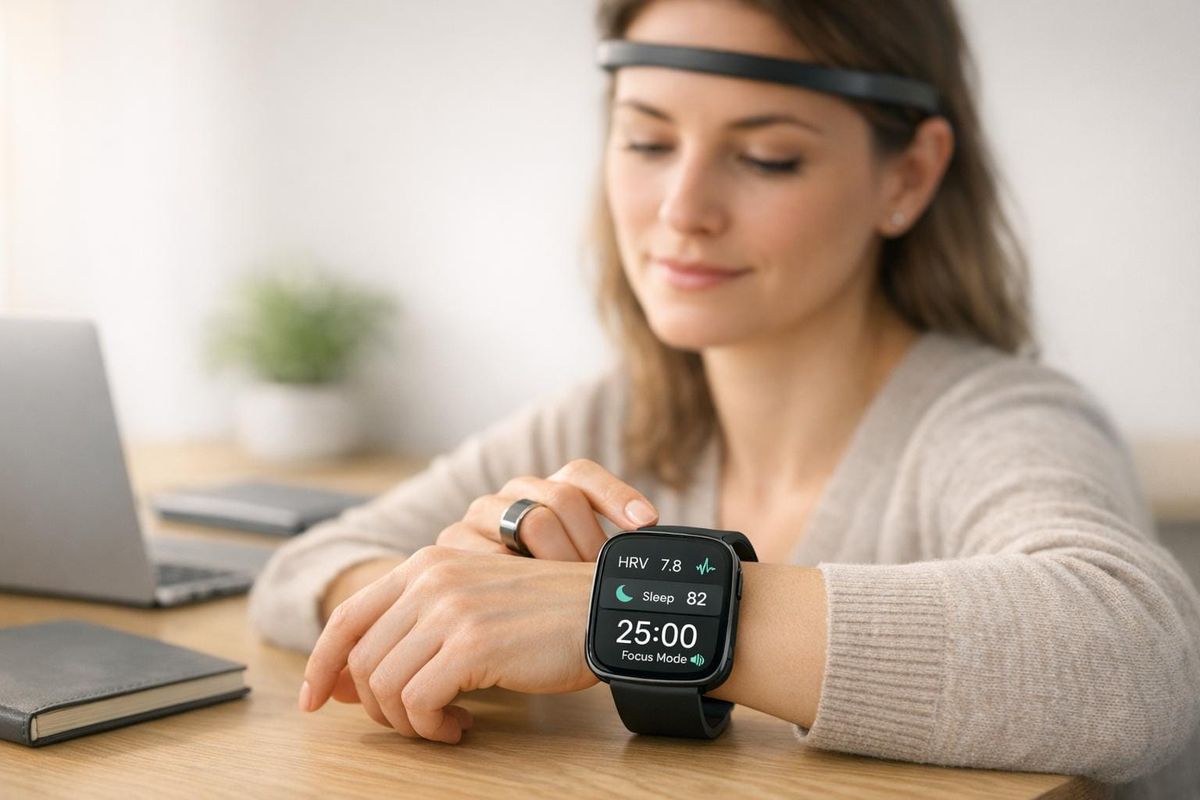
ADHD wearables are transforming how adults manage focus, organization, and productivity. These devices, like smartwatches, EEG headbands, and haptic wristbands, track metrics such as heart rate variability (HRV), sleep patterns, and stress levels to provide actionable insights. Here's what you need to know:
- Who benefits? Adults with ADHD, a condition affecting 4.4% of U.S. adults, where time blindness and forgetfulness impact over 75%.
- How they help: Subtle haptic reminders, AI-driven prompts, and focus-tracking tools improve attention, task management, and energy use.
- Top features: Sleep tracking, HRV monitoring, focus modes, and EEG brainwave feedback.
- Popular devices: Options include the clinical-grade EmbracePlus, EEG-enabled Neurable headphones, and fitness trackers like Fitbit and Garmin.
- Daily use tips: Set up a 30-day baseline, manage notifications, and use readiness scores for planning your day.
Wearables are a practical addition to ADHD management, complementing other treatments and helping users align tasks with their natural rhythms.
Features and Benefits of ADHD Wearables
Common Features of ADHD Wearables
ADHD wearables come packed with tools to tackle everyday challenges. One standout feature is haptic and vibration alerts, which provide subtle nudges on your wrist. These are great for things like medication reminders or signaling task transitions without the distraction of loud alarms. Another helpful tool is visual timers and countdown displays, which make it easier to manage time by showing how much is left - helping to create a sense of urgency to stay on track.
Many devices also monitor key metrics, such as Heart Rate Variability (HRV) and Resting Heart Rate (RHR), to give insights into stress and recovery. For example, a high HRV can indicate you're ready for mentally demanding tasks, while a high RHR might signal burnout risk. Tools like Garmin and Oura even offer "Body Battery" tracking, showing your energy levels throughout the day so you can plan intense work during high-energy periods and rest when needed. Advanced sleep tracking is another feature, breaking down deep and REM sleep cycles - important since poor sleep often worsens symptoms like inattention and impulsivity.
Some wearables take it a step further with EEG brainwave monitoring, which uses adaptive algorithms to detect patterns linked to distraction. This enables personalized biofeedback to improve focus. Other features include focus modes and notification filtering, which automatically silence unnecessary interruptions to reduce sensory overload. Finally, task management tools - like wrist-based to-do lists and voice-to-text for quick note-taking - help you capture fleeting thoughts before they're forgotten.
These features don’t just track data; they turn it into actionable insights that can help you perform better every day.
Benefits of Using ADHD Wearables
With these features, ADHD wearables can significantly improve focus and productivity. For instance, they provide real-time feedback when your attention starts to wander, helping you stay on task. They also enable smarter energy management. Checking your Body Battery score in the morning can help you decide whether to tackle demanding projects or stick to lighter tasks based on your energy levels.
Subtle vibration reminders are another game-changer, helping you combat forgetfulness without drawing attention or disrupting your surroundings. Wearables also promote self-awareness by logging behaviors - like caffeine intake - and linking them to changes in HRV or stress levels. A study from 2025 even showed that Fitbit data could predict ADHD diagnoses in teens with 88% accuracy by analyzing metrics like sedentary time and resting heart rate.
For gifted professionals with ADHD, the benefits extend to financial value as well. For example, a knowledge worker earning $75,000 annually could gain nearly $9,600 in added value by reclaiming just one extra hour of peak productivity each day.
| Feature Category | Specific Tools | ADHD Symptom Supported |
|---|---|---|
| Time Management | Visual timers, haptic alarms | Time blindness, forgetfulness |
| Focus/Attention | EEG feedback, focus modes | Distractibility, impulsivity |
| Emotional Regulation | HRV tracking, guided breathing | Overwhelm, stress |
| Energy Management | Body Battery, sleep coaching | Fatigue, executive dysfunction |
Best Smartwatches for People with ADHD in 2026 [Productivity & Focus Guide]
Top ADHD Wearable Devices
The world of wearable technology has expanded far beyond fitness trackers, offering tools specifically designed to support neurological and cognitive health. For those managing ADHD, these devices can provide real-time insights and practical tools to improve focus and overall well-being.
EmbracePlus by Empatica
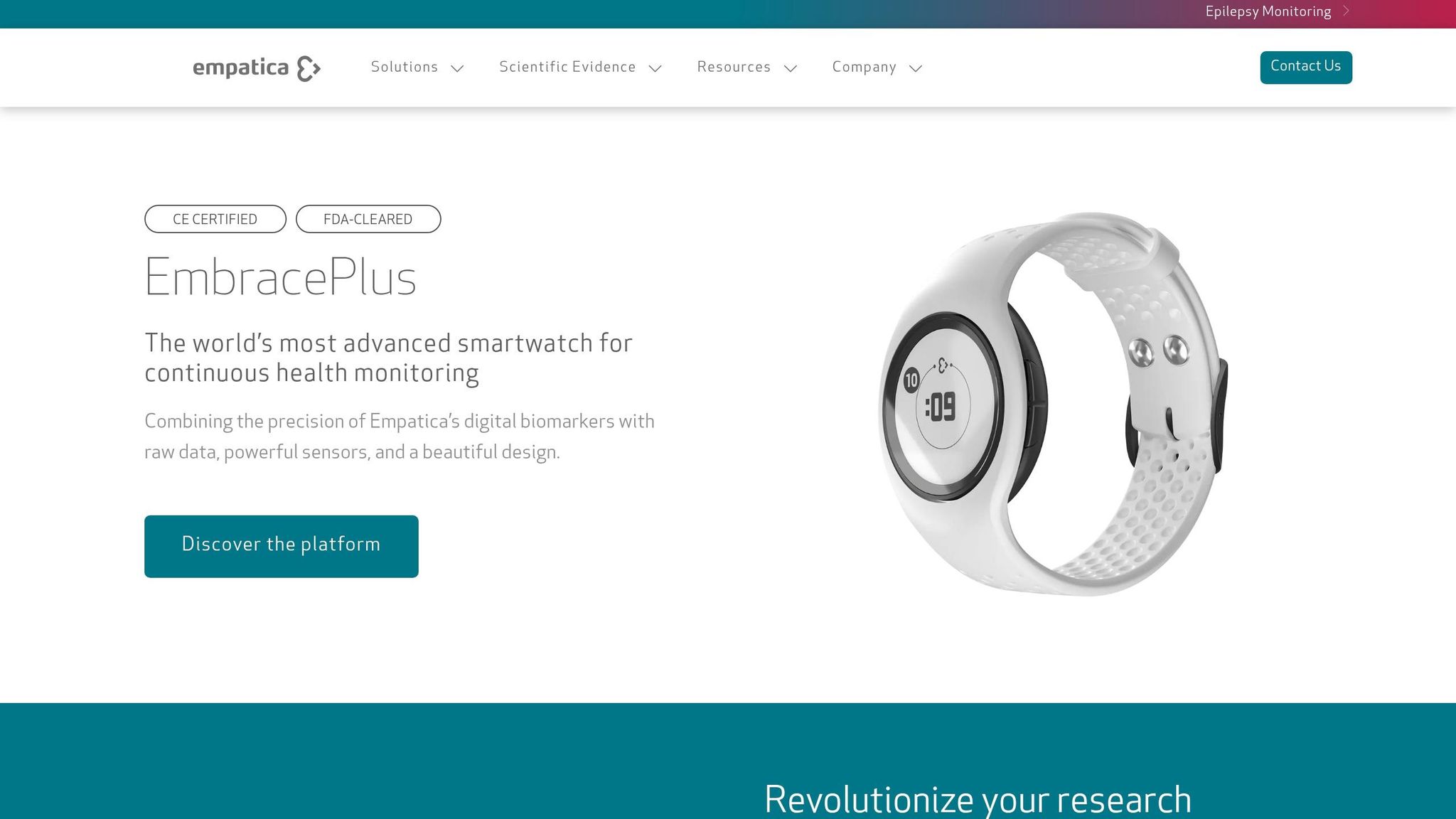
The EmbracePlus stands out as a clinical-grade device tailored for ADHD management. It's not just another wearable - this one is FDA-cleared (510(k)) and CE-certified as a class IIa medical device. Packed with advanced sensors, it measures stress, pulse rate, respiratory rate, skin conductance, and SpO2, among other metrics. Some of its key features include:
- A ventral electrodermal activity (EDA) sensor for stress detection
- A 4-channel multi-wavelength photoplethysmogram (PPG)
- High-precision 3D accelerometer and gyroscope
- Digital temperature sensor
What makes EmbracePlus particularly impressive is its ability to provide raw sensor data alongside over 300 digital measures. This makes it a valuable tool for clinical research and personalized treatment. As of April 2024, Empatica joined the EU-funded Horizon 2020 consortium to monitor adult ADHD using the EmbracePlus research suite.
"We are proud of the patient-centered, intuitive design of EmbracePlus and our companion patient app, which reduces barriers to study participation and increases patient compliance."
- Simone Tognetti, Chief Technology Officer, Empatica
The device is built for durability and convenience, featuring an always-on E Ink display, Gorilla Glass 3 for scratch resistance, and an IP67 waterproof rating (submersible up to 1 meter for 30 minutes). Mechanical buttons allow users to tag specific events, helping track behavioral or symptomatic changes in real time.
Neurable EEG Wearables
The MW75 Neuro LT takes a different approach by transforming noise-canceling headphones into a brain-monitoring tool. With 12 embedded dry fabric sensors, it tracks brain activity with lab-grade precision. Priced at $499 (including lifetime premium app access), this device offers a unique combination of functionality and affordability.
One of its standout features is real-time audio biofeedback. As you enter a deep focus state, the music volume increases, acting as a cue to maintain concentration. Users have reported impressive results:
- A 33% average increase in focus time
- Two out of three users experiencing an immediate improvement
"I love the audio biofeedback - when the music gets louder as I focus, it becomes this powerful cue. It pulls me into deep focus and helps me stay there."
- Ethan S., Biohacker & Entrepreneur
The device also includes features to combat cognitive fatigue. For instance, it uses AI to detect when you're nearing burnout and suggests taking a 10-minute break. Additionally, a quick 2-minute "Cognitive Snapshot" gauges your mental readiness each morning. The app even includes a gamified "Rocket Game" to help users learn how deep focus feels.
Actigraphy Devices for Activity Tracking
Actigraphy devices provide a passive way to monitor movement patterns, offering insights into sleep-wake cycles and circadian rhythms. These cycles are often disrupted in individuals with ADHD, leading to symptoms like impulsivity or difficulty concentrating. By using high-precision accelerometers and gyroscopes, actigraphy devices create detailed activity and sleep diaries. This information can help identify patterns and links between poor sleep and ADHD symptoms, making them a useful tool for managing daily rhythms.
FDA-Cleared Digital ADHD Wearables
Devices with FDA clearance bring a higher level of reliability, offering advanced physiological monitoring that can be integrated into professional treatment plans. Unlike standard wellness trackers, these wearables focus on markers like electrodermal activity and heart rate variability, providing more precise insights.
For example, the EmbracePlus uses an FDA-cleared algorithm called EpiMonitor, which boasts a 98% accuracy rate for seizure detection and an impressively low false alarm rate of just 0.02 per day for adults.
"Our seizure detection algorithm is trained on thousands of hours of clinical data, and uses a combination of electrodermal activity and movement data to guarantee maximum accuracy."
- Empatica
For individuals sensitive to stimulant side effects or those looking to complement existing treatments, these devices offer a non-pharmacological alternative. Their standardized safety and effectiveness make them a better option for clinical use compared to general wellness gadgets. Always consult with your healthcare provider to determine how these devices can fit into your overall ADHD management plan.
Comparison of ADHD Wearables
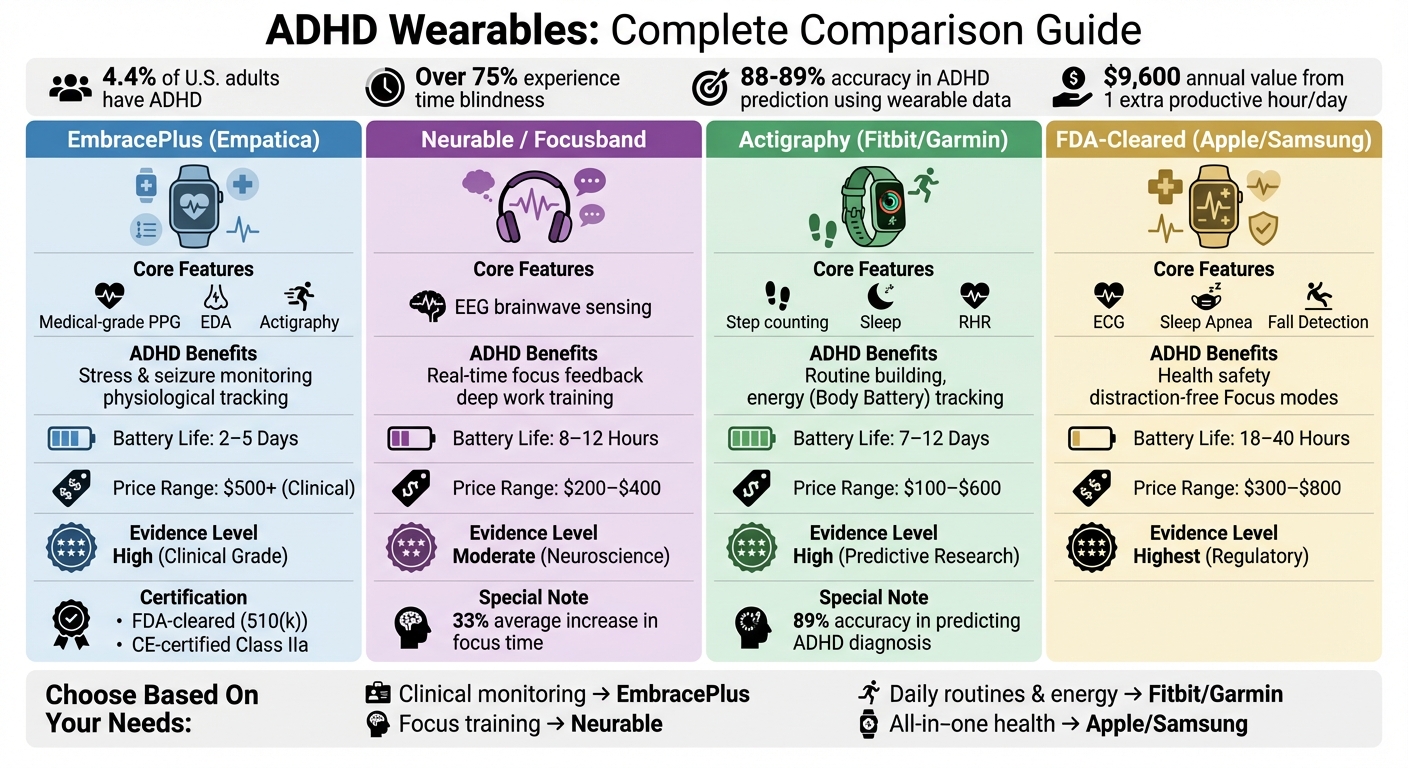
ADHD Wearable Devices Comparison: Features, Benefits, and Pricing Guide
When it comes to managing ADHD, the right wearable can make a world of difference. Whether you're after clinical-level monitoring, tools to improve focus, or help with daily routines, there's a device out there to suit your needs. Here's how some of the leading options stack up.
Medical-grade devices, like the EmbracePlus from Empatica, are designed for precision and reliability. These devices, priced at $500 or more, are perfect for individuals working closely with healthcare professionals or participating in clinical studies.
EEG-based wearables, such as Neurable and Focusband, specialize in real-time brainwave monitoring to provide focus training. These are priced between $200 and $400, offering a balance of neuroscience-backed technology and affordability.
On the other hand, actigraphy devices from brands like Fitbit and Garmin combine affordability ($100–$600) with powerful features. A study from May 2025 showed that Fitbit data analyzed with machine learning achieved an impressive 89% accuracy in predicting ADHD diagnoses in adolescents. These devices are particularly effective for tracking energy levels and establishing consistent routines.
"Fitbit-derived measurements show promise for predicting ADHD diagnosis, with machine learning classifiers... demonstrating high predictive accuracy."
- Muhammad Mahbubur Rahman, Center for Translational Research
Bridging the gap between clinical precision and everyday usability, FDA-cleared smartwatches from Apple and Samsung offer comprehensive health tools, including ECG monitoring, sleep apnea alerts, and fall detection. These devices, priced between $300 and $800, also feature distraction-free Focus modes, which can be especially helpful for tackling time blindness - a common challenge for over 75% of people with ADHD.
Below is a quick comparison table to help you evaluate these options side by side:
Comparison Table of ADHD Wearables
| Device Category | Core Features | ADHD Benefits | Battery Life | Price Range (USD) | Evidence Level |
|---|---|---|---|---|---|
| EmbracePlus (Empatica) | Medical-grade PPG, EDA, Actigraphy | Stress & seizure monitoring; physiological tracking | 2–5 Days | $500+ (Clinical) | High (Clinical Grade) |
| Neurable / Focusband | EEG brainwave sensing | Real-time focus feedback; deep work training | 8–12 Hours | $200–$400 | Moderate (Neuroscience) |
| Actigraphy (Fitbit/Garmin) | Step counting, Sleep, RHR | Routine building; energy (Body Battery) tracking | 7–12 Days | $100–$600 | High (Predictive Research) |
| FDA-Cleared (Apple/Samsung) | ECG, Sleep Apnea, Fall Detection | Health safety; distraction-free Focus modes | 18–40 Hours | $300–$800 | Highest (Regulatory) |
Each category offers something different, so the best choice depends on what you value most - be it precision, focus training, or everyday usability.
How to Use ADHD Wearables in Daily Life
Setting Up Your Device
Getting your device set up properly is the first step to making it work for you. To start, establish a 30-day baseline by wearing the device consistently, even while sleeping, for an entire month. This helps the wearable learn your unique patterns - like sleep habits, stress levels, and energy cycles - so the data it provides is more accurate and meaningful.
Managing notifications is another important step. Use the "Three-Category Rule" to organize your alerts:
- Always Alert: Essentials like medication reminders or family contacts.
- Batched: Non-urgent updates, such as work emails.
- Never: Distractions like social media.
This keeps your device from becoming another source of stress.
You can also assign specific vibration patterns for different types of alerts. For instance, a short double-tap could signal a five-minute warning before meetings, while a long pulse might indicate task transitions. This "physical language" communicates without relying on sound, which can help avoid sensory overload. Another option is enabling hourly chimes, like a subtle buzz, to passively remind you of time without needing to check your watch.
When it comes to the watch face, consider using an analog display or visual timer instead of digital numbers. For many people with ADHD, time feels abstract, so visualizing it as a shrinking wedge can make it easier to understand and manage. Add widgets (called "complications") for quick access to tools like timers, calendars, or reminders - this reduces the steps needed to use these features.
Once your device is set up, you’ll have a solid foundation for building habits that support your focus and productivity.
Building Habits with Wearables
After fine-tuning your device, the next step is integrating it into your daily routines. Start your day with a 5-minute check-in by reviewing metrics like your readiness score or "Body Battery" level. These insights can help you decide how to approach your day - whether to tackle deep work (Peak mode), handle steady tasks (Steady mode), or focus on recovery (Recovery mode). Devices like the Google Pixel Watch 4 and Garmin Venu 4 even offer Morning Reports that summarize your sleep quality and schedule, helping you reduce decision fatigue first thing in the morning.
Use your wearable’s voice assistant to capture tasks as soon as they pop into your head. Speaking tasks aloud ensures they don’t slip through the cracks of working memory.
Research also backs up the benefits of wearables for focus. A study involving 706 children found that smartwatch coaching improved on-task behavior by 19% and added over 25 minutes of focused time each day. The secret was consistency: wearing the device daily and responding to its prompts helped create new habits and neural pathways.
"The challenge isn't motivation or intelligence - it's that time feels fragmented, inconsistent, and difficult to grasp." - Allen
If charging your device is a challenge, look for models with long battery life, like the Garmin Venu 4, which lasts up to 12 days. Alternatively, choose a device with fast-charging capabilities. For example, the Apple Watch Series 11 can gain 15 hours of battery life with just 15 minutes of charging. To stay on top of this, set a nightly reminder to charge and sync your wearable.
Future Trends in ADHD Wearable Technology
ADHD wearables are shifting from simple tracking devices to interactive systems that respond in real time. This evolution is paving the way for more active and personalized ADHD management.
One exciting development is data-driven diagnostic screening. Research indicates that consumer wearables could eventually replace subjective clinical interviews, which is especially promising for areas where diagnostic wait times are lengthy.
"Real-world, real-time data from wearables could act as an additional layer of insight that supports more precise, individualized care." - Muhammad Mahbubur Rahman, PhD, Children's National Hospital
Beyond diagnostics, new interfaces are being designed to seamlessly integrate with daily routines. Tools like brain-computer interfaces (BCIs) and haptic feedback systems are leading the charge. BCIs use brain signals to enable activities like VR-based attention training, while haptic devices - such as wristbands or patches - offer subtle vibrations or taps to help manage hyperfocus and prevent sensory overload. Some systems even connect with smart furniture, adjusting lighting or providing cues when movement patterns suggest fidgeting.
The global market for AI-driven mental health tools, including wearables, is expected to reach $5 billion by 2030. As one expert notes, "We're heading toward a future where AI doesn't just track ADHD - it works with it. Tools won't just sit on a phone. They'll be wearable, touchable, and woven into daily life".
Conclusion
ADHD wearable technology offers a fresh approach to managing ADHD by syncing with your body's natural rhythms instead of relying solely on traditional methods. These devices track key biomarkers like heart rate variability, resting heart rate, and sleep quality, helping you align your activities with your biological patterns.
Wearables address core ADHD challenges in practical ways: haptic feedback helps counter time blindness (affecting over 75% of people with ADHD), biofeedback enhances focus, and readiness scores help prevent burnout. For example, if a professional earning $75,000 annually gains just one extra hour of peak productivity daily through wearable use, that translates to an estimated $9,600 in yearly value.
"The professionals who will consistently outperform their peers in the coming decade won't necessarily work more hours. They'll work in better biological alignment." - SunlitHappiness Team
To get started, spend 30 days establishing a baseline to understand your patterns. Then, use your device's readiness data for a quick morning check-in. Plan three types of workdays - Peak, Steady, and Recovery - and adjust your day based on your body's signals. This approach complements other tools like medication, therapy, and mindfulness techniques.
Whether you choose the Oura Ring Gen 4 ($349), Garmin Fenix 8 ($450), or Apollo Neuro, success depends on consistency and self-awareness. By using objective data to guide your routine, you can take a proactive step toward managing ADHD. Your body already knows when it's ready to perform at its best - wearables just help you listen.
FAQs
Which ADHD wearable should I start with?
For 2026, an excellent choice to consider is an ADHD-specific smartwatch, such as those highlighted in the article '11 Best ADHD Watches 2026 for Better Focus.' These watches are packed with features designed to improve focus, monitor health, and provide long-lasting battery performance. Top picks include the Samsung Galaxy Watch 8 and Garmin Bounce 2, both equipped with AI-powered insights and safety functionalities. Select a model that aligns with your daily routine and helps you manage ADHD more effectively.
How do I use HRV and sleep data to plan my day?
Heart rate variability (HRV) and sleep data can be powerful tools for planning your day, especially when managing ADHD. These metrics offer insights into your stress levels and sleep quality - two key factors in maintaining balance.
If your HRV is low or your sleep was poor, it might be a sign to take it easy, focus on rest, or tackle lighter tasks. On the other hand, high HRV and good sleep signal that you're ready to take on more challenging or demanding activities. By aligning your tasks with how prepared your body feels, you can enhance focus and support your overall well-being.
Will a wearable replace medication or therapy?
Wearable technology for ADHD is meant to complement treatment plans, not replace medication or therapy. These devices are designed to help with tracking symptoms, boosting self-awareness, and supporting behavioral strategies. However, they don’t directly address the neurobiological or behavioral aspects of ADHD that traditional treatments target. Instead, they serve as helpful tools to enhance overall symptom management.