How to Set ADHD-Friendly Goals That Stick
Pick goals that excite you, break them into micro-tasks, track progress visually, and use short rewards to stay motivated.
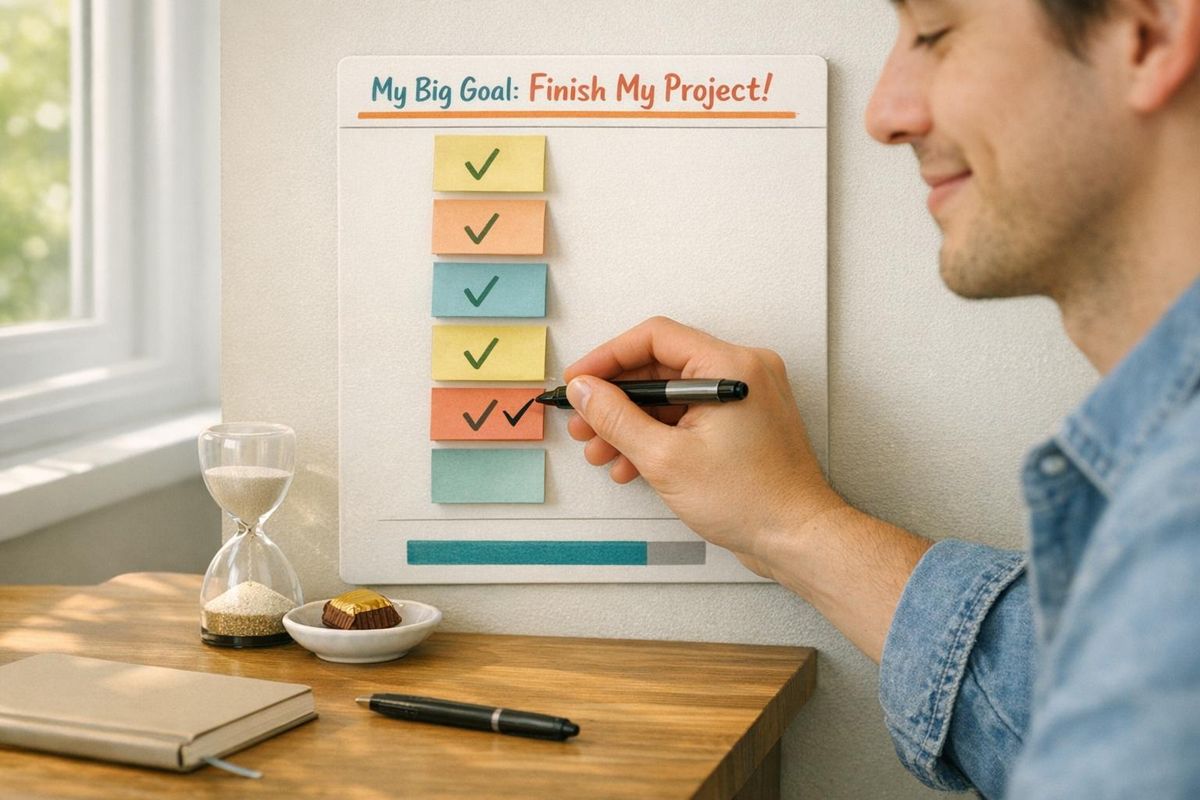
People with ADHD often struggle with traditional goal-setting methods because their brains process motivation, planning, and rewards differently. To create goals that work, focus on strategies tailored to ADHD strengths and challenges. Here's a quick breakdown:
- Why Traditional Goals Fail: ADHD brains need immediate rewards and thrive on interest, novelty, and urgency, unlike neurotypical approaches that rely on long-term planning and consistency.
- Key Adjustments: Set goals that genuinely excite you, break them into small, actionable steps, and track progress visually. Use short-term rewards to maintain motivation.
- Practical Tips:
- Reframe tasks to align with personal values and desires.
- Modify SMART goals to avoid overwhelm and boredom.
- Use tools like the 3x5 Breakdown Method for micro-tasks.
- Build habits with visual aids and routines, like habit stacking or the 10-3 Rule for focus sessions.
- Stay Motivated: Celebrate small wins, use positive self-talk, and focus on progress, not perfection.
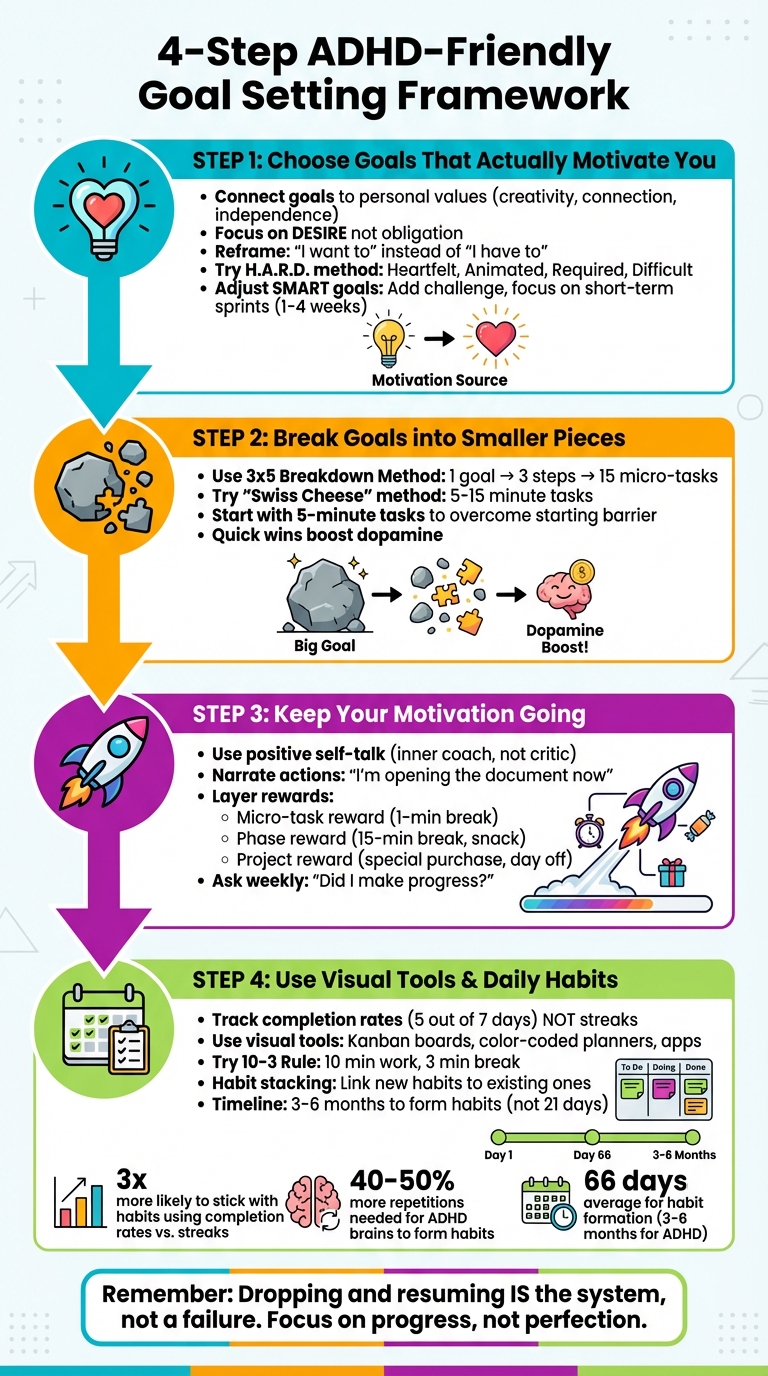
4-Step ADHD-Friendly Goal Setting Framework
Goal Setting With ADHD? 🤔 The Secret to Setting Goals You'll Stick With 💫
Step 1: Choose Goals That Actually Motivate You
The first step to creating a system that works with your ADHD strengths is setting goals that genuinely inspire you. Unlike traditional goal-setting, which assumes you'll stay motivated because a task is "important", ADHD brains thrive on desire rather than obligation. Motivation comes from triggers that connect deeply with your personal drive, not just logical reasoning.
Connect Goals to What Matters to You
For your brain to stay engaged, you need a personal and emotional connection to your goals. Forget about setting goals out of a sense of duty - pick ones that bring you fulfillment. Ask yourself: What outcome would I truly enjoy? For instance, instead of thinking, "I have to do the dishes", try reframing it to, "I want to do the dishes because I love the feeling of a clean kitchen".
"Understanding the 'why' is especially important to increase motivation in individuals with ADHD." - Lara Honos-Webb, Ph.D.
When your goals align with your core values - like creativity, connection, or independence - they tap into something called autonomous motivation. Research shows this type of motivation leads to better performance and longer-lasting effort. By focusing on what you care about, your goals are more likely to survive the inevitable drop in novelty after the initial excitement wears off.
Adjust SMART Goals for ADHD
Once your goals reflect your passions, it's time to rethink how you structure them. While the traditional SMART framework (Specific, Measurable, Achievable, Relevant, Time-bound) is popular, it often needs tweaking for ADHD brains. Here’s how you can make it work for you:
- Avoid overloading on details: Too many specifics can lead to perfectionism and overwhelm. Leave space to adapt as your interests shift.
- Add a challenge: Goals that feel too "realistic" can be boring. A little difficulty keeps things exciting and engaging.
- Make "Relevant" about rewards: Focus on goals that fuel your passions and provide regular, satisfying rewards instead of relying on their importance alone.
- Focus on short-term sprints: Break goals into 1–4 week chunks or use techniques like the Pomodoro method to create urgency and maintain momentum.
You might also explore ADHD-friendly frameworks like the H.A.R.D. method (Heartfelt, Animated, Required, Difficult) or PACT goals (Purposeful, Actionable, Continuous, Trackable). These systems emphasize emotional investment and steady action. For example, instead of vaguely aiming to "lose 20 pounds", you could commit to "walking for 30 minutes every day." The emphasis is on actions that feel rewarding and achievable in the moment.
Step 2: Break Goals into Smaller Pieces
Once you've set goals that inspire you, the next step is to make them feel manageable. ADHD impacts your brain's executive function - the "air traffic control system" that helps you start tasks, prioritize, and manage time efficiently. Facing a big, daunting goal like "get organized" or "start a business" can feel paralyzing. The key? Break that big goal into smaller, bite-sized steps.
Divide Goals into Micro-Tasks
Think of your big goal as a giant boulder. Instead of trying to move it all at once, chip away at it with small, specific actions. A great method to try is the 3x5 Breakdown Method: take one large task, split it into three main steps, and then divide each of those into five smaller actions. By the end, you’ll have a plan with 15 clear, manageable steps.
"ADHD brains thrive on quick wins and frequent rewards, which boost dopamine levels, the neurotransmitter responsible for motivation and focus."
- Russell A. Barkley, Ph.D., Clinical Scientist and Psychologist
Here’s how this might look for cleaning your living room:
- Step 1: Declutter – Toss trash, gather toys into a bin, take dishes to the kitchen, fold blankets, and organize papers.
- Step 2: Dust and Wipe – Dust shelves, clean the coffee table, wipe the TV screen, polish picture frames, and dust windowsills.
- Step 3: Vacuum and Finish – Vacuum the carpet, clean under cushions, vacuum behind furniture, fluff pillows, and light a candle.
Another helpful strategy is the "Swiss Cheese" method, which encourages tackling a big project by completing small, 5–15 minute tasks whenever you have a free moment. Got 10 minutes before a meeting? Dust one shelf. Waiting for coffee to brew? Wipe down the coffee table. These small actions chip away at the larger goal, making it feel less overwhelming.
Once you've broken your goal into micro-tasks, start with just five minutes to get the ball rolling.
Start with 5-Minute Tasks
Getting started is often the hardest part. ADHD brains can procrastinate on a task for days because anxiety makes it feel insurmountable, even if it only takes a few minutes to complete. Anxiety distorts your perception of time and difficulty, making tasks seem much worse than they are.
The solution? Make your first step so small that it’s impossible to fail. Instead of "write project report" or "get fit", start by turning on your computer or putting on your sneakers. These tiny actions break the mental barrier of starting. Set a timer for just five minutes and give yourself permission to stop when it rings. More often than not, once you’ve started, you’ll find it easier to keep going. Even if you don’t, five minutes of progress is still progress.
Step 3: Keep Your Motivation Going
Once you've tackled your goals with micro-tasks, the next hurdle is staying motivated. This can be tricky, especially when your brain craves novelty and instant gratification. For those with ADHD, this isn't about a lack of willpower - it's tied to a biological dysfunction in the dopamine reward pathway. That means your brain needs a different kind of fuel to keep going.
Talk to Yourself in Ways That Help
The way you talk to yourself has a huge impact on your ability to stay focused and productive. Many people with ADHD often have an inner critic that says things like, "Why can't I focus like everyone else?" or "I'm so disorganized." This negative self-talk can create a mental block instead of helping you move forward.
"Your inner voice is not just background noise. It's the key to your focus, confidence, and productivity."
- Lud Kowalski, Author, ADHD Wisdom Tools
Instead of letting that inner critic take over, try adopting the voice of a compassionate inner coach. For example, instead of saying, "I need to finish this whole project today", ask, "What’s the smallest amount of time I can spend on this right now?" And if you’ve missed a few days of work, remind yourself that restarting is part of the process - it’s not a failure.
Another helpful strategy is narrating your actions, either aloud or in your head. Simple phrases like "I’m opening the document now" or "I’m putting the first dish in the dishwasher" can help keep your mind anchored on the task at hand. You can even make tasks more engaging by using energetic language - turning "cleaning my inbox" into "Mission: Inbox Zero" gives your brain a quick dopamine boost.
As you work on shifting your self-talk, pair it with rewards to keep yourself moving forward.
Reward Yourself and Celebrate Small Wins
To maintain momentum, immediate rewards are key. For people with ADHD, waiting for a big payoff at the end of a project often isn’t effective. Research shows that small, immediate rewards are far better at keeping you engaged. Here’s how to set up rewards in layers:
- After each two-minute micro-task, give yourself a quick reward, like a one-minute break or a small treat.
- Once you complete a milestone, treat yourself to a phase reward, such as a 15-minute break, your favorite snack, or a short video.
- When you finish the entire goal, celebrate with a project reward, like a special purchase, a nice meal, or even a day off.
"Rather than bully and beat yourself up through a task, be compassionate with yourself. It's a powerful way to shift motivation."
- Lara Honos-Webb, Ph.D., Psychologist
During your weekly review, ask yourself one simple question: "Did I make any progress?" If the answer is yes, celebrate - even the smallest steps count. If the answer is no, don’t get discouraged. Instead, shrink your next task down to something so small that it’s almost impossible not to succeed.
This approach turns motivation into a cycle of positive reinforcement, making it easier to keep moving forward.
Step 4: Use Visual Tools and Daily Habits
Once you've broken your goals into manageable steps and fired up your motivation, the next step is keeping your progress visible and organized. For someone with ADHD, the phrase "out of sight, out of mind" isn't just a cliché - it’s a daily reality. Visual tools help bridge that gap by reducing mental strain and supporting executive function challenges.
Track Progress with Visual Tools
Visual aids can provide the quick dopamine hit your brain craves to stay motivated. Whether it’s a fun animation in an app, colorful stickers on a planner, or moving tasks across a Kanban board from "To Do" to "Done", these tools make your progress feel real and rewarding.
Digital tools are great if you tend to misplace physical items. Apps like Tiimo, PlanWiz, and Goblin Tools offer flexible pricing and features like color-coded time blocks, which help you visually grasp how time is passing - especially helpful for managing time blindness.
Paper planners work better if phone notifications easily distract you. For example, the Planner Pad uses a "funnel system" to break weekly goals into daily tasks. Plus, physically writing things down can improve memory. Place your planner in a spot you’ll see often, like next to your laptop or on your bathroom mirror.
One key tip: choose tools that track completion rates (like "5 out of 7 days") instead of streak-based systems. Research shows that adults with ADHD are three times more likely to stick with habits long-term when using flexible tracking methods. Streak-based systems, on the other hand, often lead to a "shame spiral" when the streak gets broken.
The next step? Embed these visual tools into your daily life through consistent routines.
Create Routines That Support Your Goals
Visual tracking works best when paired with daily habits. Habit stacking - linking a new habit to something you already do - can add structure without overwhelming your brain. For instance, you could check your planner while sipping your morning coffee or review your progress tracker right after brushing your teeth.
For work sessions, try the 10-3 Rule instead of the traditional 25-minute Pomodoro technique. Work for 10 minutes, then take a 3-minute break. This shorter cycle aligns better with ADHD attention spans and helps avoid burnout. You can also set a five-minute "pre-timer" to help transition out of hyperfocus mode.
"The key to success with ADHD boards is consistency. Make interacting with your board a non-negotiable part of your daily routine."
- Michael Thompson, ADHD Coach
Keep in mind that ADHD brains often need 40–50% more repetitions to turn behaviors into automatic habits compared to neurotypical brains. While the myth of forming a habit in 21 days lingers, research shows it actually takes about 66 days on average - and for ADHD individuals, it can take three to six months. Be patient, and keep those visual tools where you can see them every day.
Conclusion: Making Your Goals Last
Creating goals that work for ADHD brains means ditching one-size-fits-all systems designed for neurotypical minds. Instead, it’s about crafting flexible approaches that align with your natural tendencies - those driven by interest, novelty, challenge, urgency, and passion rather than just a sense of "importance".
Start with what excites you and break it down into tiny, manageable steps. Even a small task can get the ball rolling. As Ramon Landes wisely puts it: "Dropping and resuming IS the system, not a failure of it.". Embrace the idea that your brain thrives on change - rotate strategies, try new methods when routines feel stale, and adjust based on your energy levels.
When it comes to long-term planning, think smaller. Research shows neurotypical brains might form habits in about 66 days, but ADHD brains often need a more adaptable timeline. Instead of setting yearly goals, try working in 90-day cycles. These are short enough to stay engaging but long enough to see meaningful progress.
Celebrate the little victories along the way. Each small win - whether it’s moving a sticky note to the “Done” column or crossing an item off your to-do list - gives your brain a dopamine boost, fueling motivation for the next step. These moments of acknowledgment build momentum and make your goals feel achievable.
To keep moving forward, stay open to experimenting. Keep the strategies that work, and don’t hesitate to pivot when something stops clicking. Your system should grow and evolve with you. This constant tweaking is what makes the ADHD-friendly approach work - because real progress comes when you focus on the process rather than obsessing over distant outcomes.
FAQs
How do I pick a goal that will stay motivating after the novelty wears off?
To keep your motivation strong, pick a goal that truly connects with your personal values and interests. Start by digging into the "why" behind your goal - this helps ensure it feels meaningful to you. Break the goal into manageable, smaller steps to stay focused and avoid feeling overwhelmed. You can also use structured approaches like SMART goals or ADHD-friendly frameworks such as PACT or H.A.R.D. These methods are great for staying on track, even when the initial burst of energy starts to wear off.
What should I do when I keep dropping the goal and restarting?
If you find yourself constantly restarting goals, it might be time to rethink your approach to better suit how your ADHD brain works. Start by breaking big goals into smaller, more manageable steps. This not only makes progress feel achievable but also helps you build momentum. Keep your "why" at the forefront - knowing your purpose can be a powerful motivator.
Adopting flexible strategies and seeking external accountability - like a trusted friend or coach - can keep you on track. You can also tweak traditional frameworks, such as SMART goals, to make them less overwhelming and more tailored to your needs. The key is to create a system that feels doable and keeps you moving forward.
How can I set rewards that work without turning into distractions?
To create rewards that inspire action without becoming a distraction, aim for ones that are small, immediate, and connected to the task at hand. Recognize achievements with rewards that feel engaging but don’t overshadow the main goal. This approach keeps your focus sharp, helping you stay motivated and consistent without letting the rewards steal the spotlight.