How to Retain Complex Information with ADHD
Evidence-based routines, visualization, multisensory learning, movement, and spaced recall to retain complex info with ADHD.
Ever feel like important details slip away moments after learning them? ADHD impacts working memory, making it harder to process and retain information. But with the right strategies, you can work around these challenges. Here’s how:
- Use external tools: Notes, checklists, and reminders reduce mental strain.
- Engage your senses: Visual cues, verbal repetition, and physical movement create stronger memory connections.
- Build routines: Consistent habits free up mental energy.
- Practice active recall: Test yourself regularly to strengthen memory pathways.
- Incorporate movement: Exercise boosts focus and memory retention.
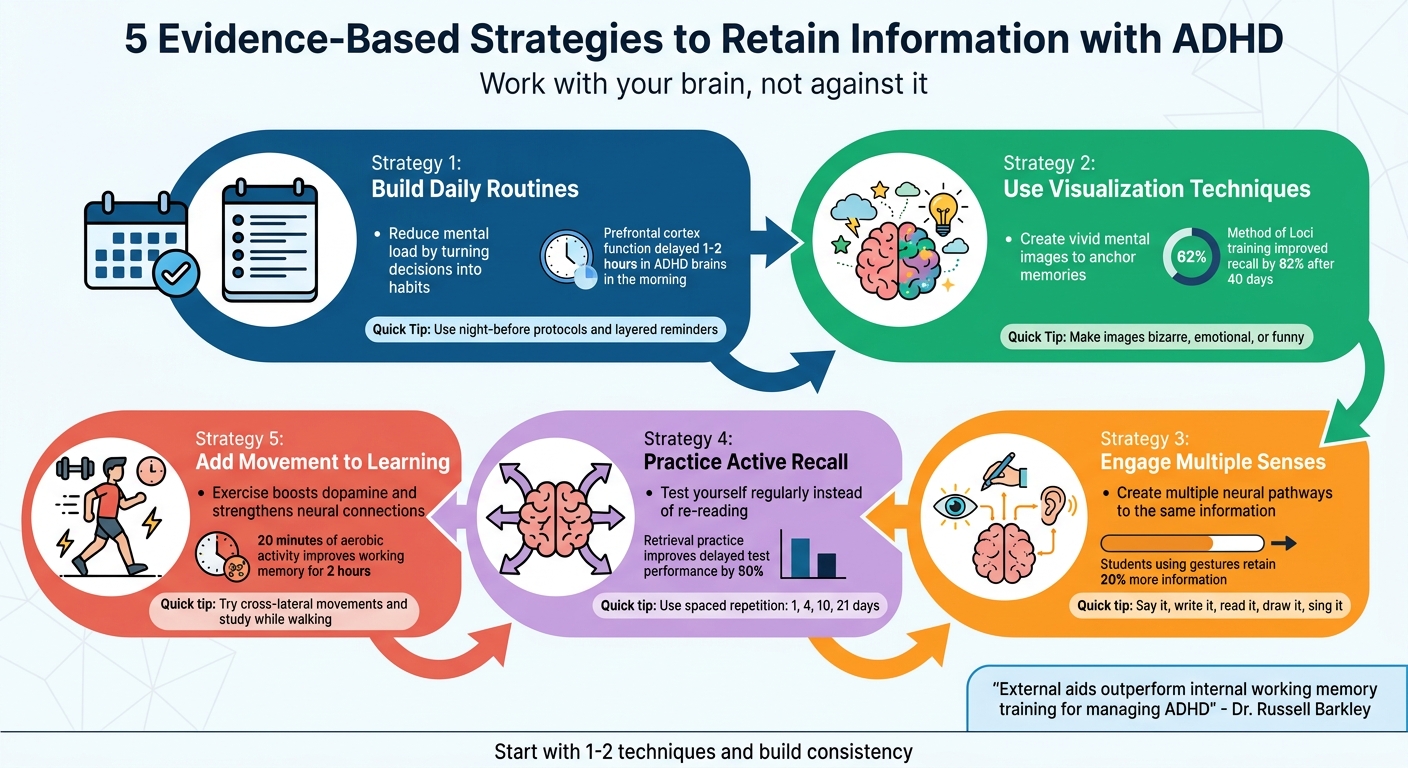
5 Evidence-Based Strategies to Retain Information with ADHD
Struggling to Retain Information? Your ADHD Brain Needs This | Ep. 332
sbb-itb-f879324
Build Daily Routines That Support Memory
Daily routines help reduce the number of small decisions your brain has to make, turning those decisions into habits that free up your working memory. For instance, adopting a "night-before protocol" - like laying out clothes, packing your bag, and prepping meals - can save mental energy, especially in the mornings when your prefrontal cortex is at its least efficient. Research shows that prefrontal cortex function is often at its lowest in the morning, and For gifted professionals with ADHD, this sluggish start can be delayed by 1–2 hours compared to neurotypical patterns.
Russell Barkley, a well-known ADHD researcher, explains:
"External aids (notes, checklists, timers, reminders) outperform internal working memory training for managing ADHD in daily life".
So, instead of trying to stretch your brain's capacity to remember more, the focus should be on reducing the load entirely.
Use Verbal and Visual Reminders
Routines can be made even more effective by adding external cues to reinforce memory. For ADHD brains, a single notification often isn't enough - it’s too easy to dismiss it with a thought like, "I'll handle this in a minute", only to forget it entirely. Layered alerts, such as reminders set for one hour, 15 minutes, and five minutes before a task, can provide the repeated nudges needed to stay on track.
Physical cues can also be powerful. For example, placing your work badge on top of your car keys or setting your gym bag by the front door creates immediate visual triggers. Verbal rehearsal - repeating instructions out loud or summarizing key points - can further help move information from short-term memory into something more stable. For tasks you do frequently, a laminated dry-erase checklist placed in a spot you see often can act as a steady external reminder. Adding color-coded notes taps into your brain's natural ability to recognize patterns, and updating your system occasionally keeps it from becoming stale.
Automate Repetitive Tasks
Another way to lighten your mental load is by automating tasks you do repeatedly. Templates and reusable formats for things like weekly reports, standard email replies, or monthly expense tracking can save you from starting from scratch each time. For daily routines, a simple laminated checklist - covering essentials like taking medication, eating breakfast, reviewing your calendar, packing your bag, and grabbing your keys - can shift the responsibility from your memory to a physical tool.
Digital tools can help, too. Recurring calendar events with built-in reminders ensure routine tasks don’t slip through the cracks. And using a capture system - whether it’s a voice memo, a notebook, or a task management app - lets you quickly jot down thoughts or to-dos before they vanish.
Use Visualization to Remember Information
Your brain processes visual information faster than verbal cues, making visualization a game-changer when your working memory is stretched thin. By turning abstract ideas into vivid images, you create strong memory anchors that stick. Think of it as giving your brain a visual "bookmark" for essential details.
The trick? Make your mental images unforgettable. Dr. Kari Miller, PhD, BCET, and ADHD Coach, explains:
"No matter whether the things we think about are funny and pleasant or scary and gross, neurochemicals in the brain are pressing the 'save' key for your memories".
So, instead of relying on plain textbook diagrams, spice things up. For instance, if you're studying RNA functions, picture a giant, neon-colored RNA molecule breakdancing on your kitchen counter or exploding into confetti. The more bizarre or emotional the image, the more likely your brain will store it.
Once you've mastered this, you can take visualization even further by tying it to specific locations.
The Classroom Visualization Method
This approach builds on the Method of Loci, a memory technique that links information to physical locations you’ll encounter during a test or presentation. Start by selecting 5–15 distinct landmarks in a room - like a fire alarm, a teacher's coffee mug, a poster, or even a crack in the wall. As you study, mentally "place" a piece of information at each spot, creating a vivid, multisensory image for each.
Here’s an example: If you need to remember that the hippocampus is involved in memory, imagine a tiny hippopotamus perched on the fire alarm, furiously scribbling notes. When test day rolls around, just glance at the fire alarm, and that quirky image will bring the information flooding back. In fact, people trained in the Method of Loci for 40 days improved their memory recall by an average of 62%.
But visualization doesn’t stop here - connecting ideas visually can boost recall even more.
Create Mind Maps to Connect Ideas
Mind maps are another powerful way to reinforce connections through visual patterns. Start by writing your main topic in the center of a page, then branch out with related ideas, connecting them with lines. Use shapes - like circles or rectangles - and color-code groups of related concepts. This method creates multiple visual pathways to the same information, making retrieval easier.
Mary D. Sanford, Ph.D., highlights the effectiveness of this technique:
"Mind mapping is so incredibly helpful".
To keep things simple, use 2–3 keywords or quick sketches for each branch instead of full sentences. This prevents your working memory from becoming overloaded and turns the mind map into an accessible, visual "cheat sheet" you can refer to anytime.
Engage Multiple Senses While Learning
Engaging multiple senses - like seeing, hearing, touching, and moving - provides your ADHD brain with the stimulation it craves. This approach creates multiple neural pathways to the same piece of information, making recall much easier. Think of it as spreading a safety net: the more senses you involve, the stronger that net becomes. By reducing the strain on your working memory, multisensory techniques help you retain information more effectively.
Dr. Kari Miller, PhD, a Board-certified Educational Therapist, explains:
"The more of these sensory factors you put into your mental images, the stronger the associations you're building in your brain and the more triggers – the equivalent of breadcrumbs – you're leaving in order to recall the information."
This multisensory approach lays the groundwork for practical, hands-on strategies that can make learning stick.
Combine Visual, Auditory, and Physical Techniques
To maximize the benefits of multisensory learning, mix and match sensory techniques to reinforce memory. A great method is to say it, write it, read it, draw it, and even sing it. By layering these sensory inputs, you create multiple ways to access the information later. For instance:
- Use colored pens or highlighters to visually organize ideas.
- Write key terms on textured notecards for a tactile experience.
- Say information aloud in a silly voice to engage your auditory sense.
- Sketch quick visuals or diagrams to connect ideas visually.
- Pair concepts with physical gestures or movements for a kinesthetic boost.
For dry or boring material, try turning it into a jingle or read your notes aloud as if you're hosting a talk show. Adding humor or absurdity can make a big difference. Dr. Kari Miller emphasizes:
"Use the gross and funny factor to your advantage, and your grades will skyrocket!"
Why does this work? Strong emotions like humor or surprise release neurochemicals that help lock memories in place. So don’t hold back - get weird, get creative, and make it memorable!
Link Information to Sensory Experiences
Another way to cement knowledge is by tying it to personal experiences or vivid sensory details. For example, if you’re learning about a company’s infrastructure, imagine it as a city: departments are neighborhoods, and the IT system is the power grid. These kinds of personal analogies make abstract ideas feel more concrete.
You can also engage your sense of smell or taste to strengthen memory. Try studying with a specific scent in the room - like peppermint or lavender - or snack on crunchy or sour foods like carrots or sour candy to boost focus. Even strange sensory cues can help create lasting associations.
For vocabulary or technical terms, use sound-alike keywords to build funny or exaggerated mental images. For example, to remember "atrophy", which sounds like "a trophy", imagine a trophy slowly crumbling into dust. As the Sachs Center points out:
"By involving the body and multiple senses, you anchor abstract concepts in concrete experiences, making them easier to grasp and retain."
The goal is to create sensory "hooks" that make recalling information feel effortless. The weirder or more personal these hooks are, the better they’ll work.
Practice Active Learning and Repetition
To truly retain information, especially for ADHD brains, active learning is a game-changer. Passive techniques like re-reading or highlighting might feel productive, but they don’t engage your brain enough to make the knowledge stick. According to research, these methods often fail because they don’t require you to actively process the material - information tends to slip away almost immediately. Active recall, on the other hand, pushes your brain to retrieve information, creating stronger neural connections in the process.
Here’s the key difference: when you actively recall information rather than just recognizing it on a page, you’re reinforcing memory pathways in a much deeper way. Dr. Russell Barkley explains it perfectly:
"The goal is not to train your brain to hold more. It is to make holding more unnecessary."
In other words, externalize what you can and focus on practicing the material you need to retain. Breaking larger topics into smaller, digestible chunks makes it easier for your brain to process without feeling overwhelmed. Combine this with spaced repetition - reviewing material at intervals like 1 day, 4 days, 10 days, and 21 days - and you’ll avoid the dreaded forgetting curve that erases new knowledge over time.
Pre-Alert and Frame Information
Before diving into new material, set the stage for your brain to absorb it. The SQ3R method (Survey, Question, Read, Recite, Review) is an excellent tool for ADHD learners. Start by surveying key elements like headings, charts, and summaries to get the big picture. Then, turn those headings into questions to guide your focus while reading. This pre-alerting approach helps your brain know what to look for, making it easier to retain.
Mind mapping is another effective strategy. Unlike traditional linear notes, mind maps allow you to visually organize ideas around a central concept with branching connections. This non-linear method prevents information overload by creating structure upfront, so you’re better prepared to handle the details later. The key is to organize your thoughts before they overwhelm your working memory.
Once you’ve created a framework, reinforce it with regular recall exercises to lock in the material.
Use Flashcards and Practice Drills
Flashcards are a powerful way to build on your structured overview and force active recall. To get the most out of them, avoid the common "peek-flip" habit - make sure to recite or write the answer before flipping the card. Each flashcard should focus on one clear concept to avoid overloading your brain. For example, instead of writing "Working memory = short-term storage", you could ask, "Why is working memory important for professionals with ADHD?"
Spaced repetition apps like Anki can automate review schedules, helping you fight the forgetting curve. If you miss a question, take a moment to rephrase the answer in your own words - this step helps encode the information into your long-term memory. You can even use AI tools to generate quiz questions from notes or meeting transcripts, saving yourself the mental energy of creating study materials.
Pair your flashcard sessions with the Pomodoro technique: study for 25 minutes, take a 5-minute break, and use that break to mentally quiz yourself on what you just reviewed. That "brain-burn" sensation you feel during recall exercises? It’s a sign your memory is actually strengthening.
Add Movement to Your Learning Process
Your brain and body are deeply connected, and this relationship can be especially impactful for individuals with ADHD. Physical activity doesn’t just benefit your body - it also enhances memory and focus. That’s because exercise triggers the release of dopamine and norepinephrine, the same neurotransmitters targeted by ADHD medications. It also boosts Brain-Derived Neurotrophic Factor (BDNF), which strengthens neural connections in key areas of the brain like the hippocampus and prefrontal cortex.
Science supports this link. For example, just 20 minutes of moderate aerobic activity can improve working memory for up to two hours. Adding movement to learning can also make a big difference: students who use hand gestures or incorporate physical activity while studying retain information 20% more effectively than those who stay seated. Even walking has been shown to boost creative thinking by as much as 60%. Pairing physical actions - like gesturing while reciting a word - with your learning material creates a "motor pathway" in the brain. This means that even if stress or fatigue disrupts your linguistic memory, your brain can still retrieve the information through the motor cortex.
Dr. John Ratey from Harvard Medical School sums it up perfectly:
"Exercise is like taking a little bit of Prozac and a little bit of Ritalin."
Here are some movement-based techniques to amplify your learning process.
Try Cross-Lateral Movements for Brain Activation
Cross-lateral movements, which involve crossing the body’s midline, are particularly effective for ADHD brains. For instance, reaching your right hand to touch your left knee stimulates both hemispheres of the brain, enhancing interhemispheric communication. This type of movement activates the prefrontal cortex, which is essential for focus and planning.
Examples of cross-lateral exercises include marching in place while touching your opposite hand to your knee or doing torso twists while swinging one arm across your body. These exercises can serve as quick attention resets and improve working memory. Additionally, you might try the "Sa Ta Na Ma" mudra - tapping each finger to your thumb in sequence. This simple exercise calms the nervous system while sharpening focus.
Include Movement in Study Sessions
Once you’ve activated your brain with cross-lateral movements, keep the momentum going by incorporating movement into your study routine. For example, you could listen to lectures while walking or review flashcards while standing. Pairing movement with study materials helps bind the two together, making it easier to recall information later.
Another effective strategy is to schedule a 20-minute walk, bike ride, or workout before tackling challenging tasks. This primes your brain for focus and problem-solving. During study sessions, take regular breaks every 25 minutes to stretch, stand, or walk around. These "brain breaks" reduce mental fatigue and keep you alert. Physical activity after studying can also aid memory consolidation, helping transfer information from short-term to long-term storage.
Ray Blakney, CEO and Founder, captures the power of this approach:
"When your body moves, your mind improves."
Create Reference Materials and Review Systems
Your brain doesn’t need to hold onto every detail - it just needs the right cues to help you recall them. For people with ADHD, who often struggle with limited working memory, external reference materials can act as a "second brain." These tools reduce the mental load and improve long-term retention by shifting the focus from internal storage to external support.
Build Quick-Reference Cheat Sheets
Cheat sheets are powerful tools designed to spark recall when you need it most. The idea is to focus on the critical 20% of information that drives 80% of your results.
The format of your cheat sheet matters. Depending on the type of information, you might use grids, decision trees, or formula strips. For concepts that aren’t linear, a visual mind map can engage your spatial memory effectively.
Design plays a big role in making cheat sheets useful. Stick to high-contrast colors and sans-serif fonts like Arial for easy readability. Use color coding to categorize information: for example, red for definitions, blue for examples, and green for formulas. Keep it concise - limit your cheat sheet to one front-and-back A5 page. This forces you to distill information rather than just copy it.
Jordan Ellis, a Senior SEO Content Strategist, explains:
"A great cheatsheet is not a pile of notes compressed onto one page. It is a carefully designed learning tool that helps you recall the right idea at the right moment."
The process of creating a cheat sheet also reinforces your learning. Rewriting information in your own words can boost retention by 30% to 40%. Try using the TEACH Method:
- Transform information into simple terms
- Explain it to someone else
- Apply it to real-life situations
- Connect it to knowledge you already have
- Highlight the most important points
To make capturing ideas easier, use tools like voice-to-text or AI apps. The quicker you record a thought, the better it sticks - especially for ADHD brains.
Combine Multiple Techniques for Better Results
Once your cheat sheet is ready, pairing it with consistent review methods can solidify your memory even further. One effective strategy is spaced repetition, where you review material at gradually increasing intervals (e.g., 1, 2, 4, 7, and 14 days). This method can improve recall by up to 50%.
To stay organized, set up a digital calendar with recurring "Review Sprint" reminders based on this pattern. After each session, rate your confidence on a scale of 1 to 5. If a topic feels unclear (scores of 1–2), shorten the review interval. If you feel confident (scores of 4–5), you can extend the gap.
Make your reviews active rather than passive. Testing yourself by recalling information is far more effective than simply re-reading. Research shows that retrieval practice can improve performance on delayed tests by 50%. Use the 3R Method:
- Read the material
- Recite it aloud
- Review it after 5 minutes
Mixing topics during study sessions, a technique called interleaving, can also improve delayed test performance by up to 43%.
You can also combine reference materials with movement and multisensory methods. For example, review a mind map while walking, say flashcards out loud, or add cross-lateral movements to your study routine. The more pathways your brain creates to the same piece of information, the easier it becomes to recall when you need it.
Conclusion
If you have ADHD, your brain processes information differently. That doesn’t mean it’s less capable - it just comes with its own set of challenges, especially when it comes to working memory. Research shows that ADHD reduces working memory capacity, making it harder to hold onto and process information in real-time. But with the right strategies, you can align with how your brain works instead of fighting against it.
Start small and focus on what feels manageable. For example, jotting down your thoughts within 30 seconds can prevent them from slipping away. Visual tools like mind maps or color-coded notes can help with organizing information, especially if you struggle with visuospatial tasks. Adding physical movement to your routine is another game-changer - just 20 minutes of moderate exercise before tackling a mentally demanding task can enhance memory performance for up to two hours. Techniques like spaced repetition and active recall are also powerful for transferring information from short-term to long-term memory.
Russell Barkley, a well-known ADHD expert, emphasizes the importance of external supports:
"External aids (notes, checklists, timers, reminders) outperform internal working memory training for managing ADHD in daily life".
So, lean into tools like reminders, cheat sheets, or voice memos - they’re not crutches; they’re essential supports.
The secret is consistency. Choose one or two techniques that feel simple and stick with them until they become second nature. Celebrate even the smallest progress. Managing ADHD-related memory challenges takes time and patience, but every step forward strengthens your ability to adapt and thrive. With steady effort and the right approach, you can turn these challenges into opportunities for growth.
FAQs
Which strategy should I start with if I’m overwhelmed?
If you’re feeling overwhelmed, it’s usually because your brain is juggling too many demands at once. One way to ease this is by simplifying your environment and focusing on what’s most important. Writing things down or using memory aids can also lighten the mental load. These small adjustments can help you feel more in control, particularly when sensory overload or racing thoughts are part of the problem.
How do I set up reminders so I don’t ignore them?
To ensure reminders are effective and ADHD-friendly, make them stand out by using multi-sensory cues. Combine visual prompts, tactile signals, or location-based notifications instead of depending only on sound. Incorporate external time cues like interval timers or alarms to address challenges like time blindness and hyperfocus. Most importantly, customize reminders to fit your personal preferences and surroundings, making them engaging and relevant to your daily routine for improved follow-through.
What’s the fastest way to use active recall at work?
The fastest way to use active recall at work, especially if you have ADHD, is to quiz yourself on important details right after learning them. Form questions about the material and check your answers to strengthen your memory. Pair this with tools like flashcards or quick mental quizzes during short breaks (like those in Pomodoro sessions) to enhance retention through quick retrieval practice.