How ADHD Impacts Long-Term and Short-Term Goal Setting
ADHD reshapes time, motivation, and planning, so goal systems must match your brain—not force it.

ADHD makes goal setting harder by affecting how the brain processes time, rewards, and planning. Gifted professionals with ADHD often struggle with long-term goals because delayed rewards feel abstract, while short-term distractions dominate attention. Problems with executive function, like working memory and impulsivity, add extra challenges. However, ADHD also brings strengths like hyperfocus and creative thinking, which can help when goals align with personal interests.
Key strategies for success include breaking tasks into smaller steps, using immediate rewards, and creating external reminders like visual tools or timers. For long-term goals, dividing them into shorter cycles, adding accountability, and using frameworks like H.A.R.D. can help maintain motivation. Tailoring methods to ADHD-specific needs makes achieving goals easier and more sustainable.
“Just Pick a Goal” Doesn’t Work for ADHD Brains - Here’s Why (And the Fix)
sbb-itb-f879324
How Executive Function Problems Affect Goal Setting
Building on earlier discussions about ADHD's impact on planning and time perception, executive function challenges add another layer of complexity to goal setting. Executive function refers to the mental processes that help turn ideas into actions. For people with ADHD, these processes work differently, creating unique obstacles. As Russell Barkley, a leading clinical scientist and ADHD expert, puts it:
"ADHD is not fundamentally a disorder of attention. It is a disorder of executive function. The attention problems are a symptom."
These difficulties show up in several ways. For instance, issues with working memory can make it hard to keep multi-step plans in mind - like forgetting important details for an activity or losing focus after an interruption. Impulsivity might lead to jumping to more stimulating tasks before finishing the current one, while trouble starting tasks can create a gap between planning and doing. Adults with ADHD often score 30% to 40% lower than their neurotypical peers on standardized tests of executive function, making prioritization and planning especially tough. Emotional regulation issues add another hurdle, as even small setbacks can throw progress off track.
How Time Perception and Dopamine Shape Goal Choices
For individuals with ADHD, time often feels divided into two categories: "now" and "not now." This isn't just procrastination - it reflects a neurological difference in how time is perceived. Future deadlines, whether an hour away or a month away, can feel equally distant. Dr. Russell Barkley explains:
"The ADHD brain operates on a 'now vs. not now' principle. Events that are not happening at this exact moment feel equally distant whether they are one hour away or one month away."
This "time blindness", combined with irregular dopamine activity, makes immediate rewards far more tempting than long-term outcomes. People with ADHD often underestimate how long tasks will take - by as much as 30% to 100%. A disrupted internal clock, influenced by dopamine, further skews their sense of time, making reliable planning even harder. Despite these hurdles, ADHD also brings strengths that can be channeled effectively when goals align with personal interests.
ADHD Strengths and Challenges in Different Goal Types
While executive function challenges can undermine traditional planning, ADHD also comes with unique strengths that can support goal achievement when used strategically. Take hyperfocus, for example. This intense concentration can act as a powerful driver for short-term goals, especially when a task feels urgent or engaging. However, hyperfocus can also cause a complete loss of time awareness, leading to missed deadlines or neglected responsibilities.
For long-term goals, the ADHD brain thrives on novelty, challenge, or personal meaning. As Dennis Francis aptly describes:
"ADHD brains need the prize in the glovebox just to start the engine."
Additionally, the characteristic "zig-zag thinking" associated with ADHD can be a strength, allowing for unexpected insights and a strong grasp of the bigger picture. On the flip side, this non-linear thinking style can make step-by-step planning feel unnatural and draining. Switching between tasks is another challenge, often requiring 15 to 20 minutes for the ADHD brain to fully adjust. Understanding these tendencies is key to creating goal-setting approaches that work with, rather than against, the ADHD brain's unique wiring.
What Research Shows About ADHD and Goal Management
ADHD affects more than just childhood - it continues into adulthood for over half of those diagnosed. In adults, the condition is estimated to affect between 1.4% and 3.6% of the population, with about 30% of individuals either not responding to or unable to tolerate psychostimulant medications. Recent studies not only confirm the challenges tied to ADHD but also point to ways to address these difficulties while recognizing strengths that can aid in managing goals.
One of the most significant hurdles for individuals with ADHD lies in executive dysfunction. This type of impairment disrupts goal-oriented behavior by making it harder to focus attention, suppress inappropriate responses, and maintain a clear view of goals. Adolescents and adults with ADHD often find it challenging to link their short-term actions to long-term objectives. A key factor here is "metamotivation" - the ability to recognize when motivation is low and take steps to boost it. It’s important to note that this isn’t about laziness; rather, it’s a neurological issue that often requires tailored strategies to manage. These insights form the basis for interventions like Goal Management Training (GMT), which directly addresses planning and organizational difficulties associated with ADHD.
Goal Management Training (GMT) for ADHD
Goal Management Training (GMT) offers a non-medication-based solution for adults with ADHD. This cognitive-rehabilitation method helps individuals break out of automatic, habitual behaviors by teaching them how to create clear goal structures and use strategies to monitor their progress. In a randomized trial involving 81 adults, those who participated in GMT reported significant improvements in their day-to-day executive functioning and a noticeable reduction in anxiety symptoms compared to those receiving standard treatment. These benefits were still evident eight months later.
One of GMT’s key tools is the "STOP-STATE-SPLIT" technique. This involves pausing to interrupt automatic behavior, clearly defining the current goal, and breaking larger, overwhelming tasks into smaller, manageable steps. The program also addresses working memory challenges - often referred to as issues with "the mental blackboard" - that can make multi-step tasks especially difficult.
Group-based GMT sessions can amplify these benefits by fostering a sense of community. Participants often shift from self-criticism to self-acceptance as they connect with others facing similar challenges. Unfortunately, a Norwegian survey revealed that only 20% of adults with ADHD were offered non-medication treatment options, highlighting the gap that GMT helps to fill.
Research on ADHD Strengths in Achieving Goals
While ADHD poses challenges, it also comes with strengths that can be harnessed for achieving goals. A qualitative study of 50 adults with ADHD found that 96% of participants identified positive aspects of their diagnosis, such as high energy levels and the ability to hyperfocus.
Creativity is another well-recognized strength among individuals with ADHD. Studies show that adults with ADHD are more likely to achieve publicly acknowledged creative accomplishments, such as securing patents or publishing books, compared to their neurotypical peers. For instance, research conducted at the University of Amsterdam in November 2020 compared 46 adults with ADHD to 44 controls. The ADHD group generated significantly more original ideas during creative tasks, particularly when motivated by a €5 bonus. Lead researcher Nathalie Boot remarked:
"Our findings suggest that goal-directed motivation may drive the enhanced real-world creative achievements of people with ADHD."
Hyperfocus is another notable strength. When deeply engaged in a task, individuals with ADHD can sustain intense concentration for long periods, enabling them to tackle complex projects, pass challenging exams, or complete demanding job assignments. Paired with the resilience and problem-solving skills many develop while navigating a world that isn’t designed for their needs, these strengths can become powerful tools - especially when bolstered by structured interventions like GMT.
Practical Strategies for Setting Short-Term and Long-Term Goals
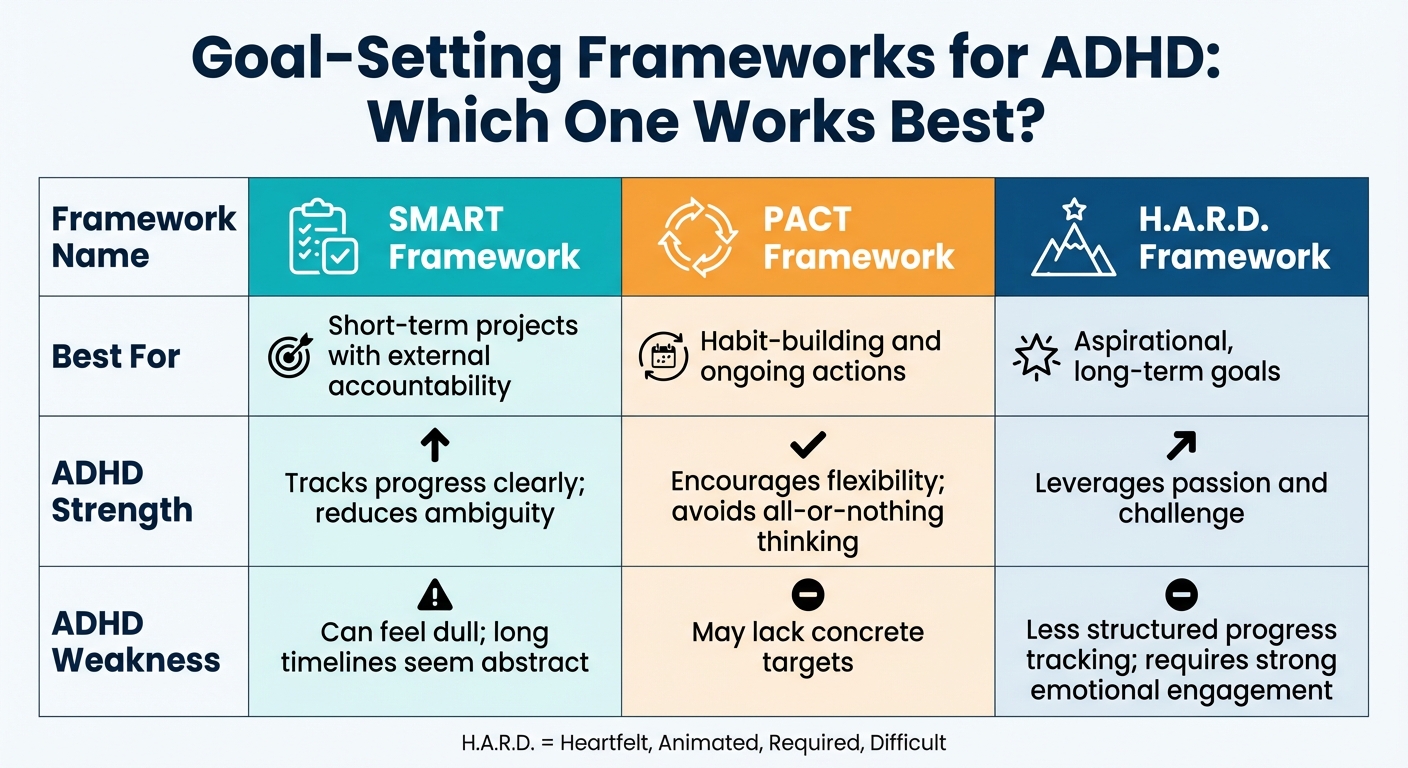
Goal-Setting Frameworks for ADHD: SMART vs PACT vs HARD Comparison
Research shows that traditional goal-setting advice often doesn’t align with how ADHD brains function. Instead of relying on generic productivity methods, these strategies are tailored to ADHD-specific neurological traits.
Strategies for Short-Term Goals
Short-term goals thrive on quick dopamine boosts to maintain motivation. The trick? Break tasks into tiny, manageable steps. For example, instead of tackling "write report", start with "open document."
Implementation intentions - creating if-then plans - can simplify decision-making and reduce mental effort. For instance: "If I sit at my desk, then I’ll open my email." Studies suggest this approach can boost follow-through by as much as 65%.
Immediate rewards are another game-changer. ADHD brains respond better to instant gratification than delayed consequences. As Ramon Landes, a medtech marketing expert, explains:
"Dopamine‐based systems outperform consequence‐based systems. Immediate rewards engage motivation; delayed consequences fail with weak executive function".
Simple treats like a quick snack or a short phone break can provide the dopamine hit needed to stay on track. This is especially important since research indicates that ADHD brains have reduced dopamine transporter availability, which makes distant rewards feel less motivating [13, 24].
Environmental scaffolding can also make a big difference. Use tools like whiteboards, sticky notes, or visible timers to create external reminders. Setting a 15-minute timer can create a sense of urgency, while working alongside someone else - a technique called body doubling - adds social accountability and helps with starting tasks [23, 24].
The I.N.C.U.P. framework is another powerful tool. Since ADHD brains are driven by interest rather than abstract importance, tasks that incorporate Interest, Novelty, Challenge, Urgency, and Passion can spark motivation and reduce the chances of abandoning tasks [23, 24].
While these strategies keep short-term goals moving, long-term goals require a different approach to sustain effort over time.
Strategies for Long-Term Goals
Long-term goals often feel abstract, which can make them harder to pursue. To tackle this, it’s essential to create structure and accountability. Techniques like breaking goals into smaller chunks and adapting traditional frameworks can help ADHD brains stay engaged.
Break annual goals into 90-day cycles. A year-long target can feel overwhelming, but dividing it into quarterly milestones makes progress feel more tangible.
Flexible SMART goals work well when adjusted for ADHD. While traditional SMART goals emphasize "Achievable", adding enough challenge to trigger a dopamine response can make them more engaging [13, 23].
Here’s a breakdown of popular goal-setting frameworks and their fit for ADHD:
| Framework | Best For | ADHD Strength | ADHD Weakness |
|---|---|---|---|
| SMART | Short-term projects with external accountability | Tracks progress clearly; reduces ambiguity | Can feel dull; long timelines seem abstract |
| PACT | Habit-building and ongoing actions | Encourages flexibility; avoids all-or-nothing thinking | May lack concrete targets |
| H.A.R.D. | Aspirational, long-term goals | Leverages passion and challenge | Less structured progress tracking; requires strong emotional engagement |
The H.A.R.D. framework - Heartfelt, Animated, Required, Difficult - works particularly well for long-term goals by tapping into the motivators outlined in I.N.C.U.P..
Accountability systems are crucial for staying on track. Regular check-ins with a coach or friend, or using tracking apps, can help compensate for working memory challenges and ensure steady progress [1, 13].
To keep long-term goals fresh, novelty rotation can be a lifesaver. Rotating through a variety of productivity techniques prevents boredom and keeps things interesting.
Connecting Short-Term Actions to Long-Term Objectives
Bridging the gap between daily tasks and broader ambitions is key for ADHD brains, which often struggle with time blindness. Making these connections visible and tangible can help.
Visual tracking systems like Kanban boards, mind maps, or visual timers externalize how micro-tasks contribute to bigger goals, countering working memory limitations [1, 13].
Framework layering is another effective strategy. Use the H.A.R.D. framework for inspiring long-term goals, PACT principles for daily habits, and SMART criteria for specific milestones.
Transition rituals can help signal the brain to shift gears. A simple five-minute routine, like brewing tea, can cue your brain to move from a passive to an active state.
Temptation bundling pairs enjoyable activities with goal-related tasks. For example, listen to a favorite podcast while working on a project. This provides an immediate dopamine boost, making long-term rewards feel less distant.
As Dr. Russell Barkley, a leading psychologist, puts it:
"ADHD isn't a disorder of not knowing what to do. It's a disorder of not doing what you know".
Conclusion: Using ADHD-Friendly Strategies for Goal Success
Setting goals when you have ADHD isn’t about forcing your brain to fit a mold - it’s about creating systems that work with how your mind naturally operates. Success comes from understanding how factors like dopamine levels, executive function, and time perception influence your motivation and productivity.
The strategies we’ve explored are grounded in research and tailored for ADHD brains. Breaking tasks into smaller, manageable steps that offer immediate rewards, using visual tools to combat time blindness, and applying the I.N.C.U.P. framework to ignite interest-based motivation are all ways to work around executive function struggles. At the same time, these methods leverage strengths like hyperfocus and creative thinking.
These approaches not only play to your brain’s natural abilities but also encourage personal experimentation. The key is to find what works for you. Some individuals thrive with H.A.R.D. goals that tap into their passions, while others prefer the steady, action-oriented focus of PACT. Experimentation is essential, and building habits through positive reinforcement and rewards will always be more effective than relying on criticism or self-doubt.
Key Takeaways
Here’s a quick recap of ADHD-friendly goal-setting strategies: Understanding your ADHD type - whether inattentive, hyperactive, or combined - helps you choose tools that suit your needs. Using visual aids, working with accountability partners, or trying body doubling can help counteract working memory challenges. Designing goals that incorporate novelty, challenge, and urgency keeps your interest-based nervous system engaged, rather than depending on abstract ideas of importance.
The biggest takeaway? When you tailor your goal-setting approach to fit your brain’s natural tendencies - using the research-backed methods and tips shared in this article - you can achieve goals in a way that feels both rewarding and sustainable.
FAQs
How do I pick goals that my ADHD brain will actually care about?
Pick goals that truly resonate with your personal interests and motivations. Ask yourself: Why does this goal matter to me? Understanding the deeper purpose behind each goal makes it feel more meaningful and rewarding.
Focus on goals that spark your excitement and feel within reach. Break them down into smaller, manageable steps to avoid feeling overwhelmed. Incorporate a mix of novelty, purpose, and your natural strengths - this combination can help keep your ADHD brain engaged and on track.
When goals feel relevant and stimulating, you're much more likely to stay motivated and see them through.
What’s the fastest way to turn a big goal into doable next steps?
Breaking down a big goal into smaller, actionable tasks is one of the fastest ways to make it feel less overwhelming, especially for individuals with ADHD. Tackling everything at once can lead to stress and task paralysis, but dividing the goal into bite-sized steps makes it more approachable. The key is to focus on creating specific, clear actions rather than vague or abstract ideas. Strategies like "chunking" goals into smaller, achievable parts can make starting - and sticking with - the process much easier.
How can I stay consistent on long-term goals when motivation drops?
To keep working toward long-term goals when motivation wanes, it helps to use strategies that match how the ADHD brain operates. Break your goals into smaller, doable steps and set expectations that feel achievable. Frameworks like PACT (Purposeful, Actionable, Continuous, Trackable) or H.A.R.D. (Honest, Actionable, Reachable, Doable) can be particularly effective. Regularly revisit the bigger picture to remind yourself why the goal matters, and adjust your plans based on your natural attention patterns. Staying flexible and tailoring your approach to fit your brain's needs can make it easier to stay on track, even when motivation dips.