Why ADHD Brains Struggle with Prioritization
ADHD brains prioritize novelty and urgency over long-term importance; low dopamine, time blindness, and weak working memory are key.

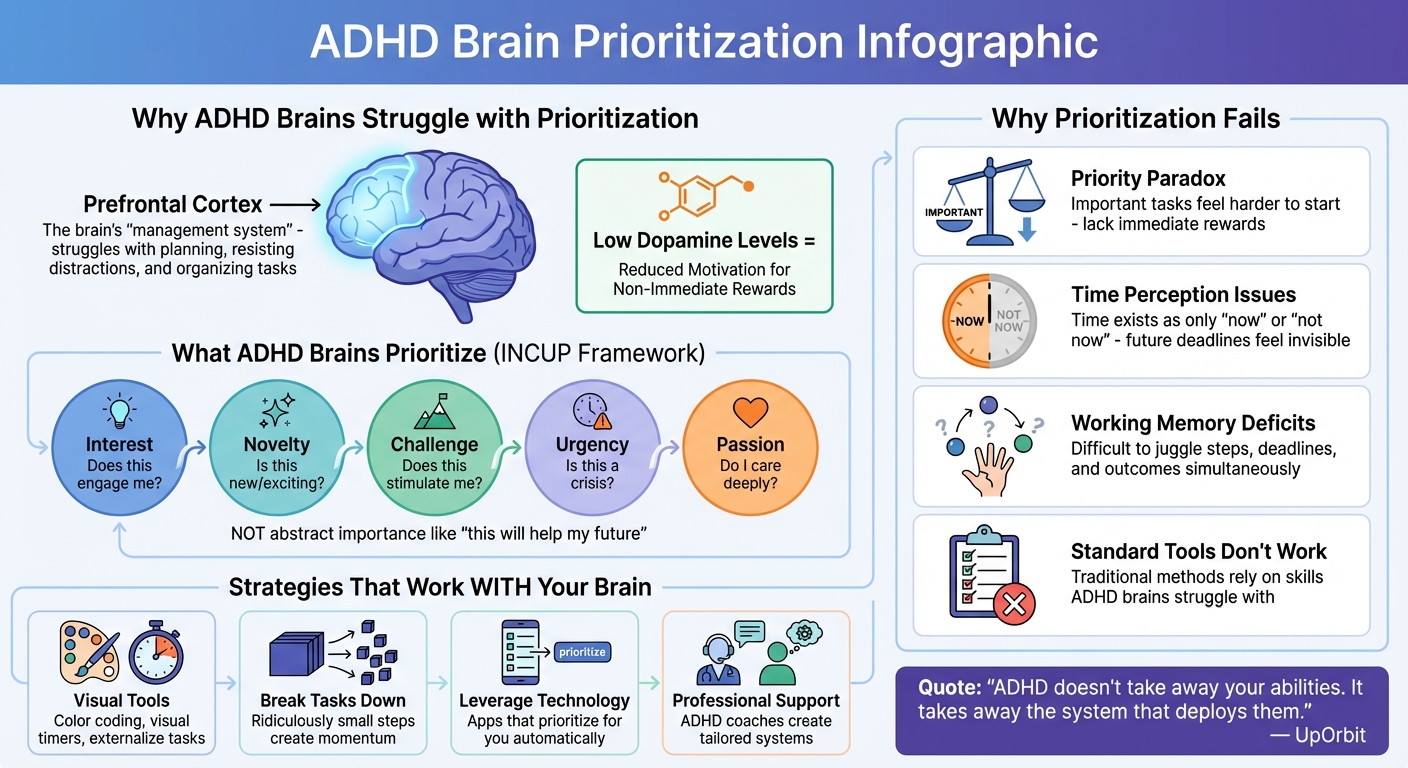
ADHD makes prioritizing tasks a real challenge, but it’s not about laziness - it’s about how the brain works. ADHD impacts the prefrontal cortex, the brain’s "management system", which struggles with planning, resisting distractions, and organizing tasks. The problem lies in low dopamine levels and altered communication between brain regions. This means ADHD brains prioritize based on triggers like interest, urgency, and novelty, not abstract importance like "this will help my future."
Here’s why this happens and what you can do:
- The Priority Paradox: Important tasks feel harder to start because they lack immediate rewards or urgency.
- Time Perception Issues: ADHD brains see time as "now" or "not now", making future deadlines feel invisible.
- Working Memory Deficits: It’s tough to juggle steps, deadlines, and outcomes, leading to overwhelm.
- Standard Tools Don’t Work: Methods like to-do lists or time-blocking fail because they rely on skills ADHD brains struggle with.
What Works?
- Visual Tools: Use color coding, visual timers, and apps to externalize tasks.
- Break Tasks into Tiny Steps: Start with ridiculously small actions to create momentum.
- Leverage Technology: Use apps that prioritize tasks for you or break down projects automatically.
- Professional Support: ADHD coaches and therapists can help you create systems tailored to your brain.
ADHD brains aren’t wired for traditional prioritization methods, but with the right strategies, you can work with your brain - not against it.
How ADHD Affects Brain Function and Prioritization
How to Prioritize with an ADHD Brain (with Sharon Saline, Psy.D.)
How ADHD Affects the Brain's Ability to Prioritize
ADHD affects the brain in ways that make prioritizing tasks a real challenge. This largely stems from reduced activity in the prefrontal cortex and altered communication between key brain regions involved in decision-making. Let’s dive into how dopamine deficits and connectivity issues contribute to these struggles.
Prefrontal Cortex Function and Dopamine Deficits
The prefrontal cortex, responsible for planning and decision-making, doesn’t work as efficiently in individuals with ADHD. This part of the brain struggles to manage executive functions like switching between tasks or tuning out distractions. A major culprit? Persistently low dopamine levels.
Dopamine plays a critical role in motivation, especially for tasks that don’t offer immediate rewards. In ADHD, low dopamine levels make it hard for the brain to focus on long-term goals. For instance, a project with a deadline weeks away might feel far less pressing than responding to an email right now. This phenomenon, known as temporal discounting, amplifies in ADHD brains, making future rewards seem almost irrelevant compared to small, immediate ones.
Here’s why stimulant medications can be effective - they boost dopamine availability in the prefrontal cortex, helping the brain engage with tasks that are important but not immediately rewarding.
But dopamine isn’t the only issue. Disruptions in how different brain regions communicate further complicate prioritization.
Brain Connectivity Issues and Working Memory Problems
In ADHD, the brain’s connectivity - particularly between regions involved in decision-making - is altered. This disrupts the internal “ranking system” that should help prioritize tasks by importance. Instead, all tasks, big or small, compete for attention, creating a sense of mental overload.
Working memory, which acts as the brain’s temporary workspace for holding and processing information, is also impaired in ADHD. Research shows that adults with ADHD struggle significantly with both verbal and spatial working memory compared to neurotypical individuals. Since prioritization relies on juggling deadlines, consequences, steps, and outcomes, these working memory deficits make the process even harder.
"ADHD doesn't take away your abilities. It takes away the system that deploys them."
– UpOrbit
As a result, logical prioritization often gives way to emotional decision-making. The amygdala, the brain’s emotional center, tends to flag tasks based on feelings like anxiety or excitement rather than actual importance. This explains why many people with ADHD find themselves waiting for a crisis to act - the rush of dopamine and norepinephrine during high-pressure situations finally cuts through the brain’s resistance to activation.
Dr. Tamara Rosier captures this dynamic perfectly:
"Prioritizing tasks and knowing what to do first is difficult for those of us with ADHD, so we rely on anxious feelings to tell us what needs to be done".
These neurological differences underline why sheer willpower isn’t enough to overcome prioritization challenges. The next sections will explore how these patterns shape behavior - and offer practical strategies designed to align with the ADHD brain’s unique wiring.
Common Prioritization Struggles in ADHD
The challenges tied to ADHD often show up as specific struggles with prioritization in daily life. These behaviors aren't about being lazy or disorganized - they stem from how the ADHD brain processes urgency, importance, and rewards.
Procrastination and Choosing Easier Tasks Over Important Ones
For people with ADHD, the bigger or more important a task seems, the harder it can be to start. Why? Abstract motivations like "this is good for my career" or "this will pay off in the future" don’t trigger the same mental drive as they might for others. Psychiatrist William Dodson describes ADHD brains as operating on an "interest-based nervous system". For example, a project due in three weeks might feel too distant to spark action, while smaller, immediate tasks - like tidying your desk or answering emails - offer quicker, more satisfying rewards. This dynamic, often called the Priority Paradox, makes tackling critical but non-urgent tasks especially tough. Adding to the difficulty is something called temporal discounting, where future rewards quickly lose their appeal compared to immediate ones.
Overwhelm and Procrastivity
Another common hurdle is the feeling of being overwhelmed. When faced with multiple demands, the ADHD brain struggles to prioritize, making everything feel equally urgent - like having all your browser tabs blinking at once. Instead of sorting tasks logically, the brain treats them as equally pressing. This overwhelm often leads to "procrastivity", where individuals focus on smaller, low-stakes tasks (like organizing a calendar) to avoid the stress of tackling bigger responsibilities. Emotional responses further complicate things. The amygdala flags tasks based on their emotional weight rather than their actual importance, labeling overwhelming or unclear tasks as threats and steering attention toward easier, safer activities.
Dr. Tamara Rosier explains it well:
"Prioritizing tasks and knowing what to do first is difficult for those of us with ADHD, so we rely on anxious feelings to tell us what needs to be done."
In many cases, people with ADHD unconsciously wait until a crisis hits. That sense of urgency often generates the dopamine and norepinephrine boost needed to finally push through and take action.
Why Standard Prioritization Methods Don't Work for ADHD
The way ADHD brains process information and motivation doesn't align with conventional prioritization tools. Popular strategies like to-do lists, the Eisenhower Matrix, time-blocking, and "Eat the Frog" are built on assumptions that work for neurotypical brains. They rely on abilities like self-motivation through abstract importance, accurate time estimation, and seamless task-switching - abilities that ADHD brains often struggle with. This mismatch is why these methods often fail for people with ADHD.
Take the Eisenhower Matrix, for example. It categorizes tasks by urgency and importance, but ADHD brains struggle with tasks in the "Important-Not-Urgent" quadrant. These tasks lack the urgency needed to trigger a dopamine response, making them nearly impossible to start. As Johannes, the creator of Super Productivity, puts it:
"The Important-Not-Urgent quadrant is where tasks go to die – visible on the matrix, invisible to your motivational system."
Without that dopamine-driven push, these tasks remain untouched, even as their importance grows, creating a frustrating cycle of inaction.
Time-blocking presents a different set of challenges. This method assumes you can accurately estimate how long tasks will take, stick to a rigid schedule, and effortlessly switch between tasks. For someone with ADHD, these assumptions break down due to time blindness, a need for novelty, and the mental strain of constant transitions. Nia from the rivva blog explains:
"Time blocking was designed for neurotypical brains... Rigid schedules, arbitrary time estimates, and the constant micro-decisions required to stick to a time-blocked day [impede] ADHD executive function."
Every transition between time blocks becomes a mini hurdle, draining mental energy. A task planned for 30 minutes might stretch to two hours, derailing the entire schedule and leaving you feeling defeated.
Even simple to-do lists fall short. For ADHD brains, tasks often disappear from focus once they're out of sight. This makes it hard to compare or prioritize items, turning the list into overwhelming clutter. Everything either feels equally urgent or fades into the background.
These struggles underscore the need for prioritization methods that work with the ADHD brain rather than against it, addressing its unique challenges and strengths.
Prioritization Strategies That Work for ADHD
Understanding how your brain operates is the first step to creating strategies that align with the way ADHD works. By tailoring techniques to the unique wiring of an ADHD brain, you can transform prioritization from a daunting challenge into something more approachable. The key? Using methods that work with your brain, not against it.
Visual Tools and Reminders
Did you know your brain processes colors faster than text? That’s why color-coding can be a game-changer for organizing tasks. Stick to 4–7 colors for simplicity and assign each one to a category: red for urgent deadlines, blue for focused work, green for health-related tasks, yellow for social commitments, and purple for creative projects.
Another helpful tool is a visual timer. Unlike digital clocks that just show numbers, devices like the Time Timer MOD display time as a shrinking red disk, making the passage of time more tangible. Watching time physically disappear helps you better understand how much is left. For digital planners, apps like SparkDay offer a 24-hour scrollable timeline, turning time into a visual and spatial concept.
As ADHD coach Christine Walter explains:
"Organization is not about being rigid - it's about creating external structures that your brain can lean on."
Adding buffer blocks of 10–15 minutes between tasks is another effective strategy. These short cushions account for transition struggles and keep one delay from derailing your entire day.
While visual tools help externalize your schedule, breaking tasks into smaller steps tackles the internal overwhelm.
Breaking Tasks into Smaller Steps
Big projects can trigger what’s often called the "Wall of Awful", a mental block that makes starting feel impossible. The solution? Break tasks into tiny, manageable steps. This approach not only removes the overwhelm but also creates dopamine feedback loops - small bursts of motivation every time you complete a micro-task, which helps counter procrastination.
The trick is to make the steps ridiculously small. For example, instead of writing "clean kitchen", start with "put one dish in the dishwasher." Or replace "write report" with "open document". These small actions aren’t about lowering your standards - they’re about sidestepping paralysis.
Another tool to try is the "Liar's Timer": commit to working for just 5–10 minutes. This tiny sprint feels easy to start but often builds momentum to keep going. Research supports this - people who set specific dates, times, and locations for tasks are 90% more likely to follow through, compared to just 35% for those with vague plans.
To make starting even easier, externalize your first step by writing it down. A note like "Open PowerPoint" or "Type title" can remove the mental roadblock of figuring out where to begin.
Using Technology and Apps
Technology can take the guesswork out of prioritization. Apps like Motion and Morgen use AI to organize tasks based on deadlines and energy levels, helping you avoid decision paralysis. For visual thinkers, apps like Tiimo and Structured offer color-coded timelines that make time easier to grasp.
If breaking down tasks feels overwhelming, tools like Goblin Tools and Llama Life can do it for you. These apps use AI to split big projects into smaller, dopamine-boosting steps automatically. Voice-based apps like Calma let you capture tasks verbally, reducing the friction of typing them out. And apps like Todoist use features like "Karma" points and streaks to provide instant rewards, giving ADHD brains the immediate feedback they thrive on.
To keep tasks visible and avoid "object permanence" issues, place task manager widgets on your phone’s home screen. Color-code tasks by category - such as work, self-care, or urgent deadlines - so your brain can process them instantly.
But even the best tools work better when paired with personalized support.
Working with ADHD Coaches and Therapists
ADHD coaches and therapists bring a personalized touch to tackling your unique challenges. Coaches can help you create energy-based schedules and develop transition rituals, like putting on headphones or tidying your desk, to signal “work mode” and make shifting between tasks smoother.
Structured breaks, guided by professionals, have been shown to make a measurable difference. A 2020 review found that these protocols improved workplace performance evaluations by 22% for employees with ADHD. That’s not just about feeling more in control - it’s about seeing real results.
Therapists, on the other hand, help address the emotional roadblocks that fuel procrastination and overwhelm. They work with you to break down the shame spiral that often accompanies large tasks, turning the intimidating "Wall of Awful" into something you can climb over instead of crashing into.
How On/Off Genius Supports ADHD Professionals
For professionals with ADHD, standard productivity advice often misses the mark. Many of these systems assume our brains work based on abstract ideas of importance. However, research suggests that ADHD brains thrive on factors like interest, novelty, challenge, urgency, and passion - a concept captured in the INCUP framework. On/Off Genius recognizes this and provides tools and strategies tailored to these unique cognitive needs.
The way ADHD brains prioritize tasks is fundamentally different from neurotypical brains. This difference, known as the ADHD Priority Paradox, highlights that while others might be motivated by the concept of importance, ADHD brains require specific triggers to activate. On/Off Genius uses this understanding to develop practical tools like the 4D Filter, which categorizes tasks based on Deadline, Damage, Desire, and Duration. Another standout framework is the One-Thing Priority System, which starts with a single "must-do" task and gradually expands to secondary goals. This approach not only simplifies planning but also helps rebuild trust in your ability to follow through.
The blog also dives into strategies for managing time blindness, a common challenge for those with ADHD. It suggests actionable methods such as creating artificial urgency by making public commitments, aligning tasks with your peak energy levels, and using if-then planning to pre-decide actions (e.g., "After lunch, I’ll open the project file and work for 25 minutes"). These strategies are designed to complement your brain's natural rhythms. For instance, accurately timing recurring tasks can be a game-changer - realizing that a task takes 45 minutes instead of the two hours you assumed can help you plan more effectively.
Whether you're struggling with "importance blindness" or trying to build consistency after years of frustration, On/Off Genius offers practical tools and insights to make prioritization feel less overwhelming and more achievable.
Conclusion
The challenges of prioritization in ADHD aren't about laziness - they stem from how the brain is wired. With reduced prefrontal activity and lower dopamine levels, abstract motivators like long-term goals don’t spark action. Instead, your brain thrives on triggers like interest, novelty, challenge, and urgency. This explains why you might immediately respond to an urgent email but procrastinate on a major project, and why conventional productivity methods often fall short.
"The priority paradox isn't a discipline problem. It's a wiring difference that requires different strategies." - Johannes, Creator of Super Productivity
FAQs
How can I tell what’s truly urgent vs just stimulating?
ADHD brains can have difficulty separating what feels urgent from what is truly important, often chasing immediate rewards over long-term priorities. To navigate this, take a moment to pause and ask yourself: Does this task align with my bigger goals or responsibilities?
Tasks that matter most might feel harder to begin because they don’t provide that quick dopamine hit. To tackle this, break the task into smaller, bite-sized steps. This approach can make daunting tasks feel less overwhelming and easier to engage with.
What’s the fastest way to start an “important but not urgent” task?
To get rolling on an “important but not urgent” task, try breaking it into smaller, bite-sized steps. Commit to one simple action - something as small as opening a document or jotting down a single sentence. Sometimes, creating a bit of urgency can help too, like setting a quick, self-imposed deadline. The key is to focus on just starting, even if it’s only for five minutes. For ADHD brains, that initial step is often the biggest hurdle.
Which ADHD-friendly tools help with time blindness and follow-through?
ADHD-friendly tools are designed to tackle challenges like time blindness and difficulty with follow-through by offering external time cues and a sense of structure. Some popular options include Focus Keeper, a Pomodoro timer that breaks tasks into manageable chunks, and Brain.fm, which uses focus-enhancing audio to help maintain concentration. Visual planners like Tiimo provide clear, easy-to-follow schedules.
For task organization, apps like Sunsama and Todoist shine. They help break down tasks and create flexible daily plans, making it easier to manage time without relying solely on internal perception. These tools offer practical ways to stay on track and adapt to changing priorities.