Urgency vs. Importance: ADHD Task Management
ADHD minds prioritize urgency over importance; learn practical systems—Eisenhower Matrix, micro-deadlines, body-doubling, and tiny steps—to regain focus.

If you have ADHD, prioritizing tasks can feel overwhelming. Everything seems urgent, making it hard to focus on what truly matters. This article explores how ADHD affects task management, why urgency often overshadows importance, and practical strategies to regain control. Key insights include:
- ADHD brains prioritize urgency over importance due to how dopamine impacts motivation.
- Time blindness creates a "Now vs. Not Now" mindset, making future tasks invisible until they’re emergencies.
- The Eisenhower Matrix helps separate urgent tasks from important ones, creating clarity.
- Artificial urgency, like setting micro-deadlines or working with a partner, can help you tackle important projects.
- Breaking tasks into smaller, actionable steps reduces overwhelm and builds momentum.
ADHD Prioritization Challenges + 2 Powerful Matrices To Help | Episode 263
Why ADHD Blurs the Line Between Urgency and Importance
The struggle to differentiate between urgency and importance in ADHD isn't about personality - it's rooted in the brain's wiring. Neurological differences in ADHD make it harder to prioritize tasks effectively.
A less active prefrontal cortex hinders the ability to rank tasks by their actual importance. On top of that, working memory challenges limit how many details - like deadlines and task steps - you can juggle at once. Then there's the amygdala, the brain's emotional alarm system, which tends to overreact to anything that feels urgent, even if it's minor. As Dana Dzamic from ADHD Insight Hub puts it:
"Urgency bias in ADHD feels a bit like having a smoke alarm that goes off not just for fires, but for warm toast, a slightly enthusiastic shower, or someone saying your name from another room."
These brain-based factors explain why ADHD often leads to issues like time blindness and the motivation paradox.
The Role of Time Blindness
Time blindness in ADHD isn't just about "bad time management." It's a documented brain timing issue rooted in disruptions in the prefrontal cortex and basal ganglia. Dopamine levels in the basal ganglia, which often fluctuate in ADHD, make time feel inconsistent - speeding up during enjoyable activities and dragging during dull ones.
This creates a mental split between "Now" and "Not Now". Tasks with far-off deadlines fall into the "Not Now" category until urgency pushes them into focus, often leading to last-minute panic. Carmen, a certified life and performance coach, describes it well:
"Time blindness isn't 'being bad at time.' It's time not showing up in your mind as a stable, trackable thing - until it's suddenly screaming at you from the calendar like a jump-scare."
This binary way of processing time explains why distant deadlines often feel invisible until they morph into urgent crises.
The Motivation Paradox
Beyond time perception, ADHD also affects motivation. The brain's reward system skews how tasks are prioritized, making the process even more complicated. Research highlights that ADHD brains are driven by INCUP (Interest, Novelty, Challenge, Urgency, Passion) rather than abstract rewards like "this will help my career".
Dopamine dysregulation plays a big role here. Long-term projects often fail to spark the brain's reward system, making them feel almost invisible. On the other hand, even small urgent tasks deliver an immediate dopamine boost. This creates the Motivation Paradox: the ADHD brain often needs the pressure of a crisis to push past the resistance to start a task. Additionally, ADHD is linked to steeper temporal discounting, meaning distant rewards lose their appeal compared to immediate ones.
This dynamic leads to a cycle where important tasks only get done under intense pressure, often at the cost of chronic stress and burnout. Maryna Chernomorets from The Cognitive Corner explains:
"The ADHD brain often lives in 'now' or 'not now.' This makes it hard to feel urgency about future deadlines until they become immediate and/or stressful."
Recognizing these brain differences is key. It's not about failing to prioritize - it's about understanding that the ADHD brain works differently. With the right strategies and support, it's possible to separate what truly needs urgent attention from what is important in the long run.
Using Urgency as a Productivity Tool
Urgency often gets a bad rap, especially for ADHD professionals, but it doesn't have to be the enemy. When handled thoughtfully, it can actually be a powerful tool to break free from the cycle of crisis mode. Let’s dive into how time pressure can spark focus and fuel progress.
The Benefits of Time Pressure
The "11th-hour clarity" phenomenon is a familiar experience for many with ADHD, and it’s backed by brain chemistry. When a deadline looms, your brain releases a burst of dopamine and norepinephrine - chemicals that also play a role in the effects of stimulants. This neurochemical boost can trigger hyperfocus, allowing you to tackle tasks with surprising speed and efficiency.
ADHD coach Marla Cummins puts it perfectly:
"Urgency can be a tool that gives your ADHD brain the spark, speed, or constraints that it needs to actually get something done right now."
Time pressure also has a way of cutting through perfectionism and decision fatigue. For example, as a deadline approaches, you’re forced to shift into a "good enough" mindset, which often leads to better results than endless overthinking. The limited time forces clarity and reduces the overwhelming number of choices that can paralyze progress.
But what happens when natural deadlines aren’t enough? You can create your own urgency to keep moving forward.
Creating Artificial Urgency
Here’s the tricky part: self-imposed deadlines often don’t stick. Why? Because your brain knows they’re not "real." Johannes, the creator of Super Productivity, explains it bluntly:
"A deadline you just make up for yourself? That's not an external anything. It's an artificial, internal deadline that has no real weight or meaning. You know it's bullshit. Your brain knows it's bullshit."
To make self-created urgency work, you need to externalize it. For example, commit to delivering a draft to a colleague by a specific time - say, Thursday at 2:00 PM. This simple social commitment turns an abstract deadline into something tangible and actionable . Another effective method is body doubling, where you work alongside someone else during a scheduled session. This adds a layer of accountability without the pressure of formal deadlines.
Rather than relying on one big, far-off deadline, break tasks into smaller, daily goals. These micro-deadlines create manageable bursts of urgency that drive productivity without overwhelming you. Pair this with tools like countdown timers to focus on short, intense work sprints. This approach taps into your brain’s natural response to challenges, as outlined in the INCUP framework. By using external deadlines and micro-deadlines, you can ensure that your most important tasks get the attention they need.
The key is balance. Urgency doesn’t have to mean living in constant stress. Instead, it can be a precise tool to help you work smarter, not harder.
The Importance Challenge: Why Long-Term Goals Get Ignored
Urgent tasks grab our attention because they create a sense of immediate pressure, which triggers a dopamine release. On the other hand, important but non-urgent tasks - like developing new skills, planning strategically, or nurturing relationships - tend to fade into the background. These projects don’t provide the instant reward that makes them feel like "real" work. Without that dopamine boost, it’s hard to build momentum for these long-term goals.
The Procrastivity Phenomenon
Procrastivity is when you tackle a series of minor tasks instead of focusing on a major, impactful project. It’s the day you clear out your inbox, tidy your workspace, and update spreadsheets - all while avoiding the one big task that could make a real difference. This isn’t about laziness; it’s your brain chasing the quick satisfaction of completing small, manageable tasks.
This behavior ties back to the ADHD brain’s preference for immediate rewards over delayed benefits. It often leads to what’s known as "busy guilt" - feeling drained from constant activity but realizing you’ve made little progress on meaningful goals. The ADHD brain tends to confuse tasks that feel visually or emotionally pressing with those that are genuinely urgent. That’s why minor annoyances often get elevated to crisis status, leaving strategic work untouched.
Johannes, the creator of Super Productivity, sums it up perfectly:
"For ADHD, the Important-Not-Urgent quadrant is where tasks go to die – visible on the matrix, invisible to your motivational system".
The lack of clear deadlines makes this issue worse by adding to the mental strain.
How Unclear Deadlines Increase Cognitive Load
When deadlines are vague or nonexistent, projects drift into an undefined future, making it harder to take action . The brain tends to categorize time as "now" or "not now", so tasks without immediate consequences often remain in limbo until they become urgent crises.
This tendency is amplified by steeper temporal discounting - where future rewards lose their motivational pull the further away they seem. For instance, completing a quarterly report that could lead to a promotion feels less compelling than quickly replying to a Slack message, even though the Slack response has a much smaller impact. As a result, low-priority tasks dominate your day while important projects keep getting pushed aside.
Dr. Dominic Ng, a neuroscientist, explains this dynamic clearly:
"This isn't a discipline problem - it's a dopamine problem. And until you understand what's actually happening in the procrastinating brain, no amount of 'just do it' advice will help".
This highlights why clear deadlines are essential - they help activate the ADHD brain’s focus by reducing cognitive overload and making important tasks feel more immediate.
Applying the Eisenhower Matrix to ADHD Task Management
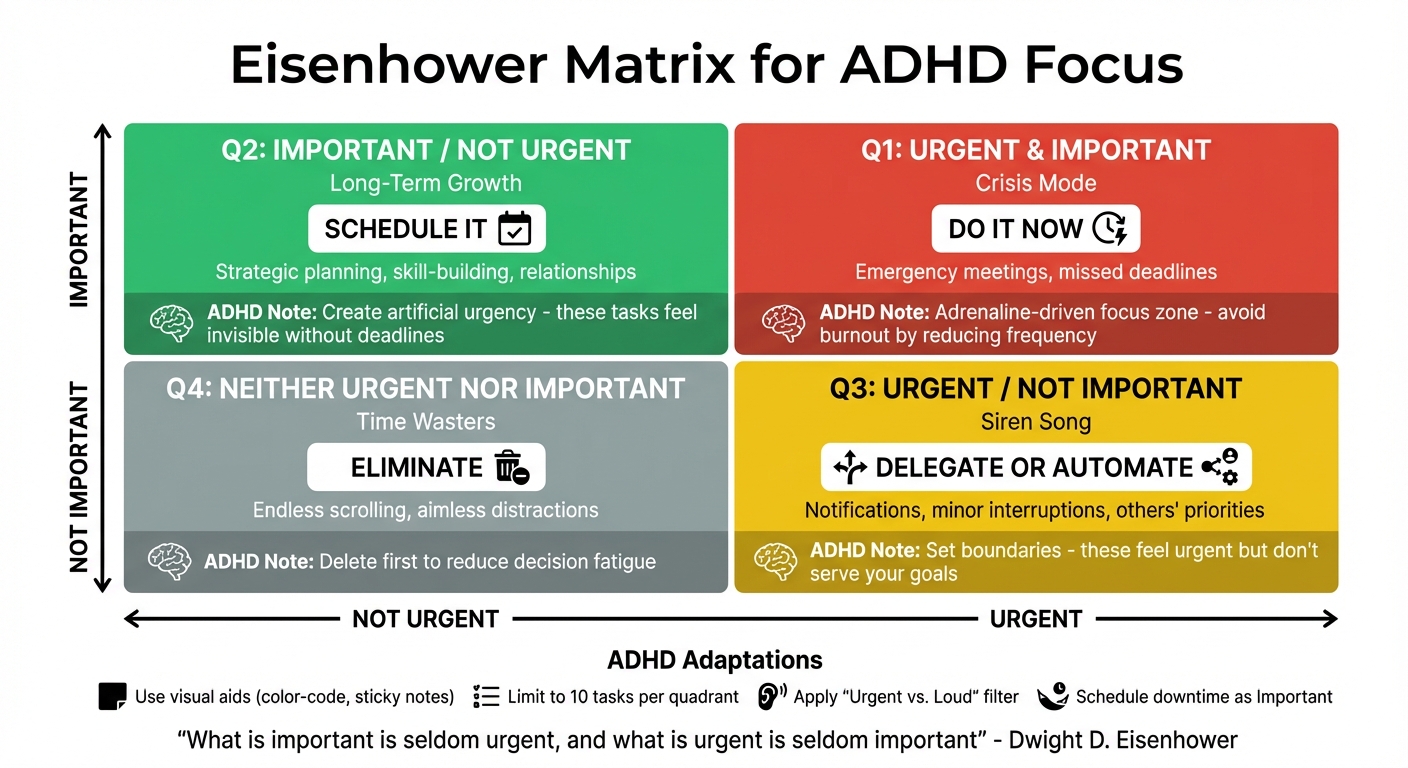
Eisenhower Matrix for ADHD Task Management: 4 Quadrants Explained
The Eisenhower Matrix offers a practical way to simplify decision-making, especially for individuals with ADHD. By categorizing tasks into four distinct quadrants, it creates a visual system to prioritize based on urgency and importance. This external structure reduces reliance on the prefrontal cortex, which often functions differently with ADHD, and makes prioritization feel less overwhelming.
Breaking Down the 4 Quadrants
The matrix revolves around two key questions: Is it urgent? (Does it have a deadline or immediate consequence?) and Is it important? (Does it align with your values or long-term well-being?). Based on your answers, tasks fall into one of four quadrants:
- Quadrant 1 (Urgent & Important): This is “Crisis Mode,” where tasks demand immediate attention - like emergency meetings or missed deadlines. While people with ADHD often excel here due to adrenaline-driven focus, staying in this zone too long can lead to burnout. The goal is to reduce the frequency of these tasks through better planning.
- Quadrant 2 (Important but Not Urgent): This is the zone for long-term growth - think strategic planning, skill-building, or nurturing relationships. However, as Dr. Russell Barkley explains:
"ADHD is, at its heart, a blindness to time. Or, to be more accurate, nearsightedness to the future".
Without immediate pressure, these tasks can feel invisible to the ADHD brain. Scheduling them with specific times and creating artificial urgency can help make them actionable.
- Quadrant 3 (Urgent but Not Important): Known as the "Siren Song", these tasks - like notifications or minor interruptions - demand attention but don’t contribute to meaningful goals. They often reflect others' priorities, not your own. Delegate, automate, or set boundaries to minimize their impact.
- Quadrant 4 (Neither Urgent nor Important): This quadrant includes time-wasters like endless scrolling or aimless distractions. The best approach? Eliminate these tasks or replace them with intentional rest that actually recharges you.
| Quadrant | Action Strategy |
|---|---|
| Q1: Urgent & Important | Do it now; reduce frequency through planning. |
| Q2: Important / Not Urgent | Schedule it; create artificial urgency. |
| Q3: Urgent / Not Important | Delegate or automate; set boundaries. |
| Q4: Neither | Eliminate or replace with purposeful rest. |
These strategies make the matrix adaptable for ADHD-specific needs, which we’ll explore further.
Addressing ADHD-Specific Challenges
Traditional prioritization assumes tasks can be ranked objectively, but ADHD brains often prioritize based on interest, novelty, or emotional pull. This means an engaging but trivial email can easily overshadow a dull yet crucial report. To combat this, apply the "Urgent vs. Loud" filter: differentiate between tasks with real consequences (urgent) and those that are just visually or emotionally overwhelming (loud).
To make the matrix more ADHD-friendly, consider these adjustments:
- Use visual aids: Color-code quadrants or use movable sticky notes to make task organization more tactile and intuitive.
- Limit task lists: Cap each quadrant at 10 tasks to avoid feeling overwhelmed.
- Separate work and personal matrices: This keeps priorities clear in different areas of life.
Another helpful approach is the "Delete First" strategy - start by clearing Quadrant 4 tasks before tackling the rest. This reduces decision fatigue and creates mental clarity. For Quadrant 2 tasks that lack urgency, add an interest level dimension to identify which ones need extra motivation techniques, like body doubling or public accountability. You might also try the Two-Anchor Method: choose just two priority tasks from the matrix each day, treating the rest as optional. This prevents paralysis from an overwhelming to-do list.
Lastly, remember to schedule downtime in your Important category. Rest isn’t wasted time - it’s a critical part of maintaining focus and energy. As Dwight D. Eisenhower himself once said:
"What is important is seldom urgent, and what is urgent is seldom important".
Practical Strategies for Balancing Urgency and Importance
The Eisenhower Matrix offers a solid framework, but making it work for ADHD requires tailoring it to how your brain naturally functions. These strategies aren't about forcing yourself to enjoy dull tasks - they're about building external systems that align with your executive functioning style.
Breaking Down Tasks into Smaller Steps
Big projects can feel paralyzing because the end goal seems so far away. Instead, focus on what ADHD coach Lynne Edris calls the First Domino - a tiny, manageable action that sets everything in motion. For instance, instead of “Write the quarterly report,” start with “Open the document.” This simple step helps bypass the resistance to getting started without relying on sheer willpower.
Another helpful approach is the Next Action method, where vague goals like “Finish research paper” are replaced with specific steps such as “Find five references”. Small, clear wins like these keep the momentum going and make follow-through easier.
For tasks that feel overwhelming, try the Two-Minute Rule: if it takes less than two minutes, do it right away. This keeps small tasks from piling up into an unmanageable list. For larger projects, break them into 15- to 30-minute chunks. This is the Garage Declutter Principle - starting small makes the task feel less daunting.
Another trick is Reverse Prioritization: tackle the easiest task first to reduce emotional pressure and create clarity for bigger challenges. Or use the Time Travel Trick: imagine your future self a week from now and ask which task they'd be most grateful you completed today.
Once you've broken tasks into smaller, actionable steps, external accountability can provide the extra push needed to stay on track.
Using External Accountability and Support
ADHD brains often struggle with internal planning, so external systems act as a kind of backup prefrontal cortex. As Lynne Edris explains:
"When prioritization is hard, it's rarely about willpower. And it's never about how smart or capable you are. It's about missing external systems to support how your brain actually works".
Body doubling is one effective method. Platforms like LifeAt.io and Bodydoubling.com offer virtual work sessions where someone else’s presence helps you stay focused on tasks.
Making public commitments can also create social urgency, which jumpstarts the brain's dopamine and norepinephrine production - chemicals essential for task initiation. For example, telling a coworker, “I’ll send you the draft by Thursday,” externalizes the deadline and adds just enough pressure to get things moving.
Another tool is using implementation intentions, which pre-plan decisions to reduce cognitive overload. For instance, create an "if-then" script: "If I sit down at my desk after lunch, then I will spend 25 minutes on the strategic report". This eliminates the need for on-the-spot decision-making.
For daily planning, the Two-Anchor Method works well: pick two key tasks for the day and treat everything else as optional. Writing just one priority on a sticky note and keeping it visible can prevent “ADHD paralysis” caused by seeing an overwhelming to-do list. Apps like Sunsama help with realistic scheduling, while Todoist can break big projects into smaller tasks.
External systems are powerful, but connecting tasks to your core values can provide deeper motivation.
Aligning Tasks with Core Values
For ADHD brains, tasks without immediate consequences often get ignored in favor of instant gratification. Tying tasks to your core values can act as a compass, helping you prioritize even when urgency isn’t enough. As ADHD coach Paula Engebretson puts it:
"Values are the why, and priorities are the what".
Start by clearing mental clutter with a quick brain dump. Then pick one or two medium-range goals in key areas of your life - work, health, family, or personal growth - to guide your daily priorities. This limits decision fatigue from juggling too many tasks.
Use the Two-Question Filter for each task: “Is this urgent (does it have a real deadline)?” and “Is this important to my well-being or values (not just external pressure)?”. This helps you separate what truly matters from tasks that only feel urgent because they’re annoying or visually overwhelming.
The 80/20 rule (Pareto Principle) is another useful tool: focus on the 20% of tasks that deliver 80% of your desired results. To tackle these, schedule them after an energizing activity to help overcome inertia.
For tasks tied to long-term goals but without hard deadlines, assign a time range and work backward to create a step-by-step plan. Don’t forget to schedule downtime - it’s not wasted time but essential for maintaining the mental energy needed for executive functioning. Use energy-based scheduling: reserve high-energy periods for strategic work and save routine tasks for when your energy dips.
Conclusion: Building Effective Systems for ADHD Task Management
Key Takeaways
The urgency vs. importance framework isn't about forcing yourself to care about boring tasks - it’s about creating systems that work with your brain, not against it. Tools like the Eisenhower Matrix and the INCUP framework are central to this approach. The INCUP framework - Interest, Novelty, Challenge, Urgency, and Passion - explains why some tasks feel impossible to tackle. It’s not laziness; it’s about how your brain processes activation signals.
The Eisenhower Matrix helps separate tasks with actual deadlines from those that just feel pressing (like visually overwhelming clutter or guilt-inducing chores). For projects without clear timelines, the Impact-Effort Matrix can help you match tasks to your energy levels and the rewards they offer.
Urgency isn’t the enemy - it’s a tool. The idea isn’t to stop urgency-driven work but to create urgency for tasks that matter. Whether it’s setting public commitments, working with a partner (body doubling), using micro-deadlines, or planning implementation steps, these strategies help spark the dopamine your brain needs to get started .
With these tools, you can start refining how you approach your daily to-do list.
The Path Forward
Take these ideas and start small. Pick one or two strategies - like the Two-Anchor Method, momentum transfer, or energy-based scheduling - and test them for a week. See what works for you.
As ADHD coach Lynne Edris wisely says:
"The goal isn't to 'get everything done.' It's to do the right things - at the right time - for your brain."
Try different tools and frameworks until you find one that sticks. Some people thrive with physical boards and color-coded systems, while others prefer digital tools with reminders to counter time blindness . The best system is the one you’ll actually use. Build a workflow that supports your unique brain.
For more tips and strategies tailored to professionals with ADHD, check out On/Off Genius.
FAQs
How can I tell what’s truly urgent versus just attention-grabbing?
Urgent tasks often come with pressing deadlines, requiring immediate action, while important tasks are those that contribute to your long-term goals and priorities. Distinguishing between the two can be tricky, but tools like the Eisenhower Matrix can make it easier. Sometimes, tasks may seem urgent but don't actually support your larger objectives - they're just distractions. Before diving in, take a moment to ask yourself: Does this task genuinely move me closer to my goals, or am I just responding to outside pressures? Prioritize what truly matters.
How can I make important tasks feel urgent without stress?
To spark urgency without overwhelming yourself, try setting deadlines that your brain perceives as real rather than random or arbitrary. Break your tasks into smaller, manageable steps that you can clearly see and track. Adding external cues - like timers or reminders - can mimic the adrenaline boost of a looming deadline. These approaches help you stay focused, create a sense of immediacy, and encourage action, all without the stress of last-minute panic.
What’s the fastest way to use the Eisenhower Matrix with ADHD?
The Eisenhower Matrix is a straightforward tool to help you organize tasks based on urgency and importance. Here's how the four quadrants work:
-
Quadrant 1: Urgent & Important
These tasks require immediate attention. Think of deadlines, emergencies, or critical problems that can't wait. -
Quadrant 2: Not Urgent but Important
These are tasks that matter in the long run but don’t need to be done right away. Schedule time for them - this is where planning, goal-setting, and personal growth live. -
Quadrant 3: Urgent but Not Important
Tasks here feel pressing but don’t actually need your personal attention. Delegate them whenever possible. -
Quadrant 4: Not Urgent & Not Important
These are distractions. Minimize, postpone, or eliminate them altogether to focus on what truly matters.
This method keeps you focused and helps prevent the feeling of being overwhelmed.