How to Build Focus-Friendly Work Routines with ADHD
Routines that match ADHD wiring—map energy, timebox tasks, reduce distractions, and use anchors, breaks, and rewards to sustain focus.
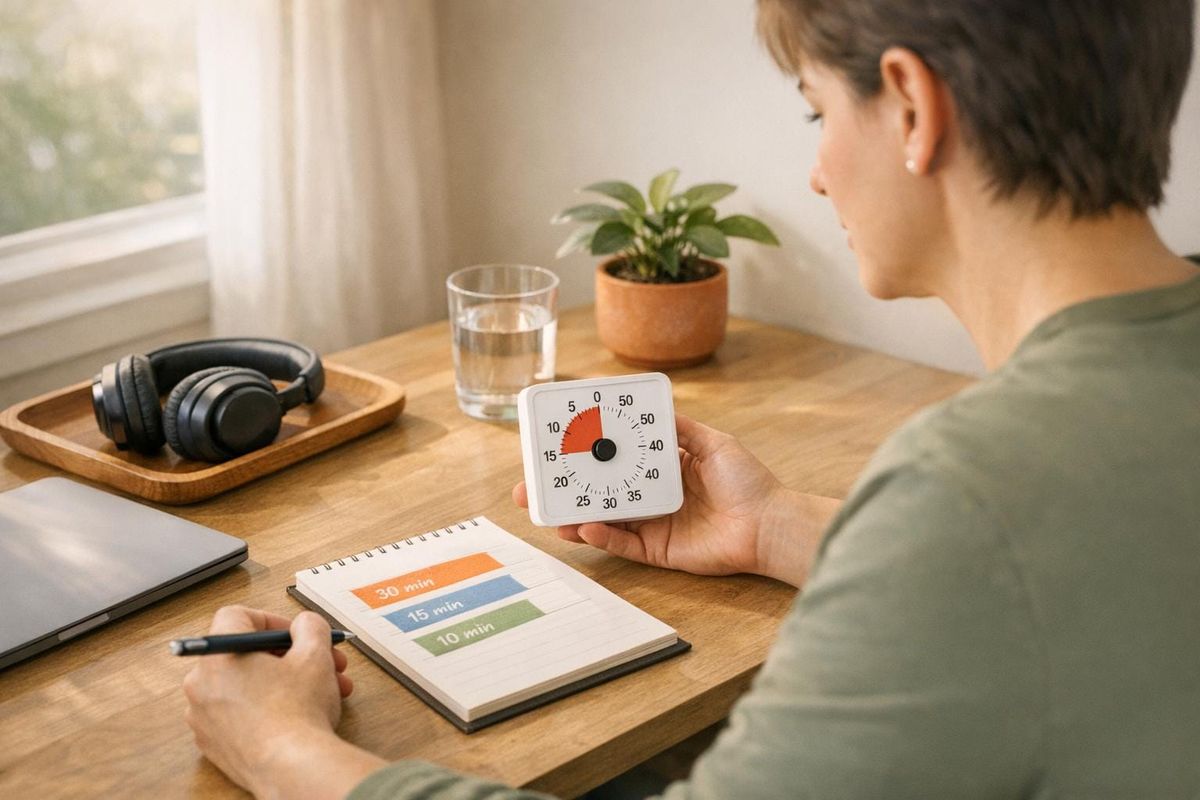
If you have ADHD, staying focused at work can feel overwhelming. But with the right strategies, you can set up routines that match how your brain works, improve productivity, and reduce stress. Here’s a quick summary of key tips:
- Understand Your Focus Patterns: ADHD-driven attention is influenced by interest, novelty, or urgency. Track what triggers hyperfocus or distractions to identify patterns.
- Map Your Energy Levels: Your focus changes throughout the day. Track your energy every 2 hours for a week, then align tasks with high, medium, and low-energy periods.
- Set Daily Anchors: Use flexible checkpoints (e.g., morning, midday, evening) to add structure without rigidity. Focus on 3 top priorities each day.
- Break Down Tasks: Simplify large projects into small, actionable steps. Use tools like checklists or visual Kanban boards for clarity.
- Use Time Boxing: Assign fixed time slots for tasks and use visual timers to stay on track. Add buffer time to account for time blindness.
- Optimize Your Workspace: Reduce visual and sound distractions, create activity-specific zones, and keep essentials within reach.
- Leverage Accountability: Body doubling (working alongside someone) and external deadlines can help you stay engaged.
- Take Breaks and Use Rewards: Plan short, active breaks and use immediate rewards to maintain motivation.
- Track and Improve: Log your routines, reflect weekly, and adjust based on what works best for you.
These strategies are designed to work with your ADHD brain, not against it. Start small, focus on progress, and build routines that make your workday more manageable and productive.
Routines for ADHD that ACTUALLY WORK to Focus and Organize
Understanding Your ADHD Focus Patterns
To create routines that work, it’s crucial to first understand how your focus operates. With ADHD, attention is driven by interest, novelty, challenge, or urgency - not necessarily by importance. This is why you might dive deeply into a fascinating topic while struggling to tackle a short but essential email.
Dr. Russell Barkley sheds light on this:
"ADHD is fundamentally a disorder of time - not just attention".
The prefrontal cortex - your brain’s control center - has difficulty regulating focus. In fact, blood flow to this area can decrease when you try to concentrate. Recognizing these neurological differences can help you stop fighting against your brain and instead work with it.
The first step is identifying your personal focus patterns. For instance, 68% of adults with ADHD experience frequent hyperfocus episodes. These episodes aren’t random; they’re triggered by specific conditions you can learn to identify and recreate. Similarly, distractions and task paralysis often occur when tasks feel overwhelming, unclear, or lack immediate rewards.
Finding Your Distraction and Hyperfocus Triggers
Start by observing what draws you in and what pushes you away. Common hyperfocus triggers include work-related tasks (35%), creative activities (25%), and gaming (20%). Your triggers might differ - maybe it’s solving a tough problem, creating visual designs, or racing against a tight deadline.
Learn to recognize the signs of hyperfocus. Does background noise fade away? Do minutes feel like seconds? Are you skipping meals or ignoring bathroom breaks? These physical cues signal that you’ve entered a hyperfocus state. As AFFiNE explains:
"Hyperfocus isn't a random lightning strike - it's a predictable response to specific conditions that you can learn to create intentionally".
On the other hand, take note of what triggers avoidance. Tasks that lead to procrastination often share traits like being vague, overwhelming, or lacking immediate rewards. Perfectionism can also play a role. Keep a two-week log tracking the date, time, trigger, and your productivity. Patterns will likely emerge within days.
Also, pinpoint your "activation energy" barriers - tasks that feel too heavy to even start. These often require external strategies like working alongside someone (body doubling) or breaking tasks into smaller, manageable chunks to make them less daunting.
Once you’ve identified your triggers, the next step is mapping your daily energy levels to align tasks with your natural rhythm.
Mapping Your Daily Energy Levels
Your ADHD brain operates on energy cycles rather than a fixed clock. Forcing deep work during low-energy periods is counterproductive. Instead, track your energy levels every two hours for 3–7 days, using a scale from 1 to 5. Focus on how alert and focused you feel - not how much you think you should be working. As business strategist Megan Flatt puts it:
"The best time to work is when it is the best time for YOU".
Once you’ve mapped your energy patterns, match tasks to your energy levels. High-energy periods are ideal for creative work, problem-solving, and strategic planning. Medium-energy times suit tasks like meetings and emails, while low-energy moments are best for routine or administrative work.
| Energy Level | Task Type | Examples |
|---|---|---|
| High (Peak) | Deep Work | Writing, designing, coding, strategic planning |
| Medium | Supportive Tasks | Email, meetings, task batching, scheduling |
| Low (Dip) | Reset/Admin | Filing, routine data entry, stretching, breaks |
Before starting a task, check your energy level. This quick self-assessment can save you the frustration of trying to focus when your brain simply isn’t ready. And because ADHD often involves time blindness, it’s wise to add 25% extra time to your task estimates. Your internal clock may not be reliable, so building in buffer time can prevent unnecessary stress.
Setting Up Daily Anchors for Structure
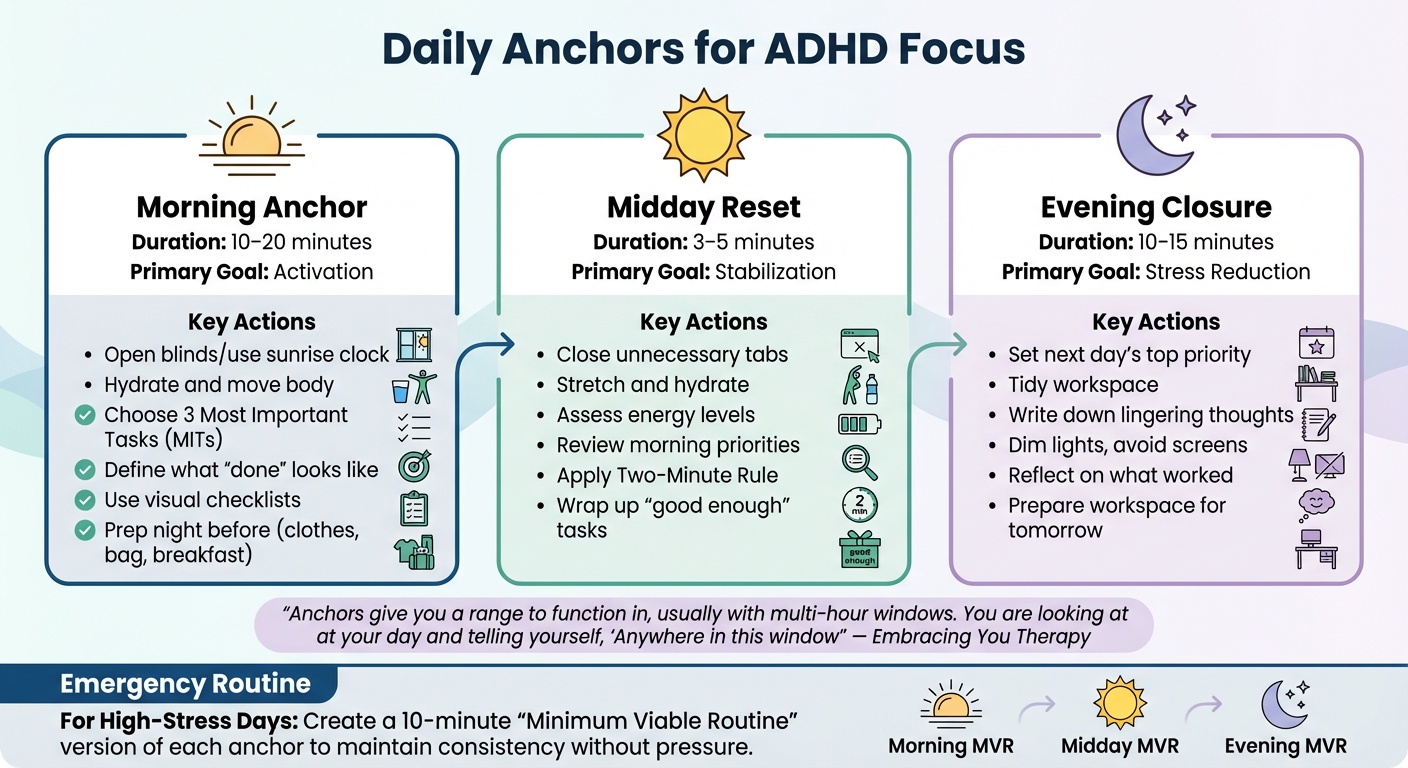
Daily ADHD Work Routine Framework: Morning, Midday, and Evening Anchors
For individuals with ADHD, daily anchors can create a sense of predictability without feeling overly rigid. Think of these anchors as checkpoints that help you stay grounded, offering structure without dictating every single moment of your day.
The idea here is flexibility. Instead of locking in a task for an exact time, assign it to a general time frame - like a morning anchor between 8:00 AM and 10:00 AM. As Embracing You Therapy puts it:
"Anchors give you a range to function in, usually with multi‐hour windows. You are looking at your day and telling yourself, 'Anywhere in this window,' as opposed to, 'At 8:52 a.m. I will…'" - Embracing You Therapy
Start simple by establishing three key anchors: morning, midday, and evening. These serve as transition rituals - brief moments that signal your brain to shift gears, whether it's starting your day, resetting during lunch, or winding down at night. Plus, they externalize structure, so you're not relying entirely on willpower.
Keep these anchors straightforward to avoid mental overload. Tools like visual checklists, sticky notes, or a dry-erase board can make them more tangible and easier to follow than relying on memory alone.
| Anchor Type | Duration | Primary Goal | Key Action |
|---|---|---|---|
| Morning Anchor | 10–20 min | Activation | Hydrate, move your body, pick top 3 tasks |
| Midday Reset | 3–5 min | Stabilization | Close tabs, stretch, hydrate |
| Evening Closure | 10–15 min | Stress Reduction | Set next day’s priority, tidy up, power down |
Morning Planning: Choosing Your Daily Priorities
Your morning anchor isn’t about cramming in as much as possible - it’s about prioritizing. Focus on identifying three Most Important Tasks (MITs) for the day. This approach minimizes decision fatigue and keeps you from feeling overwhelmed by a never-ending to-do list.
Start your day by opening the blinds or using a sunrise clock to help regulate your circadian rhythm. For those with ADHD, who often experience shifts in their sleep-wake cycle, early light exposure can help jumpstart the day. To make mornings more enjoyable, try "stepped dopamine" strategies, like playing your favorite music or podcast.
Visual checklists can also be a game-changer for managing routine tasks, especially if working memory is a challenge. As Dr. Marcus Webb, a clinical psychologist and ADHD coach, advises:
"ADHD morning routines should require the minimum number of decisions." - Dr. Marcus Webb
Once you’ve tackled the basics, spend 10–15 minutes defining your top three priorities. Be clear about what "done" looks like for each task to avoid getting stuck in endless tweaking. If a task feels daunting or vague, break it down into smaller, actionable steps before adding it to your list.
You can also prep the night before: lay out your clothes, pack your bag, and prep breakfast. Setting a departure alarm for when you need to leave can add a helpful sense of urgency.
Midday Check-Ins: Reviewing and Adjusting
A quick 3–5 minute midday reset can help you regain focus for the afternoon. Skip the self-criticism over what hasn’t been done and instead use this moment to close unnecessary tabs, stretch, hydrate, and assess your energy levels.
Revisit your morning priorities during this check-in to stay aligned. Wrap up tasks that are "good enough" rather than chasing perfection, and move unfinished items to tomorrow’s list. If you’re feeling stuck, try the Two-Minute Rule: if a task takes less than two minutes, handle it immediately. This clears mental clutter and builds momentum.
Evening Reviews: Reflecting and Preparing
Your evening anchor helps calm the mind and sets you up for a smoother tomorrow. Spend 10–15 minutes outlining the next day’s top priority, tidying your workspace, and jotting down lingering thoughts in an external system.
As one coaching resource explains:
"The brain is for processing, not storage." - Coaching Executive Function
Preparing your workspace for the next day can make a big difference. If a task didn’t go as planned, take a few minutes to reflect on what worked, what didn’t, and how to move forward without losing progress.
Start winding down about an hour before bed. Dim the lights and avoid screens to encourage melatonin production. If tidying up feels overwhelming, try "temptation bundling" - pairing it with a favorite podcast or playlist to make it more enjoyable.
For high-stress days, create a 10-minute "emergency" version of each anchor. This Minimum Viable Routine helps maintain consistency without adding pressure. As Brieanna Scolaro, LCSW, explains:
"A routine acts like an external scaffolding for these shaky internal systems – 'hacking' executive function by providing structure and predictability." - Brieanna Scolaro, LCSW
With these daily anchors in place, you’ll have a reliable framework to support your day. Next, you can refine task management strategies to further reduce stress and stay on track.
Breaking Down Tasks to Reduce Overwhelm
Big projects can feel paralyzing, especially when the steps to get started aren’t clear. For people with ADHD, initiating tasks can be particularly challenging, often leading to a "freeze" response. The key isn’t to push harder - it’s to break things into smaller, actionable steps.
A helpful approach is the "Next Physical Action" Rule. This means identifying the tiniest, most concrete step you can take. For example, instead of writing "Organize files" on your to-do list, jot down something like "Open the Documents folder". This small, specific action can help you overcome that initial hurdle of overwhelm.
It’s also important to define what "done" means before diving in. ADHD brains often get stuck in cycles of perfectionism, endlessly tweaking details. Decide upfront what a completed task looks like - whether it’s a polished draft or simply a rough outline. Having a clear endpoint prevents you from getting bogged down in unnecessary details.
Another useful strategy is brain dumping. This involves writing down every thought, task, or worry related to your project without overthinking it. By offloading this mental clutter, you free up your brain to focus on execution. As one executive function resource puts it:
"The brain is for processing, not storage".
Using Visual Tools to Simplify Tasks
Visual tools can help make abstract projects feel more tangible. A simple physical Kanban board - with columns labeled "To Do", "Doing", and "Done" - is a great example. Write each task on a sticky note and move it across the board as you complete it. This hands-on process provides a small dopamine hit, which can help maintain momentum.
For those who prefer digital solutions, floating task windows can keep you focused. These display only your current task, minimizing distractions from a long to-do list. You can also try color-coding tasks based on their mental energy requirements:
- Red for high-energy, strategic work
- Yellow for medium-effort, routine tasks
- Green for low-energy, administrative work
Scheduling Red tasks during your peak energy hours can make a big difference.
For more complex projects, break them down into micro-steps. The goal is to make each step so small that it feels almost effortless. For example, if you’re creating a presentation, your steps might include: "Create blank slide deck", "Add title slide", and "Write three main points." Completing each tiny step gives you quick wins, making progress feel achievable.
Once your tasks are visually organized, you can take it a step further by using time boxing.
Time Boxing to Maintain Focus
Time boxing builds on visual organization by turning focus into a measurable activity. This technique involves assigning a fixed time slot to each task, creating a sense of urgency that can help overcome ADHD-related challenges. Research highlights that traditional time management methods often don’t work for people with ADHD, as they don’t align with neurodivergent brain chemistry. Time boxing, however, makes time feel more tangible and actionable.
Here’s how it works: instead of saying, "I’ll work on this report", you commit to something like, "I’ll spend 45 minutes drafting the introduction." This defined time frame helps you focus and get started. It also prevents hyperfocus from derailing your schedule, ensuring you don’t spend hours perfecting one detail while neglecting the rest of your project.
Using a visual timer - like the Time Timer, which shows a disappearing colored disk as time runs out - can make the passage of time easier to track. Productivity expert Chris from Productive with Chris offers this perspective:
"The timer is your employee, not your boss".
Another tip is to apply the "Multiply by 3" Rule when estimating how long tasks will take. Many people with ADHD underestimate time due to time blindness, so it’s wise to triple your initial estimate. For instance, if you think a task will take 20 minutes, block out an hour. Don’t forget to include 10–15 minute buffer breaks between tasks to allow your brain to reset.
Pairing time boxing with body doubling - working alongside someone, even virtually - can also boost accountability. This social presence acts as an anchor, helping you stay focused during your time blocks. Together, these techniques create a practical framework for tackling tasks while staying organized and motivated.
Setting Up Your Workspace for Better Focus
Setting up your workspace thoughtfully can make a huge difference in creating routines that align with your ADHD needs.
Your environment has a big impact on your ability to focus, and this is especially true for ADHD brains. Studies show office workers get interrupted every 11 minutes on average, and it takes 23 minutes and 15 seconds to refocus afterward. This isn’t about willpower - it’s about how your environment is set up.
Even small tweaks to your workspace can help reduce mental fatigue. Johannes, the creator of Super Productivity, puts it perfectly:
"Focus is not merely a matter of willpower – it's an environmental and neurological design problem".
By understanding how your surroundings affect your mind, you can create a workspace that actually helps you focus rather than pulling you off track.
Reducing Distractions in Your Work Area
Visual clutter is like background noise for your brain - it draws attention even when you’re not aware of it. Research shows that items left in plain sight can increase mental load by 24% compared to when they’re tucked away. A simple fix? Follow the "Arms-Reach Rule." Keep only what you use daily - like your keyboard, mouse, notebook, and water bottle - within reach. Everything else? Store it out of sight in drawers or cabinets.
Your phone is another major distraction. Keeping it in another room during deep work sessions can boost your working memory capacity by 10–12%. This isn’t about self-control - it’s about removing a device that drains your mental energy just by being nearby.
Sound also plays a big role in focus. Noise-canceling headphones (rated at -25 to -30 dB) can block out office chatter. If silence feels too empty, try brown noise (like the rumble of thunder) or pink noise (think steady rain). A 2022 study even found that listening to a 15 Hz beta beat improved focus for students with ADHD. Experiment with different sounds to find what helps you lock in.
Temperature matters, too. Keep your workspace between 71–77°F (22–25°C). Temperatures below 68°F can increase errors by 44% and cut productivity in half. Warwick Batts, Client Services Manager at OP Group, explains:
"Temperature can be a major distraction. When the environment is too hot or too cold, it becomes another thing my brain needs to process, taking away focus from my actual work".
Lighting also affects your focus. Use bright, cool light (around 6500K) in the morning to stay alert, then switch to warmer, dimmer light in the evening to align with your body’s natural rhythm. Adding a desk plant can also help - it’s been shown to boost productivity by 15% and lower stress by 37%.
Once you’ve reduced distractions, organizing your workspace into distinct zones can take your focus to the next level.
Creating Activity-Specific Zones
Staying in one spot all day can lead to sensory boredom, which makes it harder for ADHD brains to stay engaged. Switching between different zones during the day can provide the novelty your brain craves to stay focused. Even in a small space, you can create specific areas for different tasks.
Start with a Command Center - a desk with a supportive chair and a large screen for tasks that need intense focus, like writing reports or analyzing data. Next, set up a Creative Corner - a cozy chair by a window, your couch, or any spot that feels more relaxed. Use this area for brainstorming, reading, or light creative work. Finally, create an Active Zone - this could be a standing desk, your kitchen counter, or even a spot with a balance board. It’s perfect for moving around while working and combating that afternoon energy dip.
To make switching zones easier, keep duplicates of essentials like chargers, pens, and notebooks in each area. You can also use sensory cues to signal your brain: a specific lamp for deep work, a certain scent for creative tasks, or a playlist for admin work.
If you’re short on space, try digital zoning. Create virtual desktops labeled "Deep Work", "Communication", and "Research" to separate tasks and reduce mental clutter. Barnaby Lashbrooke, Founder and CEO of Time etc, explains why this works:
"The ADHD brain thrives on variety. It's wired to seek novelty and fresh stimulation, so sitting in the same chair, at the same desk, staring at the same screen day after day can quickly feel more like a cage".
These zones not only help you focus on specific tasks but also make it easier to establish structured routines that support ADHD management.
Managing Time and Accountability
Once you've broken down tasks and organized them visually, the next step is managing time effectively. For individuals with ADHD, time management isn't about sheer willpower - it's about understanding and working with the way your brain processes time. Russell Barkley, a prominent ADHD researcher, describes time blindness as "the most devastating deficit in adult life that ADHD produces… a disruption in the fabric of time". Essentially, the ADHD brain simplifies time into "now" versus "later", making it tricky to gauge how long things take. But here's the upside: external tools and social accountability can bridge that gap.
Using Timers and Alarms Effectively
Standard digital timers might not cut it for ADHD brains - they're too abstract. Instead, visual timers, like the Time Timer or hourglasses, make time feel tangible by showing it physically disappearing. For tasks, don't rely on a single alarm at the end. Instead, set checkpoint alarms every 25 minutes. These periodic reminders help you pause and ask yourself, "Am I still on track?".
When scheduling, try working backward. If you have a 3:00 PM meeting, subtract the time you'll need for travel, preparation, and a 10–15-minute buffer. This approach helps you plan more realistically. Another helpful tool? Large analog clocks in your workspace. They provide a constant, visible reminder of time passing.
These external cues set the stage for the next layer of support: social accountability.
Working with Others: Check-Ins and Body Doubling
External tools are great, but pairing them with social interactions can make a huge difference. Often, the toughest part of any task is just getting started. This is where body doubling comes in - it uses the presence of another person to keep you accountable. Michael Manos, PhD, a behavioral health expert, explains:
"Essentially it's external executive functioning, like having an administrative assistant follow you around all day".
You can body double with a friend or coworker, or use platforms like Focusmate (which pairs you with someone for 50-minute sessions) or Flown (a virtual coworking space). Start each session by saying your goals out loud - just one or two specific tasks. Then, mute your mic while you work, saving any conversation for breaks. Short sessions of 20–30 minutes can help you overcome inertia, while longer blocks of 45–60 minutes might help you hit a flow state. In a survey of 220 neurodivergent individuals, many reported that body doubling boosted their productivity and was an essential tool for staying on track.
If finding a body double isn't an option, you can create urgency in other ways. For example, commit to sending a draft to a colleague by a specific time or schedule a mid-project check-in with your manager. These external deadlines turn "I'll do it later" into "I need to act now", making it easier for your brain to engage with the task.
Adding Breaks and Rewards to Your Routine
Strategic breaks and rewards are essential for balancing focus and maintaining momentum, especially for those with ADHD. Breaks aren't just helpful - they're a neurological must to avoid burnout. While some people can work for extended periods, frequent "pit stops" are what your brain needs to keep performing at its best. When breaks and rewards are planned intentionally, they enhance productivity rather than disrupt it. Let’s dive into how short breaks can reset your focus and how rewards can reinforce positive habits.
Taking Short Breaks to Reset Focus
Short, frequent breaks are more effective than longer, irregular ones. The Pomodoro Technique - 25 minutes of focused work followed by a 5-minute break - is a good starting point, but you might need to tweak it. For particularly heavy or boring tasks, shorter work sessions of 10–15 minutes may work better. On the other hand, if you're in the zone, you can extend your focus to 45–50 minutes, but leave 2 minutes at the end to wrap up your thoughts before breaking.
Active breaks are key. Activities like stretching, jumping jacks, drinking water, or tidying up can energize your brain by boosting blood flow and dopamine. Passive breaks, like scrolling through social media, can backfire and derail your focus. As the UC Davis MIND Institute advises:
"A real break, not getting on social media, where you might get stuck for an hour, but maybe stretch or take a walk".
Visual timers - like sand timers or apps with countdowns - can help make time feel more tangible and combat time blindness, keeping your breaks on track.
Using Rewards to Build Positive Habits
Once you've established a break routine, rewards can take your productivity to the next level. For ADHD brains, which often have lower dopamine levels, immediate rewards are essential for staying motivated. A "dopamine menu" can help you organize rewards based on the time and energy they require:
- Quick Hits (2–5 minutes): Listen to a favorite song, grab a crunchy snack, or do a quick set of jumping jacks.
- Medium Rewards (15–30 minutes): Call a friend or take a short walk outside.
- Big Rewards (1+ hour): Play a video game or cook a special meal.
Pairing tasks with rewards can make even the toughest jobs more manageable. For example, try "temptation bundling" - only let yourself enjoy a favorite coffee or playlist while tackling a challenging task. To keep rewards from derailing your schedule, set a timer for your reward period. Also, keep a notepad handy for jotting down distracting thoughts, so you can revisit them during your next break. By integrating rewards into your routine, you'll stay productive without letting distractions take over.
Tracking and Improving Your Routines
Once you've established structured work routines, tracking your progress becomes key to making meaningful improvements. For individuals with ADHD, who often face challenges like time blindness and working memory gaps, tracking acts as an external support system to bridge these difficulties. Even a straightforward log that captures Pomodoro sessions, task details, and reflections can transform scattered efforts into clear, measurable progress.
Keeping Simple Logs to Track What Works
Start small. Use a basic spreadsheet or document with columns for the date, task, the number of Pomodoros completed, and a brief note on "What Worked?" After each session, jot down what helped you stay focused and flag any distractions - like Slack notifications or noisy environments - that disrupted your flow. Over time, patterns will emerge, giving you insights into what drives your productivity and what holds it back.
Instead of tracking streaks, focus on completion rates. Adults with ADHD are 4–5 times more likely to abandon productivity systems within a month because missing a single day can feel like a complete failure. A more flexible approach, like measuring percentages - "I completed this 5 out of 7 days" - is easier to sustain. Studies show that using this kind of adaptable tracking makes ADHD adults three times more likely to stick with habits for six months or longer.
These logs will also guide your weekly reviews, helping you refine your routines for better results.
Reviewing and Adjusting Weekly
Set aside 30 minutes each week for a structured review. Even a quick check-in is better than skipping it entirely. ADHD coach Marla Cummins emphasizes this point:
"A partial review is better than no review".
During this time, address lingering tasks (those "open loops"), scan your calendar for missed commitments, and reflect on what worked well and what didn’t. Use these insights to plan your top three priorities for the upcoming week.
Research backs the power of reflection: Employees who spent just 15 minutes at the end of their day reflecting on their work performed 23% better on assessments compared to those who didn’t. Ray Dalio, founder of Bridgewater Associates, calls reflection:
"the most valuable habit I've acquired".
If 30 minutes feels daunting, scale it down to 10–15 minutes. The key is consistency. Commit to this practice - even imperfectly - for at least eight weeks before deciding if it’s working for you. Over time, your routines will naturally adapt to better support your focus and productivity.
Conclusion
Creating work routines that support focus when living with ADHD isn’t about imposing rigid structures. It’s about building external systems that align with how your brain naturally works, while still allowing room for flexibility. As Brieanna Scolaro, LCSW, Co-Director of Aspire Psychotherapy, explains:
"A routine acts like an external scaffolding for these shaky internal systems – 'hacking' executive function by providing structure and predictability that the ADHD brain craves."
Start small - maybe with a morning planning session, a distraction pad, or a tracking log. Progress matters more than perfection. As Kiara Manosalvas, PhD, says:
"Routines aren't about rigidity. They're about freeing up the mental energy you spend deciding what to do each day so you can focus more on the things that truly matter to you."
It’s important to remember: your brain isn’t broken; it’s just wired differently. The frustration you feel from interruptions stems from a neurological response to disrupted dopamine loops. Understanding this can help you approach routine-building with kindness toward yourself instead of self-judgment.
Balance is crucial. Too much structure can feel suffocating, while too little can lead to decision fatigue. By using strategies like daily anchors, energy-state planning, and regular reviews, you can create routines that respect your natural rhythms while enhancing productivity. Finding that balance between structure and flexibility is key to crafting a routine that works for your unique brain. Over time, small, consistent changes add up, paving the way for meaningful improvements in focus and productivity as part of your ADHD management journey.
FAQs
How do I figure out my best focus hours?
To figure out your most productive hours, spend a week tracking your energy and attention levels throughout the day. Pay attention to when you feel sharp, motivated, and focused, as well as when you're more prone to distractions or feeling drained.
Once you've pinpointed those peak focus times, use them to your advantage. Plan your most challenging or creative tasks during those hours to match your natural energy flow and get more done.
What’s the easiest way to start a task I’m avoiding?
Getting started on a task you’ve been avoiding can feel like climbing a mountain, especially with ADHD. But there are a few tricks that can make it easier to overcome that initial resistance.
One approach is to try short bursts of focus, like the 10-Minute Momentum Method. The idea here is simple: commit to working on the task for just 10 minutes. Often, once you get going, you'll find it easier to keep the momentum.
Another strategy is to break the task into smaller, more manageable steps. Instead of focusing on the big picture, tackle one tiny piece at a time. This reduces that overwhelming feeling and makes the task seem less daunting.
You can also make the task more appealing by connecting it to something you’re interested in. If you can find a way to link the task to your hobbies or passions, it might feel less like a chore and more like an opportunity.
These small adjustments can help you take that crucial first step and get the ball rolling.
How can I use hyperfocus without losing track of time?
Managing hyperfocus can be easier with the help of external tools like timers, alarms, and planned breaks. For example, setting a timer for 20–30 minutes allows you to stay focused while ensuring you pause regularly. These simple strategies can help you stay on track and avoid burnout or losing hours to a single task. Structured work sessions, combined with clear signals to start and stop, create a balance between productive focus and preventing exhaustion.