Daily Priority Checklist for ADHD Professionals
Daily checklist for ADHD pros: master list, 3–5 priorities, time-blocking, remove distractions, and a quick evening review.
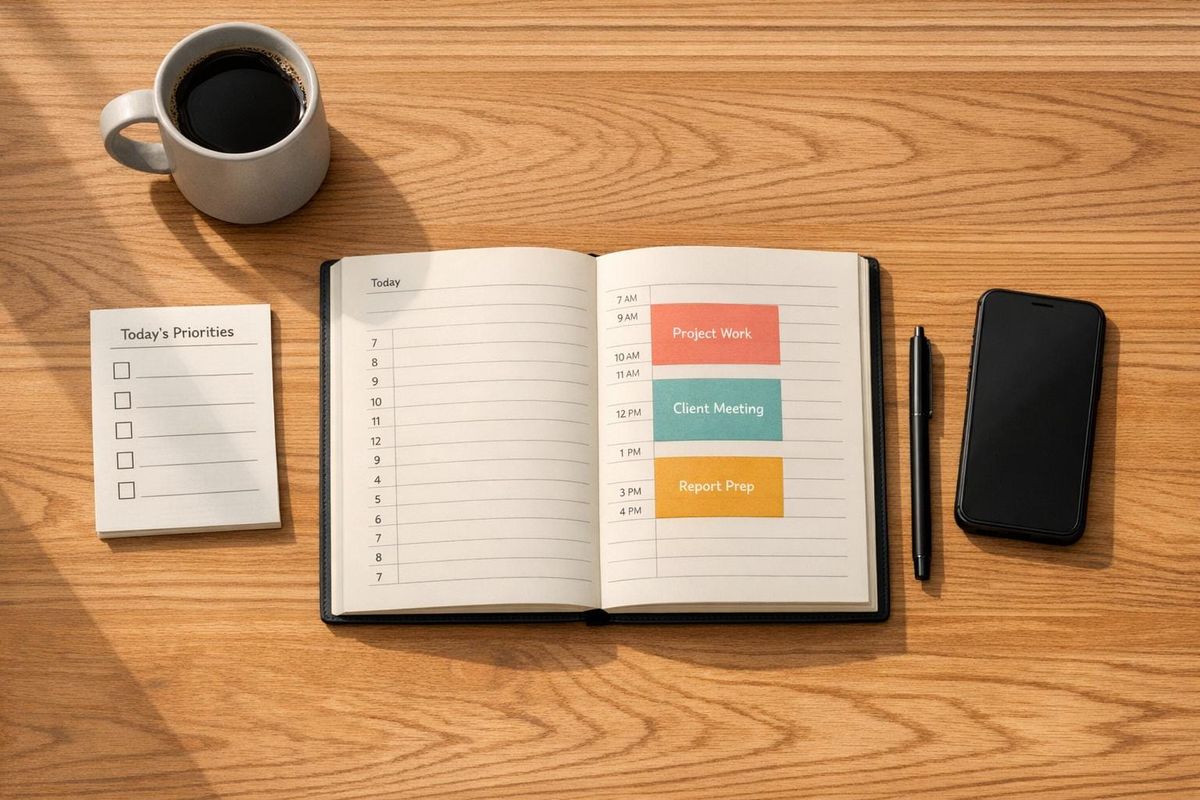
Ever feel overwhelmed by a never-ending to-do list? For adults with ADHD, managing tasks can be a daily challenge. Here's the solution: a structured priority checklist tailored to help you focus, reduce anxiety, and get things done.
Key Takeaways:
- Master List: Write down everything on your mind to clear mental clutter. Organize tasks into categories like work, health, and personal goals.
- Daily Priority List: Focus on 3–5 tasks a day using the 1-3-5 Rule: one big task, three medium tasks, and five small ones.
- Time Blocking: Schedule tasks during peak energy times, and use the 50% Rule to account for delays.
- Distraction-Free Workspace: Silence notifications, clear your desk, and use timers to stay on track.
- Evening Review: End your day by reviewing progress, rescheduling unfinished tasks, and preparing tomorrow’s priorities.
This system helps ADHD professionals stay productive and focused without feeling overwhelmed. Start small - try one step for a few days and build from there.
How to Prioritize When You Have ADHD: The Matrix
sbb-itb-f879324
Preparation: Set Up Your Priority System
Before diving into daily priorities, you need a reliable system to organize everything on your plate. Think of this as laying the groundwork - without it, your daily tasks can quickly spiral into chaos. A solid setup helps you manage and select what truly matters each day.
Create a Master List for All Tasks
Your brain isn’t designed to store every task or idea you come up with. In fact, studies show that adults with ADHD are three times more productive when using structured systems. That’s where a master list comes in. Jessica Walsh, PMHNP, refers to this as your "Master Backlog", a kind of external brain that frees up your mental space for more immediate priorities.
Start by spending 20–30 minutes jotting down every task, idea, or goal swirling in your mind. Dr. Stefan Ivantu, a Private Consultant Psychiatrist, describes this as an "Idea Treasury":
"By capturing these thoughts, you validate the idea without having to act on it immediately".
To keep things organized, divide your list into categories based on areas of your life. For example:
- Professional tasks: Work-related projects or deadlines.
- Life admin: Things like paying bills or scheduling repairs.
- Health: Doctor appointments, workout plans, or meal prep.
- Personal projects: Hobbies, learning goals, or creative pursuits.
- Someday/Maybe: Dreams or ideas you’d like to revisit later.
For added clarity, include columns for estimated time and deadlines. And don’t forget to be specific. Instead of writing "Do taxes", break it into actionable steps like "Log into tax portal" or "Download W-2." Breaking tasks into smaller pieces makes starting them feel less overwhelming.
Set Up a Routine List for Recurring Tasks
Routines help you avoid decision fatigue by automating the things you do regularly. Create a separate checklist for recurring tasks - morning rituals, weekly errands, or bedtime routines. Link these tasks in a logical sequence so one action naturally leads to the next.
Keep this list visible. Whether it’s taped to your bathroom mirror, stuck on the fridge, or placed on your desk, a visual cue works far better than relying on memory. For example, a morning routine might look like this: wake up → make bed → shower → brew coffee. Over time, these actions become automatic, saving you mental energy for bigger priorities.
Once your routines are set, you can focus on aligning tasks with your daily schedule.
Review Your Calendar for Time Commitments
Here’s a striking fact: People who set specific dates, times, and locations for tasks are 90% more likely to follow through, compared to just 35% for those with vague plans. Your calendar is a powerful tool for seeing how much time you actually have.
Review your schedule the night before to spot open time blocks and identify task opportunities. Use the 50% Rule: if you think a task will take one hour, allocate two. This buffer accounts for transitions and unexpected delays.
To work smarter, match your tasks to your energy levels. For example, tackle high-focus work during your peak energy periods (often mid-morning for many people) and save simpler tasks like emails for your afternoon slump. Your calendar isn’t just about managing your time - it’s about aligning your tasks with your mental energy when you’re at your best.
With these systems in place, you’ll be ready to select and tackle your top priorities each day.
Morning Priority Selection: Pick Your 3–5 Daily Tasks
With your system set up, it’s time to choose 3–5 tasks for the day. Keeping the list short helps you stay productive without feeling overwhelmed.
Carry Over Unfinished Tasks from Yesterday
Start by reviewing yesterday’s list. Only bring forward tasks that still matter and are achievable. If a task feels too big or keeps getting postponed, break it into smaller steps.
For instance, instead of rolling over “Finish quarterly report,” try splitting it into “Draft introduction” or “Compile Q1 sales data.” As you update your list, reassess how much time each task will take and decide if it still fits with your current priorities.
Once you’ve sorted the carry-over items, organize the rest of your tasks using a structured approach.
Use the 1-3-5 Rule
The 1-3-5 Rule is a simple way to structure your day: one big task, three medium tasks, and five small tasks, based on how much time and effort each requires. For individuals with ADHD, a slight tweak can be helpful. Focus on one must-do task that will have the greatest impact, and then add up to five main intentions - tasks that are important but can be postponed if needed.
"The power lies in building trust with yourself. Imagine the confidence you'd develop if most days, that one thing you committed to actually got done." – Learn to Thrive with ADHD
Getting that one must-do task done is a powerful way to build momentum and confidence.
Rank Tasks by Urgency and Goals
Once you’ve chosen your tasks, prioritize them in line with deadlines and overall objectives. A helpful tool here is the Eisenhower Matrix, which categorizes tasks as "Urgent and Important" or "Important but Not Urgent". Focus on the first category for immediate deadlines and carve out time for the second category - these are often tied to long-term goals but can easily slip through the cracks. Plan to tackle these during your most productive hours.
To ensure your priorities stay visible, include at least one task that moves you closer to a medium-term goal. Write your top three tasks on a sticky note and place it somewhere you’ll see often - like your desk, computer screen, or even your bathroom mirror. This simple trick helps counter the tendency to forget what’s important once it’s out of sight.
The Daily Priority Checklist: 5 Steps to Follow
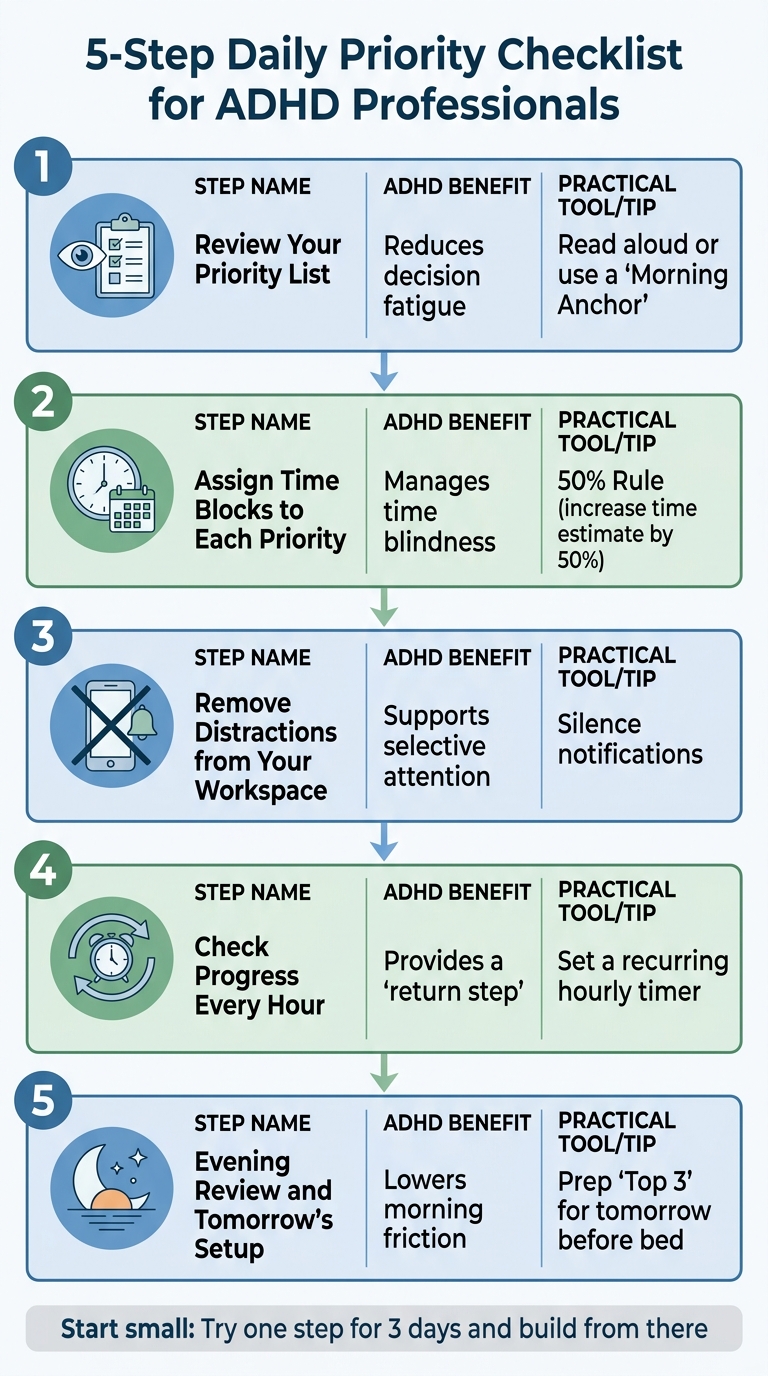
5-Step Daily Priority Checklist for ADHD Professionals
This five-step checklist is tailored for ADHD professionals to tackle common challenges like decision fatigue and time blindness. With your 3–5 tasks already set, these steps will help you stay focused and productive throughout the day.
Step 1: Review Your Priority List
Start by writing down or visually displaying your task list. This simple step reduces the strain on your working memory and makes your plan feel more concrete. To solidify your focus, review the list out loud or scan it visually.
Pair this review with a daily habit - like sipping your morning coffee. This "Morning Anchor" helps you kick off the day without wasting energy deciding what comes first. Once you've reviewed your tasks, assign specific time slots to each one.
Step 2: Assign Time Blocks to Each Priority
Break your day into focused time blocks, ranging from 15 to 45 minutes. Use the "50% rule": take your original time estimate for a task and add 50% to it. For example, if you think a task will take 30 minutes, plan for 45–60 minutes. This adjustment accounts for ADHD-related time blindness.
Schedule your most mentally demanding tasks during your peak energy periods, and save easier work - like responding to emails - for times when your energy dips. Add 10–15 minute buffers between tasks to allow for mental transitions and unexpected delays.
Step 3: Remove Distractions from Your Workspace
Before diving into a task, clear your workspace of both physical and digital distractions. Since ADHD minds often struggle to filter out interruptions, silencing notifications is crucial. Keep your phone in another room, close unnecessary browser tabs, and use website blockers to stay on track.
A visual timer - like a pie timer - can help you stay aware of time passing. These timers make time feel more tangible, which is especially useful for ADHD brains that tend to view time as either "NOW" or "NOT NOW". Once distractions are minimized, you can focus fully on your current block.
Step 4: Check Progress Every Hour
Set an hourly alarm to prompt a quick check-in with your priority list. These regular reviews act as a "return mechanism" to refocus your attention. Cross off completed tasks, adjust your schedule as needed, and track any shifts in your priorities.
These hourly check-ins also help prevent "invisible drift", where you unintentionally spend hours on tasks that stray from your original goals. By relying on an external system for these reviews, you free up your brain to focus on processing rather than remembering what comes next.
Step 5: Evening Review and Tomorrow's Setup
Dedicate 5–10 minutes at the end of your day to an "Evening Shutdown". Use this time to review what you accomplished, reschedule any unfinished tasks with updated time estimates, and identify your top three priorities for the next day. This small habit reduces the mental effort required to start fresh in the morning.
Take a moment to tidy up your workspace during this evening review. A clean desk ensures a smoother, more focused start the next day. By preparing your "Top 3" tasks the night before, you'll wake up with a clear plan and avoid decision fatigue.
| Step | ADHD Benefit | Practical Tool/Tip |
|---|---|---|
| 1. Review List | Reduces decision fatigue | Read aloud or use a "Morning Anchor" |
| 2. Time Block | Manages time blindness | 50% Rule (increase time estimate by 50%) |
| 3. Clear Distractions | Supports selective attention | Silence notifications |
| 4. Hourly Check | Provides a "return step" | Set a recurring hourly timer |
| 5. Evening Setup | Lowers morning friction | Prep "Top 3" for tomorrow before bed |
Implementation Tips: Lists and Focus Strategies
Priority List vs. Master List: Key Differences
When managing tasks, it’s crucial to distinguish between your Master List and your Priority List. The Master List is your catch-all for every task, idea, or project - essentially an external brain to reduce mental clutter. On the other hand, the Priority List narrows your focus to 3–5 actionable tasks for the day, using the 1-3-5 Rule to set a realistic plan.
Here’s a quick comparison of the two:
| Feature | Master List (Backlog) | Priority List (Daily) |
|---|---|---|
| Purpose | Collects all tasks and ideas to clear your mind | Focuses on key tasks for the day |
| Ideal Length | Unlimited; includes everything | Limited to 3–5 tasks to avoid overwhelm |
| Review Frequency | Reviewed weekly during a "Weekly Reset" | Reviewed daily - either in the morning or the night before |
| Detail Level | Broad categories (e.g., Work, Health, Personal) | Specific, actionable steps |
"A list-based approach can work extremely well for ADHD when it's designed to support attention, energy, and emotional regulation, not perfection or productivity theatre."
- Shamir Patel, Clinical Pharmacist, Ready Health
Once your lists are set, the next step is to manage your energy effectively to stay focused and productive.
Maintain Focus with Energy Management
Structuring your tasks is only half the battle. Pairing them with your natural energy levels can make all the difference. Instead of rigidly sticking to time management, focus on aligning tasks with how your energy fluctuates throughout the day. ADHD brains often thrive on interest-based motivation, but inconsistent dopamine levels can make deep work during low-energy periods feel impossible.
Here’s a strategy to help:
- Create an Energy Menu: Categorize tasks into high, medium, or low-energy levels. For example, save high-focus tasks for peak energy times and tackle simpler ones - like organizing files or tidying up - when your mental energy dips.
- Take Movement Breaks: Every 45–50 minutes, get up and move for five minutes. This can refresh your focus. Keep a water bottle handy, too, to stay alert.
- Use the "Just 5 Minutes" Rule: If a task feels overwhelming, commit to working on it for just five minutes. Often, this small start can spark hyperfocus.
ADHD circadian rhythms tend to run later than average, making early mornings particularly challenging. To kickstart your day, expose yourself to bright light within two minutes of waking - open the curtains or use a light therapy box to suppress melatonin production. Pair this with a high-protein breakfast (20–30 grams of protein) to stabilize neurotransmitter levels and maintain focus.
"Think of your energy like a battery, not a clock."
On tough days, simplify your routine with a Minimum Viable Routine. This is a 10-minute version of your daily checklist that covers essentials like medication, food, hydration, and one manageable task. It keeps your routine intact without overloading you. Research shows that adults with ADHD are three times more productive when using flexible, structured systems tailored to their energy levels.
On/Off Genius: Resources for ADHD Professionals

On/Off Genius is designed to take your daily priority checklist to the next level. It goes beyond simply understanding how your brain works by helping you put effective systems into action. This resource is all about reducing distractions and sharpening your focus, so you can channel your energy where it matters most.
One way On/Off Genius supports you is by handling routine personal errands that can sap your mental energy. Tasks like scheduling appointments, arranging childcare, or even managing car maintenance can take a backseat, freeing up your cognitive bandwidth. By taking these off your plate, the system reinforces your priority checklist and ensures your focus stays on your most important goals.
Beyond practical help, On/Off Genius offers curated frameworks and tools to simplify daily decision-making. The blog is packed with expert-recommended resources, such as task breakdown tools, visual timelines, and audio designed to enhance focus. These are perfect companions to strategies like the 1-3-5 Rule and time-blocking, seamlessly integrating into the systems you’ve already set up.
This resource also highlights specific frameworks like the One-Thing Priority System, which encourages focusing on one essential task each day to build momentum and trust in your process. Another standout is the SCHEDULE Framework - a structured approach that includes steps like Sort, Chunk, Habits, Estimate, Defer, Use timers, Limit distractions, and an End-of-day review. Together, these methods provide fresh ways to approach your routine, especially when your existing system needs a tweak or a refresh.
Conclusion
This checklist is about creating manageable, recoverable days - not chasing perfection. By setting up a system, focusing on 3–5 key tasks daily, and following consistent steps, you can create the structure your ADHD mind thrives on. It builds on the external brain strategy we touched on earlier.
Studies show that structured systems can triple productivity while cutting task-related anxiety by 90%. When you assign specific dates, times, and locations for tasks, your chances of following through jump to 90%, compared to just 35% when relying on vague plans. These small adjustments help you tackle daily struggles and prioritize what truly matters.
"ADHD systems don't fail from lack of effort, they fail from lack of structure." - Heal and Thrive
This checklist helps reduce decision fatigue and task paralysis. By using tools like visual lists, timers, and clear starting points, you shift the burden of executive function outside your mind. This frees up energy for meaningful work and builds momentum toward focus and productivity.
Start small. Try just one piece of this system - like the evening review or the 1-3-5 Rule - for three days. Each completed task strengthens your self-trust and confidence, paving the way for long-term success.
FAQs
What if I can’t pick just 3–5 tasks?
If narrowing it down to 3–5 tasks seems like too much, try zeroing in on the single most urgent or impactful task for the day. Focusing on just one key priority can keep you moving forward without feeling overwhelmed or bogged down.
How do I time-block when my day keeps changing?
To make time-blocking work with ADHD, try using flexible and shorter time blocks rather than sticking to rigid schedules. Pay attention to how well your planned blocks match your actual ability to focus, and tweak them as necessary. Tailor your approach based on your ADHD type - whether it leans more toward inattentiveness or hyperactivity - and be open to revising your schedule as priorities shift. This approach helps you maintain consistency and flexibility, even when your day takes unexpected turns.
What should I do on a low-energy ADHD day?
On those low-energy ADHD days, prioritizing self-care and easing up on tasks can make a big difference. Simplify your day to avoid decision fatigue. Start with small, easy routines - like a low-energy morning plan: wake up, check in with your body, and tackle one simple, automatic task. Stick to pre-planned, low-effort activities to save your energy. And don’t forget - it’s perfectly fine to lower your expectations and treat yourself with kindness. Focus on doing just enough to make it through the day.