Collaborative Decision-Making: ADHD Strengths and Weaknesses
ADHD traits fuel creativity and rapid problem-solving in teams; structured workflows and clear communication manage impulsivity and time-blindness.

Collaborative decision-making thrives on diverse perspectives. Adults with ADHD, who make up about 4.4% of the U.S. workforce, bring distinct strengths like rapid problem-solving, pattern recognition, and bold idea generation. However, they may face challenges such as impulsivity, time management issues, and emotional sensitivity. These traits can both enhance and complicate teamwork.
Key ADHD strengths:
- Big-picture thinking: Spotting patterns and connections quickly.
- Hyperfocus: Deep engagement with complex tasks.
- Risk-taking: Willingness to explore unconventional solutions.
Common challenges:
- Impulsivity: Quick decisions without considering long-term effects.
- Time blindness: Difficulty managing deadlines.
- Emotional variability: Intense reactions to feedback or conflict.
To optimize ADHD contributions, teams can use structured workflows, pre-meeting agendas, and visual tools like Kanban boards. Clear communication and task alignment help ADHD professionals excel, boosting team performance and innovation. Tools like On/Off Genius offer practical strategies to bridge the gap between ADHD traits and team needs.
10-10-10 Rule Alternative for ADHD Decision Making | Episode 293
sbb-itb-f879324
ADHD Strengths and Weaknesses in Collaborative Decision-Making
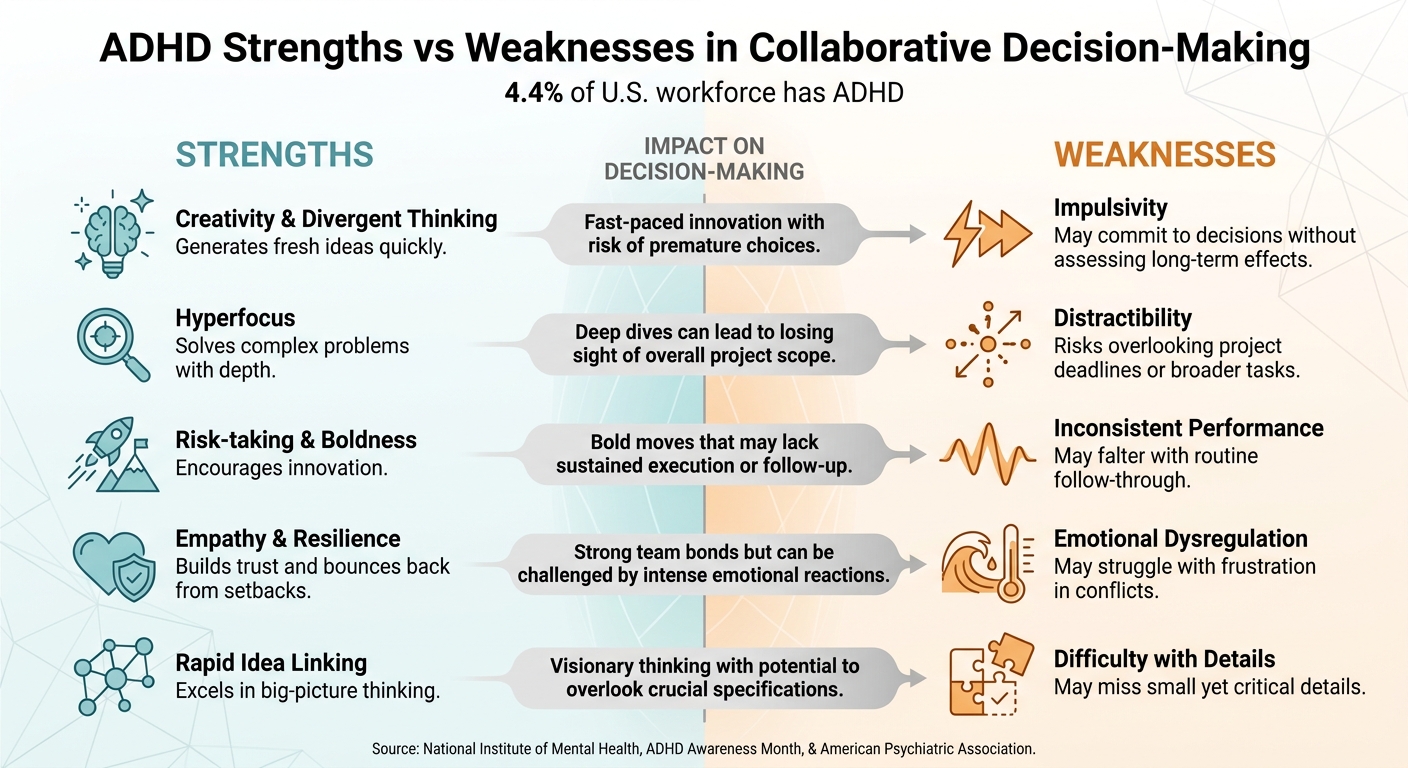
ADHD Strengths vs Weaknesses in Team Decision-Making
Professionals with ADHD bring a mix of standout abilities and notable challenges to the table. One of their key strengths lies in their creativity and ability to think outside the box. Psychotherapist and artist Dorian Schwartz captures this well:
ADHD brains are wired for novelty. Many of us are idea generators and natural risk-takers who thrive on big-picture thinking.
This knack for innovation allows them to generate ideas quickly, explore unconventional approaches, and take bold risks that others might shy away from. However, these strengths often come with challenges that can impact teamwork and decision-making.
Hyperfocus is another hallmark trait. When fully engaged, individuals with ADHD can dive deep into complex problems and produce exceptional results. But this intense focus can sometimes lead to neglecting other tasks or missing deadlines, as attention becomes overly concentrated on a single issue.
Other ADHD traits, such as impulsivity and emotional variability, also influence decision-making dynamics. Impulsivity, for instance, can lead to "delay discounting", where immediate rewards are prioritized over long-term gains. This tendency might cause quick decisions without fully considering the broader implications or team workload. Meanwhile, emotional dysregulation can complicate collaboration. While individuals with ADHD often excel in "analytical empathy", as researcher Raffaello Palandri describes - being highly attuned to others' emotions - they may lack the mirroring behaviors that help build rapport, sometimes leading to misunderstandings.
Another challenge is inconsistent performance. Novel and stimulating tasks tend to hold their attention, but routine or repetitive work may lead to disorganization or forgetfulness. This variability can make their output unpredictable, depending on the nature of the task.
The strengths and weaknesses of ADHD professionals in collaborative decision-making can be summarized in the table below.
Comparison Table of ADHD Strengths and Weaknesses
| Strengths | Weaknesses | Impact on Decision-Making |
|---|---|---|
| Creativity & Divergent Thinking | Impulsivity | Generates fresh ideas quickly but may commit to decisions without fully assessing long-term effects. |
| Hyperfocus | Distractibility | Solves complex problems with depth but risks overlooking project deadlines or broader tasks. |
| Risk-taking & Boldness | Inconsistent Performance | Encourages innovation but may falter with routine follow-through. |
| Empathy & Resilience | Emotional Dysregulation | Builds trust and bounces back from setbacks but may struggle with frustration in conflicts. |
| Rapid Idea Linking | Difficulty with Details | Excels in big-picture thinking but may miss small yet critical details. |
How ADHD Affects Team Dynamics
ADHD professionals bring a unique energy to team dynamics - driving creativity and problem-solving while sometimes introducing friction. Their knack for spotting complex patterns and understanding interconnected systems makes them invaluable in high-pressure situations. As Raffaello Palandri points out:
The ADHD individual's capacity to perceive complex patterns and systemic relationships enables them to anticipate problems, generate innovative strategies, and conceive multi-dimensional solutions that others cannot yet articulate.
This ability shines during crises, where they can quickly zero in on priorities and make fast decisions. It’s not just about short-term fixes either - this adaptability also feeds into broader, long-term planning.
The numbers back this up. Teams with neurodivergent members are shown to be 30% more effective in innovation-driven roles, and diverse executive teams solve problems up to three times faster. At JPMorgan Chase, employees in neurodiversity programs have been found to outperform their neurotypical peers by 90% to 140%. These benefits emerge when ADHD team members are positioned in roles that leverage their strengths - like prototyping, research and development, incident response, or user research. Their ability to seek out novelty and recognize patterns makes them particularly suited to these areas. However, these strengths don’t come without challenges.
ADHD traits can sometimes disrupt team workflows. For instance, time blindness - a common ADHD trait - can lead to overcommitment or missed deadlines, which might frustrate teammates relying on consistent schedules. Standard team practices, like 15-minute standup meetings, may also feel ineffective for those with ADHD due to working memory limitations. Impulsivity can show up as interruptions or off-topic contributions, which colleagues might misinterpret as unprofessional rather than recognizing them as impulse control challenges.
Another challenge is Rejection Sensitive Dysphoria (RSD), which can cause intense emotional reactions to feedback. This can lead to conflicts or even emotional "meltdowns". Interestingly, 75% of developers report experiencing negative emotions during code reviews - a response that tends to be heightened in individuals with ADHD. Emotional intensity, combined with periods of hyperfocus followed by dips in productivity, can strain team relationships.
To truly benefit from cognitive diversity, teams need to rethink their systems. As engineer and leader Linda Meg aptly puts it:
If leadership systems only work for linear thinkers, the problem is not the people. The problem is the system.
Workflows designed with ADHD in mind - like visual task boards, structured communication, and brief, focused check-ins - can actually improve productivity for everyone. This "curb-cut effect" demonstrates that strategies tailored for ADHD don’t just help individuals; they elevate the entire team’s performance. By creating structures that address individual challenges, teams can make better, more collaborative decisions.
Strategies to Optimize ADHD Contributions
Maximizing the contributions of ADHD team members starts with aligning their tasks to their cognitive strengths and simplifying communication processes. Place individuals in roles where they can excel - those with ADHD often shine in areas like creative problem-solving, generating new ideas, and thriving in fast-paced environments. Meanwhile, neurotypical colleagues might naturally take on structured tasks such as budgeting or detailed scheduling more effectively.
Effective communication is another key factor. A well-organized communication structure can significantly improve collaboration. Try using a tiered update system with categories like "Must-Know", "Nice-to-Know," and "For Reference" to help ADHD team members quickly identify critical information. Distributing pre-meeting agendas gives them time to prepare mentally, while post-meeting summaries in bullet-point format reinforce decisions and next steps. Replace lengthy meetings with 5-minute daily check-ins to confirm priorities and address obstacles. This approach keeps communication focused and helps reduce mental fatigue.
To counter time blindness and avoid mental overload, tools like Kanban boards with color-coding and single-topic digital threads can be highly effective. Apps like Forget allow team members to perform "brain dumps" during meetings, capturing spontaneous ideas without disrupting the flow of conversation. These ideas can then be organized later while preserving their creative value.
Managing impulsivity is another challenge that benefits from structured systems. For instance, enforce mandatory cool-down periods before making significant decisions. In high-pressure situations, introduce signal phrases to pause discussions, especially when hyperfocus might limit broader input. Dr. Lana Ferris of Haven Health emphasizes the importance of reframing these traits:
Seeing these traits as part of a partner's brain style - rather than flaws - is key to building patience and empathy.
This mindset shift helps turn potential friction points into opportunities to provide thoughtful support.
Additionally, fostering a culture that integrates structured approaches while addressing overstimulation is crucial. Allow team members to signal when they feel overwhelmed, creating an environment where this is normalized and addressed constructively. Combining such cultural adjustments with strength-based task alignment can transform cognitive diversity into an advantage. As the NeuroLaunch Editorial Team highlights:
Individuals with ADHD often bring unique strengths such as creativity, out-of-the-box thinking, and high energy levels. When properly harnessed, these traits can lead to innovative solutions and increased team performance.
Conclusion
Tapping into the strengths of ADHD professionals can lead to real breakthroughs in innovation when organizations create systems that embrace cognitive diversity rather than resisting it.
People with ADHD bring immense value to team decision-making through their distinct ways of thinking. Their ability to approach problems creatively, tackle challenges dynamically, and anticipate opportunities often reveals solutions that more linear methods might miss.
As Dr. Stefan Ivantu puts it:
Having ADHD doesn't mean you can't work well in a team. It just means you need the right strategies and support.
By aligning strengths with the right roles and using systems that address common challenges, teams can turn potential friction into productivity. Tools like structured workflows and clear protocols help smooth the way. Research indicates that adults with ADHD who focus on their strengths report lower levels of depression, anxiety, and stress. At the same time, organizations that embrace neurodiverse talent often gain a competitive edge in creativity and problem-solving.
For professionals looking to navigate these dynamics effectively, On/Off Genius offers tailored tools and insights to help manage focus, performance, and organization. With the right structures in place, diverse thinking can drive innovation, allowing ADHD professionals to thrive in traditional team environments without sacrificing their creative spark.
FAQs
What roles best fit ADHD strengths on a team?
Teams can tap into the strengths often associated with ADHD - like quick thinking, problem-solving, and a knack for thinking outside the box - by assigning roles that align with these abilities. Positions in areas such as crisis management, brainstorming new ideas, or tackling strategic challenges tend to be a great fit. Similarly, roles that thrive on high energy, multitasking, and a willingness to take calculated risks - like leadership or project management - can also play to these strengths.
On the flip side, tasks that demand long periods of focus on repetitive or routine work might require some adjustments to help ensure success.
How can teams prevent impulsive decisions without slowing down?
Teams can strike a balance between efficiency and thoughtful decision-making by implementing structured communication and decision-making frameworks. This includes setting clear agendas, defining discussion processes, and establishing specific timeframes for decisions. These practices help manage impulsivity while maintaining productivity.
Encouraging moments of reflection before finalizing choices allows teams to combine speed with careful consideration. This approach takes advantage of ADHD strengths, such as creativity, while reducing the risk of hasty decisions. Ultimately, these strategies promote a collaborative atmosphere where decisions are both timely and well thought out.
What’s the fastest way to reduce time-blindness and missed deadlines?
Managing time-blindness and meeting deadlines can be especially challenging for individuals with ADHD. One of the most effective ways to tackle this is by setting up external systems that enhance time awareness.
Simple tools like visual timers or alarms can make a big difference by providing clear, consistent reminders of time passing. Breaking tasks into smaller, more manageable steps can also help reduce overwhelm and keep progress on track. Adding structured schedules ensures that each part of the day has a purpose, which can help prevent distractions.
Other helpful approaches include using visual cues (like sticky notes or color-coded calendars), setting regular reminders, and even finding an accountability partner to check in with. These strategies work together to boost focus and make meeting deadlines feel much more achievable.