Why ADHD Brains Excel at Creative Problem-Solving
ADHD traits—divergent thinking, cognitive flexibility, and deliberate mind-wandering—boost creative problem-solving and workplace innovation.

People with ADHD often face challenges in focus and organization, but research shows their brains are wired for solving problems in unconventional ways. Key traits like generating multiple ideas, switching perspectives quickly, and intentional mind-wandering give them an edge in tasks that require out-of-the-box thinking.
Key Points:
- Divergent Thinking: ADHD minds connect unrelated ideas, leading to novel solutions.
- Cognitive Flexibility: They can shift between ideas seamlessly, spotting opportunities others miss.
- Mind Wandering: When deliberate, it fuels insight and sparks "Aha!" moments.
Studies, like one at Drexel University, reveal that ADHD traits can outperform linear problem-solving methods. These strengths are especially valuable in fields needing innovation and fresh perspectives. Recognizing and channeling these abilities can help individuals with ADHD thrive personally and professionally.
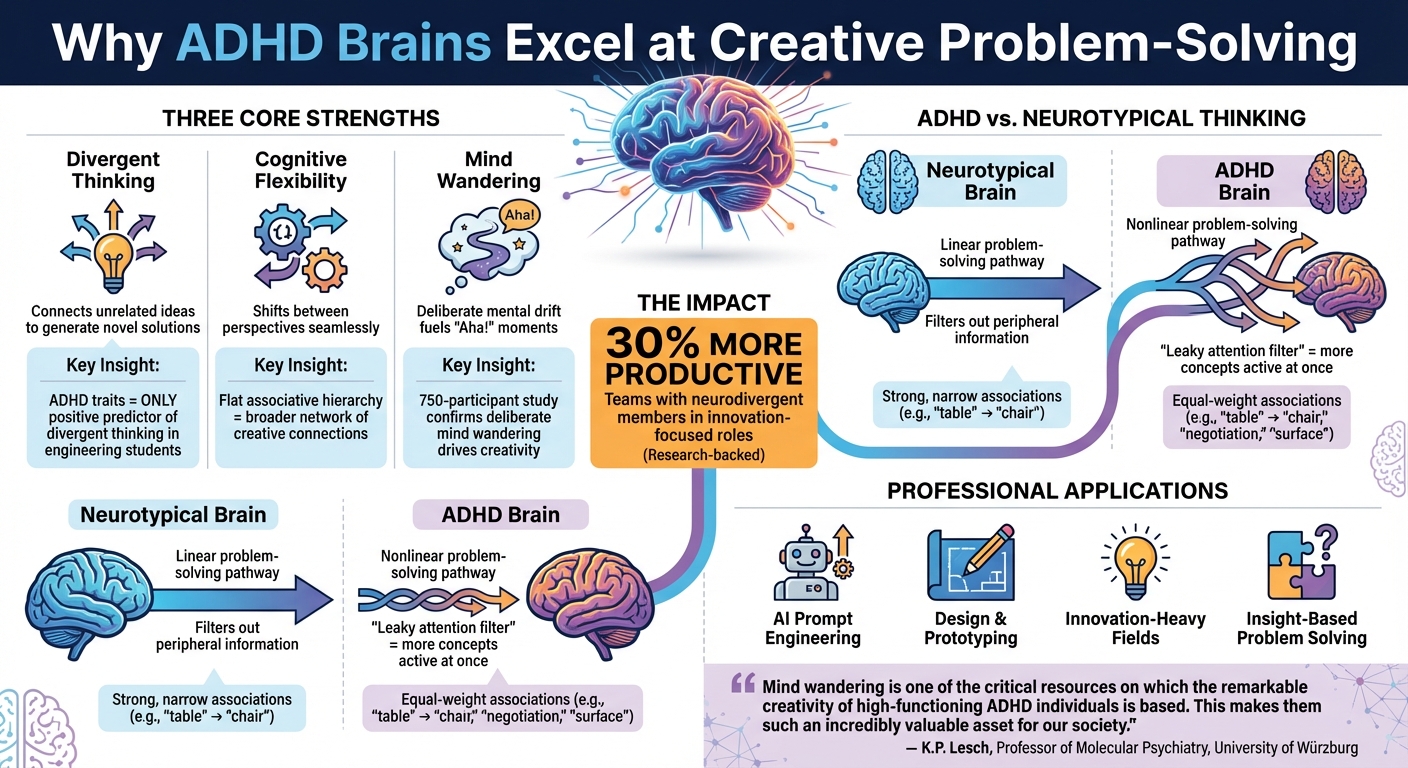
How ADHD Brains Excel at Creative Problem-Solving: Key Cognitive Advantages
Divergent Thinking in ADHD
How ADHD Supports Nonlinear Thinking
Divergent thinking refers to the ability to come up with multiple ideas or solutions from a single starting point. It’s a key element of creative thought, and ADHD brains seem naturally designed for it. This is partly due to a "leaky attention filter" in ADHD brains, which allows peripheral information to flow in and strengthens associative connections.
While neurotypical brains tend to filter out irrelevant details, ADHD brains keep more concepts active at once. This prevents fixation on traditional methods and opens up a broader range of possibilities. For instance, researcher Holly White points out that people with ADHD excel in conceptual expansion - they’re more likely to see a paperclip as a versatile tool rather than just a fastener. This resistance to conventional patterns encourages originality.
This nonlinear thinking style pairs seamlessly with other ADHD traits, creating a unique framework for tackling problems in innovative ways. These cognitive tendencies provide a strong foundation for understanding the link between ADHD and divergent thinking.
Research Connecting ADHD to Divergent Thinking
Recent studies back up the idea that ADHD traits enhance divergent thinking. Research consistently shows that ADHD characteristics directly predict stronger performance in tasks requiring creativity. For example, one study involving engineering students found ADHD traits to be the only positive predictor of divergent thinking. Even high SAT scores only correlated with GPA, not creative ability.
At the European College of Neuropsychopharmacology Congress in October 2025, Han Fang from Radboud University Medical Centre shared insights from a study involving 750 participants across Europe and the UK. Using classic exercises like brainstorming creative uses for everyday objects, the research revealed that deliberate mind wandering - intentionally letting thoughts drift - was the key link between ADHD symptoms and higher creative scores. As K.P. Lesch, a molecular psychiatry professor at the University of Würzburg, explained:
Mind wandering is one of the critical resources on which the remarkable creativity of high-functioning ADHD individuals is based. This makes them such an incredibly valuable asset for our society.
Additionally, studies show that teams with neurodivergent members are 30% more productive in roles that require innovation. This highlights how the ADHD approach to thinking doesn’t just benefit individuals - it also leads to tangible results in collaborative and professional settings where unconventional ideas are crucial.
Cognitive Flexibility in ADHD Brains
Switching Between Ideas and Frameworks
ADHD traits often contribute to remarkable cognitive flexibility, or the brain's ability to shift between concepts, perspectives, and approaches with ease. Free from conventional limitations, ADHD minds can rapidly move between ideas, sparking creative connections that others might overlook.
This adaptability stems from processes like bisociation and Janusian thinking, where individuals hold two seemingly contradictory ideas at once. Instead of seeing contradictions as barriers, ADHD brains use them as opportunities to innovate. A historical example of this is Balthasar Krems, who in the early 1800s reimagined the design of a needle by placing the eye at its pointed end. This unconventional thinking laid the groundwork for modern sewing technology.
On a neurological level, this ability is supported by what researchers call a flat associative hierarchy. In a neurotypical brain, a word like "table" might immediately and strongly connect to "chair", with more distant connections barely registering. By contrast, an ADHD brain gives equal weight to a wider range of associations, such as "chair", "negotiation", or even "surface." This broader network of connections creates fertile ground for generating novel ideas.
Thanks to this mental flexibility, individuals with ADHD often excel at rapid and creative problem-solving.
Cognitive Flexibility in Professional Settings
In professional environments, this mental agility becomes a powerful tool. ADHD professionals often rely on unconventional thinking to tackle challenges, producing solutions that others might not consider. Their preference for insight-based problem solving - where sudden flashes of understanding replace step-by-step analysis - can lead to innovative breakthroughs. As Hannah Maisano, a doctoral student at Drexel University, notes:
They appear to favor unconscious, associative processing that can produce sudden creative breakthroughs.
Research highlights how this approach is especially effective in roles requiring creativity and innovation. Insight-based problem solving not only fuels individual creativity but also gives teams a competitive edge. Workplaces that encourage "incubation periods" - allowing employees to step away from problems and let their unconscious minds process - can better tap into the strengths of ADHD professionals.
Mind Wandering and Creativity
Research on Mind Wandering and Creative Performance
Mind wandering, often seen as mere distraction, is now being acknowledged as a critical link between ADHD and creativity. Researchers distinguish between two types of mind wandering: spontaneous drifting that happens unintentionally and deliberate mind wandering that is purposeful. Interestingly, only the deliberate type appears to fuel creativity.
A 2025 study involving 750 participants from Europe and the U.K. found that deliberate mind wandering directly connects ADHD to creative thinking. On the other hand, spontaneous wandering tends to lead to challenges like disorganization. Recent findings also highlight how deliberate mind wandering - especially when paired with strategic pauses for "Aha!" moments - can significantly enhance creative problem-solving. As K.P. Lesch, a Professor of Molecular Psychiatry at the University of Würzburg, explains:
Mind wandering is one of the critical resources on which the remarkable creativity of high-functioning ADHD individuals is based. This makes them such an incredibly valuable asset for our society.
This evolving understanding of mental drift lays the groundwork for practical ways to channel it effectively.
Managing Mind Wandering While Maintaining Focus
Rather than trying to eliminate mind wandering, professionals can learn to harness it as a tool for creative problem-solving. The challenge lies in transforming unintentional drifting into deliberate, productive thought.
Mindfulness techniques tailored for ADHD can help individuals recognize when their thoughts start to wander and redirect them intentionally. Setting aside specific blocks of time for brainstorming or exploring ideas can provide the mental space needed for creativity without disrupting daily tasks. When facing roadblocks, taking short pauses can often spark innovative solutions that might not emerge through forced concentration.
Another essential strategy is capturing spontaneous ideas as they occur. Using tools like notebooks or apps ensures these flashes of insight are saved for later evaluation, allowing you to stay focused on the task at hand. By turning mind wandering into a structured process, individuals with ADHD can transform what might seem like a challenge into a powerful creative advantage.
Applying ADHD Strengths in Professional Work
Turning ADHD Traits into Workplace Advantages
ADHD traits like divergent thinking and adaptability can be powerful tools in a professional setting. Research highlights how these characteristics can drive creativity and innovation. For instance, studies show that incorporating neurodivergent perspectives can boost team innovation by 30%. In technical fields, ADHD traits have been linked to enhanced performance in tasks requiring conceptual expansion.
Take hyperfocus, for example. This intense concentration can be a game-changer during critical tasks like coding sprints or design sessions. To make the most of hyperfocus, align it with your natural energy peaks - whether that’s late at night or after a workout - and save routine tasks for periods when your energy dips. Pairing hyperfocus with a flexible mindset creates a foundation for even greater productivity.
The so-called "leaky filter" often associated with ADHD can be a surprising asset. It’s especially useful in fields like AI prompt engineering, where thinking outside the box and exploring unconventional solutions are essential. As Deloitte Insights puts it:
Divergent thinking may be the key to the next leap in AI performance. Neurodivergent team members accustomed to spotting unconventional angles can help expand the design space for AI.
Another strategy is to take deliberate breaks from complex problems. This allows your brain to process ideas in the background, often leading to those sudden "Aha!" moments. Dr. John Kounios from Drexel University explains:
Our results show that having strong ADHD symptoms can mean being a better creative problem-solver than most people.
To manage the flood of ideas that ADHD can bring, use tools like whiteboards, voice memos, or digital platforms to capture thoughts immediately. This reduces the strain on your working memory and leaves more room for creative problem-solving. Treat your first attempts as prototypes rather than finished products. This mindset not only reduces sensitivity to rejection but also encourages bold, innovative experimentation.
Tools and Strategies from On/Off Genius
On/Off Genius (https://onoffgenius.com) offers resources specifically tailored to help ADHD professionals channel their strengths into workplace success. The blog provides actionable tips for improving focus, organization, and energy management while maximizing creativity.
Instead of sticking to rigid schedules, try thematic time-boxing. This involves setting aside blocks of time for specific themes, like "Creativity" or "Admin", which align with your natural attention patterns. Another helpful approach is habit stacking - pairing new habits with existing routines, such as opening a project file while brewing your morning coffee.
For tasks that feel overwhelming, body doubling can make a difference. Working alongside someone else, either in person or virtually through "study with me" streams, creates gentle accountability and helps maintain focus. To make mundane tasks more engaging, apps like Habitica or Forest use gamification to reward progress, tapping into your brain's reward system. Visual timers can also help ground you in the moment and improve your sense of time. Finally, a quick burst of high-intensity exercise - just 5–10 minutes - before tackling challenging tasks can boost dopamine levels and prime your brain for better concentration.
These strategies and tools can transform ADHD traits into powerful assets, helping you thrive in your professional life.
ADHD & Creativity
Conclusion
ADHD brains are naturally wired for solving problems in ways that stand out. Studies reveal that traits like divergent thinking, cognitive flexibility, and insight-driven processing give professionals with ADHD a strong edge in innovation-heavy fields. While neurotypical minds often lean on linear, step-by-step problem-solving, ADHD thinkers excel at those sudden "Aha!" moments that spark groundbreaking ideas.
The challenge lies in shifting the narrative - seeing these traits as strengths rather than hurdles. Research highlights that intentional mind wandering, a core aspect of ADHD cognition, plays a key role in fueling creativity. This makes individuals with ADHD valuable contributors in industries that thrive on fresh ideas and innovative approaches.
When you understand how your mind works, you can align your skills with roles that let your strengths shine - whether it’s designing prototypes, creating system architectures, or any work that benefits from broad, cross-disciplinary thinking. Pairing your natural ability to make spontaneous connections with tools like AI for structured tasks or strategies from On/Off Genius can help you build a system that works for you.
Lean into your ADHD strengths and create systems tailored to your needs. You’re not just managing your challenges - you’re thriving. Your brain’s ability to explore unconventional paths and uncover unexpected solutions is exactly what drives innovation, especially in a world hungry for new perspectives.
FAQs
Is creative problem-solving common in ADHD?
Individuals with ADHD often shine when it comes to creative problem-solving. Thanks to traits like divergent thinking - the ability to explore multiple solutions - and sudden insight, they can tackle challenges from fresh, unconventional angles. These unique approaches often lead to solutions others might not consider. Studies also suggest that the cognitive flexibility associated with ADHD plays a key role in boosting creativity during problem-solving.
How can I turn mind wandering into useful ideas?
To make mind wandering work for you, try letting your thoughts drift on purpose rather than trying to block them out. Dedicate specific time to let your mind roam freely without being critical of where it goes. This method taps into traits often associated with ADHD, such as divergent thinking and cognitive flexibility, both of which are connected to creativity. By embracing structured free-thinking, you can spark fresh ideas and improve your problem-solving skills.
What jobs best fit ADHD creative strengths?
Jobs that tap into ADHD strengths often thrive on originality, quick thinking, and the ability to spot patterns others might overlook. Careers in advertising, marketing, entrepreneurship, design, and the arts are great fits because they celebrate brainstorming and fresh ideas. Similarly, roles in technology, research, and business strategy can be a perfect match, especially in fast-paced settings that value adaptability and solving problems on the fly. Work that offers variety and encourages creativity tends to bring out the best in individuals with ADHD.