Ultimate Guide to ADHD Goal Accountability Systems
Practical ADHD accountability strategies—coaching, body doubling, and partner systems with check-ins and tools to build consistent habits without shame.

Struggling to achieve your goals with ADHD? You’re not alone. ADHD brains often face challenges like procrastination, time blindness, and task paralysis, making it harder to follow through - even with the best intentions. Accountability systems can bridge this gap by introducing external structure and motivation, helping you stay consistent and take action.
Here’s what you need to know:
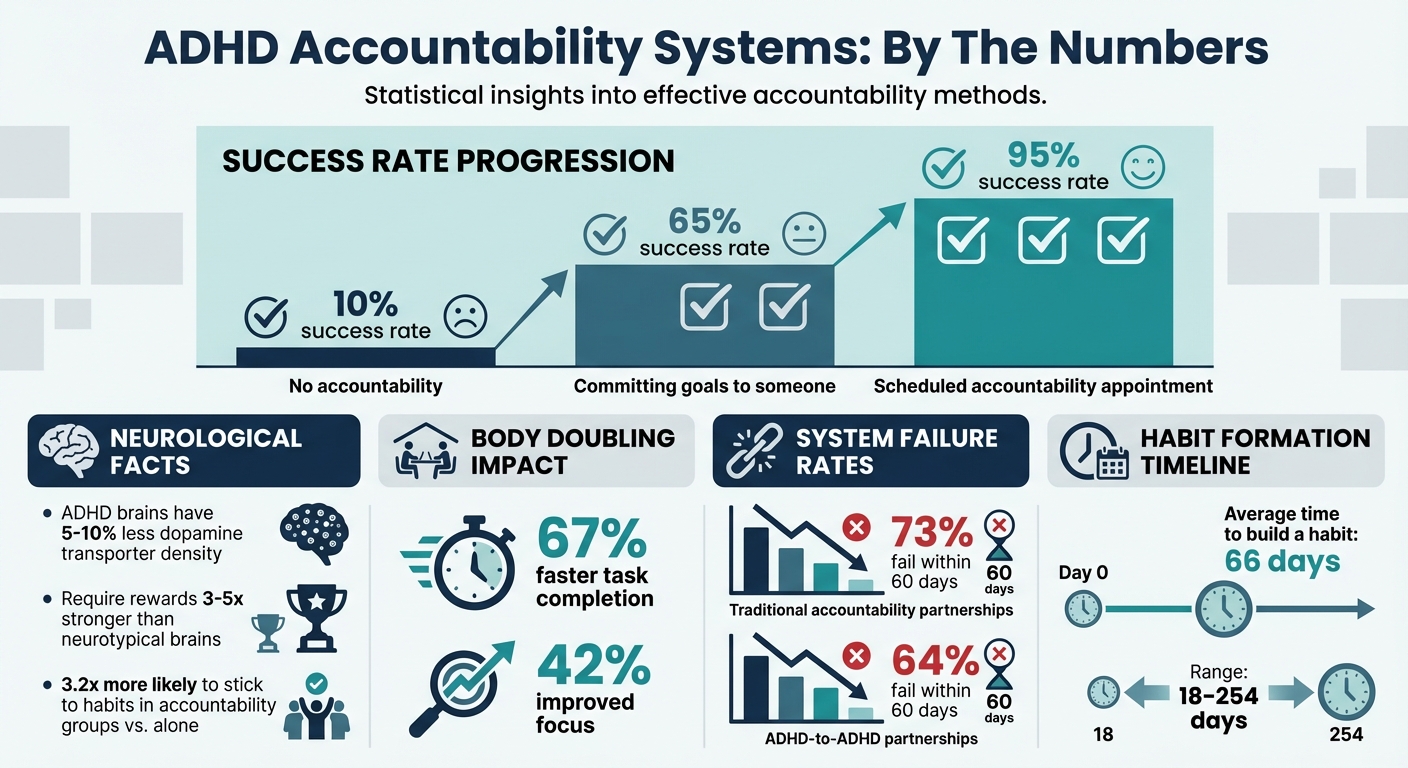
- Why it works: External accountability increases success rates from 10% to 65%. Add scheduled check-ins, and it jumps to 95%. This isn’t about pressure - it’s about creating a connection between your present self and future goals.
- How it helps: These systems reduce overwhelm, provide dopamine boosts, and tackle common ADHD challenges like time blindness and emotional dysregulation.
- Options to consider: ADHD coaching, accountability partners, and body doubling are tailored approaches to help with task initiation, focus, and habit-building.
The key is finding a system that works for your specific needs and energy levels. Whether you prefer professional support, peer-based accountability, or low-pressure tools, there’s a solution to help you take control of your goals.
ADHD Accountability Statistics: Success Rates and Brain Function Data
Tired of Failing Your Goals? ADHD Accountability Hacks That Help!
Why Accountability Systems Help ADHD Brains
ADHD is often described as a dopamine regulation disorder. Studies reveal that people with ADHD have 5%–10% less dopamine transporter density in the brain regions responsible for attention and reward processing. This isn’t about a lack of willpower - it’s a neurochemical issue that makes consistent action harder to sustain.
On top of that, the ADHD brain doesn’t naturally rank tasks by long-term importance. Instead, it focuses on Interest, Challenge, Novelty, or Urgency (ICNU). As Dr. William Dodson, a psychiatrist and ADHD expert, puts it:
"ADHD brains don't run on importance - they run on interest".
When a task doesn’t include elements like urgency or novelty, the prefrontal cortex struggles to engage. That’s why accountability systems, which introduce challenge and urgency, can make a real difference.
How External Structure Provides Motivation
The ADHD brain operates in the "now" rather than the "later". Future deadlines often feel abstract - a concept called time blindness - making it tough to act on time. Accountability systems solve this by creating artificial urgency through scheduled check-ins or social commitments.
External tools also help reduce the load on working memory. Instead of relying on internal reminders (which can often fail), visual trackers or other external cues take over this role. Dr. Russell Barkley explains:
"ADHD requires external cues, not internal motivation. If you rely on remembering, you'll fail. If you design your environment to remind you, you'll succeed".
Another effective strategy is body doubling, where simply having someone present while you work can help. Research shows that body doubling speeds up task completion by 67% and improves focus by 42%. This social presence acts as an external trigger, helping to overcome inertia and sustain engagement.
Using Dopamine and Positive Reinforcement
ADHD brains require rewards that are 3–5 times stronger than those needed by neurotypical brains. This explains why internal promises often fall short - they don’t produce a strong enough dopamine response. Accountability systems, however, tap into social reward circuits, which can deliver a much stronger dopamine boost than private commitments.
Interestingly, dopamine is more tied to the anticipation of a reward than the reward itself. Regular check-ins with an accountability partner create this anticipation, which strengthens follow-through. Studies also reveal that people with ADHD are 3.2 times more likely to stick to habits in accountability groups compared to going it alone. Breaking tasks into smaller steps provides frequent dopamine hits, keeping the ADHD brain engaged and motivated. Over time, this repeated reinforcement helps break through emotional blocks, making accountability systems even more effective.
Managing Emotions and Reducing Avoidance
Task paralysis - a "freeze" response triggered by overwhelm, anxiety, or fear of failure - is a common ADHD challenge. Marina Milos from Becoming Therapy explains:
"Task initiation is not an act of rebellion rather a neurological performance issue of a dysregulated system".
When a task feels overwhelming, the brain can shut down. Accountability systems help by offering external cues that reduce the emotional weight of starting. For instance, body doubling keeps your attention anchored in the present and makes the first step feel less daunting. This "social anchor" helps bypass the neurological shutdown that often blocks progress.
On the flip side, traditional "hustle" accountability - with its rigid deadlines, public shaming, or harsh consequences - can trigger shame spirals and worsen rejection sensitivity. A more effective approach is gentle accountability, which focuses on effort and progress rather than perfection. Using supportive language like "you showed up" reinforces positive behavior without adding emotional stress.
| ADHD Challenge | Accountability Solution | Neurological Impact |
|---|---|---|
| Working Memory Deficits | External capture & reminders | Reduces load on the prefrontal cortex |
| Time Blindness | Visual countdowns & check-ins | Bridges the gap between "now" and the future |
| Dopamine Dysfunction | Immediate micro-rewards | Delivers stronger dopamine signals |
| Task Initiation (Paralysis) | Body doubling / Social presence | Lowers activation energy with external triggers |
| Emotional Dysregulation | Gentle, shame-free support | Eases avoidance and reduces freeze responses |
Types of Accountability Systems for ADHD Professionals
These systems are designed to work with the unique ways ADHD brains process information by offering external structure, motivation, and support. By tapping into how external cues can boost dopamine and reduce task paralysis, these approaches help tackle common challenges like starting tasks, staying consistent, or improving executive function skills. Below, you'll find a breakdown of three tailored systems and the specific challenges they address.
ADHD Coaching: Professional Support and Structure
ADHD coaching offers personalized strategies to help professionals strengthen their executive function skills. Unlike peer-based systems, coaches provide feedback tailored to your specific strengths and circumstances. This makes it a great choice for those looking to develop new strategies rather than just maintain habits.
However, coaching comes at a cost - typically between $100 and $200 per session, or around $800 to $1,200 per month for weekly sessions. For professionals managing complex challenges or struggling with peer accountability systems, this investment can be highly effective. As Dr. Erica Hurley, PhD, explains:
"ADHD isn't about willpower. It's about finding the right tools to support your brain".
It's also worth noting that relying on a spouse for accountability can strain personal relationships, creating unhealthy dynamics of overfunctioning or underfunctioning. Professional coaches help maintain clear boundaries, ensuring your goals are supported without impacting personal connections.
Next, let's look at a peer-based system that relies on shared accountability.
Accountability Partners: Shared Goals and Mutual Support
An accountability partner is a peer who helps monitor your progress while you do the same for them. This shared commitment creates a form of social pressure that can significantly improve follow-through. Studies show that simply committing your goals to someone else can increase your success rate to 65%, while setting a specific accountability appointment raises it to 95%.
That said, ADHD-to-ADHD partnerships can be tricky. Without a structured system in place, these arrangements have a 64% failure rate within 60 days. Emotional sensitivity, such as rejection sensitivity dysphoria (RSD), can also make these partnerships fragile.
A helpful workaround is "Quiet Accountability", where partners check in with minimal effort - like sending a simple "✓" or "X" emoji. This reduces emotional strain while retaining the benefits of mutual commitment.
For tasks that require immediate action rather than long-term planning, body doubling might be a better fit.
Body Doubling: Getting Started on Tasks
Body doubling involves working alongside someone else - either virtually or in person - while each of you focuses on your own tasks. The presence of another person can increase productivity without requiring conversation. This method leverages the Hawthorne Effect, where people naturally perform better when they know they're being observed.
This approach is especially useful for routine or mundane tasks, like answering emails or organizing files, where the main hurdle is just getting started. As Carolina ADHD Coaching explains:
"A body double serves as external accountability - seeing another person work helps initiate action".
Body doubling is also budget-friendly. Platforms like Focusmate offer a free tier, with unlimited sessions available for about $5 per month. Another option, Focus101, is entirely free and caters specifically to neurodivergent users. While body doubling is excellent for task initiation, it doesn't help with building long-term executive function skills.
| System Type | Best for | Social Demand | Cost |
|---|---|---|---|
| ADHD Coaching | Strategy & Emotional Regulation | High | $100–$200 per session |
| Body Doubling | Task Initiation & Focus | Very Low | Free to ~$5 per month |
| Accountability Partner | Mutual Support & Connection | High | Free |
How to Build Your Own ADHD Accountability System
Creating an accountability system tailored to ADHD involves designing it to align with how your brain processes information and addressing gaps in executive function.
Step 1: Identify Your Patterns and Needs
ADHD often comes with challenges like working memory issues, time blindness, and difficulty starting tasks. The first step is figuring out where your system needs to step in. Are you struggling with starting tasks, remembering them, or managing when they happen? Each of these requires a specific kind of support.
Set goals that are clear and measurable. For instance, instead of saying, "exercise more", aim for something like, "complete a 20-minute workout." Vague goals lead to decision fatigue, something ADHD brains tend to avoid. Stick to goals that allow for a simple yes-or-no answer.
If missing a goal triggers feelings of shame, focus on progress, not perfection. As Work Brighter puts it:
"Accountability is any kind of external support to help you follow through. It's not about punishment or shame, it's about creating connections and systems that make it easier to do what matters to you".
Also, think about your social energy. If coordinating with others feels draining, opt for quiet, asynchronous check-ins. If you thrive on human connection, live sessions or active groups might be a better fit. Your system should align with your natural preferences, not work against them.
Step 2: Select Your Accountability Method
Choose a method that addresses your specific challenges. For example, if you need help with emotional regulation or building strategies, ADHD coaching can provide professional guidance. If your main struggle is getting started, body doubling through platforms like Focusmate offers real-time support without requiring conversation.
For group settings, small cohorts of 5–15 people provide "distributed accountability." Unlike one-on-one setups, these groups don't fall apart if one person drops out. This is important because traditional accountability partnerships often fail - 73% within 60 days, and ADHD-to-ADHD partnerships fail 64% of the time. If you prefer one-on-one accountability, keep check-ins simple, like a quick ✓ or X, to avoid unnecessary emotional strain.
Your chosen method should complement the external accountability mechanisms you already use, leveraging your brain's natural response to structure and social cues.
| Personality/Challenge | Recommended System Feature | Why? |
|---|---|---|
| Introvert | Asynchronous / Observation-only | Avoids social exhaustion and performance pressure |
| High RSD | Binary check-ins (Yes/No) | Reduces shame by removing the need for explanations |
| Time Blindness | Daily check-ins | Short feedback loops help with time perception |
| Perfectionist | Consistency tracking (not streaks) | Encourages persistence after missed days |
| Extrovert | Synchronous / Active groups | Harnesses energy from human connection |
Step 3: Add Tools and Strategies for Consistency
Keep check-ins quick - under 60 seconds. Use automated reminders or location-based alerts to avoid relying on memory.
Visual tracking can provide a quick dopamine boost. Physical tools like wall calendars or mirror trackers offer immediate feedback, while apps like Streaks ($6.99 one-time) or Loop Habit Tracker (free) are great digital alternatives.
Prepare a recovery plan in advance. Use the "2-Day Rule": missing one day is fine, but two days in a row requires a reset. If you miss a day, simply return with a "back today" message - no need for apologies or explanations. As Cohorty explains:
"Failure isn't the problem - hiding failure is".
To make your new habits stick, try habit stacking. For example: "After brushing my teeth, I will text my accountability partner". After 30 days, reevaluate your system to see if adjustments are needed. The first two weeks are about finding your rhythm, so don’t judge your progress too early.
With these strategies, you’ll be better equipped to maintain your accountability system over time.
Maintaining Your System Over Time
Once you've set up a personalized accountability system that works for your ADHD needs, keeping it running smoothly is essential for long-term success. ADHD naturally brings cycles of high engagement and low focus, so it's normal to occasionally drift from your system. The trick is to recognize when things aren't working and make adjustments before small issues turn into big problems.
Weekly Reviews and Adjustments
Set aside 20–30 minutes every Thursday or Friday morning to review your week. Pick a time when you feel alert and focused - this will help you get the most out of the process [12,33]. During your review, jot down tasks that take longer than two minutes and schedule them for later. Count how many tasks you completed that week, decide on one habit to stop or repeat, and set three clear goals for the upcoming week [12,34]. Stick with this routine for eight weeks before assessing how well it’s working.
Once a month, go a step further with an "accountability audit." Ask yourself: Does your system still feel helpful, or does it need a tweak? Regularly checking in like this ensures your system stays aligned with your needs. And don’t forget - rewarding yourself for progress is just as important as the review itself.
Rewarding Progress and Celebrating Wins
A tiered reward system can help keep you motivated. For quick tasks, enjoy small, instant rewards like a favorite snack or the satisfaction of checking off a box. For reaching bigger milestones, plan phased rewards, and for completing major projects, treat yourself to something more significant. ADHD brains thrive on these immediate boosts of motivation.
Shift your mindset to embrace "curious accountability." Instead of framing missed goals as failures, view them as opportunities to learn what went wrong. As Marla Cummins puts it:
"F.A.I.L. = First Attempt in Learning. Really"
Celebrate even the small victories - showing up and making an effort counts, even if you don’t finish everything on your list.
Tracking Progress and Building Habits
For ADHD, visual cues often work better than digital reminders, which are easy to ignore. Place a habit tracker where you’ll see it daily, like on your mirror or desk. If you prefer digital tools, use automated trackers that require minimal effort, like a simple "Yes/No" entry each day. Aim for consistency rather than perfection - a 70% success rate is a realistic goal, as 100% can be tough to maintain.
Follow the "Never Miss Twice" rule: missing one day is fine, but try not to let it happen two days in a row. Create specific recovery plans to make restarting easier. For example, "If I skip a workout today, I’ll do a 5-minute stretch tomorrow" [12,34].
Lastly, remember that building habits takes time. Research shows it can take anywhere from 18 to 254 days, with the average being about 66 days. Be patient with yourself - it’s a process, not a race.
Conclusion
Creating an ADHD accountability system provides the external framework to help close the gap between what you're capable of and what you actually achieve. The statistics are compelling: having a clear accountability appointment can boost your success rate from 10% to 95%.
To make this work, use the strategies and tools outlined earlier - figure out your patterns, choose an accountability approach that matches your energy levels, and keep your system running with weekly reviews, progress celebrations, and visual tracking. Opt for tools that are quick and easy to use (under 60 seconds), and externalize your plans so your brain can focus on execution instead of trying to manage all the details. This approach lays the groundwork for steady progress.
"Success doesn't mean sticking to the plan; it means making the plan work for you…and not feeling guilty about it." - Work Brighter
Your system should flex with your natural shifts in focus and energy. When something stops working, view it through a "scientific" lens - missed deadlines aren't failures; they're just data to help you adjust.
FAQs
How do I pick the best ADHD accountability system for me?
To discover the most effective ADHD accountability system, start by reflecting on your personality, specific challenges, and the kind of support that works best for you. The most helpful systems are adaptable, encouraging, and designed with ADHD needs in mind. You might find success with options like one-on-one partnerships, group-based systems, or creative approaches such as micro-habits or visual reminders. The key is to choose something that reduces feelings of overwhelm, fits your preferences, and provides external accountability in a way that motivates rather than pressures you.
What should I do if I miss check-ins or fall off track?
It’s normal to miss check-ins or feel like you’ve lost your way. Start by asking yourself what led to the slip-up. Was your system too strict? Did it lack the support you needed? Use this reflection to tweak your approach - make it more flexible and tailored to how your mind works. Begin again with small, realistic goals and simple, manageable check-ins. Instead of seeing setbacks as failures, treat them as chances to learn and improve. The goal is to build a structure that supports you and adjusts to your needs.
How can I use accountability without triggering shame or RSD?
To practice accountability without causing shame or triggering rejection sensitivity dysphoria (RSD), focus on approaches that feel kind and emotionally safe. Think of it as having a supportive friend by your side, rather than a strict critic. Prioritize self-compassion and encouragement over any sense of punishment or rigidity.
Create systems that work for you - ones that aren’t overly rigid or public. Instead of pressuring yourself with strict commitments, build in flexibility and use gentle check-ins to stay motivated. This way, you can maintain progress without the emotional weight of shame or RSD.