5 Tax Prep Tips for ADHD Entrepreneurs
Simple, ADHD-friendly tax strategies: automate expenses, weekly check-ins, a tax savings account, visual dashboards, and a tax pro.

Navigating tax season can be overwhelming, especially for entrepreneurs with ADHD. Challenges like disorganization, procrastination, and executive dysfunction often lead to missed deadlines and financial stress. But with the right steps, you can simplify the process and avoid costly mistakes. Here's how:
- Automate expense tracking with tools like QuickBooks or Expensify to keep records organized and accurate.
- Schedule weekly financial check-ins to stay on top of expenses and reduce end-of-year chaos.
- Set up a dedicated tax savings account to ensure you're prepared for tax payments.
- Use visual dashboards like Wave or Quicken to make financial data easier to understand.
- Hire a tax professional to handle complex filings and ensure compliance.
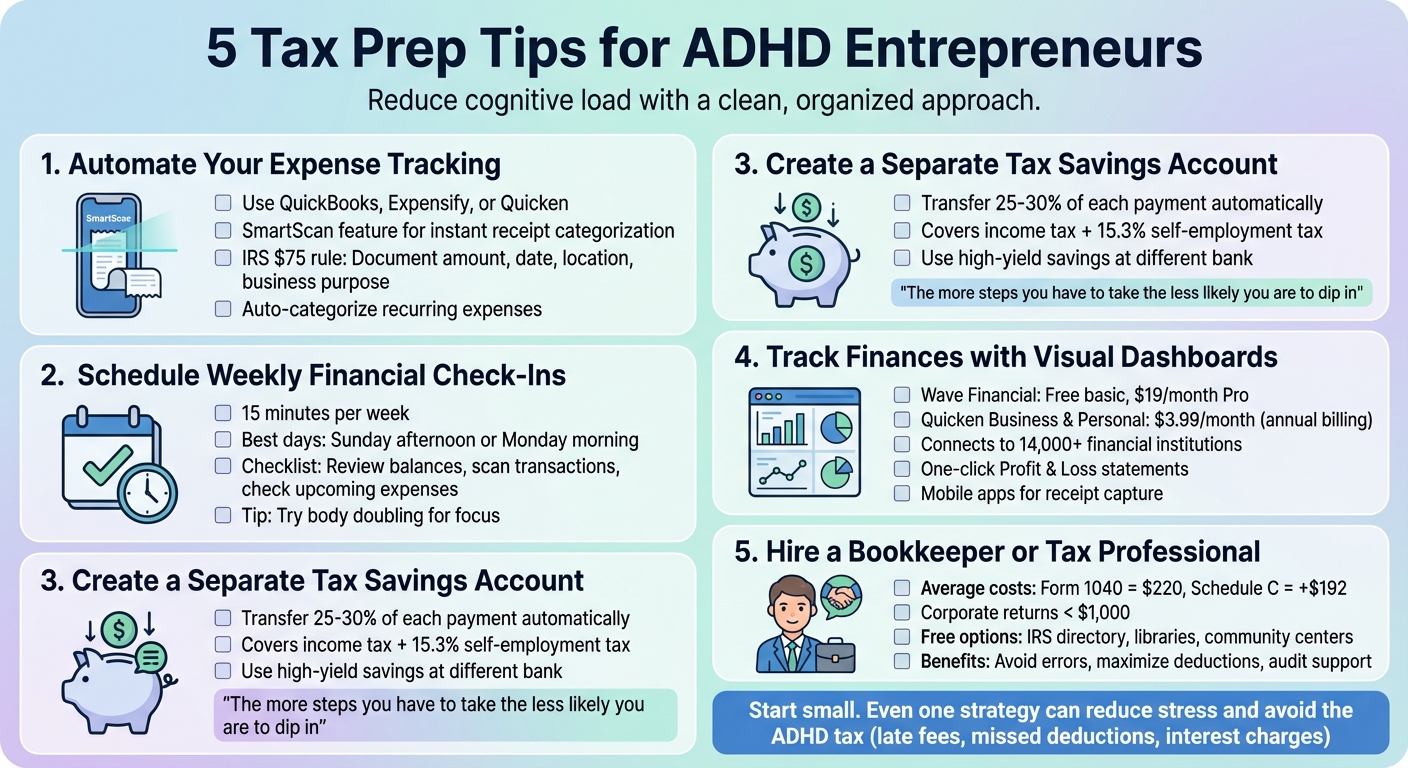
5 Tax Prep Tips for ADHD Entrepreneurs: Visual Guide
ADHD and taxes: How to stop the annual panic
1. Automate Your Expense Tracking
Tracking expenses manually can be a nightmare, especially for entrepreneurs with ADHD. Paper receipts vanish into thin air, digital invoices get buried under countless emails, and trying to recall months of transactions feels impossible. The answer? Stop relying on memory and let technology handle it.
Connect your business accounts to accounting tools like QuickBooks, Expensify, or Quicken. These platforms automatically pull in transactions as they happen, saving you from the hassle of manually logging every purchase. Expensify even has a SmartScan feature that lets you snap a photo of a receipt with your phone, categorizes it instantly, and tracks mileage using GPS at the IRS-approved rate.
Take advantage of categorization rules. For example, you can set Adobe charges to always be labeled as "Software/Subscriptions." This removes unnecessary decision-making when preparing your taxes and keeps everything organized. With automatic categorization and smart receipt capture, staying on top of your records becomes effortless.
"Manual tracking wastes time and invites errors. Expensify's built-in expense tracker keeps your records clean, categorized, and ready for tax time." - Expensify
Make it a habit to photograph receipts immediately. By using an app to store digital copies in the cloud, you’ll have IRS-compliant records ready if you're ever audited. This small step also helps preserve deductions you might otherwise lose. Remember the IRS "$75 rule": while receipts aren’t required for most business expenses under $75, you still need to document the amount, date, location, and business purpose.
2. Schedule Weekly Financial Check-Ins
Taking just 15 minutes each week to review your finances can save you from the stress of forgotten expenses, surprise bills, and long, overwhelming transaction lists. This habit creates a steady rhythm for managing your money and keeps things manageable. Pick a consistent day for this - Sunday afternoons or Monday mornings often work well, especially for entrepreneurs who want to set the tone for the week ahead. For those with ADHD, breaking tasks into smaller, scheduled intervals can make the process feel less daunting.
"Waiting until the end of the month to assess your money often leads to surprises, panic, or forgotten expenses. That's why a weekly reset is key - shorter timeframes reduce decision fatigue and make staying on track feel manageable." - Kimbree Redburn, Financial Coach
Treat this like any other appointment by adding it to your calendar. Create a simple checklist for your session: log into your bank accounts to check balances, review credit card transactions, and scan your upcoming calendar for expected expenses. If staying focused is a challenge, try body doubling - schedule your check-in while a friend or family member works nearby. Their presence can help you stay on task.
Choose a time when your energy is at its peak. Pair the session with an existing habit, like enjoying your Monday morning coffee, and give yourself a small reward afterward. For small business owners, this habit can be a game-changer. Instead of wasting hours reconstructing financial records for taxes, a weekly 15-minute review keeps everything organized and reduces the year-end scramble.
Focus on the numbers, not judgment. If it helps, use visual tools like color coding - green for spending that aligns with your goals, yellow for neutral expenses, and red for unintended ones. This makes it easy to spot patterns without getting bogged down in details. The goal isn’t perfection; it’s staying on top of your finances so tax season doesn’t become a nightmare.
3. Create a Separate Tax Savings Account
Separating your tax funds into a dedicated account is a smart way to manage your finances and avoid unnecessary spending. A tax savings account acts as a safeguard, keeping tax money out of reach and reducing the temptation to treat it as extra cash. Financial planner David DeWitt, CFP®, highlights this concept perfectly:
"The more steps you have to take the less likely you are to dip in when you're not meant to!"
The trick is to automate the process. Set up automatic transfers from your business account to this tax savings account every time you get paid. A good rule of thumb is to transfer 25–30% of each payment right away. This amount typically covers both your income tax and the 15.3% self-employment tax for Social Security and Medicare. If 25–30% feels like too much at first, start smaller and gradually increase the percentage.
"Every single time a client pays you, immediately transfer 25-30% of that income into a separate high-yield savings account." - Allied Tax Advisors
For added convenience and security, consider opening a high-yield savings account at a bank that's different from your primary checking account. This extra layer of separation makes it harder to access the funds impulsively while allowing your money to earn interest until tax time. Automating this process simplifies your routine and ensures you're consistently setting aside what you need without the hassle of manual tracking.
4. Track Finances with Visual Dashboards
For entrepreneurs with ADHD, endless rows of spreadsheet data can feel overwhelming and lead to procrastination. Visual dashboards, on the other hand, turn those numbers into vibrant charts and graphs, making it easier to quickly grasp your financial situation. In just seconds, you can get a clear picture of your income, expenses, and tax responsibilities.
Platforms like Wave Financial and Quicken Business & Personal simplify this process. They make it possible to "see clearly" and "decide faster" without the hassle of technical setups. Quicken even allows you to view both personal and business finances in one place, giving you the flexibility to "zoom in or zoom out" as needed. Patrick Bazinet, a graphic designer who uses Wave, shares:
"Wave is an asset to my business and my sanity... I'm not sweating bullets during tax season."
One major advantage of these tools is automation. Both Wave and Quicken sync directly with your bank accounts - Quicken connects to over 14,000 financial institutions - and automatically categorize your transactions for tax purposes. Say goodbye to manual data entry and stacks of paper receipts. For example, Wave enables users to generate Profit & Loss statements with a single click, while Quicken organizes transactions into IRS-ready forms, including Schedules A, B, C, E, F, and Form 1040.
When it comes to cost, Wave offers basic bookkeeping for free, with a Pro plan priced at $19/month. Quicken Business & Personal is available at $3.99/month when billed annually. Both platforms also feature mobile apps, letting you capture receipts on the go and update your financial data in real time. This level of automation makes managing taxes far less stressful and sets the stage for adopting other strategies to streamline your financial processes even further.
5. Hire a Bookkeeper or Tax Professional
While technology can simplify tax recordkeeping, having a professional on your side brings a level of expertise that software alone can't provide. Outsourcing your tax preparation is a smart move - it helps you avoid costly errors, take advantage of industry-specific deductions, and frees up your time and energy to focus on running your business. Tax professionals stay updated on the latest tax laws, offer critical support in case of an audit, and can even create a personalized checklist of documents tailored to your business needs. This guidance can be a lifesaver when you're unsure where to begin.
"The best money you will ever spend is hiring someone to prepare your taxes. They are up to date on all the laws and if you ever get audited, they will help you during that time." - Vida Carey M. Ed, ADHD Coach
Another major advantage is the accountability they provide. Scheduling a meeting with a tax professional gives you a concrete deadline, encouraging you to get your financial records in order. Even if your documentation isn't perfect, professionals know how to ask the right questions and piece everything together for a complete tax filing.
It's also important to understand the costs involved. On average, preparing a Form 1040 costs about $220. Adding a Schedule C for business income runs an additional $192, while corporate returns typically stay under $1,000. If you're working with a tighter budget, the IRS offers a directory of certified professionals, and many libraries, community centers, and colleges provide free tax preparation services. To make things even easier, ask for e-filing during your appointment to avoid dealing with physical paperwork.
Conclusion
Tax season doesn’t have to feel overwhelming when you have systems designed to fit the way your ADHD brain operates. The five strategies shared here - automating expense tracking, scheduling weekly financial check-ins, setting up a dedicated tax savings account, using visual dashboards, and hiring a professional - are all about breaking down the chaos into manageable steps. Tackling tax prep in smaller, more digestible tasks helps reduce stress and minimizes the risk of costly mistakes.
The benefits go beyond just filing on time. Even adopting one of these strategies can simplify the process and protect your financial well-being. It helps you avoid the "ADHD tax" - those hidden costs like late fees, interest charges, or missed deductions that quietly chip away at your finances over time.
Start small. Maybe it’s creating a tax folder or carving out 15 minutes each month for a financial check-in. As ADHD Money Coach Vanessa Dean wisely puts it:
"Staying organized isn't about perfection - it's about creating a system that works for you. Small, intentional steps now can make tax season less stressful and more manageable."
These tips aim to help ADHD entrepreneurs turn tax season into a manageable, straightforward process. By building simple, consistent habits, you can free up mental energy to focus on leading your business. The goal isn’t to master tax law - it’s to establish habits that give you financial clarity and peace of mind throughout the year.
FAQs
What expenses can I deduct as an entrepreneur?
As an entrepreneur, you can claim deductions for expenses such as home office costs, vehicle expenses, health insurance premiums, retirement contributions, and business-related travel and meals. These deductions lower your taxable income, potentially saving you money when filing taxes. Make sure to maintain detailed and accurate records to back up your claims.
How do I estimate quarterly taxes if my income varies?
To calculate quarterly taxes when your income varies, begin by estimating your total annual earnings. This includes all sources, such as freelance or business income, bonuses, and investment returns. If you anticipate owing $1,000 or more after accounting for withholding and credits, you'll need to make quarterly payments.
Split your estimated tax amount into four payments, typically due on April 15, June 15, September 15, and January 15. If your income shifts during the year, adjust these payments accordingly to avoid penalties. You can also rely on safe harbor rules to stay compliant.
What should I do if I’m missing receipts or records?
If you don’t have receipts or records, you can rely on alternative documentation to back up your deductions. Examples include mileage logs, bank statements, or official forms. Maintaining accurate records is essential to stay compliant and reduce the chances of facing audit issues.