2 Powerful Matrices for ADHD Priority Management
Use the Eisenhower and Impact-Effort matrices to prioritize tasks, match energy levels, and reduce ADHD overwhelm.
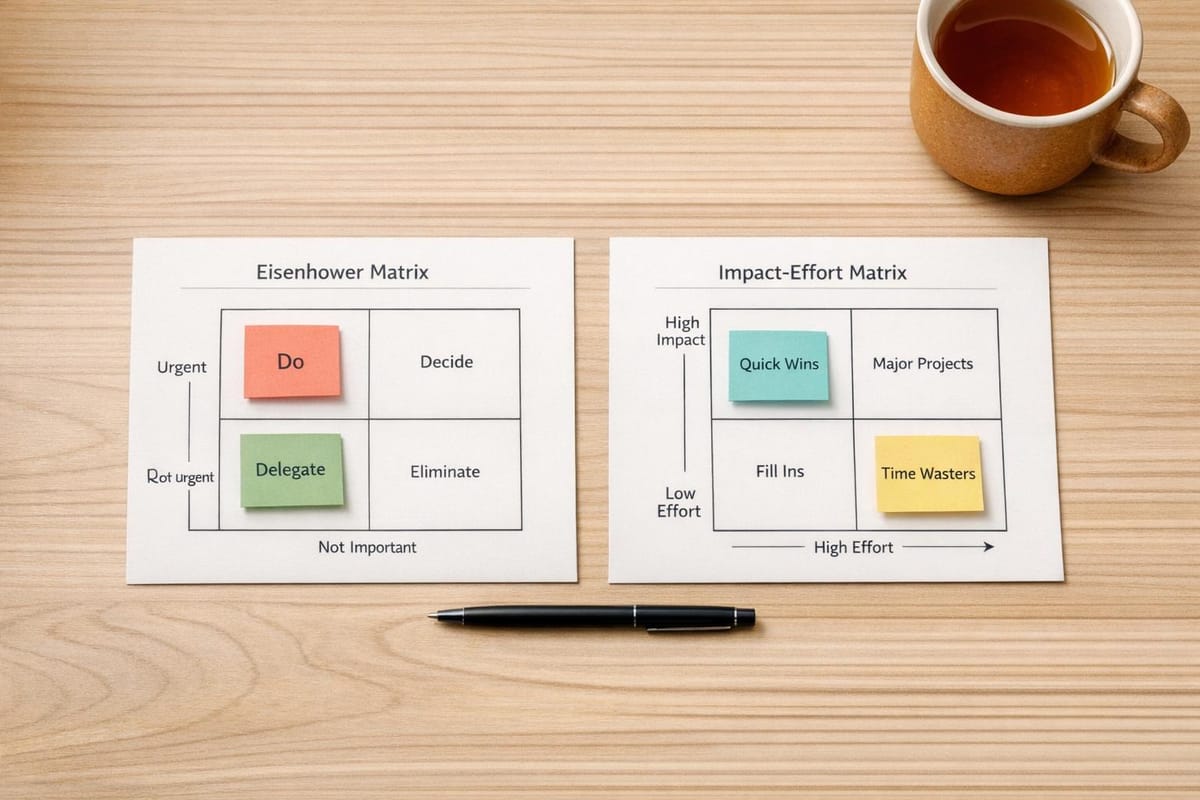
If managing priorities feels overwhelming due to ADHD, two tools can help simplify decision-making: the Eisenhower Matrix and the Impact-Effort Matrix. These frameworks organize tasks visually, making it easier to focus on what matters most while accounting for energy levels and urgency.
Key Takeaways:
- The Eisenhower Matrix sorts tasks by urgency and importance, helping you focus on long-term goals instead of just immediate demands.
- The Impact-Effort Matrix prioritizes tasks based on their value versus the energy they require, aligning with how you feel in the moment.
Both tools reduce mental strain, improve focus, and make prioritization less daunting. Learn how to use them together for better results.
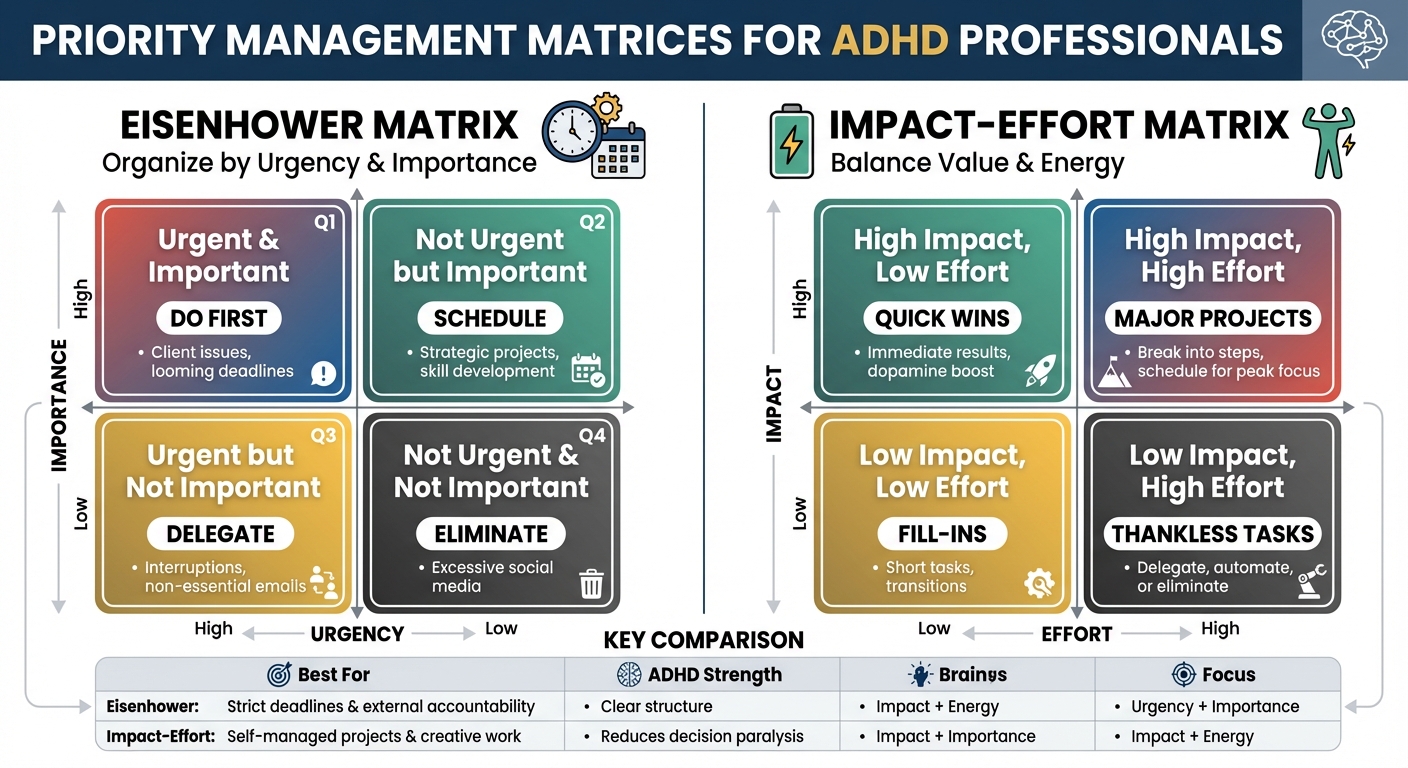
Eisenhower Matrix vs Impact-Effort Matrix for ADHD Priority Management
ADHD Prioritization Challenges + 2 Powerful Matrices To Help | Episode 263
1. Eisenhower Matrix
The Eisenhower Matrix organizes tasks into four categories: urgent/important, not urgent/important, urgent/not important, and not urgent/not important. It’s named after President Dwight D. Eisenhower, who famously said, "I have two kinds of problems: the urgent and the important. The urgent are not important, and the important are never urgent". For individuals with ADHD, this framework helps externalize the sometimes tricky task of prioritizing, which can feel overwhelming.
Here’s how each quadrant can guide decision-making for ADHD professionals:
- Quadrant 1: Urgent & Important – These are tasks that demand immediate attention, like client issues or looming deadlines.
- Quadrant 2: Not Urgent but Important – This includes long-term goals such as strategic projects or skill development.
- Quadrant 3: Urgent but Not Important – These are distractions that can often be delegated, like interruptions or non-essential emails.
- Quadrant 4: Not Urgent & Not Important – Activities in this category, like excessive social media use, are time-wasters to cut out.
For ADHD professionals, this system helps counteract the natural tendency to prioritize immediate gratification, a challenge tied to executive dysfunction. A 2018 study in the Journal of Consumer Research highlighted the "Mere-Urgency Effect", where people often choose urgent tasks over important ones, even when those urgent tasks offer less reward. This happens because urgency activates the amygdala, which can override the prefrontal cortex - the part of the brain responsible for weighing long-term importance. By using the matrix, individuals are prompted to pause and reflect, moving the decision-making process from their minds onto paper or a screen.
This tool is especially useful when juggling external deadlines from clients or supervisors. Physical aids like Post-It notes, alarms, or whiteboards can help ADHD professionals stay on track, especially for tasks in Quadrant 2 that lack immediate deadlines. A quick, daily 5-minute review of the matrix can also help avoid misclassifying priorities.
The ultimate goal? Shift focus away from Quadrant 1 by dedicating more time to Quadrant 2. As productivity expert Phuc Doan puts it, "Q2 is the only quadrant that has no external advocate. Nobody emails you to ask why you haven't worked on your most important long-term project today".
2. Impact-Effort Matrix
The Impact-Effort Matrix shifts the focus from urgency to balancing value against the energy required for a task. Imagine a 2x2 grid: the vertical axis represents Impact (the value or payoff a task brings), while the horizontal axis measures Effort (the time, energy, or resources needed). This tool, much like the Eisenhower Matrix, externalizes your decision-making process but focuses on payoff rather than urgency, making it especially useful for ADHD professionals.
Why does this work so well for ADHD brains? It tackles a common challenge: difficulty gauging how close a deadline is or how long a task might take. As Honestly ADHD explains, "For ADHDers, most tasks feel equally important/urgent until the last possible minute (thanks, time blindness!)". By prioritizing tasks based on their value rather than their urgency, this matrix helps you focus on what truly matters.
The real game-changer here is Perceived Effort. For ADHD professionals, effort isn't just about how objectively hard a task is - it’s about how it feels in the moment. Productivity coach Lynne Edris highlights this, saying, "The effort side isn't about how hard a task is objectively - it's about how it feels to you in this moment. This is called Perceived Effort - and it's one of the most empowering tools for getting unstuck". This flexibility allows you to align tasks with your current energy levels, tackling low-effort tasks when you're drained and saving high-effort ones for when you're at your best.
Here’s a breakdown of the matrix's four quadrants:
- Quick Wins: High impact, low effort. These tasks deliver immediate results and a dopamine boost - perfect for starting your day or building momentum.
- Major Projects: High impact, high effort. Break these into smaller steps and schedule them during your most focused hours.
- Fill-Ins: Low impact, low effort. Use these for short tasks or as transitions between meetings.
- Thankless Tasks: Low impact, high effort. Delegate, automate, or eliminate these whenever possible to conserve your energy.
This matrix shines in situations like self-managed projects, creative work, or routines without strict deadlines - areas where everything might feel equally pressing. Interestingly, organizations that use tools like this report completing projects 2.5 times more often on schedule, with 70% experiencing better control over their workload.
Pros and Cons
Each matrix brings its own set of advantages and challenges, offering ADHD professionals tools to simplify decision-making and reduce mental strain. Let’s break down the strengths and limitations of these two popular approaches.
The Eisenhower Matrix is particularly helpful for managing tasks tied to strict deadlines or external accountability. Its straightforward 2x2 grid format makes it easier to spot "work about work" - those low-value tasks that can eat up as much as 60% of your day. This visual clarity can be a game changer for identifying and eliminating distractions.
However, the urgency-driven nature of this matrix can sometimes backfire for individuals with ADHD. It might lead to heightened anxiety or even paralysis when trying to classify tasks. Shaunta Grimes captures this struggle well:
"The problem is, my neurodivergent brain struggles to classify some tasks as less urgent and less important than others."
Another limitation is its lack of flexibility for fluctuating energy levels, which are common for those with ADHD.
On the other hand, the Impact-Effort Matrix shifts the focus to balancing energy and value, making it a better fit when all tasks feel equally pressing. By considering effort alongside impact, it helps align tasks with available energy, making it easier to achieve "quick wins." For example, one hospital successfully reduced medication errors by 40% after prioritizing a high-impact barcode scanning project.
That said, this matrix has its own challenges. Its subjective nature can make it tricky to use when deadlines are non-negotiable, and it requires a steady planning routine paired with a reliable calendar to function effectively.
| Feature | Eisenhower Matrix | Impact-Effort Matrix |
|---|---|---|
| Best For | Tasks with strict deadlines and external accountability | Self-managed projects and creative work that align with energy levels |
| ADHD Strength | Offers clear structure and helps identify low-value distractions | Reduces decision paralysis by emphasizing quick wins and energy alignment |
| ADHD Weakness | Can increase anxiety and cause struggles with time blindness | May feel too subjective and less practical for rigid deadlines |
| Primary Focus | Urgency and Importance | Impact (Value) and Effort (Energy) |
Conclusion
The Eisenhower Matrix and the Impact-Effort Matrix each bring something different to the table for ADHD professionals. The Eisenhower Matrix is ideal for handling external demands - like deadlines, client needs, or admin tasks that come with clear consequences. On the flip side, the Impact-Effort Matrix is better suited for managing creative projects or long-term goals, especially when time blindness makes it hard to prioritize.
For the best results, combine both tools. Start with a brain dump to declutter your mind, then use the Eisenhower Matrix to sort out what truly matters. After that, move the prioritized tasks into the Impact-Effort Matrix to match them with your energy levels. This method helps you identify "Quick Wins" that boost momentum while ensuring critical tasks don’t fall through the cracks.
It’s important to note that neither matrix works perfectly on its own for ADHD professionals. As productivity coach Lynne Edris explains:
"The effort side isn't about how hard a task is objectively - it's about how it feels to you in this moment. This is called Perceived Effort - and it's one of the most empowering tools for getting unstuck".
To make these tools effective, you’ll also need external support systems, like a calendar that aligns with your energy patterns and a consistent planning routine. These structures help ensure the strategies stick.
To get started, try experimenting with both matrices for at least a month to get past the initial learning curve. Adjust them as needed to fit your unique workflow. For more ADHD-specific tools and resources to refine your prioritization system, check out On/Off Genius, which offers tailored insights for professionals navigating ADHD challenges.
FAQs
How do I decide whether to use the Eisenhower Matrix or the Impact-Effort Matrix?
The Eisenhower Matrix is perfect for prioritizing tasks by evaluating their urgency and importance. It's a great tool for handling deadlines effectively while steering clear of feeling overwhelmed.
On the other hand, the Impact-Effort Matrix helps you measure tasks based on their impact and effort, making it easier to pinpoint high-value tasks that require minimal effort - ideal for strategic planning.
Deciding which to use comes down to your focus: Are you tackling immediate priorities or planning for long-term, impactful outcomes?
How can I combine both matrices without spending too much time planning?
To streamline your workflow, you can merge the Impact vs. Effort matrix with the Eisenhower matrix by evaluating tasks based on impact, effort, urgency, and importance. Here's how:
- Start by asking: "Does this task have a high impact or importance?"
- Follow up with: "Is it urgent, or can it wait?"
Using these questions, you can quickly place tasks into a combined framework. This approach allows for faster decision-making and helps you prioritize more effectively.
What should I do when every task feels urgent and important?
When everything feels pressing, the Eisenhower Matrix can help you sort through the chaos. This tool lets you prioritize tasks by dividing them into four categories based on urgency and importance. It’s a simple way to figure out what demands your immediate attention, what can be scheduled for later, what should be delegated, and what’s better off eliminated altogether.
Start by doing a brain dump - write down everything on your mind. This clears the mental clutter and gives you a clear picture of what you’re dealing with. Then, organize each task into the matrix. You’ll likely find that many tasks aren’t as critical as they initially seemed. By using this approach, you can reduce overwhelm and stay focused on the goals that truly matter.