Why Noise Impacts ADHD Focus and Performance
Why steady sounds like pink or brown noise can help people with ADHD focus, and how to find the right noise and volume.

Noise affects people with ADHD differently than neurotypical individuals. For ADHD brains, silence can be distracting, while certain types of noise can enhance focus. Here’s what you need to know:
- ADHD brains struggle to filter irrelevant sounds due to lower dopamine activity.
- Silence often leads to internal distractions, while steady noise can improve focus.
- White noise (like static) helps mask distractions but isn’t ideal for everyone.
- Pink noise (like rainfall) is softer and better for long tasks.
- Brown noise (like thunder) calms restlessness and aids deep focus.
Key Insight: Controlled noise, like pink or brown noise, can help ADHD individuals focus by providing the right level of stimulation. Experiment with noise types and volumes to find what works best for you.
How Noise Affects ADHD Brains
Sensory Processing Differences in ADHD
If you have ADHD, your brain processes sounds differently than a neurotypical brain. Think of it this way: a neurotypical brain works like a spotlight with a dimmer switch, focusing on what’s important and tuning out the rest. In contrast, an ADHD brain acts more like a floodlight, registering all sounds at the same intensity. This difference stems from reduced activity in the prefrontal cortex - the part of the brain responsible for managing attention and controlling impulses.
Research shows that up to 60% of people with ADHD experience sensory processing challenges, which can make them either hypersensitive or unresponsive to stimuli. This creates what’s often called a "sensory paradox." You might seek out stimulation but feel overwhelmed by unpredictable or chaotic sounds. Everyday noises - like a ticking clock or a distant conversation - can all demand your attention at once.
These sensory traits make noisy environments particularly challenging, often leading to cognitive overload.
How Noise Creates Cognitive Overload
Because of these sensory differences, your brain’s inability to filter sounds can lead to exhaustion. For example, meaningful noises like conversations, music with lyrics, or TV dialogue demand extra processing as your brain tries to interpret the language. This constant competition for resources drains your cognitive energy quickly. Unlike neurotypical brains, which can “dim” background noise, an ADHD brain processes all sounds as if they’re equally important.
Unpredictable noises - like a door slamming or sudden laughter - can worsen the problem by repeatedly pulling your attention away from the task at hand. Even silence can be tricky. Without background noise, your brain might fixate on tiny sounds or internal thoughts, causing a similar sense of overload.
Stochastic Resonance: When Noise Helps Focus
Interestingly, not all noise is bad. While chaotic noise can overwhelm, steady and controlled noise can actually help you focus. This is thanks to a phenomenon called stochastic resonance. ADHD brains often operate in a state of cortical under-arousal, meaning they need more stimulation to function optimally. Moderate, consistent noise can amplify weak neural signals, improving the brain’s signal-to-noise ratio.
A 2007 study by Söderlund et al. found that background noise improved cognitive performance in participants with ADHD, while it had the opposite effect on neurotypical individuals. The sweet spot for this effect seems to be around 70 dB - about the volume of a normal conversation.
This benefit ties back to the brain’s dopamine system. Since ADHD brains have lower dopamine levels, they often need extra external stimulation to reach an optimal state of arousal. The key is choosing the right kind of noise. Steady, non-linguistic sounds like brown noise or rainfall provide just enough stimulation without triggering language processing, allowing your brain to focus more effectively on the task at hand.
Brown Noise for ADHD (Focus, reading, studying, coding)
Types of Noise and Their Effects on ADHD Focus
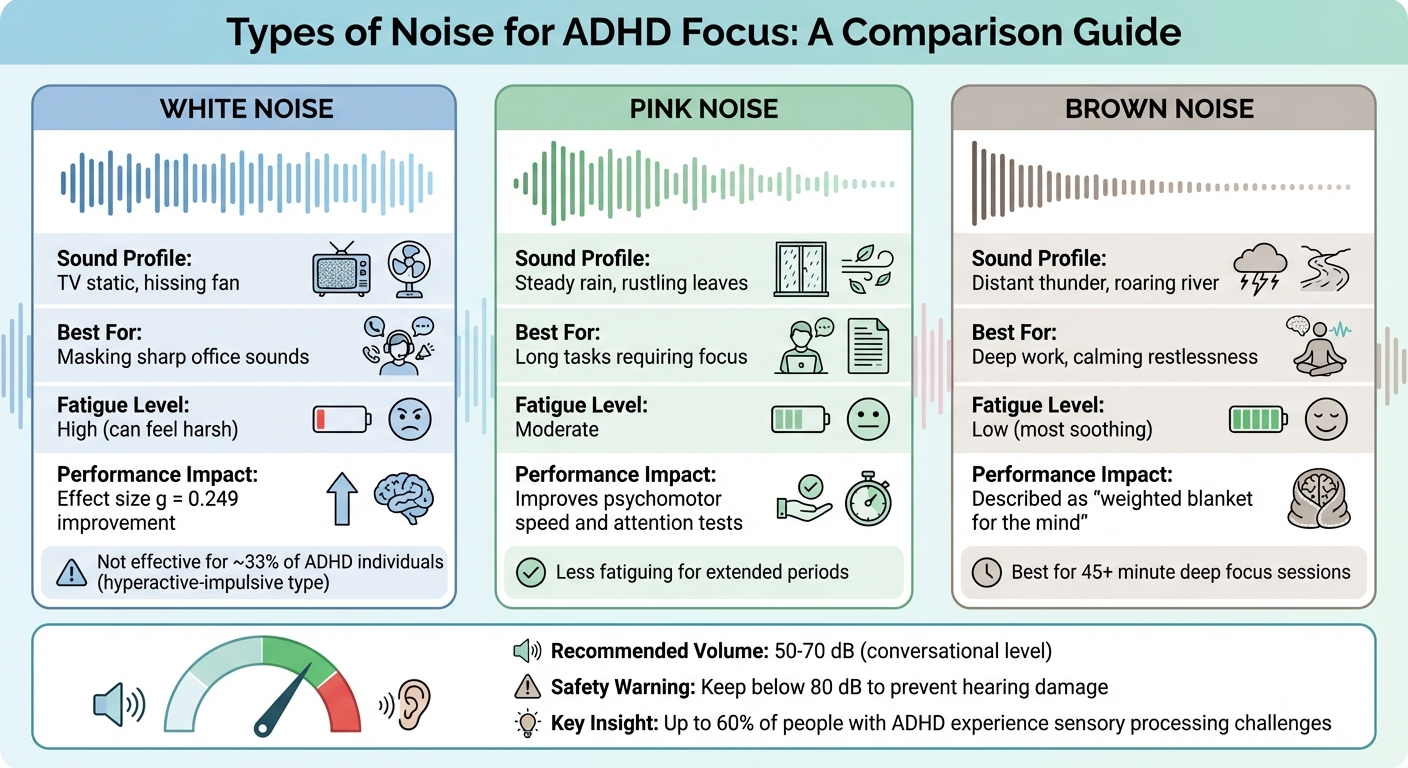
Comparison of White, Pink, and Brown Noise Effects on ADHD Focus
When it comes to managing focus for individuals with ADHD, understanding how different types of noise affect cognition can make a world of difference. White, pink, and brown noise each have unique sound profiles and impacts, making them useful tools depending on the situation. Here’s a closer look at how these noise types can help optimize focus.
White Noise: Masking Distractions
White noise is characterized by equal energy across all audible frequencies, which creates a sound similar to TV static or the hum of a fan. It’s particularly effective at drowning out sharp, unpredictable sounds like office chatter, keyboard typing, or notification alerts. For those with ADHD, white noise has been shown to slightly improve task performance (effect size g = 0.249), though it can negatively affect neurotypical individuals.
That said, white noise isn’t for everyone. About one-third of people with ADHD, especially those with predominantly hyperactive-impulsive traits, may find it counterproductive. This group might already be at an optimal arousal level, so white noise could overstimulate rather than help. If you’re in a noisy environment like a coffee shop or open office, white noise can be useful for short periods. For longer work sessions, however, you might want to switch to a less intense option.
If white noise feels too sharp or tiring, pink noise offers a softer alternative.
Pink Noise: Calming Hyperactivity
Pink noise shifts more power to lower frequencies, creating a sound that’s softer and more natural - think steady rainfall or the rustling of leaves. This makes it less fatiguing for extended periods of focus, especially during tasks that require sustained attention. Studies have linked pink noise to improvements in psychomotor speed and better outcomes in attention-related tests.
"White/pink noise provides a small benefit on laboratory attention tasks for individuals with ADHD or high ADHD symptoms, but not for non-ADHD individuals." – Joel T. Nigg, PhD, Director of the Center for ADHD Research at Oregon Health & Science University
Pink noise is excellent for masking distractions while avoiding the auditory fatigue that can come with white noise. It’s a go-to choice for those who need to concentrate for long stretches without feeling overstimulated.
For tackling internal restlessness rather than external distractions, brown noise might be the better fit.
Brown Noise: Reducing Restlessness
Brown noise, also called red noise, emphasizes even lower frequencies, creating a deep, rich sound reminiscent of distant thunder, a roaring river, or a powerful waterfall. Many people with ADHD describe it as a "weighted blanket for the mind," helping to calm internal chatter and reduce restlessness. While large-scale clinical studies on brown noise and ADHD are still lacking, anecdotal evidence highlights its soothing effects.
Brown noise is especially useful for deep focus sessions lasting 45 minutes or more, particularly when internal restlessness is the main challenge. To get the most out of brown noise, keep the volume at a conversational level (50–70 dB) and use over-ear headphones to fully capture its low frequencies. Just be mindful of prolonged exposure - keeping the volume below 80 dB will help prevent hearing damage.
| Noise Type | Sound Profile | Best For | Fatigue Level |
|---|---|---|---|
| White | TV static, hissing fan | Masking sharp office sounds | High (can feel harsh) |
| Pink | Steady rain, rustling leaves | Long tasks requiring focus | Moderate |
| Brown | Distant thunder, roaring river | Deep work, calming restlessness | Low (most soothing) |
Practical Strategies for Managing Noise at Work
Finding the right way to manage noise at work can make a huge difference, especially for individuals with ADHD. Since responses to noise can vary widely, it’s crucial to test and adapt strategies systematically.
Testing Different Noise Types and Volumes
Start by gathering some baseline data. Track how many hours you spend in deep focus and how often distractions occur over a week. This gives you a solid reference point to measure the impact of different noise types.
Next, test a specific noise color (like brown noise) for one week. Keep the variables consistent - use the same workspace, perform similar tasks, and play the noise at a controlled volume. Stick to levels between 50–70 dB, as anything above 85 dB can harm both performance and hearing. Allow yourself a few minutes to adjust to the noise at the start of your session.
It’s worth noting that white noise doesn’t work for everyone. In fact, around one-third of people with ADHD may find it more distracting. If you notice agitation or struggle to focus, switch to another noise color. Over time, you can rotate noise types or even include silent days to see what works best for different tasks.
Once you’ve got a testing routine, you can explore tools to help implement these strategies.
Noise-Reduction Tools and Apps
There are plenty of apps designed to help with focus. Options like Brain.fm, Quilence, DeepHush, and myNoise offer customized noise profiles and even track focus improvements. Many of these apps have free trials, making it easy to experiment without committing. Dr. Kevin J.P. Woods, Director of Science at Brain.fm, highlights the value of tailored audio:
"The breakthrough finding in our peer-reviewed study demonstrates the power of custom-designed music optimized for neurotypes like ADHD."
Pair these apps with over-ear noise-canceling headphones featuring an ANC rating of -25 to -30 dB. These headphones create a kind of "focus bubble", helping to block out distractions.
Designing Workspaces to Reduce Noise
Your physical workspace can also play a big role in managing noise. Position your desk to face a wall or a window to minimize visual distractions. Adding sound-absorbing materials like acoustic panels, rugs, heavy curtains, or upholstered furniture can further reduce noise.
In open offices, where making structural changes isn’t an option, consider using tall monitors, partitions, or privacy screens. These visual barriers signal to others that you’re in focus mode.
Noise from conversations, especially at 55–70 dB, can disrupt cognitive performance. To counter this, try sound masking tools or physical barriers .
You can also create a "focus trigger" in your workspace. This could be something like a specific desk lamp, a favorite scent, or another item you only use during deep work sessions. Small digital changes, like activating your computer’s "Do Not Disturb" mode or keeping your phone out of sight (or in a timed lockbox), can also help. Research shows that even having your phone visible can lower cognitive capacity by 10–12%. And if you’re interrupted, it takes an average of 23 minutes and 15 seconds to regain full focus.
Finally, fine-tune your environment. A room temperature of 68–72°F and lighting with a cool, blue-enriched tone (5000K–6500K) can improve alertness.
To explore more strategies and tools for managing auditory distractions and staying on task with ADHD, check out On/Off Genius at onoffgenius.com.
With these strategies in place, you’re well on your way to creating a workspace that supports better focus and productivity.
Conclusion: Managing Noise for Better ADHD Performance
Recognizing how noise affects your ADHD brain can make a noticeable difference in your productivity. The connection between sound and focus is backed by neuroscience: for many with ADHD, external noise helps the brain achieve the right level of arousal for concentration. Studies, including a recent meta-analysis, have shown that white and pink noise can significantly enhance focus for those with ADHD, though they may have the opposite effect on neurotypical individuals.
However, there’s no universal solution. Around one-third of people with ADHD actually find white noise makes their performance worse. That’s why experimenting is so important. Your response to different sound types can vary based on your ADHD subtype, the task you're working on, and even your current energy level.
To figure out what works best for you, try testing different noise colors for 10–15 minutes while monitoring your performance. Keep the volume between 50–70 dB to prevent sensory overload. Options like steady brown or pink noise are great for masking distractions, while specialized focus music can use neural entrainment to align your brainwaves with productive rhythms. These practical strategies build on the ideas explored earlier.
ADHD often comes with both a sensitivity to and a need for background stimulation. By treating sound as a tool rather than an obstacle, you can create an auditory setup that complements your brain’s unique needs. Simple changes, like using noise-canceling headphones or a brown noise app, can make a noticeable impact on your ability to focus.
Fine-tune your sound environment to support your ADHD brain and improve your daily performance.
FAQs
How do I know which noise color works best for me?
To figure out which noise color suits you best - white, pink, or brown - try listening to each and see which one feels comfortable for long periods without making you feel tired. Since everyone reacts differently, take some time to experiment, especially if you're managing ADHD. Pick the sound that keeps your mind engaged without becoming a distraction or wearing you out.
What volume is best for focus without overstimulation?
A volume of around 70 dB is considered ideal for boosting focus and sparking creativity without overwhelming the senses. For individuals with ADHD, this noise level can improve concentration while keeping auditory distractions to a minimum.
Why can silence feel distracting with ADHD?
Silence can be challenging for individuals with ADHD because their brains often thrive on a certain level of stimulation to stay focused. In a completely quiet setting, the absence of background noise might make concentrating harder. Instead of focusing, the brain may start searching for stimulation elsewhere, which can lead to distractions.