Checklist for Choosing an ADHD Workplace Coach
Clear checklist to vet ADHD workplace coaches—credentials, experience, methods, fit, pricing, red flags, and client results.
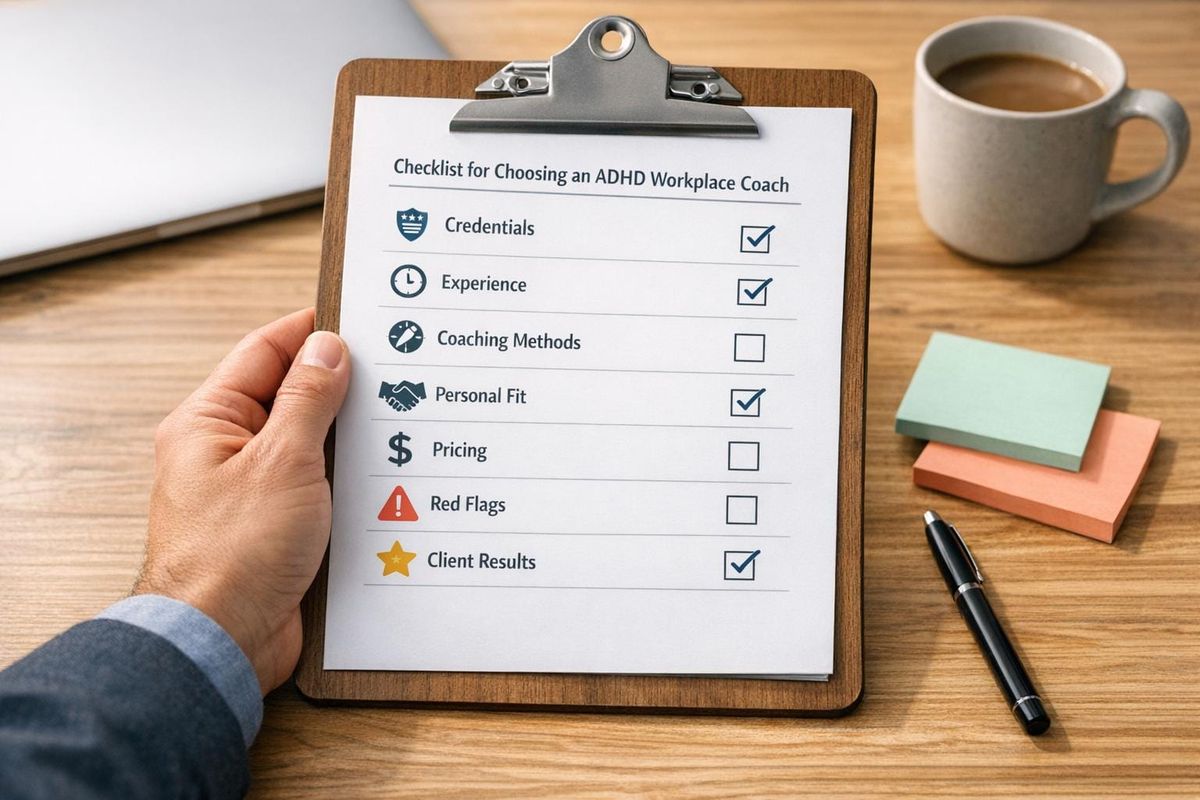
Finding the right ADHD workplace coach can help you tackle challenges like time blindness, procrastination, or hyperfocus at work. This guide breaks down key factors to consider, so you can make an informed decision. Here’s what to look for:
- Credentials: Seek coaches certified by ADHD-specific organizations like PAAC. Look for CACP, PCAC, or MCAC credentials, which combine general coaching skills with ADHD expertise.
- Experience: Choose someone with a strong track record of working with ADHD professionals, particularly in workplace settings.
- Coaching Style: Schedule a consultation to ensure their communication style resonates with you. Look for clear, supportive, and actionable advice.
- Methods: Ask about ADHD-friendly tools like visual timers, task boards, or strategies for managing energy and focus.
- References and Testimonials: Verify their success with similar clients through specific workplace results.
- Pricing and Logistics: Understand session costs, refund policies, and scheduling flexibility upfront.
Your coach should not only understand ADHD but also help you implement practical systems tailored to your needs. Take your time to interview potential coaches and ensure they align with your goals.
6 Traits To Look For In A Professional ADHD Coach When You Hire One
Step 1: Check the Coach's Credentials and Expertise
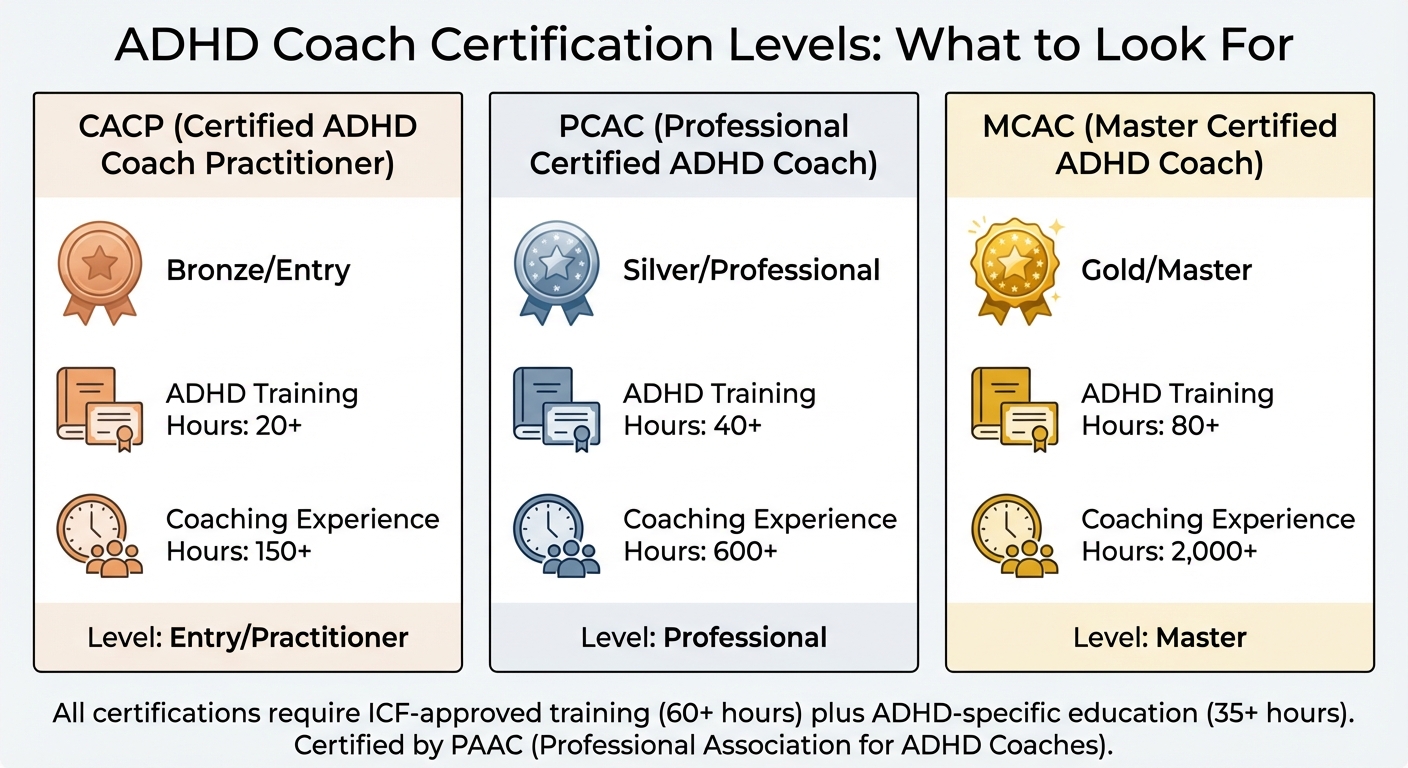
ADHD Coach Certification Levels: Training Hours and Experience Requirements
When choosing an ADHD coach, it's essential to verify that they have qualifications specifically tailored to ADHD. General coaching credentials might not be enough to address the unique challenges related to ADHD and executive functioning.
Look for ADHD-Specific Certifications
The Professional Association for ADHD Coaches (PAAC) is the leading global organization for certifying ADHD coaches. When evaluating a coach, look for these specific credentials: CACP (Certified ADHD Coach Practitioner), PCAC (Professional Certified ADHD Coach), and MCAC (Master Certified ADHD Coach). These certifications require a combination of general coaching knowledge and ADHD-specific expertise. For example, a qualified ADHD coach must complete at least 60 hours of ICF-approved training along with 35 hours of ADHD-focused education.
While general coaching credentials from the International Coaching Federation (ICF) - such as ACC (Associate Certified Coach), PCC (Professional Certified Coach), and MCC (Master Certified Coach) - indicate a solid foundation in coaching principles, they don't necessarily reflect expertise in ADHD coaching. The best coaches balance these general credentials with ADHD-specific certifications to ensure they meet both ethical and specialized standards.
| Credential Level (PAAC) | ADHD Training Hours | Coaching Experience Hours |
|---|---|---|
| CACP (Practitioner) | 20+ | 150+ |
| PCAC (Professional) | 40+ | 600+ |
| MCAC (Master) | 80+ | 2,000+ |
Once you've established their credentials, dive deeper into their practical experience working with ADHD clients.
Ask About Their Experience with ADHD Professionals
Credentials are important, but hands-on experience is equally critical. Ask about the coach's background working specifically with ADHD clients. How many years have they worked in this area? How familiar are they with workplace-specific challenges like managing impulsivity during meetings or creating productivity systems?
For example, a PCAC-certified coach typically has over 600 hours of ADHD coaching experience, while an MCAC-certified coach has logged more than 2,000 hours. This level of experience often means they've encountered a wide range of scenarios and can tailor their strategies to meet individual needs.
"An ADHD coach needs to be sufficiently knowledgeable about the disorder and how ADHD can impact the client and others in the client's life." – Alan R. Graham, Ph.D., PCC, MCAC
After confirming their experience, make sure they stay updated on the latest ADHD research and coaching techniques.
Check Their Commitment to Continuing Education
ADHD research evolves rapidly, and a good coach should stay current by pursuing continuing education. Ask about their recent training or advanced coursework, such as "Advanced ADHD Coaching for Adults", which focuses on workplace issues like executive function and professional relationships. Coaches trained at respected institutions like ADD Coach Academy (ADDCA) or MentorCoach often incorporate cutting-edge research into their practices.
"By becoming a credentialed ADHD coach, you become part of a growing community of ADHD Coaches who have been formally assessed and are determined to meet the highest standards of skill, experience and training." – MentorCoach
Step 2: Confirm ADHD Specialization and Workplace Focus
When choosing a coach, it's crucial to ensure they have a deep understanding of ADHD-specific challenges in the workplace. General productivity advice won’t cut it. A coach specializing in ADHD should be equipped to address issues like time blindness, procrastination, and trouble starting tasks - all of which can significantly impact professional performance.
Review Their Workplace Productivity Strategies
Ask potential coaches about the specific tools and techniques they use to address ADHD-related challenges at work. A skilled coach should offer strategies tailored to how ADHD brains operate.
For example, to combat time blindness, effective coaches might recommend using visual timers, realistic time-blocking with built-in buffers, or focus forecasting - this could mean communicating your deep work periods to your team or adjusting meeting schedules to align with your energy peaks . For task initiation, they might suggest minimal entry methods like starting with a five-minute action, pairing tasks with physical movement, or using the "AIR method" to break through feelings of overwhelm . For prioritizing and externalizing tasks, they could introduce frameworks like the "3S Prioritization Model", encourage thought downloads to clear mental clutter, or recommend creating visual task boards and checklists to reduce reliance on working memory .
"Traditional coaching often treats energy as infinite. ADHD-informed coaching recognizes that attention and energy are finite, precious resources that must be managed strategically." – Tandem Coaching Partners
"If it has to live in your head, it's already at risk." – Heal‑Thrive ADHD Coaching
Also, ask about body doubling - working alongside someone else to boost accountability and persistence. A great coach should explain how they adapt common productivity strategies to meet the ADHD brain's need for variety. They may also offer to evaluate your physical and digital workspace to identify subtle stressors that could be undermining your focus. These tailored approaches are especially important for professionals facing unique workplace challenges.
Ask About Experience with Gifted Professionals
If you’re a high-achieving professional, you’ll want a coach who understands the specific hurdles you face. Did you know that nearly 29% of entrepreneurs have ADHD - almost ten times the rate of the general population? People with ADHD are also three times more likely to start their own businesses compared to neurotypical individuals. These professionals often thrive when they can channel ADHD traits like risk-taking and problem-solving into their work.
Ask your coach how many of their clients are business owners or executives. High-performing individuals often grapple with issues like delegation paralysis, decision fatigue, or the "hyperfocus-crash" cycle, where intense productivity is followed by burnout. They may also deal with Rejection Sensitive Dysphoria (RSD), which can lead to over-delivering, undercharging, or avoiding tough conversations in leadership roles.
"ADHD coaching addresses the neurological roots of execution problems, not just strategy. A business coach gives you the plan; an ADHD coach helps your brain actually follow it." – Decoding ADHD
During your consultation, share an example of a failed productivity strategy and observe the coach’s response. A good ADHD coach will ask thoughtful questions to understand why it didn’t work for your brain, rather than suggesting you simply didn’t try hard enough. They should also be prepared for the "week 5 dip" - a common phase where initial enthusiasm wanes, and old habits resurface - and explain how they’ll help you stay on track during this period.
The right coach will help you harness strengths like hyperfocus in a way that works for you, instead of trying to suppress it. They’ll help you develop contingency plans for when focus shifts unexpectedly and teach you to recognize avoidance patterns before they escalate into bigger problems .
Step 3: Test Communication Style and Personal Fit
Finding a coach with the right qualifications is essential, but feeling comfortable with them is just as critical. You need someone you can trust to discuss workplace challenges - a coach who listens attentively and without judgment.
Schedule Initial Consultation Calls
Most reputable ADHD coaches offer a free 15- to 30-minute discovery call. This is your chance to see if you "click" with them. Pay attention to how they listen, respond, and communicate. Before the call, jot down 5–10 questions about your goals, the coach's methods, session logistics, and what a typical session involves. During the conversation, notice if they use active listening techniques - like paraphrasing ("So what I’m hearing is … is that correct?") or verbal cues like "I see" or "Got it" - to show they’re engaged.
"Effective communication with someone who has ADHD involves being clear, direct, and supportive." – Allison Geller, Communication Coach and Founder, Connected Speech Pathology
Clarity and simplicity are key. Many people with ADHD may feel overwhelmed by overly complex explanations, so look for a coach who communicates clearly and directly. It’s also worth asking if they provide written summaries or follow-up notes after sessions - these can be a great support for working memory.
Consider sharing a specific workplace challenge, like managing impulse control in meetings, and see if the coach offers practical, actionable advice. This kind of clear and supportive communication is vital for tackling ADHD-related issues like time blindness or hyperfocus, which were mentioned earlier.
After the call, think about how well you connected on a personal level. Did their communication style resonate with you?
Assess Compatibility and Trust
Once the consultation is over, take a moment to reflect. Did you feel comfortable asking questions? Were you able to express your needs openly, without fear of being judged?
Look for a coach who uses language that highlights your strengths, helping you see ADHD traits as assets rather than flaws. It’s also important that they clearly differentiate coaching from therapy and know when to recommend a mental health professional if needed.
"ADHD coaching is a non-judgmental partnership. One where you and your coach work together to form helpful strategies to bring you closer to your goals." – ADDA Editorial Team
If you're still unsure after the initial call, ask if the coach offers a single trial session. This can give you a better sense of how their coaching style works in practice before committing to a longer-term arrangement.
Step 4: Review Coaching Methods and Tools
Now it’s time to focus on the practical side of things. This step builds on the connection you’ve established with your coach, aiming to ensure their approach is tailored to your specific needs. You’ll want to dig into how they plan to address ADHD-related challenges at work and the tools they rely on to make that happen.
Ask About ADHD-Friendly Tools and Techniques
A good ADHD workplace coach should have a well-equipped toolkit designed to tackle common ADHD challenges. Don’t hesitate to ask, “What tools do you use to help with time blindness, task initiation, or maintaining focus?”
Look for strategies that are proven to work, such as visual timers, body doubling, or digital task management tools. See if the coach mentions techniques like the Two-Minute Rule (immediately completing tasks that take less than two minutes) or temptation bundling (pairing an unpleasant task with something enjoyable, like sipping your favorite coffee or listening to a podcast). These methods are designed with the ADHD brain in mind, recognizing that it’s driven by interest rather than importance.
"ADHD brains are interest-based, not importance-based. Knowing something matters doesn't make it engaging." – Expert ADHD Coaching Team
Also, ask if they help you identify your energy peaks throughout the week to schedule demanding tasks during your most productive hours. Coaches who use scaling methods - like rating your “dread” or “confidence” on a 0–10 scale - can help fine-tune strategies before you hit burnout. Another key approach is buffer scheduling, which avoids back-to-back meetings or tasks, acknowledging that ADHD brains often struggle with task-switching.
Beyond these immediate tools, it’s important to assess how the coach plans to set you up for long-term success.
Ask About Long-Term Strategy Development
Quick fixes are not enough. You need a coach who focuses on building lasting skills. The best coaches work on addressing deeper executive function issues, like planning, prioritizing, problem-solving, and self-monitoring, rather than just offering surface-level tips.
"The goal isn't to work like a neurotypical person. It's to work in a way that uses your ADHD strengths while working around its challenges." – Expert ADHD Coaching Team
Ask how they’ll help you create sustainable external structures to support areas where your ADHD brain might struggle. For example, do they teach backward planning for big projects, where you start with the final deadline and break it into smaller milestones? Do they guide you in designing simple action plans for those inevitable low-energy days?
Finally, make sure they’re committed to regularly reassessing your progress and adapting strategies as needed. Flexibility and ongoing adjustments are key to making coaching effective over the long haul.
Step 5: Spot Red Flags and Ask Key Questions
When searching for an ADHD coach, protecting yourself from unqualified individuals is crucial. The ADHD coaching field is largely unregulated, and a report from JAMA Network Open found that 89% of ADHD coaches surveyed lacked a professional mental health background. With a 54% rise in self-identified coaches since 2019, bringing the total to 122,974 by 2025, it’s more important than ever to know what to look for - and what to avoid.
Watch for Warning Signs
Be cautious of any coach who claims they can "cure" ADHD or guarantees specific results. ADHD is a neurological condition, and it doesn’t have a quick fix. Also, steer clear of coaches who’ve completed less than 40 hours of training - experts recommend a minimum of 60 hours of in-person instruction to ensure professional competency.
"The absence of standards and regulations about who can declare themselves an ADHD coach make it particularly important to practice due diligence when vetting an ADHD coach, especially as there are no legal protections for clients." – Margaret Sibley, Clinical Psychologist, University of Washington
Pay attention to how the coach interacts with you. A good coach will follow the 70/30 rule, allowing you to talk about 70% of the time. If they dominate the conversation or seem unwilling to listen, that’s a red flag. Additionally, ask about the issues they handle. If they claim to address everything, including trauma, addiction, or suicidal ideation without having clinical qualifications, it’s a major warning sign.
"Everything [in response to what issues a coach covers] is a red flag." – Jonathan Passmore, Psychologist and Executive Coach
Ask if the coach receives regular professional supervision - ideally quarterly - and which ethics code they follow, such as those set by the International Coaching Federation (ICF) or the Professional Association for ADHD Coaches (PAAC). If they become defensive when questioned about their methods or challenges, it’s best to look elsewhere.
These tips can help you identify potential issues before committing to a coach.
Prepare Your Interview Questions
Once you’ve identified potential red flags, use specific questions to confirm the coach’s qualifications. For example, you could ask:
- "How many ADHD clients have you worked with, and how many were professionals in high-pressure roles?"
- "What ADHD-specific training or continuing education have you completed recently?"
For workplace-related support, ask:
- "How do you help clients manage time blindness and improve time management at work?"
- "What strategies do you use to help clients break cycles of procrastination?"
- "How will you track and evaluate my progress toward specific workplace goals?"
Don’t forget to discuss logistical and ethical boundaries. For instance:
- "How do you ensure confidentiality in employer-sponsored coaching relationships?"
Conduct the interview in a calm, distraction-free environment. Pay attention to whether the coach listens attentively and makes you feel respected and understood. These interactions can reveal a lot about their approach and professionalism.
Step 6: Check References and Testimonials
After evaluating a coach's credentials and methods, the next step is to dig into their track record. Client references and testimonials can provide a clear picture of whether the coach delivers results that matter - especially for ADHD professionals navigating workplace challenges. Instead of settling for generic praise, look for evidence of tangible improvements.
Request References from ADHD Professionals
Start by asking the coach for references from clients who have faced challenges similar to yours. Great coaches often work with a wide variety of professionals, ranging from CFOs and senior partners to tech managers and educators. For example, Susan, a GVP and Americas Solution Leader, collaborated with coach Sherri Cannon using 360-degree feedback to successfully manage organizational change. This partnership led to her promotion and an expanded leadership role. Similarly, E.M., a former Fortune 500 VP turned consultant, experienced a dramatic income boost - going from under $100,000 annually to surpassing his previous corporate salary in just 90 days of coaching with Bonnie Mincu.
"As a result of Bonnie's coaching my income has shot up from below six figures annually to well above what I was earning in a corporate environment."
– E.M., Former Fortune 500 VP and Entrepreneur
When requesting references, be specific about your professional level. If you're an executive, ask to connect with other ADHD executives who have worked with the coach. Direct conversations with peers at a similar level can provide valuable insights into the coach's ability to address challenges unique to your role.
Review Testimonials for Workplace Results
Testimonials can reveal a lot, especially when they highlight specific workplace improvements. For example, Tyler, a financial advisor, shared that eight months of coaching with Sherri Cannon led to faster task completion and increased client acquisition - results that surpassed his previous decade of work. Another client, a freelance writer, credited coaching with reducing an overwhelming email backlog from thousands to fewer than 100, while also eliminating late fees entirely.
"I have not missed a deadline since the day I first called Bonnie. She was one of the best investments I ever made in my career."
– S.M., Freelance Writer
Look for testimonials that mention ADHD-focused strategies like "Time Sense" exercises, Mind Mapping for complex projects, or between-session text support. These tools can make a significant difference in managing challenges like time blindness and task initiation. Additionally, pay attention to feedback on how the coach helps address emotional barriers such as ADHD-related shame or imposter syndrome. For instance, Bonnie, a Nursing Education Director and ADHD Coach, reflected on her journey:
"I felt like an imposter. No one knew I prepared hours the night before presentations because I seemed like a natural."
– Bonnie, Director of Nursing Education & ADHD Coach
Overcoming these emotional hurdles is often a key step toward achieving lasting workplace success.
Step 7: Understand Pricing, Contracts, and Logistics
Once you've confirmed your coach's qualifications and expertise, it's time to address the practical details. Knowing the costs, session logistics, and contract terms upfront can help you avoid surprises and ensure the coaching arrangement aligns with your budget and schedule.
Review Costs and Value
ADHD coaching prices can vary significantly based on the coach's experience and the type of service you need:
- Individual sessions: $100–$300 per hour
- Executive sessions: $300–$500+ per hour; monthly packages: $2,000–$5,000+
- Group coaching: $50–$100 per session (around $200–$400 monthly)
- Typical monthly range: $300–$600
Most coaches offer a free 15–30 minute discovery call to determine if you're a good fit before any financial commitment. Payment structures can include per-session billing, prepaid blocks, or monthly memberships. Be sure to ask about total costs upfront, including any hidden fees. If you're self-employed or run your own business, coaching fees might qualify as tax-deductible professional development expenses, which could make the investment more manageable. Some coaches also offer sliding scale fees based on income.
Before committing to a package, check the refund policy. For instance, unused sessions might not be refundable, or the coach might charge a higher single-session rate for completed sessions if you cancel a block prematurely. Also, clarify the policy for missed sessions. Most coaches require 24-hour notice to avoid being charged for a missed appointment. However, some ADHD-focused coaches may offer flexibility, understanding that time management can occasionally be a challenge.
Clarify Session Logistics
Sessions typically last 30 to 60 minutes. Many coaching arrangements begin with weekly sessions for the first 8–10 weeks and may shift to bi-weekly as you progress. Regularly scheduled sessions - whether weekly or every other week - help establish a dependable routine, which is especially helpful for ADHD professionals who thrive on structure.
Ask about what kind of support is available between sessions. Some coaches include accountability check-ins via text, WhatsApp, or email as part of their standard rate. It's also worth discussing the coach's availability for communication outside of sessions. Some may only respond on specific days, like Monday through Thursday. If your work schedule is unpredictable, inquire about flexibility in scheduling. And if your employer is footing the bill, check whether the coach can provide corporate billing or VAT reverse-charge invoices for business transactions. Many ADHD coaches offer rolling, session-by-session commitments rather than locking you into long-term contracts, giving you the option to pause or stop whenever needed.
Once you've nailed down session details, make sure to review the contract terms to avoid any misunderstandings.
Examine Contract Terms
Carefully read the coaching agreement before signing. The contract should clearly define coaching as a service aimed at improving productivity and performance. It should also state that you are fully responsible for your own decisions and well-being. Look for a "not therapy" clause that clarifies coaching is not a substitute for mental health care, legal advice, or financial guidance. If you're currently in therapy, the agreement should recommend consulting your mental health provider to ensure coaching is appropriate.
Pay attention to confidentiality terms and their limits. Coaching relationships are not "legally confidential" in the way medical or legal relationships are. The contract should outline exceptions to confidentiality, such as court orders, threats of harm, or workplace harassment reports. If your coach is pursuing ICF or PAAC credentials, confirm that the agreement only allows them to share your name and contact information for verification purposes - not details from your sessions. Most contracts also allow either party to terminate the relationship at any time.
Conclusion
Finding the right ADHD coach is about more than just credentials - it's about connecting with someone who truly understands how your mind works and can help you build systems that last. This checklist guides you through verifying qualifications, assessing compatibility, reviewing methods, and understanding costs.
As Bonnie Mincu, Founder of Productivity Pathfinder, explains:
"ADHD coaching should be all about customization, not force-fitting yourself to get a strategy to work".
A skilled ADHD coach knows that challenges like time blindness, difficulty starting tasks, and managing emotions require personalized approaches - not one-size-fits-all productivity tips. This tailored support can turn ADHD-related hurdles into strengths, especially in the workplace.
While monthly coaching packages range from $300–$700, the value lies in the long-term benefits. The right coach helps you develop self-awareness, build external systems, and create habits that continue to support you long after your sessions end. Using the checklist provided, you’ll be equipped to make a well-informed decision.
Take the time to interview potential coaches, ask thoughtful questions, and trust your instincts when it comes to rapport. With the right partner, you can turn ADHD traits into workplace strengths. Considering that 29% of entrepreneurs have ADHD and individuals with ADHD are 300% more likely to start their own businesses, the right coaching can unlock your professional potential.
For additional resources and strategies tailored to ADHD professionals, visit On/Off Genius, where you’ll find tools designed specifically for your unique way of thinking.
FAQs
How do I tell if a coach is truly ADHD-trained?
To determine if a coach is equipped to work with adults with ADHD, check if they have specific experience in this area and rely on proven, research-backed techniques. A good coach will be familiar with the unique hurdles ADHD presents and provide personalized, judgment-free strategies. Reputable organizations emphasize the value of evidence-based methods and a supportive, collaborative relationship. Make sure to confirm their qualifications in ADHD-focused coaching to ensure they’re the right fit for you.
What should I ask in a 15–30 minute discovery call?
A discovery call is a great way to figure out if a coach aligns with your ADHD workplace needs. During the call, ask about their experience working with ADHD professionals, their coaching methods, and how they tailor strategies to individual needs. It's also helpful to discuss their availability, their overall process, and any success stories they can share from similar clients.
Before the call, take a moment to jot down your goals. Having a clear list ensures you touch on the most important topics during the conversation.
How can I check if coaching is worth the cost?
Deciding if coaching is worth the investment starts with evaluating how well it aligns with your personal goals. Look closely at the coach’s expertise - especially their experience in tackling ADHD-related challenges in the workplace. Can they help you make measurable progress? That’s key.
Before committing, prepare thoughtful questions for your consultation. This is your chance to understand their approach and determine if it fits your needs. Also, define your objectives clearly. What do you want to achieve? Having a clear picture will help you gauge the potential value.
Coaching can be a worthwhile investment when it provides personalized strategies, accountability, and consistent support to enhance both your productivity and overall well-being.